Page 3 :
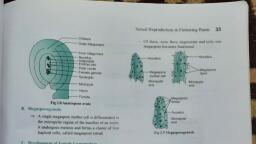
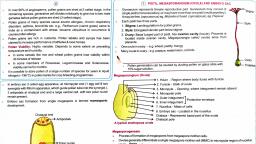
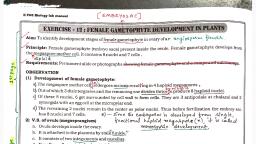
The MMC is large and contains a dense cytoplasm and a prominent nucleus. It undergoes meiosis to produce four megaspores., Step wise events in Megasporogenesis, Mega Spore Mother Cell (MMC), meiosis, Megaspore tetrad, 3 degeenr ate & 1 remain functional, 1st Mitosis, 2 nucleate embryo sac, 2nd Mitosis, 4 nucleate embryo sac, 3rd Mitosis, 8 nucleate embryo sac, 7 Celled , 8 nucleate Embryo sac, Megasporo genesis, Megaga , metogen, esis
Page 5 :
Monosporic pattern - most common-, both meiotic divisions, are accompanied by cell plate formation - resulting in four one- nucleate megaspores - three megaspores, generally the micropylar-most megaspores, undergo cell death, Polygonum Type: 8 Nucleate & 7 celled embryo sac, Oenothera Type: 4 nucleate – one in central cell & 3 in egg apparatus; Antipodal cells absent; Endosprem Diploid
Page 7 :
Tetrasporic embryo sac :, embryo sac both the meiotic divisions karyokinesis not followed by cytokinesis., → All the four haploid nuclei at the end of meiosis are enclosed in a common cytoplasm forming a coeno-megaspore., →All the 4 nuclei take part in formation of 7 celled & 8 nucleate embryo sac.
Page 10 :
Adoxa type –, MMC -> meiosis -> four nuclei -> arranged two at each end., Both the nuclei -> mitotic division -> eight nuclei, One egg & 2 synergids at the micropylar region; three antipodal cells at the chalazal end & two nuclei in the centre.
Page 11 :
2. Plumbago type: Four nuclei -> Mitosis -> eight nucleated -> arrangement of two nuclei at each side (four sides) -> four nuclei, one from each side, become aggregated in the centre. The nucleus at the micropylar end behaves as egg
Page 12 :
3. Penaea type: Four nuclei -> 1st Mitosis -> eight nucleated -> 2nd, Mitosis 16, nucleated -> 4 nuclei at each side (four sides) remain crosswise. Later on, four nuclei, one from each side, become aggregated in the centre., → 16 nucleate, 13- celled embryosac, 4. Peparomia type: Four nuclei -> 1st Mitosis -> eight nucleated -> 2nd Mitosis 16 nucleated -> dispersed -> 8 become polar nuclei, 6 antipodals at chalazal end & one egg and one synergid remain at the micropylar end.
Page 13 :
5. Drusa type: Four nuclei -> one at micropyle end & 3 at chalazal end ->1st, Mitosis -> eight nucleated -> 2nd Mitosis 16 nucleated -> one nucleus from each side aggregate at center . 16 nucleate, 15- celled embryosac, 6. Frittilaria type: Four nuclei -> one at micropyle end & 3 at chalazal end -> fusion of chalazal nuclei (3n) -> 1st Mitosis -> 4 nucleate (2 haploid & 2 triploid) -> 2nd Mitosis -> 8 nucleate (4 haploid & 4 triploid) -> one nucleus from each side aggregate at center, 3 haploid nuclei at micropyle one egg and 2 synergids & 3 triploid(3n) nuclei at chalazal end forms antipodals. 8 nucleate, 7- celled embryosac