Page 1 :
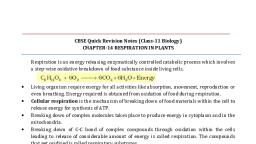
CHAPTER-14, RESPIRATION IN PLANTS, , Respiration is an energy releasing, enzymatically controlled catabolic process which involves, a step-wise oxidative breakdown of food substance inside living cells., , Ce Hi20¢5 + 602 —> 6CO2 + 6H2O + Energy, , Living organism require energy for all activities like absorption, movement,, reproduction or even breathing. Energy required is obtained from oxidation of food, during respiration., , Cellular respiration is the mechanism of breaking down of food materials within the, cell to release energy for synthesis of ATP., , Breaking down of complex molecules takes place to produce energy in cytoplasm and, in the mitochondria., , Breaking down of C-C bond of complex compounds through oxidation within the cells, leading to release of energy is called respiration. The compounds that get oxidized, are called respiratory substrates., , Energy released during oxidation is not used directly but utilized in synthesis of ATP,, which is broken down when energy is required. Therefore, ATP is called energy, currency of cells., , The process of respiration requires oxygen. In plants oxygen is taken in by stomata,, lenticels and root hairs., , Plants can get along without respiratory organs because:, , 1. Each plant part takes care of its own gas-exchange needs., 2. Plants do not present great demands for gas exchange., , 3. Distance that gases must diffuse in large plant is not great., , 4. During photosynthesis 02 is released in leaves and diffuse to other part of leaves., , During process of respiration oxygen is utilized and carbon dioxide and water is, released along with energy molecules in form of ATP., , Respiratory Quotient is the ratio of the volume of carbon dioxide produced to the
Page 2 :
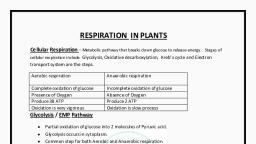
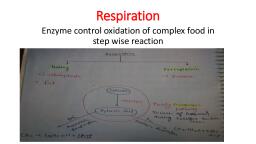
volume of oxygen consumed in respiration over a period of time. RQ is equal to one, for carbohydrate and less than one for protein and peptones., , —<—, . Respiration, , , , = 1, " Aerobic Respiration L Anaeborbic Respiration, , , , Aerobic Respiration, , , , iF, , aka aes, Glycolysis Kreb's Cycle Terminal Oxidation, — meni aac, , Aerobic Respiration is an enzymatically controlled release of energy in a stepwise catabolic, process of complete oxidation of organic food into carbon dioxide and water with oxygen, acting as terminal oxidant., , Glucose, , , , 2 Pyruvie acid, Boy
Page 3 :
Glycolysis, , e The scheme of glycolysis is given by Gustav Embden, Otto Meyerhof, and J. Parnas. It, is also called as EMP pathway., , © Glycolysis is the partial oxidation of glucose or similar hexose sugar into two, molecules of pyruvic acid through a series of enzyme mediated reaction releasing, some ATP and NADH2. It occurs in cytoplasm., , e In plants glucose is derived from sucrose or from storage carbohydrates. Sucrose is, converted into glucose and fructose hy enzyme invertase., , ¢ Glycolysis starts with phosphorylation of glucose in presence of enzyme hexokinase to, form Glucose-6-phosphate. One molecules of ATP is used in this process., , e Innext steps Glucose-6-phosphate is converted into fructose-6-phosphate, catalysed by, enzyme phosphohexose isomerase., , e Fructose-6-phosphate uses another molecule of ATP to form Fructose-1-6 biphospahte, in presence of enzyme phosphfructokinase., , , , Pyruvic Acid, ills I alec, Lactic Acid Fermentation Alcoholic Fermentation Aerobic Respiration, —_— — <a, , ¢ In glycolysis two molecules of ATP are consumed during double phosphorylation of, glucose to fructose 1,6 biphosphate. Two molecules of NADPH2 are formed at the time, of oxidation of glyceraldehyde 3-phosphate to 1,3 biphosphoglycerate. Each NADH is, equivalent to 3ATP, so that net gain in glycolysis is 8 ATP., , e Pyruvic acid is the key product of glycolysis, further breakdown of pyruvic acid, depends upon the need of the cell., , e Inanimal cells, like muscles during exercise, when oxygen is insufficient for aerobic, respiration, pyruvic acid is reduced to Lactic acid by enzyme lactate dehydrogenase, due to reduction by NADH2.
Page 4 :
¢ In fermentation by yeast, pyruvic acid is converted to ethanol and CO2. The enzyme, involved is pyruvic acid decarboxylase and alcohol dehydrogenase catalyse this, reaction., , © In both lactic acid fermentation and alcohol fermentation very less amount of energy, is released., , ¢ Yeasts poison themselves to death if concentration of alcohol reaches above 13%., , ¢ Final product of glycolysis, pyruvate is transported from the cytoplasm into, mitochondria for further breakdown., , e Oxidation of Pyruvate to Acetyl-CoA is done to produce CO2 and NADH. The reaction, catalyzed by pyruvic dehydrogenase requires the participation of several Coenzymes, including NAD+., , Mg?*, , Pyruvic acid + CoA + NAD+ ———————_> Acetyl CoA + CO», , Pyruvate dehydrogenase, , +NADH + H*, , © The Acetyl CoA enters a cyclic pathway called TCA cycle or Kreb’s cycle.