Page 1 :
8 ELECTROMAGNETIC WAVFS, 8.1 INTRODUCTION, , In the earlier chapters we have studied that an electric current produces magnetic, field and that two wires carrying current exert a magnetic force on each other. Also we, have studied that a magnetic field changing with time gives rise to an electric field. Is, the converse also true? Can a electric field changing with time produce a magnetic field?, The answer to this question was given by James Clerk Maxwell who argued that magnetic, field is produced not only by electric current but also by a time varying electric field. While, applying Ampere’s Circuital law to find magnetic field at a point outside a capacitor, connected, to a time varying current, Maxwell noticed an inconsistency in Ampere’s circuital law. He, , found that the Ampere’s circuital law becomes consistent only if there is an additional current, called displacement current,, , Maxwell formulated a set of equations involving electric and magnetic fields, and their, sources, the charge and current densities. These equations are known as Maxwell’s equations., , These equations together with the formula for Lorentz force are able to explain mathematically, all the basic laws of electromagnetism., , The most important result to emerge from Maxwell’s field equations is the existence, of electromagnetic waves. Electromagnetic waves are coupled time varying electric, and magnetic fields which propagate in space. According to these equations, the speed, of electromagnetic waves is very close to the speed’of light (3 x 10⁸ms~'). This lead Maxwell, to conclude that light is an electromagnetic wave. In 1887, Hertz demonstrated experimentally, , the existence of electromagnetic waves. Later Marconi and others used these waves for, wireless communication., , 8.2 DISPLACEMENT CURRENT, , : >, According to Ampere’s circuital law, the line integral of the magnetic field B around, any closed path is equal to 1, times the total current threading the closed path. That is,, , Bed! =yol where I is the net current threading the surface bounded by, , a closed path C. Maxwell in 1864 found an inconsistency in this relation. This, inconsistency can be understood with the help of the following observations using, a parallel plate capacitor C as follows :, , Let I be the time dependent current in the circuit during the charging of the, capacitor. Consider a plane circular loop Cc, of radius r whose centre lies on the, wire carrying current and its plane is perpendicular to the direction of the current, in the wire [Fig 8.1 (a)], , The magnitude of the magnetic field due to the current is same at all points, on this loop and it is acting tangentially along the circumference of the loop. If, B is the magnitude of the magnetic field at any point P, then using Ampere’s circuital, law for loop C,, we have,, , Scanned with CamScanner
Page 2 :
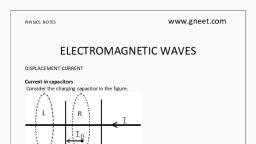
364) unit - Vi @—, , , , , , , , But § B-d¢ =f BdCcos0° = Bx 2ar, , Now consider a pot shaped surface C,, , without lid which does not touch the (a), current anywhere, but has its bottom, , between the plates. The mouth of this pot, shaped surface is the same circular loop, C, mentioned earlier (Fig. 8.1 (b)]. Another, such surface is shaped like a tiffen box, without lid [Fig. 8.1 (c)]. Since this surface, does not touch the current carrying wire,, the conduction through it is zero, i.e. I =, 0. Using Ampere’s circuital law to the loop, Cc, of the pot shaped surface,, , 23, § B-dé=Bx2nr=p9x0=0, , , , C, , or B = 0 ues. (8.2) (b), , From these results we find that there Ss, is a magnetic field at P if caloulated os, through one way (Eq.8.1)and there is no, magnetic field at P if calculated through b> |, another way (Eq.8.2). Since this a, contradiction arises from the use of I ee, Ampere’s circuital law, we can say that c es, Ampere’s circuital law is logically i eS, inconsistent. Maxwell argued that this (c) c, inconsistency is due to a missing term in, the above relations. The missing term must Fig. 8.1, , , , , , , , be such that one gets the same magnetic, field at a point P whatever be the surface, term must be related with a ch, 8.1 (c)] between the plates of, , s used. One can guess that this missing, anging electric field through the surface S$ [Figthe capacitor, during charging., , Expression for displacement current:, , Scanned with CamScanner
Page 3 :
eres:, , ELECTROMAGNETIC waves. |[365, , , , , , , , , , , , If q is the charge on the capacitor and V is the potential difference between, its plates at any instant of time, then q = CV or V = nl, , But electric field between the plates of the capacitor is,, , pov a4 -|4 4.4, d Cd |e,A jd &,A, The electric flux through the surface S in Fig. 8.1(c) is,, , q, g, HEX AH pyxAcd, , EgA £9, dq ., If > is the rate of change of charge with time on the plate of the capacitor,, then,, de dq dg de, dt eg dt Gt att, , This. represents the current through the surface S due to changing electric, field and it is called Maxwell’s displacement current represented as [,. Thus,, displacement current is given by, , = ¢ {te, Ty = FOG sseeeesssssssnvnsssssessseeeeeee (8.3), , ‘, , The displacement current is the missing term in Ampere’s circuital law., , Maxwell modified Ampere’s circuital law in order to make it logically consistent., , The modified form of Ampere’s circuital law is, 78S, , §B-dl=yp(1+Ip)=no(l +60 26) =gl +note Ze, , This relation is also known as Ampere-Maxwell law. In this relation, the current, I carried by the conductors due to flow of charges is called conduction current. The, current | due to changing electric field (inside the capacitor) is called displacement, current. The source of magnetic field is not just the conduction current due to flowing, charges but also the displacement current due to changing electric field. The sum of, the conduction current and displacement current (i.e. +1) has the important property, of continuity along any closed path although individually they may not be continuous., In general, both conduction current and displacement current will be present giving rise, to total current. In a conducting medium, conduction current dominates over displacement, Current, while in an insulating medium displacement current dominates over conduction, current, The displacement current has the same physical effects as the conductioin current., , Scanned with CamScanner
Page 4 :
366]) UNIT- vi, @, , , , , , Inside the capacitor, the magnetic field between the plates See Current, while the magnetic field outside the plates of the capacitor I 10 current,, Both these magnetic fields have the same value., , One of the important consequence of displacement a is that the laws, of electricity and magnetism become more symmetrical. According to Faraday’s lay,, of induction, there is an induced emf equal to the rate of change of magnetic flux,, The induced emf implies the existence of electric field. So, we can Say that, magnetic field changing with time gives rise to electric field. The electric field changing, with time gives rise to magnetic field since displacement current is a Source of, a magnetic field. Thus, time dependent electric and magnetic fields ive rise to, each other. One very important consequence of this symmetry is the existence of, electromagnetic waves., , 8.3 ELECTROMAGNETIC WAVES, 8.3.1 Source of electromagnetic waves:, , . The important result of Maxwell’s theory is that accelerated charges radiate, electromagnetic waves. Consider a charge oscillating with some frequency (such, as oscillatory L-C circuit). An oscillating charge is an example of accelerating charge,, It produces an oscillating electric field in space, which produces an oscillating magnetic, , field, which in turn is a source of oscillating electric field, and so on. The oscillating, electric field and magnetic field thus regenerate each, through space. The frequency of the electromagnetic, of oscillation of the charge. The energy associated wi, at the expense of the energy of the source, nam, , other as the wave propagates, wave is equal to the frequency, th the propagating wave comes, , ely, the accelerated charge., According to Maxwell, electromagnetic waves are those waves in which, there are. sinusoidal variation of electric and magnetic field vectors at right, angles to each other as well as at right angles to the direction of wave, tmation of Maxwell’s theory came in the form of Hertz’s, , Heinrich Hertz. produced electromagnetic waves of longer, wavelength (6 m) using a spark oscillator and detected them successfully. He showed, , that the nature of these waves was Same as that of light and thermal radiation., A few years later, Jagadish C d, , 8.3.2 Nature of electromagnetic Waves :, , Scanned with CamScanner
Page 5 :
0 ELECTROMAGNETIC WAVES ||367, , , , , , , , , , , , , , Fig. 8.2, , , , , , to the direction of propagation. Fig. 8.2 shows a typical example of a plane, electromagnetic wave propagating along the Z-direction. The electric field E. is, along X-axis and varies sinusoidally with Z at a given time. The magnetic field, B, is along the Y-axis, and varies sinusoidally with Z at a given time., , The electric field E. and magnetic field B_ are perpendicular to each other,, and also perpendicular to the direction of propagation which is Z-axis. Also they, are in the same phase. The equations for the sinusoidal variation of E. and BY, with time t are as follows :, , E, = Ey Sim (Ot-K2) ceesssessseesseeenseee cosogeys 3 (8.4), , x, B By Sim (@t-KZ) ...cesseeeseeeeeeeeesseeeeeseereeeeneneeees (8,5), , y, , il}, , : >, where E, and B, are the maximum values or amplitudes of electric field vector E, , >, and magnetic field vector B respectively. @ is the angular frequency. k is called, propagation constant or angular wave number and it is related to wavelength ) as, , o, , 2n ; ., k =: The speed of the electromagnetic wave Is = 7., , Using equations (8.4) and (8.5) for E, and BY respectively, and the Maxwell’s, , . 1, equations, one finds that o = ck where c = aK, Ho&o, , , , If v is the frequency of the electromagnetic wave, we have, , 2n, amv =e x [ ore = vA, , Scanned with CamScanner