Page 1 :
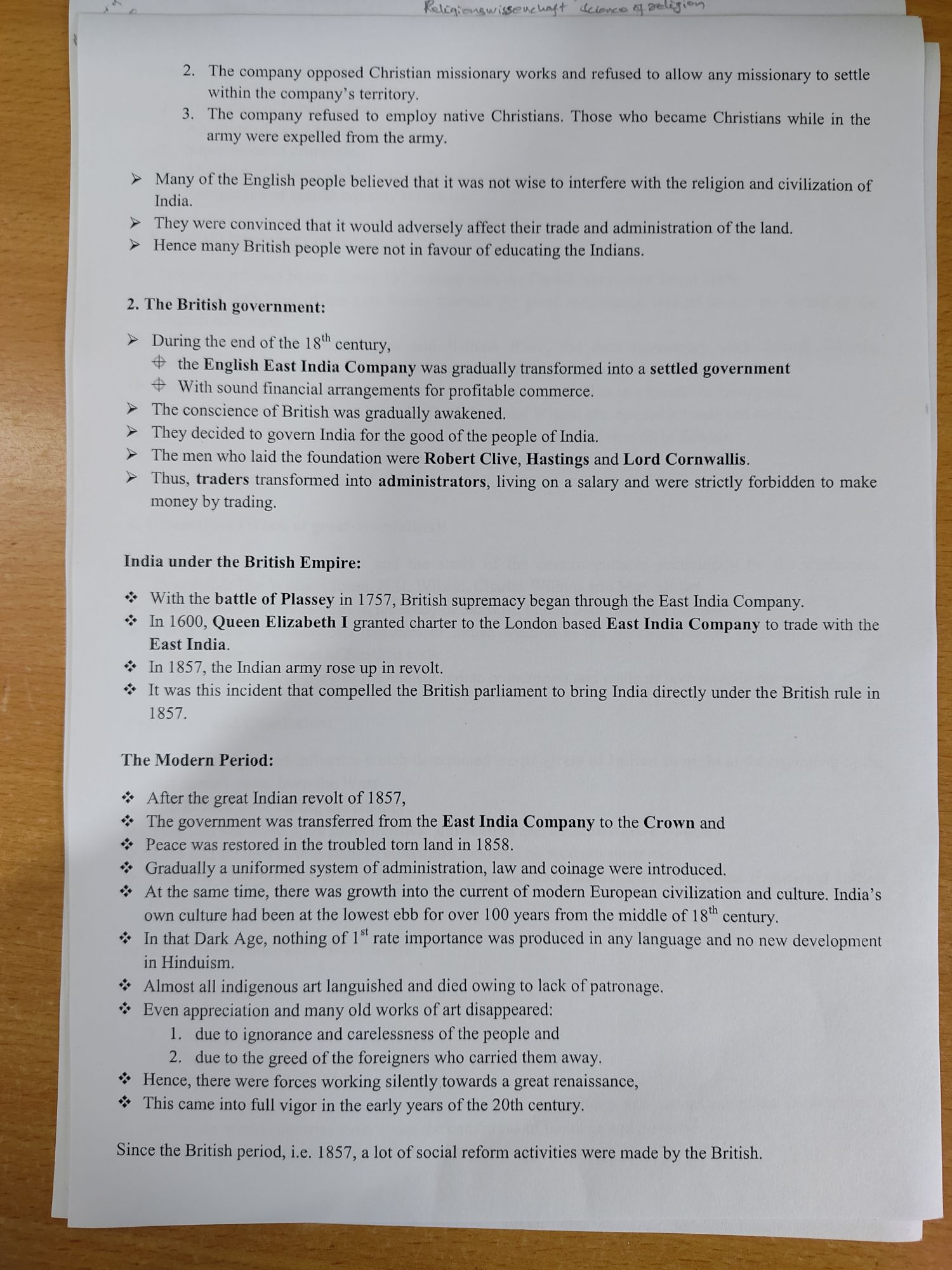
Faleienaw igseneoo¢t Le tronesc ef Benes"), , - The company opposed Christian missionary works and refused to allow any missionary to settle, within the company’s territory., The company refused to employ native Christians, Those who became Christians while in the, , army were expelled from the army., , » Many of the English people believed that it was not wise to interfere with the religion and civilization of, India., , » They were convinced that it would adversely affect their trade and administration of the land., , » Hence many British people were not in favour of educating the Indians., , . The British government:, , During the end of the 18" century,, , *P the English East India Company was gradually transformed into a settled government, , ~* With sound financial arrangements for profitable commerce., , The conscience of British was gradually awakened,, , They decided to govern India for the good of the people of India., , The men who laid the foundation were Robert Clive, Hastings and Lord Cornwallis., , Thus, traders transformed into administrators, living on a salary and were strictly forbidden to make, money by trading., , , , India under the British Empire:, , With the battle of Plassey in 1757, British supremacy began through the East India Company., , In 1600, Queen Elizabeth I granted charter to the London based East India Company to trade with the, East India., , In 1857, the Indian army rose up in revolt., , It was this incident that compelled the British parliament to bring India directly under the British rule in, , 1857., , The Modern Period:, , After the great Indian revolt of 1857,, The government was transferred from the East India Company to the Crown and, Peace was restored in the troubled torn land in 1858., Gradually a uniformed system of administration, law and coinage were introduced., At the same time, there was growth into the current of modern European civilization and culture. India’s, own culture had been at the lowest ebb for over 100 years from the middle of 18" century,, In that Dark Age, nothing of 1" rate importance was produced in any language and no new development, in Hinduism., Almost all indigenous art languished and died owing to lack of patronage., Even appreciation and many old works of art disappeared:, 1. due to ignorance and carelessness of the people and, 2. due to the greed of the foreigners who carried them away., Hence, there were forces working silently towards a great renaissance,, % This came into full vigor in the early years of the 20th century., , Since the British period, i.e. 1857, a lot of social reform activities were made by the British.