Page 1 :
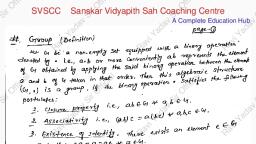
For More Questions Click Here, 1. A non empty set A is termed as an algebraic structure ________, a) with respect to binary operation *, b) with respect to ternary operation ?, c) with respect to binary operation +, d) with respect to unary operation –, View Answer, Answer: a, Explanation: A non empty set A is called an algebraic structure w.r.t binary operation “*” if, (a*b) belongs to S for all (a*b) belongs to S. Therefore “*” is closure operation on ‘A’., 2. An algebraic structure ____ is called a semigroup., a) (P, *), b) (Q, +, *), c) (P, +), d) (+, *), View Answer, Answer: a, Explanation: An algebraic structure (P,*) is called a semigroup if a*(b*c) = (a*b)*c for all, a,b,c belongs to S or the elements follow associative property under “*”. (Matrix,*) and (Set, of integers,+) are examples of semigroup., 3. Condition for monoid is __________, a) (a+e)=a, b) (a*e)=(a+e), c) a=(a*(a+e), d) (a*e)=(e*a)=a, View Answer, Answer: d, Explanation: A Semigroup (S,*) is defined as a monoid if there exists an element e in S such, that (a*e) = (e*a) = a for all a in S. This element is called identity element of S w.r.t *., 4. A monoid is called a group if _______, a) (a*a)=a=(a+c), b) (a*c)=(a+c), c) (a+c)=a, d) (a*c)=(c*a)=e, View Answer, Answer: d, Explanation: A monoid(B,*) is called Group if to each element there exists an element c such, that (a*c)=(c*a)=e. Here e is called an identity element and c is defined as the inverse of the, corresponding element., 5. A group (M,*) is said to be abelian if ___________, a) (x+y)=(y+x)
Page 2 :
b) (x*y)=(y*x), c) (x+y)=x, d) (y*x)=(x+y), View Answer, Answer: b, Explanation: A group (M,*) is said to be abelian if (x*y) = (x*y) for all x, y belongs to M., Thus Commutative property should hold in a group., 6. Matrix multiplication is a/an ____ property., a) Commutative, b) Associative, c) Additive, d) Disjunctive, View Answer, Answer: b, Explanation: The set of two M*M non-singular matrices form a group under matrix, multiplication operation. Since matrix multiplication is itself associative, it holds associative, property., 7. A cyclic group can be generated by a/an _____ element., a) singular, b) non-singular, c) inverse, d) multiplicative, View Answer, Answer: a, Explanation: A singular element can generate a cyclic group. Every element of a cyclic group, is a power of some specific element which is known as a generator ‘g’., 8. How many properties can be held by a group?, a) 2, b) 3, c) 5, d) 4, View Answer, Answer: c, Explanation: A group holds five properties simultaneously – a)Closure b) associative c), Commutative d) Identity element e) Inverse element., 9. A cyclic group is always _________, a) abelian group, b) monoid, c) semigroup, d) subgroup, View Answer
Page 3 :
Answer: a, Explanation: A cyclic group is always an abelian group but every abelian group is not a, cyclic group. For instance, the rational numbers under addition is an abelian group but is not, a cyclic one., 10. {1, i, -i, -1} is _____, a) semigroup, b) subgroup, c) cyclic group, d) abelian group, View Answer, Answer: c, Explanation: The set of complex numbers {1, i, -i, -1} under multiplication operation is a, cyclic group. Two generators i and -i will covers all the elements of this group. Hence, it is a, cyclic group.