Page 1 :
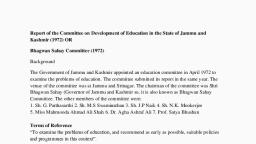
Report of the Committee on Development of Education in the State of Jammu and, Kashmir (1972) OR, Bhagwan Sahay Committee (1972), Background, The Government of Jammu and Kashmir appointed an education committee in April 1972 to, examine the problems of education. The committee submitted its report in the same year. The, venue of the committee was at Jammu and Srinagar. The chairman of the committee was Shri, Bhagwan Sahay (Governor of Jammu and Kashmir so, it is also known as Bhagwan Sahay, Committee. The other members of the committee were:, 1. Sh. G. Parthasarthi 2. Sh. M.S Swaminathan 3. Sh. J.P Naik 4. Sh. N.K. Mookerjee, 5. Miss Mahmooda Ahmad Ali Shah 6. Dr. Agha Ashraf Ali 7. Prof. Satya Bhushan, Terms of Reference, “To examine the problems of education, and recommend as early as possible, suitable policies, and programmes in this context”., , Recommendations of the commission, ❖ Transformation of Educational System, A programme of high priority is to transform the educational system to make it a powerful, instrument of social change. From this point of view, it will be necessary to blend the formal, with the informal system of education, to extend the coverage of the educational system to, include the working population also and to revise the curricula., ❖ The New Educational System, The new educational system in the State would be as follows:, 1. Eight years of primary and middle school stage, • A primary school stage covering classes I-V or age group 6-11, • Middle school stage covering VI-VIII or age group 11-14, 2. Four years of secondary stage: (classes VIII-XII or age-group 14-18).The secondary, schools will be of three types:, a) Vocational schools providing a two-year course and also other subsidiary courses,, b) two year secondary schools teaching classes IX-X and, c) full-fledged secondary schools teaching classes IX-XII.
Page 2 :
3. A university stage which will cover a two-year pass course and a three-year honours, course for the first degree and a two-year post graduate course followed by appropriate, facilities for research. There will also be adequate facilities for research., ❖ Education of non-student youth in an age group of 15-25, It is necessary to develop as large a programme as possible for non-student youth in the age, group 15-25. From this point of view, pilot programmes should be initiated immediately in the, cities of Srinagar and Jammu and in one rural area in each district. The programme may be, extended in the light of experience gained., ❖ Revision of Curriculum at the School Stage, The State Board of School Education should be immediately constituted and made responsible, for preparation of curriculum at the entire school stage before the end of 1973-74. In the, following year the text books should be prepared and teachers should be oriented. The new, curriculum should be introduced before in class I and class IX respectively in 1975-76. In every, subsequent year, the curriculum should be extended to the next higher class., ❖ Revision of Curriculum at the University Stage, The Universities of Jammu and Srinagar should immediately take up the problem of, restructuring the undergraduate courses on the broad lines indicated in the Report. Professional, courses in selected fields should also include in the B.A pass Degree. The work of designing, courses should be completed during 1973-74 and they should be initiated at the beginning of the, academic year 1974-75. The post graduate courses should also be restructured on the broad lines, recommended by the Education Commission and the desirable of introducing M. Phil. Course in, certain fields where universities have the necessary facilities and personnel should also be, explored., ❖ Adoption of a New Calendar for the School year, The academic-calendar in the State should be reorganized in such a manner that the number of, institutional days in a year would be not less than 150., ❖ Planning the Proper Location of Schools, A quick survey of the entire area of the State should be carried out in the next 3-4 months to, determine the proper location of educational institutions in different categories., ❖ Institutional Planning, Depending upon its catchment area, the classes to be taught in a school should be decided on, some rational basis. Policies for staffing schools in relation to classes taught and enrolments, should be clearly prescribed and scrupulously observed. Conditions for up-grading schools, should be drawn up on a rational basis and once an upgrading is decided upon, it should, ordinarily proceed in schools from class to class every year.
Page 3 :
❖ General Education of Teachers, In future, candidates who have passed the higher, secondary examination should be given, preference in recruitment. Eventually, a pass at the higher secondary stage of 12 years should be, the minimum qualifications for recruitment as a teacher in a primary or middle schools., Graduates should be encouraged to serve in primary and middle schools., ❖ Teacher Education, An emergency programme should be drawn up to train all the untrained primary, middle and, secondary school teachers in service in a period of 3 to 5 years. The duration of the training, course for primary and middle school teachers should be continued at one year, but provision, should be made for periodical refresher courses for all teachers. A system of apprentice-teachers, should be introduced., ❖ Training of Secondary Teachers, A University Department of Education should be created at Jammu. A programme for the inservice education of secondary teachers should be developed and a one-year training course for, graduates, who will be teaching in primary schools, should be specially designed and initiated. A, State Board of Teacher Education should be established., ❖ Qualitative Upgrading of Schools, A programme should b drawn up and implements for providing the minimum facilities necessary, for primary, middle and secondary schools. A healthy competition should be encouraged, amongst the schools to complete with each other in standards, and the schools which show, initiative and results should be assisted to improve further and reach optimum levels. A system, of grading the schools qualitatively should be introduced., ❖ Improvement in Text Books, There should be an autonomous organization for the production, distribution and sale of textbooks. There is a great need for producing teacher guides, supplementary reading materials and, other teaching and learning aids. A major effort is also needed to ensure that every student has, access to all his textbooks right from the opening of the schools year., ❖ Methods of Teaching and Evaluation, The new and dynamic methods of teaching should be adopted. A well designed progress Card, should be introduced for all pupils and maintained carefully and regularly. A system of internal, assessment should be universally adopted, but the result of both the assessments-internal and, external should be kept separate.
Page 4 :
❖ State Board of School Education, There should be a State Board of School Education whose responsibility would include not only, holding of public examinations at the school stage, but also approving curriculum and textbooks, for the entire school stage and conducting panel inspections of secondary schools., ❖ Affiliated Colleges, Some emergency measures should be adopted to reduce the serious congestion and overcrowding, in affiliated colleges. Residential accommodation should be provided for teachers, where, necessary and especially in colleges.A State Council of Affiliated Colleges should be, established., ❖ Universities, Early steps should be taken to provide a campus to the Jammu University. In Srinagar, University, the bus service should be arranged to make it possible for students to spend more, time in the campus. Academic centers should be provided in the city for university students. The, opening of some new departments, such as earth science or management and department of, Teacher Education should be started in the Jammu University. The possibility of establishing, social science research centers in the two universities in collaboration with the Indian Council of, Social Science Research should be explored., ❖ Scholarships, A liberal provision of scholarships should be made at the secondary and university stages., ❖ Education of Girls and Women, Special emphasis should be laid on the education of girls and women. The trend towards coeducation should be encouraged and at the primary stage, co-education should be adopted as a, general policy. Special facility should be given to women to become teachers especially in rural, areas, and two women’s institutes should be established one in Kashmir and one in Jammu., ❖ Television, Television should be used intensively for educational programmes .A special cell should be, created for it in the Education Department and a committee should be set up immediately to, work out all the details of the programme., ❖ Education Administration, The Education Department should be strengthened, the State Institute of Education should be, reorganized, a planning and statistical unit should be established. Private educational institutions, should be regulated on the broad lines recommended by the Education Commission. A, comprehensive Education Act should be enacted and the Education Code should be revised for, the guidance of the Department.