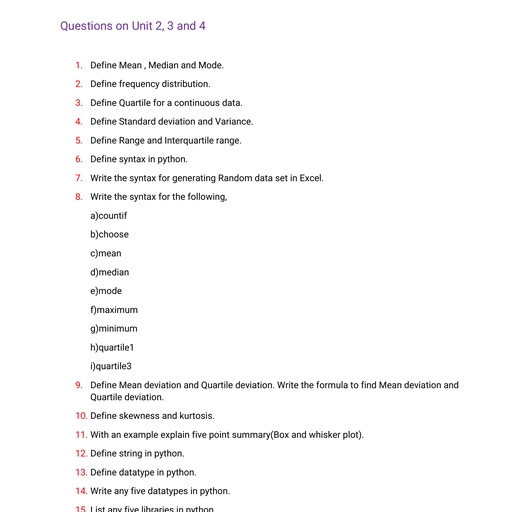
Page 1 :
STATISTICS AND ANALYTICS, , 20SC01P, , 1. Define statistics?, Statistics is the study of the collection, analysis, interpretation, presentation,, and organization of data., 2. What is data?, Data is a collection of facts, such as numbers, words, measurements,, observations or just descriptions of things., 3. What are data collection tools?, The devices or instruments used to collect the data are called data collection, tools., 4. Name any two data collection tools., Questionnaires, Survey, Interview, Focus group discussion., 5. What is qualitative data?, It represents some characteristics or attributes., 6. What is quantitative data?, It represents numerical value., 7. What is primary and secondary data?, Primary data is data collected for first time. Secondary data is the data, sourced by someone other than user., 8. What is discrete data?, This type of data take only specific value., 9. What is continuous data?, This type of data take values from a given range., 10., “She has two ears” which type of data represents?, Quantitative data, 11., “She weighs 5.5 kg”,which type of data represents?, Continuous data
Page 2 :
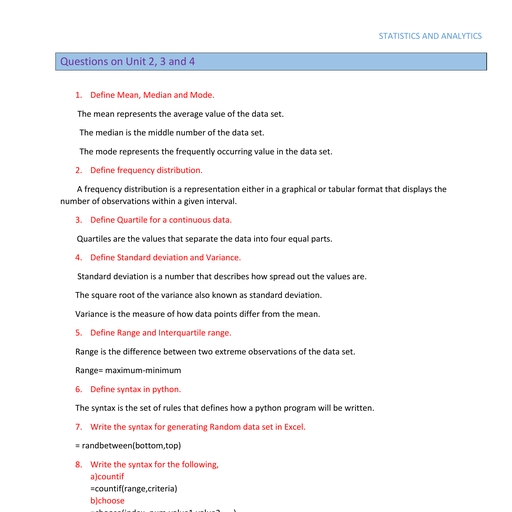
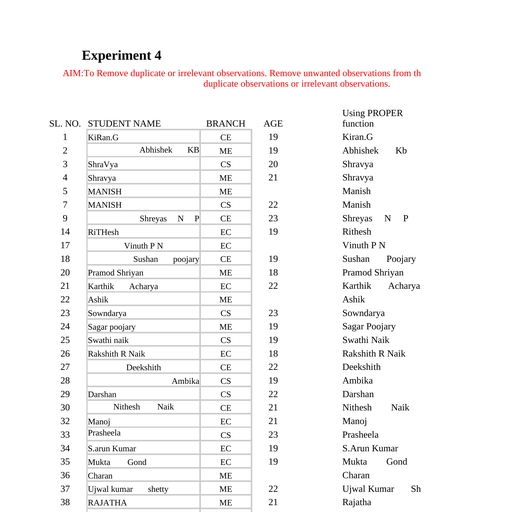
12., What is data cleaning?, Data cleaning is the process of fixing or removing incorrect, corrupted,, incorrectly formatted, duplicate, or incomplete data within a dataset., 13., What is box plot?, A boxplot is a graph that presents information from a five-number summary., 14., What is frequency distribution table?, A list, table or graph that displays the frequency of various outcomes in a, sample of data., 15., What is bar graph?, It represents categorical data with rectangular bars whose height is, proportional to frequency., 16., What is Histogram?, It represents continuous data with no gap between bars., 17., What is frequency curvepolygon?, It represents quantitative data using smooth curve or free hand curve., 18., What is frequency polygon?, It represents quantitative data using line graph., 19., , What is the difference between bar graph and histogram, The histogram is drawn in such a way that there is no gap between the, bars. There is proper spacing between bars in a bar graph that indicates, discontinuity., Histogram presents numerical data whereas bar graph shows categorical, data., , 20., Difference between grouped and ungrouped data., Ungrouped data is used for small dataset whereas grouped data is used for, larger dataset., 21., Define frequency of data set., Frequency is how often something happens., 22., , Define mean, median and mode.
Page 3 :
Mean is the average of the observations., That is, Mean =, Median is the middle of a sorted list of numbers., Mode is the number which appears most often., 23., Define Range., Range is the difference between highest value and the lowest value in the data, set., 24., Define quartiles., Quartiles are the values that divide a list of numbers into quarters., 25., Define inter quartile range., Inter quartile range = Q3-Q1, 26., Define line graph., It is a graph that shows the information that change over time., 27., Define mean deviation., It is the average deviation from the mean value of the given data set., 28., What is the relationship between mean, median and mode for, moderately skewed distribution?, Mean – Mode = 3 (Mean – Median), 29., What is the relationship between mean, median and mode for, symmetrical skewed distribution?, Mean = Median = Mode, 30., Define Variance and standard deviation., Variance is a measure of how data points differ from the mean., The square root of the variance is known as the Standard deviation., 31., Who developed the Python language?, Guido van Rossum in 1989, 32., In which language is Python written?, Python is written in C programming language, and it is also called CPython.
Page 4 :
33., .py, , Which is the extension of the Python file?, , 34., Which character is used in Python to make a single line comment?, For a single line comment, # is used. For multi line comment triple single, quotes at the beginning and at the end of the comment is used., 35., , Which are the five standard data types in python?, , 1. Numbers, 2. String, 3. List, 4. Tuple, 5. Dictionary