Page 1 :
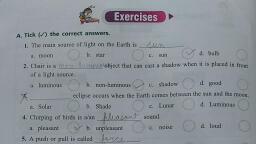
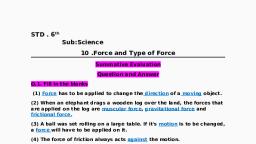
10.Light ,Sound and Force, Exercises, A. Choose the correct answers., 1.Bulb is a luminous object., 2.Sound is not required for the formation of shadow., 3. Bursting of crackers is an example of unpleasant sound., B. Write T for true or F for false., 1. At noon the shadows are long., False, 2. Sounds that are unpleasant to the ear are called noise., True, 3. When we rub our palms together, they become cold., False, 4. Friction is the force that increases the movement of an object., False, C. Fill in the blanks., 1. We are able to see the moon because of the light of the Sun., 2. A Force can change the direction of a moving object., 3. Friction always works opposite to the direction of movement., 4. Sounds that are good to our ears are called Music., D. Give two examples of each., 1. Luminous objects, Sun and Bulb, 2. Non-luminous objects, Books and Table, 3. Pleasant sounds, Music and Playing Guitar, 4. Force, Push and kicking, E.Answer these questions in brief., 1.When can we see non-luminous objects?, Ans- We can see non luminous objects only when light takke on them., 2 How is it possible for us to hear the sounds around us?, Ans- because of air it is possible to hear the sound., 3. Define force., Ans- A push ir pull applied on an object is called force., 4. What is friction?, Ans-Friction is a force that stops or slow down the movement of an object., F. Answer these questions in detail., 1. List the things that force can do., Ans-, Force can make an object move, Force can stop a moving object., Force can change the direction of a moving object., Force may change the shape of an object., 2. How is a shadow formed? How does the length of your shadow change during the day?, Ans-A Shadow is formed when light cannot pass through an object.The length of an object during morning and in evening are long and in noon are short., 3. Draw three luminous and three non-luminous objects., Ans-