Page 1 :
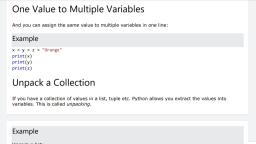
Python does not really have a syntax for multi line comments., , To add a multiline comment you could insert a # for each line:, , Example, , #This is a comment, #written in, , #more than just one line, print("Hello, World!"), , Or, not quite as intended, you can use a multiline string., , , , Since Python will ignore string literals that are not assigned to a variable, you can add > ~, string (triple quotes) in your code, and place your comment inside it: 5/43, , ne, , coe, , , , Example, , , , This is a comment, written in, more than just one line, , print("Hello, World!"), , As long as the string is not assigned to a variable, Python will read the code, but then ignore it, and, you have made a multiline comment., , 3.Python Variables, 3.1 Variables, , Variables are containers for storing data values., , Creating Variables, , Python has no command for declaring a variable., , A variable is created the moment you first assign a value to it., , Example, x= 5, , y = "John", print(x), print(y), , Variables do not need to be declared with any particular type, and can even change type after they, have been set., , Example, , x=4 # x is of type int, x = "Sally" # x is now of type str, print(x), , Casting, If you want to specify the data type of a variable, this can be done with casting., , Example, x = str(3) # x will be '3', , y = int(3) # y will be 3, z = float(3) # z will be 3.0, , Get the Type, , You can get the data type of a variable with the type() function., , Example, , xs 5, , y = "John", print(type(x)), print(type(y)), , You will learn more about data types and casting later in this tutorial.