Page 1 :
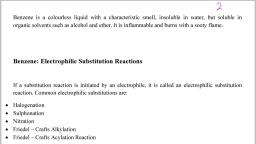
Exp 7. Aim: 2,4,6 tribromo aniline, Chemicals: from video, You tube link: https://youtu.be/vLegMK_qaBs, Theory or principle:, , Introduction, Electrophilic substitution reactions are typical reactions of aromatic compounds., Electrophilic aromatic substitutions include a wide variety of reaction like nitration,, sulphonation, Friedel-Crafts' alkylation and acylation , halogenations and so on. These substitutions', therefore, form a route of access to various aromatic c compounds by, permitting introduction of certain substituent which can then be transformed or replaced by, the desired ones. However, the various aromatic compounds differ in the case or facility with, which they undergo electrophilic substitution. It has been found that a substituent group, present on the benzene ring affects both the reactively of the ring towards electrophilic attack, and the orientation of the incoming substituent. The reactivity of an aromatic compound, towards an electrophilic is reflected in the severity of conditions for the reaction and the time, it would take. Orientation, determines whether the substituent already present would direct, the incoming substituent to ortho/para or to the meta position. On this basis the substituent, have been broadly classified is as follows :, 1. Activating groups which facilitate further substitution and are ortho/para directing., These are electron donating groups., Strongly activating –NH2(-NHR,-NR2), - OH, Moderately activating OCH3 (OC2H5, etc.) –NHCOCH3, Weakly activating -C6H5, -CH3 (-C2H5, etc.), 2. Deactivating groups which make further substitution difficult and are meta directing., These are electron attracting groups. –NO2 SO3H -N(CH3)3, CHO, -COR -CN COOH (-COOR) ETC, 3. Deactivating groups which are ortho/para directing. - F, - CI, - Br, - I, From the above you can see that nearly all substituent groups fall in two categories,, activating and ortho/para directing or deactivating and meta directing. The halogens, are in the class by themselves being deactivating but ortho/para directing. This is, because their inductive effect is -I, however, due to mesomeric effect or resonance
Page 2 :
they direct the incoming substituent lo ortho/para position. On the basis of these, effects, it is possible to predict fairly accurately the course of any aromatic, substitution. In this experiment, we are describing the preparation of 2, 4, 6 – tribromo, aniline from aniline. Since NH2 group is a strongly activating group, you would, expect aniline to undergo further substitution easily. That indeed happens; reaction in, fact, is exothermic, and with multiple substitutions we get the tribromo product., Further, as the -NH2 group is ortho/para directing, the substituent take the two ortho, and para position., , Reaction and mechanism: from video, Procedure: from video, , Calculation: Mol wt of aniline, Mol wt of 2,4,6 tribromoaniline, Theoretical yield:, MP standard
Page 3 :
Exp No. 8 : Synthesis of P-bromoacetanilide, REFERENCES:, 1. Practical Organic Chemistry; F G Mann and B C Saunders; 4th edition; page no. 166- 167., 2. Elementary Practical Organic Chemistry. Part 1: Small scale preparation; Arthur I. Vogel; 2nd, edition; page no: 267., 3. PHARMACEUTICAL ORGANIC CHEMSITRY, III SEMESTER B.PHARM, , PRACTICAL LAB MANUAL, S.A.RAJA PHARMACY COLLEGE, VADAKKANGULAM 627 116, Page No.18, Link: https://youtu.be/YE_cHGxx5rQ, , REQUIREMENTS:, Reagents: Acetanilide-1g, glacial acetic acid-1ml, bromine-0.42ml., Apparatus: Conical flask, beaker, measuring cylinder, funnel, filter paper, glass rod etc., , Principle: This mechanism is a classic example of electrophilic aromatic substitution. An, amine may lead to di- and tri- substituted products. If an amide is used in place of the amine,, monosubstitution usually predominates (the electron-withdrawing carbonyl group makes the, benzene ring less nucleophilic). This ortho-, para- directing group will tend to only add, groups para- to itself because of the steric bulk of the amide group., Reaction and mechanism: From video, PROCEDURE:, Dissolve finely powdered acetanilide in 5ml of cold glacial acetic acid contained in a 250ml, , conical flask. Prepare a solution of 0.42ml of bromine in 6ml of glacial acetic acid and add, slowly to the acetanilide solution with shaking. Mix well and allow to stand for 15 minutes at, room temperature. Pour the contents into a beaker containing 60 ml of cold water. Stir the, mixture well to eliminate acetic acid, unchanged bromine etc. Filter off the precipitated pbromo acetanilide washed with cold water to remove acid dried and submitted., Calculation From video