Page 1 :
s, , as, , d e n o t e da, , The factor, , U=, , as, , i=j, is, , is introduced so that, , ji, cluding of course i *j, Gravitation Potential:, , of, , mm, i=1 i*j, , each pair, , otential, , m of pot, Omof, potenti, , and m, , energy of the, system, , ij and, , ij, , particle is not conunted twice, such as, , meaningless)., , Mass, , a, , The Gravitational ential at a point in a gravitational field is, defined, as, the, ing, unit mass from, amount of work, to that, bringing a unit,, infinity, pOint., done in, words, In, other, gravitational potentiai at, as the gravitational potential Energy, unit, int isdefined, per, at, a, mass,, of, point, gravitational fiekd, Gravitational potential =-Gravitational potential energy, U, , m, , ie.. V=-where Vis gravitational potential Uis gravitational, potential energy, , So if we consider a body of mass M for which gravitational potential at a distance r is to be, , V=_-GMm/r, , m, , -GM, , V=-, , GMm, , b y purming m, , GM, , =, , 1 (u, , found out then gravitational potertial energy between M and m at distancer is U=--GMm, So, , m, , integrating expression., , The same expression can be obtained by using F=, mass. Then
Page 2 :
Mechanica, , 130, dw = Fdx =, , GM, , between limits, , dx, , x, , potential due to mass, , tox =r we get gravitational p, , o, , =, , GM, dx, Mat adistancer as V= W=GM[=V=, , It is a scalar Quantity, , and Gravitational potential, Relation between Gravitational Field (Attraction), the amount of work d, to another point B then, Ifa unit mass is moved from one point A, between points A and B. If E is the gravitationaleh, doing so is a measure of potential difference, small distance dr is equal to E dr which is e, and work done in moving unit mass through very, difference of potential between A and B., v+dv, , done in, , B, .. Edr = v - (v + dv) = -dv, , dv, , E -dr, Gravitational, , potential due, , to, , spherical, , shell, , Let us consider a thin spherical shell of mass M and Radius R having mass per unit area, , M, , 4TR, M, =4nR'o, Case 1. At External point(r > R), Let P be, , an, , external, , point at a, , distance, , ., , r, , from the centre O, , of the spherical shell., , (1), So OP, , =, , I., , The shell is assumed to be made up of Large no of circular rings consider one such ring, , between two planes AB and CD, ZCOP = 0, ZAOC = d0 So radius of the, , ring, , CG, , =, , OC sin 0, , circumference =, , or, , CG, , =, , R sin 6. Then the, , 2nRsine., , d0f, Also,, , dd, , A C = Rde is the, , R, , width of the ring, So area of this ring = circumference x width, , = (27tRsine) (Rd6), , = 2TR sinede., Mass of this elementary ring = (2nR'sinßd® )a, , Let CP, , x, then gravitational potential at P due to this ring is givenDy, , dV=massof sice, , or, , ring)G
Page 4 :
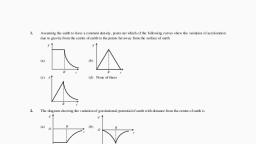
Mechanic, , 132, point (r, , Case 3. Ar Internal, Let, , point, , R), , <, , Pbean internal point, -2TRoG, , Then as before dV= =, , at, , ofIntegration, , de, F, , dx, =, , Now the limits, , R., , which is less than, , r, a distance, , are, , from, , x, , PË=R, , r, , to, , = PF, , x, , =, , R, D, , +T, , -2nRoGRdx, , ie. dV=-, , R-T, , -GM|, V = 4tRoG =-, , So, , (9), , R, , R, which is constant, the potential at any, , as M 4TR'o is mass of shell., , and, point insidea shll isconstant, , is, , equal to that on the surface, , shell, field due to spherical, >, Case 1. At External point (r R)., -GM, , Gravitational, , For r > R, we have V=, , -dv, , So E, E dr gives, So, , E=, , GM, , -GM, , r, , 2, , drdr, , (10), , Case 2. At a point on the surface of the shell:, For point on the surface of the shell we have, -GM, , Then equation, , (10) gives, , =, , r, , R, ... (11), , which is constant., , R2, , Case 3. At an Internal point (r < R), , Forr, , -GM, , <R, V=-, , R, , -dv, , |E, Egives, dr, , 0, , =, , as, , V= constant., , So there is no gravitational field inside a spherical shell., , R..B.., , ..R.B., , E =0, V=, , -GM, , V, , -GM, R, , -GM, , -GM, , E=-, , E =, , Graph between V &r, , Graph between E and r, , for a spherical shell, , for a spherical shell, , -GM
Page 5 :
vitationand Ce, , due to solid sphere, , Gravi, a t i o n a lp o t e n t i a, , Let, , a, , volume, , us, , M, , mass, , a solid sphere ofmass M and Radius R having density p=., , c o n s i d e r, , 4, , TTR, , 4, , M-nR', lid, , The, , to be, , sphere is assumed, , At an, , Case 1., P be a, , made up of large no of thin uniform concentric spherical, , :, external point (r> R)., outsid the solid sphere at a distance r from the, , point, a, ieOP=r. Consider, , shell of radius x and thickness dx, x thickness, 4x dx., surface Area, , Let, C e n t r e, , vohume, , of the, , shell, , (1, , =, , mass of shell, , =, , Then gravitational, , so, , that, , dx, , =, , (4txèdx)p, potential at point P due to this spherical shell, volume, , den_ity, , x, , -G(mass of shell), is dV=., , dis tan ce, , or, , dV, , Gravitational potential, , G4Txdxp, , at, , point, , (1), , P due to whole solid, , sphere, , is obtained, , by integrating, , equation (1), ie., , 4hGpR, 3, , dx, , fdv=nGp, , V-, , -v-, , 2), , fromeqution ()M=nR'p, Case 2. At a point on the surface : (r= R), When point P lies on the surface of the solid sphere then we have r = R the Radius of the, , sphere, /_-GM, .V=, becomesVGM|, , R, , Case3. At Internal Point:(r< R)., , which is constant ..... (3), , Wher, te, the Doipoint P lies inside the sphere at a distance r from the centre then, P duesphere, pointsolid, sum of the, to sølid, (lying, P due to theat inner, ofradius, all to, thethe, spherical, shells, potentials, outside, sphere risand, equal, , potential, (lying between, , r, , and R).
Page 6 :
134, The gravitational potential, , at, , point P due to inner solid sphere, , of radius, , r, , Mechanics, , is given hu, , .ao, , -G(massof sphere of radius, , V, =-, , 1.e,, , VTrpG, , .., , (4, , Let us consider an elementary spherical shell ofradius X and thickness dx, for which P:, , internal point. So the potential at internal point is same as that on the surface of shell. So gravitati, shell of radius, potential at point p due to this elementary, , x, , is, , tional, , given by, , -G(massof shell)-G(volume xdensity), dV, =, X, radius, , -G(47xdx}Pdv,=4TGpxdx, , . . . . (), , x, The potential at P due to all the shells lying between x, , =, , r, to x =, , R, , is obtained hu, , integrating equation (5), R, , ie. dV, -47Gp x dx, 0, , or, , =4tpG, , V =47tGp|, , 4mpG 3R-3F, , or V, =-, , . . (6), , 2., , 3, , Gravitational potential at point P due to whole solid sphere is given by V=V, +V,, Hence, using equation (4) and (6) we get, , V=r'pG-4pG 3R-3r), 3, , 2, , or VRpa, (3R-), 3, or, , V(3R, -P), 2R, (as, , . . . . . (7), , M=tR'p, , is, , mass, , of solid sphere of radius R.)
Page 8 :
Mechanies, , 136, , E= GM/r, , GM/, =, , -GM, , v, Graph, for, , a, , R, , between, , = -GM/R, , GM/R, , E, , R-r), , R, , Graph between E andr, , Vandr, , uniform solid, , -GMr, , fora uniform solid, , sphere, , sphere, , Mass, , Inertial and Gravitational, virtue of which it opposes th, inherent property of a body by, Inertial Mass : Inertia is the, line. Mass of a body is a measure, motion along a straight, uniform, of, or, Greater is the effort o, a, change of its state of rest, that greater the mass of body,, from, experience, know, we, it is called inertiol, its inertia, because, dependence of inertia on mass,, state ofa body. Due to, the, to, change, force required, mass., , of motion, From Newton's 2nd law, which represents inertial, , ,, , we can, , get the expression, , for inertial mass,, , as, , F, , =, , ma, , na, , mass, , magnitude of external force, is applied to two bodies of inertial, acceleration in the body. If same force F, required to produce unit, in them are a, and a, respectively then F ma, so that acceleration produced, So if, , a, , 1,, , |m =F| i.e, Inertial, , mass, , of a, , body is equal, , to, , =, , ma.ses, , =, , m, and m,, , m,a,, oF m, , to the, i.e, inertial masses of two bodies are inversely proportional, , accelerations, , produced by, , a force., , then other, So if out of these tow masses if one is chosen to be a standard mass, inertial mass can be easily found out., , mass, , whichs, , Gravitational mass, , of a body is to measure gravitational force F exerted on a, body by a standard body like earth using Newton's law of gravitation., If a body of mass m, is placed on the surface of earth of mass M and radius R then from, Another way of determining, , mass, , Newton's law of gravitation the gravitational force on the body is given by F=GMm,/R, F, , HenceGGM/R
Page 9 :
137, , Force Motion, andCentral, , aaton and, Cent, , on, , terms of the, , iin this way is called gravitational mass as it is expressed in, carth. So if GM/R' =1 then m, F, exerted on a body by, force, vitational., defined as magnitude of gravitational pull experienced by, mass of a body is, . ravitational, ational masse, determined, , m a s s, , The, , y, , in a, , gravitational, , and, , the, boddy, , Inertial, , f, , Intercity, , field of unit, , Gravitational mass, , these bodies be, dies of Gravitational masses m and m respectively. Let, mass of earth then, R from third body 1.e., earth. If M is the gravitational, , two bodi, , EQutvalence, , consider, , We, , edistance, , datsame, distance, , placed., , F=, , law of gravitation, Newton's, n'slaw, , GMm,/R", , is force exerted, , on mass, , m, , Similarly force, , n body ofmass m, by earth is F=GMm,/R, , h o m, , (gTavitational), , GMm/R, So F/F, F GMmg/R, , a, , *******, , (A), , unsidered above and both are, be the inertial masses of the two bodies, to, under gravity then a a' =g called acceleration due, cuum from same place, , and, , if m., , allowedto ., , m,, , =, , gravity, , F=mg., , From, , F, , .(B), , =m'g==|, , have, equation (A) and (8) we, , m, , ma, , .., , mm, , (C), , masses. In, to the ratio of their gravitational, masses of two bodies is equal, Ratio of Inertial, to each other. In fact experiments, Inertial mass and gravitational mass are proportional, the, words, other, , have shown that, Examples 1 :, , these two, , masses are, , identical., , of earth 6400 km, radius, and Sun from the following data. Radius, Earth, of, mass, the, Find, 9.8, G= 6.67 x 10⁻¹" Nm/kg, g, x, =, of earth orbit 1.5 10* km,, is due to gravitational, on Earth then its weight mg, Solution. When a body of mass m is placed, =, , =, , GMm, , force between earth and body., , So, , =, , mg=-, , R, , M=, , ms, , GR 9.8x(6.4x10°), G, , 6.67x10, , ie, mass of Earth M = 6.02 x 10kg., , Also, , when earth revolves around seen in, , circular orbit of radius, , provided by gravitational force between sun and earth., , Mo'r= GM, but o, , ,M,/r, , 21T, 365x 24x 3600, , mass of sun M, =-, , >, , M,, , r'o, =, , G, , 2x10 rad/s, , x10"(2x10-2x10"kg, 6.67 x10-, , r, , then, , centipetal force, , is
Page 10 :
Mechanics, , 142, Central Force Motion, , Central force F a force which acts on a particle such that it is always directed toward, force depends only in the distancefrom, from a fixed, and the, , magnitude of the, , centre, away, centre is called central force., , A central force is represcnted, unit vector, , f=Tris a, , along, , f(r)f where fr) is a, , F=, , by, , function of, , he, , distance.r only, and, , from the fixed centre., , of, >, it is repulsion if fr) 0.Examples central force are, The force is attractiveiffr) < 0 and, Electrostatic force of attraction or repulsi, Ision, between two masses,, attraction, of, force, gravitational, between two charge etc., , A central force is, , always, , conservative so that, , J (T), , -ôv, , force motion, of centralMomentum, is conserved. If a particle, (1) Angular, , Features, , expressed, , as, , f=, F(r)=f(r)f. where r/r, , is, The Torque acting on the particle, , -0 as Yx7=0, So No external Torque acts, But, , Torque, , on, , is, , a, , unit, , vector, , function, , and Vis a, , of distance, , is under central force then, , it, , along the direction of Y., , gIven by, , the particle., , is the rate of change of angular, , momentum, , i.e, T= dL, , where L, , =, , Angular, , dt, , momentum., , t=0 then, , Soif, , L=constant, , =0, , dt, , momentum with respect, under a central force then the Angular, , So when particle, centre of force is a constant of motion., a, , moves, , (2) Motion under central force, is constant in magnitude and, , direction, , as, , is confined in, L, , =, , constant, , a, , plane: We know, , for central force motion. Fro.n, , know that r is perpendicular to L , and as, the rule of cross product we, , direction the, , plane of the, , perpendicularto L., , motion is fixed also. As, , a, , L=l rxp. Also, , result r, , L is fixed in, , can move, , in, , a, , plane, , to
Page 11 :
Gaviator, aationand Central, velocity, , Force Motion, , of a particle, , 143, B, , noving under central force, , Areal, , (3), rernains, Constant, , and F+, +df, d, Let, , espect, , to, , be position, , origin, , andB, , vector, , of coordinate, , ofa partich, , at, , point A, , system, , AB-T+dr-i=d?, covere, , in time dt from, , area, , The, , Ato B is d-irdi,, , dr, df, , Areal velocity= r2x m dt/", 2m, , ie,, , Areal, , velocity=2m xp= 2m, , = constant as L = constant for a particles under, , **, , central force motion., , force remains constant, that the areal velocity of a particle under central, conclude, Hence, of the coordinate system., to, with respect the origin, to One Body problem, Body problem and Its Reduction, of a one body problem, under central force can be reduced to the form, we, , wo, , The two body problem, , as, , is explained, , below., , which depends, of two particles under a central forceffr)i, Let us consider an Isolated system, the line joining the two particles. If m, between two particles and is directed along, on the distance, vector, and, wiht respect to origin, masses of the two particles having position, the, be, andm,, shown inthe, , figure,, , then from vector law, where i, , is vector distance of m, from m,., , he two particles exert central, , f, , IS, , force exerted by m,, , on, , +Y =Yi, , and m, i.e, along, force on each other along theline joining m,, , m, then, , F, , is force exerted on m,, , pair given by F, =-F, (From Newton's 3rd lw), , by m,, , i.e action and reaction
Page 12 :
144, So if we write, , Mechanio, F,, , =, , f(r)i, , then, , E, -f()F, =, , Then the equaltions of motion for m, and m, are given by m,, , d, , and, and m,, m, dt?, , d, , m, =f(r)f, , (), , =-f(r)i, , (2), , m,, , from equantion (1) and (2)weget, , dt, , Then, , -f(r}f, , =f(7)f, , and i=-f{ri, m, , subtracting we get fi-Y =f(r)f, , --s, , m, , m2, , m, , ,m,, , mm, -f(r), dt2, m, +m,, (3), , T S)i, where we have used, , m,m,, , (4), , m, +m2|, , known as reduced mass of the system. equation (3) is similar to the equation of motion for a, , particle of mass acted on by a force f(r)r. So the two body problem has been reduced to one, body problem. In other words the problem of calculating the two position vectors r and r of two, particles of mass m, and m, have been reduced to finding a single vector ., , If we are able to solve, , equation (3) for f then we can easily obtain the values of r and r, in terms of centre of mass, , coordinates., The, , positions, , vector of the centre of mass of two, , R ,tm, r,, m, +m,, , Also from r=-r, , body system is given by, 5)
Page 13 :
Central ForceMotion, Gaviaton7a, onand, -r, Weget,=, , which, , when put in, , m,+m,, , (m, +m,), , m, +m,, , ie R, , equation (5), , (m, +m,)-m,i, , gives R =, , m, , 145, , m,f, , ie. R, , m, +m,, m,m,, , (6), , m+m, , is the reduced mass of system, , m, +m,, , Also, , m,, or, , mm +m,, , Similarly=R-|, , sothat equation(6) become=R+m, , * ****, , m, , (8), , ., , m+m2, , and R-, , ***, , m, , the centre of, But if we consider, , system, , or, , centre of mass frame then, , mass, , coordinate, , |R =0, , respectively as, , (9), , m, m, , Centre of mass, , So the centre of mass coordinates of m, and m, are, , and m, , (7), , m m, , shown below, , The Energy Equation and Energy Diagram, The equation of motion under central force using the concept of reduced mass is given by, (), where, , is reduced mass f(r) is magnitude of central force. So it we introduce the plane, , poiar coordinates, , r, , and 0 in the, , wOComponents, , plane of motion then we know that acceleration of, , the radial acceleration given by, 2, , Bvnby r6-2r0 0, , the, , particle has, , and transverse acceleration a,
Page 15 :
CentralForceMotion, , 147, , and, , pavtaton, , uuróU-comstanm, 2, , +r0+U =constant, , *, , ***>, , (7), , or 2, , r, , is KE of as y=tt+ röo in polarcoordinates, , B u tt h eq u a n t i t y , u, , So, , given, quation (7), , Which, , shows, , clearly, , |KE+ U=constant, , **, , (8), , the left hand side of above equation is the total energy of the, under motion in central force, the, we conclude that for a particle, , that, , force. So, , under centre, , *********, , constant., , p a r t i c l e, , remains, , otal, , energy, , +U=consconstant, , which is 2nd, , integral of motion, , *****|, , 9), , H e n c ew ew T i t e E, , is rewritten as, Equation (6), , 4+U), 2ur, , the energy equation for, which looks like, , nitroduce, , ... (10), , E=ur+, a, , ******, , particles moving in, , one, , dimension. But if, , ..(11), , E+U(t)=Ua(), 2ur, , Thencquation, where, , 10 becomes|E=ur, , U), , potential energy by, , as, , (12), , +U (), , is called efifective potential energy, known, , we, , or, , potential, , which differs fron, , the centrifugal potential corresponding, , to, , true, , the centrifugal force, , central force, energy Equations in, and, represent, (12), (10), force., Equations, which is a pseudo, a, is easy to handle with as it contains single, motion but the latter equation i.e., equation (12), other words, contains two coordinates r and 0. In, COordinate r in contrast to equation (10) which, to move, of a particle of mass ja constrained, the, for, energy, the, to, similar, is, equation, quation (12), 2, , and potential energy U)., Onga straight line with kinetic energyur, , uy, , the radial, , motion. This helps us to use the Energy Diagram, , Equation (12) involves, , radhal, to know about the features of, , motion., ror, , f(t, , attractive gravitational force, , mm,, , or, , inverse square law of force, , we know
Page 16 :
148, where k, , Gm,m, is a constant. But from the relation U =-|Sr)dr = [ k, , Mechan, , U-Sothat U, , +U(r)becomes U ?, , 2ur, , Thevariation of 2ur?, , Withris shown, , k, , in graph (a) and variation of, , with r is shown, , graph (b). The variation of effective potential with distance r is showm in graph (c), , U, , in, , L2ur, , E-E, , P, , Q E=E =0, , Energy o, , E=E,, , k/r, , -E= E,, The energy diagram showing different values of energy which determine nature of motion, as discussed below., Case 1. Totalenergy E = E, >0., , The radial KE is given, , by KE E-U, =, , u r =(E-U) which is always positive., The, KE, , ,, , point where radial KE vanishes, , 0. As, , is called, , turning point., , So at, , point P,, , we, , have E =Ua, , resultr=r, is turning point for particle with energy E,. Butr can not belessthan, as in this case, U> E, then E, Uwill be negative which is not possible as KE> 0.(always), =, , a, , -, , The particle will come from infinity towards other then incoming particle can not come closer than, , , and then returns back to infinity (Opposed by centrifugal barrier). The Motion is unbounded, and, path is a Hyperbola.
Page 17 :
entral ForceMotion, Totalenergy, , C, , f, , a, , o, , s, , 2., , e, , r, t, , o, , t, , a, , E =1E,=0, , there is only one turning point at Q where 00, nergyE E.=0,, , r, So in this, d | this case is similar to case 1. The motion of particle is unbounded but the path, =, , l, E, , and, , 149, , n, , e, , r, , g, , y, , i, , this., , 6aparabola, , E E, < 0, Total energy, 3., line cuts the curve for U at two points R and S for which the radial, Cnse, thiscasethe, he energy, this case there are two turning points, and the motion is bounded, =, , and r,., , dotanes, , arer,, , apsidal distances., energy E-E, UU, , also, , twaen, , Hence in t, , known a, , The path is, , an, , Ellipse., , =, , r,, , Total, , 4., , Case, , the Energy, case the, this, , line mects the curve for, , U,, at point T for which the radial distance, , case, , in, , which, , U has, , value. So at this point T of the curve, , minimum, , Udr 0, , L, , ur, The minimum value of total energy is given by, , E-(), , k, become, E, , 2, , I, , uk, Hence for E=E,, , =, , U, , the motion occurs only at one value of radial, , is circle of radius, The path of the particle, motion, Solution for central force, , k, , distance r=t,, , =-, , uk, , having total energy negative., , of, central force to find the solution. The integrals, We can use the integrals of motion under, , motionin, , central, , force problem are L ur, =, , 0=Constant and E, , =, , ur, , +, , +U, , =Constant, , **, , **** (1), , E-U-ur, dr, , dt, , Fromtherelation L= ur 0=Hr, , de, , dt
Page 18 :
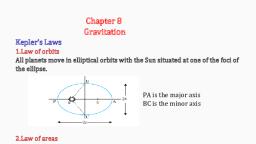
150, , de= ur dt >de =-, , echanics, , dr, , L, , ur22E, , -, , |, , dr, d9, , So that, , integrating above equation we get the, dr, , solution, , dr, , 0=L, , -0,-L, , +0,, , -U, 2ur?, , KEPLER'S LAWS, , Kepler's, , laws of planetary motion, , are, , (1) Every planet revolves around the sun in elliptical orbits with sun situated at one ofits foci, the law of elliptical orbits., (2) The radius vector joining the sun and the planet sweeps out equal areas in equal tim, ie., the Areal velocity of a planet is constapt. Kepler's 2nd law is called law of Area., , Kepler's, , Ist law is known, , as, , (3) The square of the time period of revolution of a planet about the sun is proportional t, cube of the semimajor Axis. Kepler's 3rd law is known as Harmonic law., , Discussions, Kepler's 1st law : As planet revolves around sun under gravitational force J(T)=-, , k-Gm,m.) {U)=Ifrdr}. Thenpotential energy U(r)=de=-, , k, , Using thisvalueintheexpressi, , Ldr, , ur 2E-U-_L, we get dG =-, , Hr, Hence Integrating this, , Ldr, , E+k, , 2ur, , equation we get 0=|, ur, , Ldr, , +, , E+k__1, , 2ur, , . (1)