Page 1 :
L. No: 25.Changes in our, surroundings, Q1. Fill in the blanks, 1. Bats are nocturnal animals., 2. When the stomach is full, cows and, buffaloes sit in a peaceful place and ruminate., 3. Birds are the first to sense the end of the, night., 4. When the sun rises, its light is soft., 5. Tuberose blooms at night., Q2.True of false., 1. The moon cannot be seen on the day of, new moon, True., 2. Few living beings set out to search of food, after the sun has set., True.
Page 2 :
3. The day when the moon looks triangular is, the day of the full moon, False., 4. Birds start chirping at dawn., , True., , 5. The sun gradually shifts towards the, east., , False., , Q3. Match the columns., A, , Answers., , 1. Owl, , -, , 2. Buffalo, , -, , 3. Raatrani -, , Nocturnal animal., Animal that ruminates., Blooms at night., , Q4. Answer in one word., 1 The different shapes of the moon., -Phases of the moon.
Page 3 :
2. Few living beings set out in search of food, after the sun has set. – Nocturnal animals., 3.The day on which the moon is completely, round Full moon day., 4. The day on which the moon cannot be seen, -New moon day., Q5. Name the following:, 1. The hill station in Satara district: Panchgani,, Mahabaleshwar., 2. Nocturnal animals: Bat, Owl, Hyena,, Leopard., 3. Insects hovering around flowers:, Bees, butterflies , bugs , beetles., Q6. Cross out the wrong ., 1. After the day of full moon to new moon,, the shape of moon grows bigger/smaller.
Page 4 :
2. At morning/afternoon, the shadows are, long., 3. At evening/ afternoon, the shadows are, very short., 4. On full/ new moon day the moon appears, completely round., , Q7. Answer the following., 1. When does the day start?, Ans. The day starts after sunrise., 2. When does the night start?, Ans. The night starts after sunset., 3. What are the shadows like when the sun is, directly overhead?, Ans. When the sun is directly overhead , the, shadows are very short., 4. What are the phases of the moon?
Page 5 :
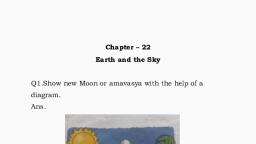
Ans: The changing shapes of the moon is, called phases of the moon., 5. What is meant by crescent moon?, Ans: A very small shape of the moon is called, crescent moon., 6. After how many days does a new moon, follow another new moon?, Ans: Nearly after 30 days a new moon follows, another new moon., 7. What is full moon day?, Ans: The day on which the moon appears, completely round is called full moon day., 8. What is new moon day?, Ans: The day on which the moon cannot be, seen at all is called new moon day., 9. What happens to the shape of the moon, from the day of the full moon to day of the, new moon?
Page 6 :
Ans: The shape of the moon keeps on, decreasing., 10. What happens to the shape of the moon, from the day of the new moon to day of the, full moon?, Ans: The shape of the moon keeps on, increasing., 11. After the day of the new moon, for how, many days does the moon grow bigger?, Ans: From the day of new moon, nearly for, fifteen days the moon grows bigger., 12. Make a list of flowers which bloom in the, morning?, Ans: Rose, daisy, sunflower, mogra, Jasmine, etc. bloom in the morning., 13. What is the benefit of rumination to the, animals?
Page 7 :
Ans: Rumination helps animals to digest the, food., , Q8 Answer in brief., 1. What is rumination?, Ans: 1). Some animals graze until their, stomachs are full. 2).Later they bring back the, swallowed food into their mouth again a little, at a time and chew it. 3). Then they swallow, the chewed food a second time, this is called, rumination., 2. Who are called nocturnal animals?, Ans:1) Some animals sleep during the day and, search for food at night. They are called, nocturnal animals.2) For ex: Tiger, bat , owl,, leopard etc., 3. Write the brief about a tourist place, Mahabaleshwar.
Page 8 :
Ans: 1) Mahabaleshwar is a hill station, located in western ghats of satara district., 2) It is one of the evergreen forest in India., 3) It is a holiday spot and an important, pilgrimage site for Hindus., , 4. What do birds do at the time of sunrise?, Ans: 1) Birds start chirping from early dawn., 2) They leave their nest and start flying in, flocks. 3) They begin to search for food., , OPEN ENDED QUESTIONS., Q1. What do you do in the morning?, Ans: I wake up , brush my teeth and then take, a bath and do breakfast.