Page 1 :
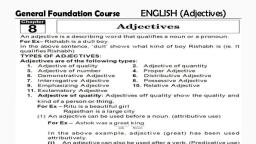
Remember, , An adjective is a word that adds to the meaning, of a noun by describing any of its qualities., , Sometimes we have to describe some quality of a noun. For this, a qualifying, word is added before the noun. It adds to the meaning of that noun with, the desired quality. Such a qualifying word is called an adjective., , Remember that the word — adjective —has its d silent. So, it is pronounced, AJEKTIV, not ADJEKTIV., , Read the following sentences:, , Tall trees grow, , 1. Tall trees grow in forests., in forests., , , , , , 2. The old man walks slowly., , The words—tall, old—have been used before the nouns trees and man. The, word tall states the quality of tallness of the trees. The word old states the, quality of elderliness of the man., , Let us have some more examples :, 1. The hind legs of a camel are crooked., , 2. The earth is round in shape. stat wee, , 3. The widow is poor and weak. brave., , , , 4, Shivaji was brave., , The words given in bold type are adjectives. They are used after the verbs, for the nouns used before the verbs. So, remember that adjectives can be, used before their nouns or after the verbs that are used for those nouns., , 1. The word— adjective —has its d silent., 2. Adjectives describe the qualities of their nouns., , 3. An adjective may come before its noun or after the verb used for its noun., 4. Remember that the words of number— one, two, first, second, some,, many etc.—are not adjectives. They are numeral determiners., , 5. Words of quantity—much, some, all, more—are also not adjectives., , They are quantity. determiners., , , , 47