Page 1 :
csci 210: Data Structures, Trees, , 1
Page 2 :
Summary, , , Topics, •, , general trees, definitions and properties, , •, , interface and implementation, , •, , tree traversal algorithms, , •, , •, , , , •, , depth and height, , •, , pre-order traversal, , •, , post-order traversal, , binary trees, •, , properties, , •, , interface, , •, , implementation, , binary search trees, •, , definition, , •, , h-n relationship, , •, , search, insert, delete, , •, , performance, , READING:, •, , GT textbook chapter 7 and 10.1, 2
Page 3 :
Trees, , , , , So far we have seen linear structures, •, , linear: before and after relationship, , •, , lists, vectors, arrays, stacks, queues, etc, , Non-linear structure: trees, •, , probably the most fundamental structure in computing, , •, , hierarchical structure, , •, , Terminology: from family trees (genealogy), , 3
Page 4 :
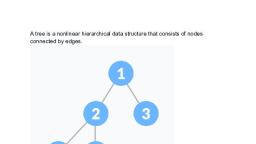
Trees, , , store elements hierarchically, , , , the top element: root, , , , except the root, each element has a parent, , , , each element has 0 or more children, , root, , 4
Page 5 :
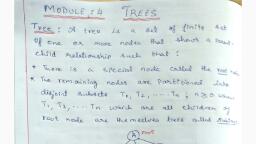
Trees, , , Definition, •, , , , , , A tree T is a set of nodes storing elements such that the nodes have a parent-child, relationship that satisfies the following, •, , if T is not empty, T has a special tree called the root that has no parent, , •, , each node v of T different than the root has a unique parent node w; each node with parent w is a child of w, , Recursive definition, •, , T is either empty, , •, , or consists of a node r (the root) and a possibly empty set of trees whose roots are the, children of r, , Terminology, •, , siblings: two nodes that have the same parent are called siblings, , •, , internal nodes, •, , •, , nodes that have children, , external nodes or leaves, •, , nodes that don’t have children, , •, , ancestors, , •, , descendants, , 5
Page 6 :
Trees, root, , internal nodes, , leaves, , 6
Page 7 :
Trees, , ancestors of u, , u, , 7
Page 8 :
Trees, , descendants of u, , u, , 8
Page 9 :
Application of trees, , , Applications of trees, •, , class hierarchy in Java, , •, , file system, , •, , storing hierarchies in organizations, , 9
Page 10 :
Tree ADT, , , Whatever the implementation of a tree is, its interface is the following, •, , root(), , •, , size(), , •, , isEmpty(), , •, , parent(v), , •, , children(v), , •, , isInternal(v), , •, , isExternal(v), , •, , isRoot(), 10
Page 12 :
Algorithms on trees: Depth, , , Depth:, •, , , , depth(T, v) is the number of ancestors of v, excluding v itself, , Recursive formulation, •, , if v == root, then depth(v) = 0, , •, , else, depth(v) is 1 + depth (parent(v)), , , , Compute the depth of a node v in tree T:, , , , Algorithm:, , int depth(T, v), , int depth(T,v) {, if T.isRoot(v) return 0, return 1 + depth(T, T.parent(v)), }, , , , Analysis:, •, , O(number of ancestors) = O(depth_v), , •, , in the worst case the path is a linked-list and v is the leaf, , •, , ==> O(n), where n is the number of nodes in the tree, , 12
Page 13 :
Algorithms on trees: Height, , , Height:, •, , , , height of a node v in T is the length of the longest path from v to any leaf, , Recursive formulation:, •, , if v is leaf, then its height is 0, , •, , else height(v) = 1 + maximum height of a child of v, , , , Definition: the height of a tree is the height of its root, , , , Compute the height of tree T: int height(T,v), , , , Height and depth are “symmetrical”, , , , Proposition: the height of a tree T is the maximum depth of one of its leaves., , 13
Page 14 :
Height, , , Algorithm:, int height(T,v) {, if T.isExternal(v) return 0;, int h = 0;, for each child w of v in T do, h = max(h, height(T, w)), return h+1;, }, , , , Analysis:, •, , total time: the sum of times spent at all nodes in all recursive calls, , •, , the recursion:, , •, , •, , v calls height(w) recursively on all children w of v, , •, , height() will eventually be called on every descendant of v, , •, , overall: height() is called on each node precisely once, because each node has one parent, , aside from recursion, •, , for each node v:, –, , •, , •, , O(1 + c_v), , go through all children of v, where c_v is the number of children of v, , over all nodes: O(n) + SUM (c_v), –, , each node is child of only one node, so its processed once as a child, , –, , SUM(c_v) = n - 1, , total: O(n), where n is the number of nodes in the tree, , 14
Page 15 :
Tree traversals, , , A traversal is a systematic way to visit all nodes of T., , , , pre-order:, •, , , , parent comes before children; overall root first, , post-order:, •, , root, children, children, root, , parent comes after children; overall root last, , void preorder(T, v), visit v, for each child w of v in T do, preorder(w), , void postorder(T, v), for each child w of v in T do, postorder(w), visit v, , Analysis: O(n), , [same arguments as before], , 15
Page 16 :
Examples, , , Tree associated with a document, , Pape, r, Title, , Abstract, , Ch1, , 1.1, , , , In what order do you read the document?, , 1.2, , Ch2, , Ch3, , 3.1, , Refs, , 3.2, , 16
Page 17 :
Example, , , Tree associated with an arithmetical expression, , +, 3, , *, 12, , , , +, 5, , 1, , 7, , Write method that evaluates the expression. In what order do you traverse the tree?, 17
Page 18 :
Binary trees, , 18
Page 19 :
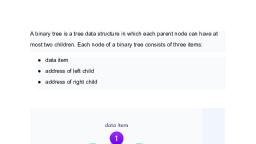
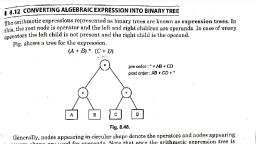
Binary trees, , , , , Definition: A binary tree is a tree such that, •, , every node has at most 2 children, , •, , each node is labeled as being either a left chilld or a right child, , Recursive definition:, •, , a binary tree is empty;, , •, , or it consists of, , • a node (the root) that stores an element, • a binary tree, called the left subtree of T, • a binary tree, called the right subtree of T, , , Binary tree interface, • left(v), • right(v), • hasLeft(v), • hasRight(v), • + isInternal(v), is External(v), isRoot(v), size(), isEmpty(), 19
Page 20 :
Properties of binary trees, , , In a binary tree, •, , level 0 has <= 1 node, , •, , level 1 has <= 2 nodes, , •, , level 2 has <= 4 nodes, , •, , ..., , •, , level i has <= 2^i nodes, , d=0, d=1, d=2, , d=3, , , , Proposition: Let T be a binary tree with n nodes and height h. Then, •, , h+1 <=, , n, , <=, , 2, , •, , lg(n+1) - 1, , <=, , h, , h+1, , -1, , <=, , n-1, 20
Page 21 :
Binary tree implementation, , , use a linked-list structure; each node points to its left and right children ; the tree, class stores the root node and the size of the tree, , , , implement the following functions:, • left(v), , BTreeNode:, , • right(v), , data, , • hasLeft(v), • hasRight(v), , parent, , left, , right, , • isInternal(v), • is External(v), • isRoot(v), • size(), • isEmpty(), •, , also, • insertLeft(v,e), • insertRight(v,e), • remove(e), • addRoot(e), , 21
Page 22 :
Binary tree operations, , , insertLeft(v,e):, •, , create and return a new node w storing element e, add w as the left child of v, , •, , an error occurs if v already has a left child, , , , insertRight(v,e), , , , remove(v):, •, •, , , , , , remove node v, replace it with its child, if any, and return the element stored at v, an error occurs if v has 2 children, , addRoot(e):, •, , create and return a new node r storing element e and make r the root of the tree;, , •, , an error occurs if the tree is not empty, , attach(v,T1, T2):, •, , attach T1 and T2 respectively as the left and right subtrees of the external node v, , •, , an error occurs if v is not external, 22
Page 24 :
Binary tree traversals, , , , , Binary tree computations often involve traversals, •, , pre-order:, , •, , post-order:, , left right root, , additional traversal for binary trees, •, , in-order:, •, , , , root left right, , left root right, , visit the nodes from left to right, , Exercise:, •, , write methods to implement each traversal on binary trees, , 24
Page 25 :
Application: Tree drawing, , , Come up with a solution to “draw” a binary tree in the following way. Essentially, we, need to assign coordinate x and y to each node., •, , node v in the tree, • x(v) = ?, • y(v) = ?, , 0, 1, 2, 3, 4, , 0, , 1, , 2, , 3, , 4, , 5, , 6, , 7, 25
Page 26 :
Application: Tree drawing, , , We can use an in-order traversal and assign coordinate x and y of each node in the, following way:, •, , x(v) is the number of nodes visited before v in the in-order traversal of v, , •, , y(v) is the depth of v, , 0, 1, 2, 3, 4, , 0, , 1, , 2, , 3, , 4, , 5, , 6, , 7, 26
Page 27 :
Binary tree searching, , , , , write search(v, k), •, , search for element k in the subtree rooted at v, , •, , return the node that contains k, , •, , return null if not found, , performance, •, , ?, , 27
Page 28 :
Binary Search Trees (BST), , , , , Motivation:, •, , want a structure that can search fast, , •, , arrays: search fast, updates slow, , •, , linked lists: search slow, updates fast, , Intuition:, •, , , , tree combines the advantages of arrays and linked lists, , Definition:, •, , a BST is a binary tree with the following “search” property, , v, , – for any node v, , allows to search efficiently, , k, T1, , all nodes in T1<= k, , T2, , all node in T2 > k, , 28
Page 30 :
Sorting a BST, , , Print the elements in the BST in sorted order, , 30
Page 31 :
Sorting a BST, , , Print the elements in the BST in sorted order., , , , in-order traversal: left -node-right, , , , Analysis: O(n), , //print the elements in tree of v in order, sort(BSTNode v), if (v == null) return;, sort(v.left());, print v.getData();, sort(v.right());, 31
Page 33 :
Searching in a BST, //return the node w such that w.getData() == k or null if such a node, //does not exist, BSTNode search (v, k), , {, , if (v == null) return null;, if (v.getData() == k) return v;, if (k < v.getData()) return search(v.left(), k);, else return search(v.right(), k), }, , , , Analysis:, , •, •, •, , search traverses (only) a path down from the root, does NOT traverse the entire tree, O(depth of result node) = O(h), where h is the height of the tree, , 33
Page 34 :
Inserting in a BST, , , insert 25, , 34
Page 35 :
Inserting in a BST, , , insert 25, •, , There is only one place where 25 can go, 25, , , , //create and insert node with key k in the right place, , , , void insert (v, k), , {, , //this can only happen if inserting in an empty tree, if (v == null) return new BSTNode(k);, if (k <= v.getData()) {, if (v.left() == null) {, //insert node as left child of v, u = new BSTNode(k);, v.setLeft(u);, } else {, return insert(v.left(), k);, }, } else //if (v.getData() > k) {, ..., }, }, , 35
Page 36 :
Inserting in a BST, , , Analysis:, •, , similar with searching, , •, , traverses a path from the root to the inserted node, , •, , O(depth of inserted node), , •, , this is O(h), where h is the height of the tree, , 36
Page 37 :
Deleting in a BST, , , delete 87, , , , delete 21, , , , delete 90, , , , case 1: delete a leaf x, , , , •, , if x is left of its parent, set parent(x).left = null, , •, , else set parent(x).right = null, , case 2: delete a node with one child, •, , , , link parent(x) to the child of x, , case 2: delete a node with 2 children, •, , ??, , 37
Page 38 :
Deleting in a BST, , , delete 90, , u, , , , copy in u 94 and delete 94, •, , the left-most child of right(x), , , , or, , , , copy in u 87 and delete 87, •, , the right-most child of left(x), , node has <=1 child, , node has <=1 child, , 38
Page 39 :
Deleting in a BST, , , Analysis:, •, , traverses a path from the root to the deleted node, , •, , and sometimes from the deleted node to its left-most child, , •, , this is O(h), where h is the height of the tree, , 39
Page 40 :
BST performance, , , , , , , Because of search property, all operations follow one root-leaf path, •, , insert:, , O(h), , •, , delete:, , •, , search: O(h), , O(h), , We know that in a tree of n nodes, •, , h >= lg (n+1) - 1, , •, , h <= n-1, , So in the worst case h is O(n), •, , BST insert, search, delete: O(n), , •, , just like linked lists/arrays, , 40
Page 41 :
BST performance, , , , , , , , , worst-case scenario, •, , start with an empty tree, , •, , insert 1, , •, , insert 2, , •, , insert 3, , •, , insert 4, , •, , ..., , •, , insert n, , it is possible to maintain that the height of the tree is Theta(lg n) at all times, •, , by adding additional constraints, , •, , perform rotations during insert and delete to maintain these constraints, , Balanced BSTs: h is Theta(lg n), •, , Red-Black trees, , •, , AVL trees, , •, , 2-3-4 trees, , •, , B-trees, , to find out more.... take csci231 ( Algorithms), , 41