Page 1 :
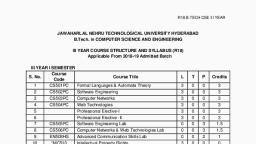
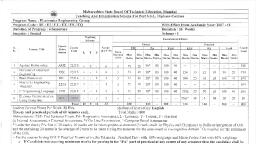
‘Scheme of Teaching & Examination of Bachelor of Eng!, , R.T. M. Nagpur University, Nagpur, FOUR YEAR B.E. COURSE, , B.E. SCHEME OF EXAMINATION wef: 2021-22, , ineering IIT Semester 8.E. (Computer Science and Engineering), , , , , , , , , , , , , , , , , , , , , , , , , , , , , , , , , , , , , , , , , , , , , , , , , , , , , , , , , , Sr] Course | Category Course Name Wours/ [Credit ‘Maximum Marks, fio] Se Week | § Theory Practical Tom, “E] Fy PI, Tnternal [University Internal/University, TBECSES0IT | Basic [Applied Mathematics] 3 [ 1) = | 4.00 30 70 > > 100, Sciences |, courses | |, Z | BECSESOAT | Professional Object Oriented 3 [1] -| 400 3 [70 = 100, core courses Programming with Java |, } | __ st tt 7, 3 | BECSEIOST | Professional Operating System 3 [=| =) 300 30 | 70 3 100, core courses | |, | BECSEROAT | Professional Computer Architecture & | 3 ] 1) - | 4.00 30 | «70 > - 100, core courses Digital System |, S | BECSEIOST | Professional Ethics in IT 3 | -)- | 300 ET) ] 70 ] 100, core courses, | |, © | BECSEOET | Humanities [Universal Human Values | 2/=]= [200 m= | 3 | . ] : 50, Social and |, Managemen, Ea : = = |, 7 | BeC5E307T | Mandatory [Environment Science 2) - [= | 000 |, Course (Audit) | | |, @ | BECSEROAP | Professional Object Oriented - ZT] 100 | = > 5 25 50, ‘core courses Programming with Java Lab, 9 | BECSEIO3P | Professional Operating System Lab - 2) 100 | = > [os | 2 | 5%, coecrunes |, TO | BECSESOSP | Professional Computer Workshop-1 Lab T-|-[2[ 100] - - Fs cr 50, core courses | |, Total 19 3) 6) 23.00) 165 385 7. 75 700, L aah
Page 2 :
RASHTRASANT TUKADOJI MAHARAJ NAGPUR UNIVERSITY, NAGPUR, FOUR YEAR BACHELOR OF ENGINEERING (B.E.) DEGREE COURSE, SEMESTER: 3" (C.B.C.S.), , BRANCH: COMPUTER SCIENCE & ENGINEERING, , , , , , Subject : Applied Mathematics - III Subject Code : BECSE301T, «.. |College Assessment| University, Load Credits Marks Evaluation Total Marks, 08 Hes.(Theory) || agg 30 70 100, , , , , , , , , , , , , , 01 Hr. (Tutorial), , , , , , Aim: To provide the necessary mathematical skills required to solve problems of practical interest and to expose, students to a range of problems and teach appropriate methods to solve them., , Prerequisite(s): Basic Mathematics and Calculus, , Course Objectives:, , , , 1 A primary objective is to provide a bridge for the student from lower-division, mathematics courses to upper-division mathematics, , , , , , 2 Explain the importance of mathematics and its techniques to solve real life problems, and provide the limitations of such techniques and the validity of the results., 3 Propose new mathematical and statistical questions and suggest possible software, , , , , , packages and/or computer programming to find solutions to these questions,, , , , Course Outcomes:, , After completing the course, students will be able to:, , col Understand numerical methods, matrices for the solution of linear and nonlinear, equations, and the solution of differential equations, among other mathematical, processes and activities., , co2 Analyze real world scenarios to recognize when matrices and probability are, appropriate, formulate problems about the scenarios, creatively model these, scenarios (using technology, if appropriate) in order to solve the problems using, multiple approaches,, , CO3 Organize, manage and present data in a clear and concise manner., , , , , , , , , , co4 Develop an ability to identify, formulate, and/or solve real world problems., , , , cos Understand the impact of scientific and engineering solutions in a global and, societal context., , C06 Create the groundwork for post-graduate courses, specialized study, and research in, computational mathematics., , , , , , , , , , , , Unit I: Numerical Methods [8 Hours], Solution of algebraic and transcendental equations: Newton—Raphson method, Method of false position, , and their convergence, Solution of simultaneous linear equations using Gauss-Seidal method and Crout’s, , Lo, , method (LU decomposition).
Page 3 :
Numerical solution of ordinary differential equations: Taylor's series method, Euler’s modified method,, , Runge-Kutta fourth order method, Milne’s predictor- corrector method., , Unit I: Matrices {7 Hours], Linear dependence of vectors, Eigen values and Eigen vectors, Reduction to diagonal form, Singular value, decomposition, Sylvester's: theorem (Statement only), Largest Eigen value and its corresponding Eigen, vector by iteration method., , Unit I: Mathematical Expectation and Probability Distributions [8 Hours], Discrete Random Variable: Review of discrete random variable, Probability function and Distribution, function, Mathematical expectation, Variance and Standard deviation, Moments, Moment generating, , function,, , Probability Distributions: Binomial distribution, Poisson distribution, Normal distribution, Exponential, distribution., , Unit IV: Statistical Techniques [6 Hours], Statistics: Introduction to correlation and regression, Multiple correlation and its properties, Multiple, , regression analysis, Regression equation of three variables., , Measures of central tendency and dispersion: Mean, Median, Quartile, Decile, Percentile, Mode, Mean, , deviation, Standard deviation., , Skewness: Test and uses of skewness and types of distributions, Measure of skewness, Karl Pearson’s, , coefficient of skewness, Measure of skewness based on moments., , Unit V: Stochastic Process and Sampling Techniques [7 Hours], Stochastic Process: Introduction of stochastic process, Classification of random process, Stationary and, non-stationary random process, Stochastic matrix., , Markov Chain: Classification of states, Classification of chains, Random walk and Gambler ruin., , Sampling: Population (Universe), Sampling types and distribution, Sampling of mean and variance, Testing, a hypothesis, Null and Alternative Hypothesis, One-tail and two-tails tests (Only introduction), t test and F, , test (Only introduction), Chi-square test., , Text/ Reference Books:, 1. Advanced Engineering Mathematics (Wiley), Erwin Kreyzig., , 2. Higher Engineering Mathematics (Khanna Publishers), B. S. Grewal., , 3. Advanced Engineering Mathematics (S. Chand), H. K. Dass., , 4. Probability and Statistics (Schaum's Outline Series), Murray Spiegel, John Schiller, R. A. Srinivasan., 5. Advanced Mathematics for Engineers, Chandrika Prasad., , 6. Probability, Statistics and Randam Processes (TMH), T. Veerarajan., , Set
Page 4 :
RASHTRASANT TUKADOJI MAHARAJ NAGPUR UNIVERSITY, NAGPUR, FOUR YEAR BACHELOR OF ENGINEERING (B.E.) DEGREE COURSE, , , , , , SEMESTER: 3" (C.B.C.S.), BRANCH: COMPUTER SCIENCE & ENGINEERING, Subject : Object Oriented Programming with Java Subject Code : BECSE302T, 3 College University, Head Credits Assessment Marks | Evaluation Total Marks, 03 Hrs. (Theory), OL Hr. (Tutorial) 04 30 70 100, , , , , , , , , , , , , , , , Aim:, , This course explains the fundamental ideas behind the object-oriented approach to, programming. Knowledge of java helps to create the latest innovations in programming. Like the, successful computerlanguages that came before, java is the blend of the best elements of its rich, heritage combined with the innovative concepts required by its unique environment. This, course involves OOP’s concepts, java basics concepts, inheritance, polymorphism, interfaces,, inner classes, packages, Exception handling, multithreading and objects Oriented Methodology, basic concepts., , Prerequisite(s): Knowledge of structure programming language and Application development, , Course Objectives:, , , , | | Gain knowledge about basic Java language syntax and semantics to write Java, programs and use concepts such as variables, conditional and iterative execution, , methods ete., , , , 2 | Be able to use the Java SDK environment to create, debug and run simple Java, programs., , , , 3. | To analyze the object-oriented paradigm using java programming language, , , , 4 | To implement small/medium scale java programs to resolve small business, , problems,, , , , , , , , , , Course Outcomes:, , At the end of this course student are able to:, , , , col Identify classes, objects, members of a class and relationships among them for a, specific problem, , , , co2 Understand and demonstrate the concepts of garbage collection, polymorphism,, , , , , , , , , , inheritance etc.
Page 5 :
co3 Do numeric (algebraic) and string-based computation., , co4 Understand and implement modularity as well as basic error handling, techniques, , CO5 Develop, design and implement small multithreaded programs using Java, language, , CO6 | Apply appropriate problem-solving strategies for the implementation of small, , , , /medium scale java applications, , , , lhe foe