Page 2 :
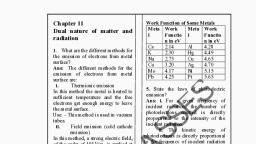
CHAPTER 11:- DUAL NATURE OF RADIATION AND MATTER, Work function:The minimum energy required tp remove an electron from the metal surface is called work function. It is, denoted by 𝜙0 and measured by eV (electron volt). One eV is the energy acquired by an electron when it is, accelerated by a potential difference of 1 volt. So 1 eV = 1.602 x 10 -19 J. The work function depends on the, properties of the metal and the nature of its surface. The work function of platinum is the highest (𝜙0 = 5.65, eV) while it is the lowest for caesium (𝜙0 = 2.14 eV)., Electron emission:The types of electron emission are (i) Thermionic emission (ii) Field emission (iii) Photo-electric emission., (i) Thermionic Emission:- The process of emission of electrons from the metal surface by heating is called, thermionic emission., (ii) Field Emission:- The process of emission of electrons from the metal surface by applying a very strong, electric field is called field emission., (iii) Photo-electric Emission:- The process of emission of electrons from the metal surface when radiation of, suitable frequency falls on it is called photo-electric emission. It was discovered by Heinrich Hertz in 1887., Hertz’s observations of photo-electric effect:- In the production of electromagnetic waves by means of a, spark discharge, Hertz observed that high voltage sparks across the detector loop were enhanced when the, emitter plate was illuminated by ultraviolet light from an arc lamp., Hallwachs’ and Lenard’s observations:- Lenard observed that when ultraviolet radiations fall on the emitter, plate of an evacuated glass tube enclosing two electrodes (metal plates), current flows in the circuit. As soon, as the radiations were stopped, the current flow also stopped., (i) Hallwachs observed that the zinc plate in an electroscope lost its charge when it was illuminated by, ultraviolet light., (ii) the uncharged zinc plate became positively charged when it was further irradiated., (iii) Positive charge on the zinc plate was found to be further enhanced when it was further illuminated., From these observations he concluded that negatively charged particles were emitted from the zinc plate, under the action of ultraviolet light., Photo-electric effect:- The phenomenon of emission of electrons from the metal surface when radiation of, suitable frequency falls on it is called photo-electric effect. The electrons so emitted are called photo-electrons, and the corresponding current is called photo current., The experimental arrangement is as shown in the figure., It consists of an evacuated glass/quartz tube having a, photosensitive plate C and another metal plate A., Monochromatic light from the source S of sufficiently short, wavelength passes through the window W and falls on the, photosensitive plate C (emitter). The electrons are emitted by, the plate C and are collected by the plate A (collector), by the, electric field created by the battery. Current flows in the circuit., The polarity of the plates C and A can be reversed by a, commutator. Thus, the plate A can be maintained at a desired, positive or negative potential with respect to emitter C., SMGPUC SIRSI, , Experimental arrangement of PEE, , Page 2
Page 3 :
Experimental observations of photo-electric effect:I., Photo-electric effect is an instantaneous process., II., For a given photosensitive material, there exists a certain minimum cut-off frequency of the incident, radiation, called the threshold frequency, below which no emission of photoelectrons takes place., III., For a given material and radiation above the threshold frequency, the photo current is directly, proportional to the intensity of incident radiation., IV., For a given material and intensity, the kinetic energy of the photo-electrons is directly proportional to, the frequency of incident radiation., V., The negative potential given to the anode to stop the photo-electrons in reaching it, called stopping, potential, depends on the frequency of incident radiation., , Variation of photoelectric current with incensity, of light, , Variation of photocurrent with plate potential for different intensity, of incident radiation, , Variation of stopping potential V0 with, frequency of incident radiation for a given, photosensitive material, , Variation of photocurrent with plate potential for different, frequencies of incident radiation, , Note:- (i) According to the wave theory of light, the free electrons at the surface of the metal absorb the, radiant energy continuously and kinetic energy of the photoelectrons increase with intensity. (ii) Incident, energy is distributed by all electrons and an electron requires more time to come out of the metal surface., Therefore the process was not instantaneous., Einstein’s photo-electric equation:- In 1905 Albert Einstein explained photo-electric effect on the basis of, quantum theory of light. Light consists of tiny packets of energy called quanta. Each quantum has energy, E = hν, where h is called Planck’s constant. The maximum kinetic energy of a photoelectron is given by, Einstein’s photoelectric equation, Kmax = hν – 𝜙0. Here 𝜙0 is the work function., (i) According to this equation, since 𝜙0 is constant, Kmax depends only on the frequency of incident, radiation ν., SMGPUC SIRSI, , Page 3
Page 4 :
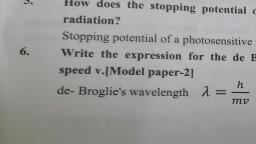
(ii) Since Kmas is non-negative, photoelectric emission is possible only if hν > 𝜙0, hν > hν0, ν > ν0 there, exists minimum frequency called threshold frequency (ν0) for photo-electric emission., (iii) Intensity of radiation corresponds to the number of quanta per unit area per unit time. Therefore, photocurrent depends on the intensity., (iv) According to Einstein, each electron interacts with each energy quanta, the process is instantaneous., Note:- (i) The maximum kinetic energy of a photoelectron is equal to the stopping potential in eV 0., (ii), , eV0 = hν – 𝜙0 or, , ( ), , therefore V0 versus ν curve is a straight line with slope = (h/e)., , Particle nature of light: Photon According to Einstein, light consists of tiny packets of quantum called, photons. Energy of a photon is E = hν. The properties of photon are, 1), In interaction of radiation with matter, radiation behaves as if it is made up of particles called, photons., 2), Each photon has energy E (=h ν ) and momentum p (= h ν /c), and speed c, the speed of light., 3), All photons of light of a particular frequency ν , or wavelength λ , have the same energy E (=h ν =, hc/ λ ) and momentum p (= h ν /c= h/ λ ), whatever the intensity of radiation may be., 4), Photons are electrically neutral and are not deflected by electric and magnetic fields., 5), In a photon-particle collision, the total energy and total momentum are conserved. However, the, number of photons may not be conserved in a collision., Wave nature of Matter:- in 1924 Louis de Broglie proposed the wave nature of the particles. The waves, associated with moving particles are called matter waves. The wavelength of matter wave is called de, Broglie wavelength. It is given by the equation, , . Here m is the mass and p is momentum of the, , particle. The de Broglie wavelength of an electron of mass m, charge e, kinetic energy K and accelerating, potential V is given by, √, , √, , ., , Substituting the value of the constants we get, , √, , nm Or, , √, , Å., , Heisenberg’s Uncertainty Principle:It is not possible to measure both the position and momentum of any particle at the same time, exactly. There is always some uncertainty (Δ x) in the specification of position and some uncertainty (Δp), in the specification of momentum. The product Δx . Δp = h/2π ≈ ħ, both Δx and Δp are non-zero such that, their product is of the order of ħ., Now, if an electron has a definite momentum p, (i.e.Δp = 0), by the de Broglie relation, it has a definite, wavelength λ. A wave of definite (single) wavelength extends all over space. By Born’s probability, interpretation this means that the electron is not localised in any finite region of space. That is, its position, uncertainty is infinite (Δx → ∞), which is consistent with the uncertainty principle., Davisson and Germer Experiment:The wave nature of electrons was first experimentally verified by C.J. Davisson and L.H. Germer in 1927., The experimental arrangement is as shown in the figure. It consists of an electron gun which comprises of, a tungsten filament F, coated with barium oxide and heated by a low voltage power supply (L.T. or, battery). Electrons emitted by the filament are accelerated to a desired velocity by applying suitable, voltage from a high voltage power supply (H.T). They are made to pass through a cylinder with fine holes, producing a fine collimated beam. The beam is made to fall on of a nickel crystal., SMGPUC SIRSI, , Page 4
Page 5 :
The electrons are scattered in all directions by the, atoms of the crystal. The intensity of the scattered, electron beam is measured by the electron detector, (collector). The detector can be moved on a circular, scale and is connected to a sensitive galvanometer,, which records the current. The deflection of the, galvanometer is proportional to the intensity of the, electron beam entering the collector. The apparatus, is enclosed in an evacuated chamber. The variation of, the intensity (I) of the scattered electrons with the, angle of scattering θ is obtained for different, accelerating voltages., The experiment was performed for accelerating voltage 44 V to 68 V. A strong peak appeared in the, intensity (I) of the scattered electron for 54V at a scattering angle θ = 50º The appearance of the peak in a, particular direction is due to the constructive interference of electrons scattered from the crystal. From, the electron diffraction measurements, the wavelength of matter waves was found to be 0.165 nm. The, de Broglie wavelength λ associated with electrons is given by, √, , √, , = 0.167 nm., , Thus, there is an excellent agreement between the theoretical value and the experimental, value of de Broglie wavelength. Davisson Germer experiment thus strikingly confirms the wave nature of, electrons and the de Broglie relation., Problems:1) Monochromatic light of frequency 6.0 ×10¹⁴ Hz is, (b) If N is the number of photons emitted by the, –3, produced by a laser. The power emitted is 2.0 ×10 W. source per second, the power P transmitted in, (a) What is the energy of a photon in the light beam?, the beam equals N times the energy per photon, (b) How many photons per second, on an average, are, E, so that P = N E. Then N =, emitted by the source?, Solution (a) Each photon has an energy, E=hν, N = 5.0 x 10¹⁵ photons per sec., E = ( 6.63 ×10⁻³⁴ J s) (6.0 ×10¹⁴ Hz), E = 3.98 × 10⁻¹⁹ J, 2) The work function of caesium (a) For the cut-off or threshold, is 2.14 eV. Find (a) the threshold, frequency, φ0 = hν0, frequency for caesium, and (b), the wavelength of the incident, light if the photocurrent is, brought to zero by a stopping, =, potential of 0.60 V., , =, = 5.16 x 10¹⁴ Hz, , SMGPUC SIRSI, , (b) eV0 = hν – 𝜙0 ,, , eV0 =, , =, , J, =, , (, , – 𝜙0, , ), , = 454 nm., , Page 5
Page 6 :
3) The wavelength of light in the, visible region is about 390 nm for, violet colour, about 550 nm, (average wavelength) for yellowgreen colour and about 760 nm, for red colour. What are the, energies of photons in (eV) at, (i) violet end, (ii) average, wavelength, yellow-green colour,, (iii) red end of the visible, spectrum?, Take h = 6.63 × 10⁻³⁴ Js and, 1 eV = 1.6 x 10⁻¹⁹J, , Solution, , (ii) For yellow-green light,, , (a) Energy of the incident photon,, , λ2 = 550 nm,, , 4) What is the de Broglie, wavelength associated with (a) an, electron moving with a speed of, 5.4 × 10⁶ m/s, and (b) a ball of, mass 150 g travelling at 30.0 m/s?, , Solution, , (b) For the ball:m’ = 0.150 kg,, , (a) For electron: m = 9.11×10⁻³¹kg, , speed v’ = 30.0 m/s., , speed v = 5.4×10⁶ m/s., , Then momentum p’ = m’ v’, , Then, momentum p = m v, , = 0.150 × 30.0, , = 9.11×10–31 × 5.4 × 106, , p’= 4.50 kg m/s, , p = 4.92 × 10⁻²⁴ kg m/s, , de Broglie wavelength λ’ = h/p’., , E = hν = hc/ λ, , =3.26 x 10⁻¹⁹ J, , E = (6.63 × 10⁻³⁴) (3 ×10⁸)/ λ, , = 2.26 eV, (iii) For red light, λ3 = 760 nm, , (i) For violet light, λ1 = 390 nm,, = 5.1 x 10, , -19, , =2.62 x 10⁻¹⁹ J, , J, , = 1.64 eV, , = 3.19 eV, , de Broglie wavelength, λ = h/p, , = 1.47 x 10⁻³⁴ m, , = 0.135 nm, , 5) A particle is moving three, times as fast as an electron. The, ratio of the de Broglie, wavelength of the particle to that, of the electron is 1.813 × 10⁻⁴., Calculate the particle’s mass and, identify the particle., , Solution, de Broglie wavelength of a, moving particle, having mass m, and velocity v, , Taking the ratio & simplifying,, , ( )( ), m = 9.11 x 10⁻³¹ x x, m = 1.675 x 10⁻²⁷ kg, Thus, the particle, with this mass, could be a proton or a neutron, , mass m =, , 6) What is the de Broglie wavelength associated Solution, with an electron, accelerated through a potential The de Broglie wavelength, difference of 100 volts?, =, = 0.123 nm, √, , SMGPUC SIRSI, , √, , Page 6
Page 7 :
Annual Examination Questions:1., 2., 3., 4., 5., 6., , Mention three types of electron emissions. [March 2014, March 2019, June 2019], Define electron volt. [July 2016], Mention Hallwachs’ and Lenard’s observations. *June 2015+, Define work function. [June 2015, July 2016, June 2017, March 2018], Define threshold frequency. [June 2015, June 2017, March 2018], Mention five experimental observations of photoelectric effect (or laws of photoelectric emission), [March 2016, March 2017, July 2018, March 2019, Sep 2020], 7. Define work function. Write Einstein's· photoelectric equation and explain the terms.[March 2020], 8. Write Einstein’s equation of photoelectric effect. Give Einstein’s explanation of photoelectric, effect. [March 2015], 9. Define stopping potential. [June 2015, June 2017], 10. Mention three properties of photon. [March 2014, March 2018], 11. What is the rest mass of a photon? [June 2019], 12. What are matter waves or de-Broglie waves? [July 2016, June 2017], 13. What is de-Broglie wavelength? [March 2017], 14. How does the de-Broglie wavelength vary with momentum of moving particle? [June 2017], 15. Mention the de-Broglie relation and explain the terms. [July 2016, March 2017], 16. Write the de-Broglie wavelength of electrons in terms of electric potential and explain the terms., [March 2019], 17. An alpha particle, a proton and an electron are moving with equal kinetic energy. Which one of, these particles has the longest de Broglie wavelength? Give reason.[March 2020], 18. What is the outcome (conclusions) of Davisson Germer experiment? [March 2015, March 2017], 19. Calculate de-Broglie wavelength associated with an electron moving with a speed of 2 x 10⁵ ms-1., Given h = 6.625 x 10⁻³⁴ Js, me = 9.11 x 10⁻³¹ kg. [July 2018], Problems:, 1) The work function of caesium metal is 2.14 eV. When light of frequency 6 × 10 14Hz is incident on the, metal surface, photoemission of electrons occurs. What is the (a) energy of the incident photons (b), maximum kinetic energy of the emitted electrons. (c) Stopping potential, and (d) maximum speed of, the emitted photoelectrons?, Given h = 6.63 x 10⁻³⁴ Js, e = 1.6 x 10⁻¹⁹ C, me = 9.1 × 10⁻³¹ kg [July 2014], 2) Light of frequency 8.41 x 10¹⁴ Hz is incident on a metal surface. Electrons with their maximum speed of, 7.5 x 10⁵ ms-1 are ejected from the surface. Calculate the threshold frequency for photoemission of, electrons. Also find the work function of the metal in eV., Given Planck’s constant = 6.625 x 1034 Js and mass of the electron = 9.1 x 10⁻³¹ kg. [March 2018], 3) Light of frequency 7.21 x 10¹⁴ Hz is incident on a metal surface. Electrons with their maximum speed of, 6.0 x 10⁵ ms-1 are ejected from the surface. Calculate the threshold frequency for photoemission of, electrons., Given Planck’s constant = 6.626 x 10⁻³⁴ Js [March 2017], , SMGPUC SIRSI, , Page 7