Page 1 :
APPGCET -2021: SYLLABUS, TEST NAME: 307 - Physical Sciences, ELECTRICITY, MAGNETISM AND ELECTRONICS, 1. Electrostatics: Gauss law and its applications-Uniformly charged sphere, charged cylindrical, conductorand an infinite conducting sheet of charge. Deduction of Coulmb’s law from Gauss, law Mechanical force on a charged conductor Electric potential - Potential due to a charged, spherical conductor, electric field strength from the electric dipole and an infinite line of, charge. Potential of a uniformly charged circular disc., 2. Dielectrics: An atomic view of dielectrics, potential energy of a dipole in an electric field., Polarizationand charge density, Gauss’s law for dielectric medium- Relation between D,E,, and P. Dielectric constant, susceptibility and relation between them. Boundary conditions at, the dielectric surface. Electric fields in cavities of a dielectric-needle shaped cavity and disc, shaped cavity., 3. Capacitance: Capacitance of concentric spheres and cylindrical condenser, capacitance of, parallel platecondenser with and without dielectric. Electric energy stored in a charged, condenser – force between plates of condenser, construction and working of attracted disc, electrometer, measurement of dielectric constant and potential difference., 4. Magnetostatics: Magnetic shell - potential due to magnetic shell - field due to magnetic shell, – equivalentof electric circuit and magnetic shell - Magnetic induction (B) and field (H) permeability and susceptibility - Hysteresis loop., 5. Moving charge in electric and magnetic field: Hall effect, cyclotron, synchrocyclotron and, synchrotron- force on a current carrying conductor placed in a magnetic field, force and, torque on a current loop, Biot -Savart’s law and calculation of B due to long straight wire, a, circular current loop and solenoid., 6. Electromagnetic induction: Faraday’s law-Lenz’s law- expression for induced emf - time, varying magnetic fields -Betatron -Ballistic galvanometer - theory - damping correction - self, and mutual inductance, coefficient of coupling, calculation of self inductance of a long, solenoid -toroid – energy stored in magnetic field - transformer - Construction, working,, energy losses and efficiency., 7. Varying and alternating currents: Growth and decay of currents in LR, CR and LCR, circuits – Criticaldamping. Alternating current relation between current and voltage in pure, R,C and L-vector diagrams - Power in ac circuits. LCR series and parallel resonant circuit Q-factor. AC & DC motors-single phase, three phase (basics only)., 8. Maxwell’s equations and electromagnetic waves: A review of basic laws of electricity and, magnetism -displacement current - Maxwell’s equations in differential form - Maxwell’s, wave equation, plane electromagnetic waves -Transverse nature of electromagnetic waves,, Poynting theorem, production of electromagnetic waves (Hertz experiment)., 9. Basic Electronics: Formation of electron energy bands in solids, classification of solids in, terms offorbidden energy gap. Intrinsic and extrinsic semiconductors, Fermi level, continuity, equation - p-n junction diode, Zener diode characteristics and its application as voltage, regulator. Half wave and full wave, rectifiers and filters, ripple factor (quantitative) – p n p, and n p n transistors, current components in transistors, CB.CE and CC configurations transistor hybrid parameters - determination of hybrid parameters from transistor, characteristics -transistor as an amplifier — concept of negative feed back and positive feed, back -Barkhausen criterion, RC coupled amplifier and phase shift oscillator (qualitative)., 10. Digital Principles: Binary number system, converting Binary to Decimal and vice versa., Binary additionand subtraction (1’s and 2’s complement methods). Hexadecimal number, system. Conversion from Binary to Hexadecimal - vice versa and Decimal to Hexadecimal
Page 2 :
vice versa. Logic gates: OR, AND, NOT gates, truth tables, realization of these gates using, discrete components. NAND, NOR as universal gates, Exclusive - OR gate, De Morgan’s, Laws - statement and proof, Half and Full adders. Parallel adder circuits., , 1., , 2., , 3., , 4., 5., , 6., , 7., , 8., , 9., , MODERN PHYSICS, Atomic Spectra: Introduction– Drawbacks of Bohr’s atomic model – Sommerfeld’s, elliptical orbits –elativistic correction (no derivation). Stern & Gerlach experiment Vector, atom model and quantum umbers associated with it. L-S and j-j coupling schemes. Spectral, terms, selection rules, intensity rules. Spectra of alkali atoms, doublet fine structure. Alkaline, earth spectra, singlet and triplet fine structure. Zeeman Effect, Paschen-Back Effect and Stark, Effect., Molecular Spectroscopy: Types of molecular spectra, pure rotational energies and spectrum, of diatomicmolecule, determination of internuclear distance. Vibrational energies and, spectrum of diatomic molecule. Raman effect, Classical theory of Raman effect., Experimental arrangement for Raman effect and its applications., Quantum Mechanics Inadequacy of classical Physics: (Discussion only)Spectral radiation, -Planck’slaw. Photoelectric effect - Einstien’s photoelectric equation. Compton’s effect, (quantitative) experimental verification. Stability of an atom - Bohr’s atomic theory., Limitations of old quantum theory., Matter Waves: de Broglie’s hypothesis- wavelength of matter waves, properties of matter, waves. Phase and group velocities. Davisson and Germer experiment. Double slit, experiment. Standing de Brogile waves of electron in Bohr orbits., Uncertainity Principle:Heisenberg’s uncertainty principle for position and momentum (x, and px), Energyand time (E and t). Gamma ray microscope. Diffraction by a single slit., Position of electron in a Bohr orbit. Particle in a box. Complementary principle of Bohr., Schrodinger Wave Equation:Schrodinger time independent and time dependent wave, equations.Wavefunction properties - Significance. Basic postulates of quantum mechanics., Operators, eigen functions and eigen values, expectation values. Application of Schrodinger, wave equation to particle in one and three dimensional boxes, potential step and potential, barrier., Nuclear Physics Nuclear Structure:Basic properties of nucleus - size, charge, mass, spin,, magnetic dipolemoment and electric quadrupole moment. Binding energy of nucleus,, deuteron binding energy, p-p and n-p scattering (concepts), nuclear forces. Nuclear models liquid drop model, shell model., Alpha and Beta Decays: Range of alpha particles, Geiger -Nuttal law, Gammow’s theory of, alpha decay.Geiger - Nuttal law from Gammow’s theory. Beta spectrum - neutrino, hypothesis, Fermi’s theory of p-decay (qualitative)., Nuclear Reactions: Types of nuclear reactions, channels, nuclear reaction kinematics., Compoundnucleus, direct reactions (concepts).Nuclear Detectors - GM counter,, proportional counter, scintillation counter, Wilson cloud chamber and solid state detector., , SOLID STATE PHYSICS, 1. Crystal Structure: Crystalline nature of matter. Cystal lattice, Unit Cell, Elements of, symmetry.Crystalsystems, Bravais lattices. Miller indices. Simple crystal structures (S.C.,, BCC, CsCI, FCC, NaCI diamond and Zinc Blends)2., 2. X-ray Diffraction: Diffraction of X -rays by crystals, Bragg’s law, Experimental techniquesLaue’smethod and powder method., 3. Nanomaterials: Introduction, Nan particles, metal nanoclusters, semiconductor, nanoparticles, carbonclusters, carbon nanotubes, quantum nanostructures - nanodot, nanowire, and quantum well. Fabrication of quantum nanostructures., 4. Bonding in Crystals: Types of bonding in crystals - characteristics of crystals with
Page 3 :
differentbindings. Lattice energy of ionic crystals - determination of Medelung constant for, NaCI crystal, calculation of Born coefficient and repulsive exponent. Born – Haber cycle., 5. Magnetism: Magnetic properties of dia, para and ferromagnetic materials. Langevin’s theory, ofparamagnetism. Weiss’ theory of ferromagnetism -Concepts of magnetic domains,, antiferromagnetism and ferrimagnetism ferrites and their applications., 6. Superconductivity: Basic experimental facts - zero resistance, effect of magnetic field,, Meissner effect,persistent current, Isotope effect Thermodynamic properties, specific heat,, entropy. Type I and Type II superconductors.Elements of BCS theory-Cooper pairs., Applications. High temperature superconductors (general information), THERMODYNAMICS AND OPTICS, 1. Kinetic theory of gases: Introduction -Deduction of Maxwell’s law of distribution of, molecular speeds,, Experimental verification Toothed Wheel Experiment, Transport Phenomena - Viscosity of, gases -thermal conductivity - diffusion of gases., 2. Thermodynamics: Introduction - Reversible and irreversible processes -Carnot’s engine and, it sufficiency - Carnot’s theorem - Second law of thermodynamics, Kelvin’s and Claussius, statements - Thermodynamic scale of temperature - Entropy, physical significance - Change, in entropy in reversible and irreversible processes - Entropy and disorder - Entropy of, universe - Temperature- Entropy (T-S) diagram - Change of entropy of a perfect gas-change, of entropy when ice changes into steam., 3. Thermodynamic potentials and Maxwell’s equations: Thermodynamic potentials–, Derivation of, Maxwell’s thermodynamic relations -Clausius-Clayperon’s equation - Derivation for ratio of, specific heats - Derivation for difference of two specific heats for perfect gas. Joule Kelvin, effect – expression for Joule, Kelvin coefficient for perfect and Vanderwaal’s gas., 4. Low temperature Physics: Introduction - Joule Kelvin effect - liquefaction of gas using, porous plugexperiment. Joule expansion - Distinction between adiabatic and Joule Thomson, expansion –Expression for Joule Thomson cooling - Liquefaction of helium, Kapitza’s, method -Adiabatic demagnetization - Production of low temperatures - Principle of, refrigeration, vapour compression type. Working of refrigerator and Air conditioning, machines. Effects of Chloro and Fluro Carbons on Ozone layer; applications of substances at, low temperature., 5. Quantum theory of radiation: Black body-Ferry’s blackbody - distribution of energy in the, spectrum ofBlack body -Wein’s displacement law, Wein’s law, Rayleigh-Jean’s law Quantum theory of radiation - Planck’s law - deduction of Wein’s law, Rayleigh-Jeans law,, from Planck’s law –Measurement of radiation - Types of pyrometers - Disappearing filament, optical pyrometer - experimental determination - Angstrom pyroheliometer - determination, of solar constant, effective temperature of sun., 6. Statistical Mechanics: Introduction to statistical mechanics, concept of ensembles, Phase, space, Maxwell-Boltzmann’s distribution law, Molecular energies in an ideal gas, BoseEinstein Distribution law, Fermi-Dirac Distribution law, comparison of three distribution, laws, Black Body Radiation, Rayleigh- Jean’s formula, Planck’s radiation law, Weins, Displacement, Stefan’s Boltzmann’s law from Plancks formula., Application of Fermi-Dirac statistics to white dwarfs and Neutron stars., 7. The Matrix methods in paraxial optics: Introduction, the matrix method, effect of, translation, effect ofrefraction, imaging by a spherical refracting surface. Imaging by a coaxial optical system. Unit planes. Nodal planes. A system of two thin lenses., 8. Aberrations: Introduction - Monochromatic aberrations, spherical aberration, methods of
Page 4 :
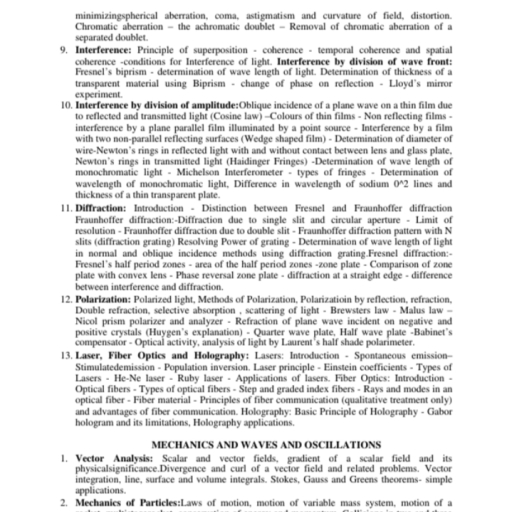
minimizingspherical aberration, coma, astigmatism and curvature of field, distortion., Chromatic aberration – the achromatic doublet – Removal of chromatic aberration of a, separated doublet., 9. Interference: Principle of superposition - coherence - temporal coherence and spatial, coherence -conditions for Interference of light. Interference by division of wave front:, Fresnel’s biprism - determination of wave length of light. Determination of thickness of a, transparent material using Biprism - change of phase on reflection - Lloyd’s mirror, experiment., 10. Interference by division of amplitude:Oblique incidence of a plane wave on a thin film due, to reflected and transmitted light (Cosine law) –Colours of thin films - Non reflecting films interference by a plane parallel film illuminated by a point source - Interference by a film, with two non-parallel reflecting surfaces (Wedge shaped film) - Determination of diameter of, wire-Newton’s rings in reflected light with and without contact between lens and glass plate,, Newton’s rings in transmitted light (Haidinger Fringes) -Determination of wave length of, monochromatic light - Michelson Interferometer - types of fringes - Determination of, wavelength of monochromatic light, Difference in wavelength of sodium 0^2 lines and, thickness of a thin transparent plate., 11. Diffraction: Introduction - Distinction between Fresnel and Fraunhoffer diffraction, Fraunhoffer diffraction:-Diffraction due to single slit and circular aperture - Limit of, resolution - Fraunhoffer diffraction due to double slit - Fraunhoffer diffraction pattern with N, slits (diffraction grating) Resolving Power of grating - Determination of wave length of light, in normal and oblique incidence methods using diffraction grating.Fresnel diffraction:Fresnel’s half period zones - area of the half period zones -zone plate - Comparison of zone, plate with convex lens - Phase reversal zone plate - diffraction at a straight edge - difference, between interference and diffraction., 12. Polarization: Polarized light, Methods of Polarization, Polarizatioin by reflection, refraction,, Double refraction, selective absorption , scattering of light - Brewsters law - Malus law –, Nicol prism polarizer and analyzer - Refraction of plane wave incident on negative and, positive crystals (Huygen’s explanation) - Quarter wave plate, Half wave plate -Babinet’s, compensator - Optical activity, analysis of light by Laurent’s half shade polarimeter., 13. Laser, Fiber Optics and Holography: Lasers: Introduction - Spontaneous emission–, Stimulatedemission - Population inversion. Laser principle - Einstein coefficients - Types of, Lasers - He-Ne laser - Ruby laser - Applications of lasers. Fiber Optics: Introduction Optical fibers - Types of optical fibers - Step and graded index fibers - Rays and modes in an, optical fiber - Fiber material - Principles of fiber communication (qualitative treatment only), and advantages of fiber communication. Holography: Basic Principle of Holography - Gabor, hologram and its limitations, Holography applications., , 1., , 2., , 3., , 4., , MECHANICS AND WAVES AND OSCILLATIONS, Vector Analysis: Scalar and vector fields, gradient of a scalar field and its, physicalsignificance.Divergence and curl of a vector field and related problems. Vector, integration, line, surface and volume integrals. Stokes, Gauss and Greens theorems- simple, applications., Mechanics of Particles:Laws of motion, motion of variable mass system, motion of a, rocket, multistagerocket, conservation of energy and momentum. Collisions in two and three, dimensions, concept of impact parameter, scattering cross-section, Rutherford scattering, Mechanics of rigid bodies:Definition of Rigid body, rotational kinematic relations, equation, of motionfor a rotating body, angular momentum and inertial tensor. Eulers equation,, precession of a top, Gyroscope, precession of the equinoxes, Mechanics of continuous media:Elastic constants of isotropic solids and their relation,, Poisson’sratioand expression for Poisson’s ratio in terms of y, n, k. Classification of beams,
Page 5 :
types of bending, point load, distributed load, shearing force and bending moment, sign, conventions, simple supported beam carrying a concentrated load at mid span, cantilever, with an end load., 5. Central forces:Central forces - definition and examples, conservative nature of central, forces,conservative force as a negative gradient of potential energy, equation of motion under, a central force, gravitational potential and gravitational field, motion under inverse square, law, derivation of Kepler’s laws, Coriolis force and its expressions., 6. Special theory of relativity:Galilean relativity, absolute frames, Michelson-Morley, experiment,Postulates of special theory of relativity. Lorentz transformation, time dilation,, length contraction, addition of velocities, mass-energy relation. Concept of four vector, formalism., 7. Fundamentals of vibrations:Simple harmonic oscillator, and solution of the differential, equation-Physical characteristics of SHM, torsion pendulum, - measurements of rigidity, modulus , compound pendulum, measurement of ‘g’, combination of two mutually, perpendicular simple harmonic vibrations of same frequency and different frequencies,, Lissajous figures, 8. Damped and forced oscillations:Damped harmonic oscillator, solution of the differential, equation ofdamped oscillator. Energy considerations, comparison with undamped harmonic, oscillator, logarithmic decrement, relaxation time, quality factor, differential equation of, forced oscillator and its solution,, amplitude resonance, velocity resonance, 9. Complex vibrations :Fourier theorem and evaluation of the Fourier coefficients, analysis of, periodicwave functions-square wave, triangular wave, saw-tooth wave, 10. Vibrations of bars: Longitudinal vibrations in bars- wave equation and its general solution., Special cases (i) bar fixed at both ends, (ii) bar fixed at the mid point, (iii) bar free at both, ends, (iv) bar fixed at one end. Transverse vibrations in a bar- wave equation and its general, solution. Boundary conditions, clamped free bar, free-free bar, bar supported at both ends,, Tuning fork.Velocity of ultrasonics in liquids by Sear’s method. Applications of ultrasonic, waves., 11.Vibrating Strings: Transverse wave propagation along a stretched string, general solution, of waveequation and its significance, modes of vibration of stretched string clamped at both, ends, overtones, energy transport, transverse impedance, 12.Ultrasonics: Ultrasonics, properties of ultrasonic waves, production of ultrasonics by, piezoelectric andmagnetostriction methods, detection of ultrasonics, determination of, wavelength of ultrasonic waves., *****************