Notes of D.Ph 2nd Yr Maa College, Pharmaceutical Chemistry pharmaceutical chemistry II notes.pdf - Study Material
Page 2 :
www.pharmanotes.org, , CONTENTS, 01, 02, 03, 04, 05, 06, 07, 08, 09, 10, 11, 12, 13, 14, 15, 16, 17, 18, 19, 20, , ANTISEPTICS AND DISINFECTANTS, ANTIBIOTICS, ANTI-LEPROTIC DRUGS, ANTI-TUBERCULAR DRUGS, ANTHELMINTICS, SULPHONAMIDES, ANTI-MALARIAL DRUGS, ANTI-AMOEBIC DRUGS, ANTI-FUNGAL AGENTS, ANTI-NEOPLASTIC AGENTS, NARCOTIC ANALGESICS, ANTIPYRETICS ANALGESICS, NON-STEROIDAL ANTI-INFLAMMATORY DRUGS (NSAIDs), SEDATIVES AND HYPNOTICS, ANALEPTICS, TRANQUILIZERS, ANTI-DEPRESSANTS, GENERAL ANAESTHETICS, LOCAL ANAESTHETICS, COAGULANT, , 4-5, 6-8, 9-10, 11-12, 13-14, 15-16, 17-18, 19, 20, 21, 22-23, 24-25, 26-27, 28-29, 30-31, 32-33, 34, 35-36, 37-38, 39, Page 2 of 57
Page 3 :
www.pharmanotes.org, , 21, 22, 23, 24, 25, 26, 27, 28, 29, 30, , ANTI-COAGULANT, HYPOGLYCEMIC AGENT, DIURETICS, HISTAMINE AND ANTI-HISTAMINE, DIAGNOSTIC AGENTS, STEROIDAL DRUGS, ADRENERGIC DRUGS, ADRENOLYTIC DRUGS, CHOLINERGIC DRUGS, ANTI-CHOLINERGIC DRUGS, , 40, 41-43, 44-46, 47-48, 49, 50, 51-52, 53, 54-55, 56-57, , WWW.PHARMANOTES.ORG, , Page 3 of 57
Page 4 :
www.pharmanotes.org, , CHAPTER-1, ANTISEPTICS AND DISINFECTANTS, Antiseptics: - Antiseptics are the agents that destroy or kill or prevent the growth of the microorganism when applied to, living tissues. They are applied in the form of mouthwashes, gargles, soaps, preparations for minor wound and burns., Disinfectants: - These are the agents that kill vegetative bacteria when use on an inanimate (non-living) objects., CLASSIFICATION, 1) Phenols and related compounds, Ex: Phenol, Chlorocresol, Chloroxylenol., 2) Alcohol and Related compounds, Ex: Ethanol, Isopropyl alcohol., 3) Aldehyde, Ex: Formaldehyde, 4) Carboxylic acid derivatives, Ex: Benzoic acid, Methyl P-hydroxy-benzoate., 5) Halophors, Ex: Povidone-iodine, chloramine-T., 6) Heavy metals, Ex: Silver sulphadaizine, Thiomersal, 7) Quaternary ammonium compound, Ex: Benzalkonium chloride, Cetrimide., 8) Dyes, Ex: Proflavin, Brilliant green., 9) Miscellaneous, Ex: Nitrofurazone, Nitrofurantoin., , PROFLAVIN, , CHLOROCRESOL, , Page 4 of 57
Page 5 :
www.pharmanotes.org, , Properties, , Proflavin, , Chlorocresol, , Physical, Properties, , Orange to red crystalline powder, odourless,, soluble in water., , Stability &, Storage, , Affected by light & hygroscopic. Hence it is stored Oxidized by air or oxygen hence it is store in a tightly, in tightly - closed light -resistant containers., closed container., , Different, Formulation, , Proflavin creams, , Uses, , It is used, a) In treatment of infected wound., b) For dressing of wounds and burns, c) For treatment of local infections of ear,, mouth, throat and skin., , Colourless crystal characterstic odour soluble in hot, water., , Chlorocresol solution., , a) It is a powerful bactericide and fungicide., b) It is used as preservative in creams &, pharmaceutical preparations for external use., , WWW.PHARMANOTES.ORG, Page 5 of 57
Page 7 :
www.pharmanotes.org, , Penicillin is the first antibiotics discovered. It was first extracted from penicillin notatum. Along 30 penicillin have been, isolated by the fermentation method using mixture of various stains. Penicillin contains β lactum ring, a 4-membered cyclic, amide, is fused with thiazolidine ring so that the nitrogen atom and adjacent carbon atom are common to both rings. This, gives bicyclic hetrocyclic system called penem, CLASSIFICATION, 1) Natural penicillin, Ex: Penicillin - G, Procaine Penicillin, 2) Semi synthetic penicillin, a) Acid resistance penicillin., Ex: Phenoxymethyl penicillin, b) Penicillinase resistance penicillin, Ex: Cloxacillin, 3) Broad spectrum penicillin, Ex: Ampicillin, Carbencillin., , Page 7 of 57
Page 8 :
www.pharmanotes.org, , Properties, , Benzyl Penicillin (Penicillin-G), , Physical, Properties, , White crystalline powder,, characteristic odour, soluble in, water, , Stability and, storage, , Stability of benzyl penicillin, depends upon moisture content., If moisture content is less than, 0.5% at room temperature,, benzyl penicillin is stable for 2 to, 3 years. Hence stored in tightly, closed container and protects, from moisture, Benzyl Penicillin injection,, Benzyl Penicillin eye drop,, Benzyl Penicillin eye ointment, , Formulation, , Brand Names, , Uses, , Phenoxymethyl penicillin, White crystalline powder,, odourless, bitter taste, freely, soluble in alcohol, , Ampicillin, White crystalline powder, bitter, taste, soluble in water., , Unstable above 25oC. Hence stored, Stored in tightly closed container in tightly closed containers in a cool, place or at a temperature not, exceeding 25 degrees., Phenoxymethyl penicillin, Capsule, Phenoxymethyl, penicillin tablet, Phenoxymethyl, penicillin oral suspension, , Ampicillin Capsule, Ampicillin tablet,, Ampicillin oral suspension,, Ampicillin injection, , Pentids, Crystapen, PAM., , Depen, Penitriad, Crystapen V, , Roscillin, Ampillin, Ampipin, , It is used to treat, a) Syphilis, b) Gonorrhea, c) Pneumonia, d) Pharyngitis, e) Tetanus, f) Diptheria, g) Anthrax, , It is used to treat, It is used to treat, a) Respiratory tract infection, a) Respiratory tract infection, b) Urinary tract infection, b) Urinary tract infection, c) Bone and joints infections, c) Bone and joints infections, d) Meningitis, d) Meningitis, e) Syphilis, f) Gonorrhea, g) Pneumonia, , Page 8 of 57
Page 9 :
www.pharmanotes.org, , Chapter - 3, Anti- Leprotic Drugs, Leprosy is a chronic infectious disease caused by mycobacterium leprae. The disease mainly affects the skin, the peripheral, nerves, mucosa of upper respiratory tract and also the eyes. It multiply very slowly, symptoms can take as long as twenty, years to appear. Untreated leprosy can cause progressive and permanent damage to skin, nerves limbs & eyes. The drug, used for the treatment of leprosy is called as anti leprotic drugs., , CLASSIFICATION, 1) Sulphones, Ex : Dapsone, Solapsone, 2) Phenazine, Ex : Clofazimine, 3) Antituberclosis drugs, Ex : Rifampicin , Ethionamide, 4) Other antibiotics, Ex : Ofloxacin , Clarithromycin, , STRUCTURE, , Dapsone (DDS), , 4,4- diamino diphenyl sulphone, , Page 9 of 57
Page 10 :
www.pharmanotes.org, , Properties, , Dapsone, , Physical properties, , White or creamy white crystalline powder, odourless, bitter taste and soluble in acetone and in dil., Mineral acids., , Stability & Storage, , Pure dapsone is stable. But in the presence of trace of impurities and water, it is discoloured. Hence it is, stored in well-closed light-resistant containers., , Formulation, , Dapsone Tablet, , Brand names, , Dubronax, Acezone, , Uses, , a) It is a drug of choice for leprosy, b) It is used in the treatment of dermatitis, c) In combination with trimethoprim or pyrimethamine, it is used to treat pneumonia, , WWW.PHARMANOTES.ORG, Page 10 of 57
Page 11 :
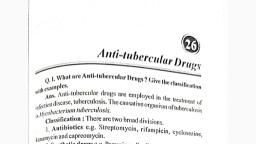
www.pharmanotes.org, , Chapter – 4, Anti-Tubercular Drugs, Tuberculosis or T.B. (Tubercle bacillus) is an infectious disease caused by various strains of mycobacterium usually, mycobacterium tuberculosis. Tuberculosis usually attacks the lungs but can also affect other parts of the body. The, classic symptoms are a chronic cough with blood-hinged sputum, fever, night-sweats and weight loss. The drug used, for the treatment of tuberculosis is called as anti-tubercular drugs. Treatment is difficult and requires long courses of, multiple antibiotics. Social contacts are also screened., CLASSIFICATION, 1) P-amino salicylic acid(PAS) and Analogues, Ex: P-amino salicylic acid (PAS), 2) Pyridine derivatives, Ex: Isoniazid(INH), Ethionamide, 3) Pyrazine derivatives, Ex: Pyrazinamide, 4) Ethylene diamine derivatives, Ex: Ethambutol, 5) Antibiotics, Ex: Rifampicin, Streptomycin, Cycloserine, , ISONIAZID, , ETHAMBUTOL, , Pyridine-4-Carbohydrazide, , (+)N.N’-Bis{(R)-1-hydroxymethyl, propyl}ethylenediamine, , P-AMINO SALICYLIC, ACID, , PYRAZINAMIDE, , Pyrazine-2-Carboxamide, , 4-amino,2-hydroxy, benzoic acid, , Page 11 of 57
Page 12 :
www.pharmanotes.org, , Properties, , Isoniazid, , P-amino salicylic, acid(PAS), , Ethambutal, , Pyrazinamide, , Physical, Properties, , White crystalline powder,, odourless and sweet taste, followed by bitter taste. It is, soluble in water., , Yellowish white, crystal acidic taste,, soluble in dilute nitric, acid., , White crystalline, powder, odourless and, freely soluble in water., , White crystalline, powder, odourless, bitter, taste and soluble in, ether and chloroform., , Stability and, storage, , Affected by light. Hence, stored in tightly- closed light, resistant containers., , Affected by air and, light. Hence stored in, tightly- closed light resistant containers., , Stored in tightly closed, containers., , Stored in tightly -closed, containers., , Formulations, , ISsoniazid Elixir, Isoniazid, tablet, Isoniazid injection, , Amino salicylic acid, tablet, Amino salicylic, acid capsule, , Ethambutal tablet,, Ethambutal powder, , Pyrazinamide tablet, , Brand Names, , Cadizide, isonex, Rimpazid,, Isocadipas, , Idipas, Isopar,, Benzapas, , Albutol, Ly- boytol,, Myambutol, , Zinamide, Pyride,, Pyrina-500, , It is used in the treatment of, a) Pulmonary, tuberculosis, b) Extrapulmonary, lesions, c) Lupus vulgaris, , Treatment of, tuberculosis in, combination with, Isoniazid and, Streptomycin, , Treatment of, tuberculosis, , Treatment of, tuberculosis, , Uses, , Page 12 of 57
Page 16 :
www.pharmanotes.org, , COTRIMOXAZOLE is a mixture of five parts of Sulphamethoxazole and one part of Trimethoprim. Sulphamethoxazole and, Trimethoprim are bacteriostatics and when given alone bacterial resistance developed and needed higher dose produce, toxic affects like Crystaluria.When combinations of these two drugs are given the antimicrobial activity was increased., Cotrimoxazole is used in the treatment of, a) Genito-urinary tract infection, infections, , b) Respiratory tract infection ( bronchitis, pneumonia ) c) Meningitis d) Enteric, , Brand name: Septran, Ciplin, Formulations: Cotrimoxazole tablet (480mg), Cotrimoxazole Injection. , Cotrimoxazole mixtures, , Properties, , Sulphacetamide, , Sulphadaizine, , Sulphguanidine, , Physical, Properties, , White or Yellowish crystalline, powder, odourless and slightly, soluble in aqueous alkaline, solution and dilute mineral acids, , White or Yellowish crystalline, powder, odourless and slightly, soluble in aqueous alkaline, solution and dilute mineral acids, , White or Yellowish crystalline, powder, odourless and slightly, soluble in aqueous alkaline, solution and dilute mineral acids, , Stability, and Storage, , Affected by heat and air. Hence, they are stored in a tightly- closed, light- resistant containers., Eye drops, Eye ointments, , Affected by heat and air. Hence, they are stored in a tightlyclosed light- resistant containers., Tablet, Injection, , Affected by heat and air. Hence, they are stored in a tightly- closed, light- resistant containers., Tablet, , To treat eye infection, , Treatment of meningitis,, Treatment of UTI, , Treatment of local intestinal, infection, , Different, Formulation, Uses, , Page 16 of 57
Page 17 :
www.pharmanotes.org, , Chapter -7, Anti-malarial Drugs, Malaria is a disease caused by parasite protozoa which belong to the genus Plasmodium, transmitted through the bite of, female anopheles mosquito. Four plasmodium species responsible for causing malaria in human being are P.falciparum,, P.ovale, P.vivax and P.malariae., The characteristic symptoms of malaria are chills, fever, and sweating and body pain. Anti-malarial are the drugs which, prevent or cure malaria., , CLASSIFICATION, 1) Cinchona alkaloids, Ex: Quinine, 2) 4-amino quinolines, Ex: Chloroquine, amodiaquine, 3) 8-aminoquinolines, Ex: Primaquine, 4) Acridines, Ex: Mepacrine, 5) Biguanidines, Ex: Proguanil, 6) Pyrimidine derivatives, Ex: Pyrimethamine, Trimethoprim, 7) Miscellaneous, Ex: Prontosil, Mefloquine, Dapsone, , Page 17 of 57
Page 18 :
www.pharmanotes.org, , Properties, Physical, properties, , Quinine, , Chloroquine, , Pyrimethamine, , Yellow crystalline powder,, odourless, bitter taste, soluble, in alcohol, dil. Acids, , White crystalline powder,, odourless, bitter taste, soluble in, water, , White crystalline powder,, odourless, tasteless, soluble in, mineral acid., , Stability and, storage, , Affected by light. Hence it is, stored in well -closed lightresistant containers, , Affected by light. Hence it is, stored in well -closed lightresistant containers, , Affected by light. Hence it is stored, in well -closed light- resistant, containers, , Formulation, , Quinine tablet, Quinine, injection, , Chloroquine tablet, Chloroquine, injection, , Pyrimethamine tablet,, Pyrimethamine injection, , Brand name, , Vigotab, Larigo, , Ciplaquine, Nivaquine, , Pyralfin, Daraprim, Onli-2, , a) To treat severe and, complicated malaria caused by, plasmodium falciparum., b) To treat cerebral malaria, c) To relieve muscle cramps, , a) To suppress and cure malaria, b) To treat amoebic hepatitis, c) To treat rheumatoid arthritis, , To treat malaria, , Uses, , WWW.PHARMANOTES.ORG, Page 18 of 57
Page 20 :
www.pharmanotes.org, , Chapter - 9, Anti- Fungal Agent, Disease caused by fungus is known as mycosis. Mycoses are common and a variety of environmental and physiological, conditions can contribute to the development of fungal diseases. People are at risk of fungal infections when they are taking, strong antibiotics for a long period of time because antibiotics kill not only damaging bacteria, but healthy bacteria as well., This alters the balance of microorganisms in the mouth, vagina, intestines and other places in the body, and results in an, overgrowth of fungus., Individual with weakened immune systems are also at risk of developing fungal infections. This is the case of people, with HIV/AIDS, people under steroid treatments, and people taking chemotherapy. People with diabetes also tend to develop, fungal infections., Mycoses are classified according to the tissue levels initially colonized, 1 Superficial mycoses:- Superficial mycoses are limited to the outermost layers of the skin and hair, 2 Subcutaneous mycoses:- Subcutaneous mycoses involve the dermis, subcutaneous tissues, muscle and fascia., 3 Cutaneous mycoses:-Cutaneous mycoses extend deeper into the epidermis, and also include invasive hair and nail, diseases., 4 Systemic mycoses due to primary pathogens:- Systemic mycoses due to primary pathogens originate primarily in, the lungs and may spread to many organ systems, 5 Systemic mycoses due to opportunistic pathogens:-Systemic mycoses due to opportunistic pathogens are infections of, patients with immune deficiencies, who would otherwise not be infected. Examples of immunocompromised conditions, include AIDS, alteration of normal flora by antibiotics, immunosuppressive therapy, and metastatic cancer., Anti fungal agents are used to treat variety of fungal infections. Some of antifungal agents are active orally while others are, mostly applied in the form of ointments, creams, liniments, lotions, suspension etc, CLASSIFICATION OF ANTI-FUNGAL DRUGS, 1 Topical antifungal agents:-, , Ex: Nyastatin, Hamycin, Tolnaftate, , 2 Systemic antifungal agents :-, , Ex: Griseofulvin, Amphotericin-B, , 3 Official fatty acid:-, , Ex: Undecylenic acid, , Page 20 of 57
Page 21 :
www.pharmanotes.org, , Chapter -10, Anti-Neoplastic Agents, Anti-neoplastic agents are the medical term for cancer or tumour. Cancer is defined as a rapid proliferation of abnormal cell of, any tissue, leading to the dearrangment of normal body functions. Cancer is not a disease but a group of diseases affecting, different organs and system of the body., A cancer cell arises from mesodermal cells (which form bone, muscles, cartilages and tissues) is called sarcoma, and if it, arises from endoderm cells (which form intesti8nal system and its associated organs) and ectoderm cells (which form skin,, and appendages and nerve tissue) is called carcinoma. Leukemia and polycythemia are the types of blood cancer., The agent which causes cancer is known as carcinogenic agents., Cancer is more difficult to cure than bacterial infections. The drugs which are used in the treatment of cancer is known as, anticancer drugs. The therapy which is utilized today is use of ionizing radiation, surgery and use of chemotherapeutic, agents., CLASSIFICATION OF ANTI-CANCER DRUGS, 1 Alkylating agents:-, , Ex: Chlorambucil, Busulfan, Melphalan, Decarbazine, , 2 Antibiotics:-, , Ex: Actinomycin-D, Mitomycin-C, Daunorubicin, , 3 Antimetabolite agents:- Ex: Methotrexate, Mercaptopurine, Azothiopurine, 5-Flurouracil, 4 Hormones:-, , Ex: Promostanalone Propionate, Androgens, Estrogens, Progestins, , 5 Plant products:-, , Ex: Vincristine, Vinblastine, , 6 Enzymes:-, , Ex: L-Asparginase, , 7 Miscellaneous:-, , Ex: Hydroxyurea, , Page 21 of 57
Page 22 :
www.pharmanotes.org, , Chapter - 11, Narcotic Analgesics, Narcotic agents are potent analgesics which are used to relieve moderate to severe pain. Analgesics are selective central, nervous system depressants used to relieve pain. The term analgesic means "without pain". Even in therapeutic doses,, narcotic analgesics can cause respiratory depression, nausea, and drowsiness. Long term administration produces, tolerance, psychic, and physical dependence called addiction., The first narcotic analgesic discovered was morphine, which was isolated from opium. Morphine is used :, a) For control of moderate to severe pain, d) To treat diarrhoea, CLASSIFICATION, , b) To suppress cough c) As a pre-anesthetic medication, STRUCTURE, , 1) Naturally occurring:, a) Morphine and its analogues, Ex: Morphine, Codeine, 2) Totally Synthetic drugs:S, a) Morphinan analogues, Ex: Levorphanol, b) Benzomorphan analogues, Ex: Pentazocin, c) 4-phenylpiperidine analogues, Ex: Pethidine, d) Phenyl propylamine analogues., Ex: Methadone, Page 22 of 57
Page 23 :
www.pharmanotes.org, , Properties, , Pethidine, , Physical, Properties, , White crystalline powder, odourless, bitter taste, soluble in water, alcohol and chloroform., , Storage and, Stability, , Affected by light. Hence it is stored in well - closed light - resistant containers., , Formulaton, , Pethidine injection, Pethidine tablet., , Brand names, , Pathilorphan, pethanol; Algil, Alodan, Dispadol, Dolantin, , Uses, , It is used:, a) To relieve moderate to severe pain (spastic condition of intestine, uterus, bronchi, urinary, bladder), b) As apre-anaesthetic medication, c) As an obstetrical analgesic ( analgesic during labour), , WWW.PHARMANOTES.ORG, Page 23 of 57
Page 24 :
www.pharmanotes.org, , Chapter - 12, Antipyretics Analgesics, Pyrexia is a condition where body temperature has been raised above normal. The rise in temperature may be due to, infection or other diseases. The drugs which lower the raised (elevated) body temperature and bring it to normal are called, antipyretics., The drugs which relief from low intensity pain is called analgesic. Most of the drugs having both analgesic and antipyretic, activities. Antipyretic analgesic are also called febrifuges or non narcotic analgesic, CLASSIFICATION, 1) Aniline and P-amino phenol derivatives, Ex: Acetanilide, Paracetamol, 2) Salicylic acid derivatives, Ex: Aspirin, 3) Pyrazole derivative, Ex: Analgin, Antipyrin, , Page 24 of 57
Page 25 :
www.pharmanotes.org, , Properties, , Paracetamol, , Aspirin, , Physical Properties, , White crystalline powder, odourless,, bitter taste, soluble in alcohol, , White crystalline powder, odourless, bitter taste,, slightly soluble in water and freely soluble in, alcohol, , Stability and storage, , It is stored in well - closed light - resistant, containers, , Stable in air but slowly hydrolysed in presence of, moisture. Hence stored in tightly closed, containers, , Formulation, , Paracetamol tablets Paracetamol Elixirs, , Aspirin tablets Aspirin dispersible tablets, , Brand name, , Crocin, Calpol, Metacin, Dolo, , Disprin, Sprin, , Uses, , It is used as, a) Antipyretic, b) Analgesic, c) Antirheumatic, , a) Used to relieve from mild to moderate pain, like body pain, headache and toothache., b) To treat gout, , WWW.PHARMANOTES.ORG, Page 25 of 57
Page 28 :
www.pharmanotes.org, , Chapter - 14, Sedatives and Hypnotics, Sedatives are the drugs which depress central nervous system and used in relief of tension, anxiety and restlessness., Hypnotics are the drugs which depress central nervous system and produce sleep resembling like natural sleep. They are, used to overcome insomnia (sleeplessness)., CLASSIFICATION, 1) Barbiturate, a) Long acting barbiturate (6 hrs or more), Ex: Barbitone, Phenobarbitone, b) Intermediate barbiturate (3 to 6 hrs), Ex: Butabarbitone, c) Short barbiturate (less than 3 hrs), Ex: Cyclobarbitone, d) Ultra short barbiturate (1/2 to 1 hrs), Ex: Thiopentone sodium, 2) Non-Barbiturate, a) Benzodiazepine, Ex: Nitrazepam, Diazepam, b) Amides and imides, Ex: Glutethemide, methyprylone, c) Alcohol and its derivatives, Ex: Triclofos sodium, d) Aldehyde and derivatives, Ex: Paraldehyde, e) Miscellaneous, Ex: Bromides, Promethazine,, Diphenhydramine, , PHENOBARBITONE, , GLUTETHEMIDE, , α-ethyl, α-phenyl glutarimide, , Page 28 of 57
Page 29 :
www.pharmanotes.org, , Properties, , Phenobarbitone, , Physical Properties White crystalline powder, odourless, bitter, taste and soluble in alcohol, Stability and, storage, , Formulations, , Brand Names, Uses, , Glutethemide, White powder, odourless and bitter taste, , It is a stable compound. Hence stored in well - Affected by air, moisture and light. Hence it is stored, closed containers., in tightly - closed light - resistant containers., Phenobarbitone tablet,, Phenobarbitone capsule,, Phenobarbitone elixirs,, Phenobarbitone injection, , Glutethemide Tablet,, Glutethemide Capsule, , Gardenal, Phenytal, , Doriden, , a) Used as sedatives and hypnotics., b) Used to treat grandmal and, psychomotor epilepsy., c) Used to treat Neonatal jaundice., , Used as sedative and hypnotics, , WWW.PHARMANOTES.ORG, Page 29 of 57
Page 31 :
www.pharmanotes.org, , Properties, , Caffeine, , Nikethamide (Coramine), , Physical Properties, , White crystalline powder, odourless, bitter, taste, soluble in water, , Slightly yellow oily liquid, faint aromatic odour and, slightly bitter taste. It is miscible with water, alcohol, and ether., , Stability and storage, , It is decomposed by strong solution of caustic, alkalies, its salt are decomposed by water., Hence it is stored in tightly - closed containers., Label should bear whether it is anhydrous or, monohydrate., , Formulation, , Aspirin and caffeine tablets,, caffeine and sodium benzoate tablet,, caffeine citrate tablet,, caffeine iodine tablet, , Brand Names, , Anacin, coldarin, Powerin, , Uses, , 1) It is C.N.S stimulant and it is used:, a) To enhance mental activity., b) To get relief from fatigue and mild, depression., c) To cause insomnia in moderate dose., 2) It has mild diuretic activity., 3) It is generally given in combination with, aspirin or codeine for analgesic activity., 4) It also stimulates respiratory centre., , It is affected by light. Hence stored in tightly closed light - resistant containers., , Nikethamide injection, , Coramine, Nikethyl, It is used as respiratory stimulants., , Page 31 of 57
Page 33 :
www.pharmanotes.org, , Properties, , HALOPERIDOL, , CHLORPROMAZINE, , DIAZEPAM, , Physical, properties, , Yellowish white microcrystalline, powder, odourless, tasteless,, soluble in alcohol., , White or cream coloured powder, with slight odour, bitter taste,, soluble in water and alcohol., , Yellowish white crystalline powder,, odourless, tasteless, soluble in, water, alcohol., , Stability and, storage, , Stored in well closed containers Affected by light. Hence it is, stored in well -closed lightresistant containers, , Affected by moisture and light., Hence it is stored in well -closed, light- resistant containers, , Formulation, , Haloperidol tablet, Haloperidol, injection, Haloperidol capsules,, Haloperidol elixir, , Chlorpromazine tablet,, Chlorpromazine injection,, Chlorpromazine elixir, , Diazepam tablet, Diazepam, injection, Diazepam capsules,, Diazepam elixirs, , Brand name, , Halidol, Trancodol, , Copamide, Largactil, Chlorozine, , Calmpose, Sedanite, , 1) It is a major tranquilliser and, used to treat acute, schizophrenia, mania,, hypomania, behavioural, disturbances, severe anxiety,, and childhood development, disorders., 2) It is an antiemetic (to control, nausea and vomiting), , 1) It is used to treat acute, schizophrenia, mania,, hypomania., 2) It is an antiemetic (to control, nausea and vomiting), 3) It has local anaesthetics, property., 4) It also reduces salivary and, gastric secretion., 5) It is a vasodilator, , It is used:, 1) For management of anxiety and, tension states., 2) For management of acute, alcoholic withdrawal, 3) As an adjunct for relief of skeletal, muscle spasm, 4) Parenterally,, a) to treat epilepsy, b) to produce sedation, c) to treat excitation states, , Uses, , Page 33 of 57
Page 34 :
www.pharmanotes.org, , Chapter - 17, Anti depressants, Antidepressants are the drugs which counteract or overcome mental depressant. These drugs are therapeutically useful in, variety of cases pertaining to mentally ill patient. It is believed that mental depression occurs due to disturbance in the level, of biogenic amines. Antidepressant drugs counteract mental depressant by balancing these amines in the brain., CLASSIFICATION, , STRUCTURE, , 1 Typical tricyclic antidepressants, a) Iminodibenzyl derivatives:- Ex: Imipramine, b) Dibenzoxepines:- Ex: Doxepine, c) Benzocycloheptanes and related compounds:- Ex:, Amitriptyline, nor-triptyline, , 2 MAO Inhibitors, a), b), •, •, , Hydrazides:- Ex: Phenezine, Non-hydrazides:Cyclopropylamines:- Ex: Tranylcypromine, Sympathomimetics:- Ex: Dextramphetamine, 3 A typical antidepressants:Ex: Dibenzipine, Iprindole, 4 Miscellaneous:, a) Β-adrenoreceptor agonist:- Ex: Salbutamol, b) Thyrotropin:- Ex: Thyrotropin-ReleasingHormone (TRH), , Stability and storage: Affected by light. Hence stored in, tightly – closed, light – resistant containers., Uses: It is used to treat:, a) Depressive illness, b) Anxiety disorders, c) Nocturnal enuresis in children, d) hyperactivity and attention deficit, e) Catalepsy, f) Allergic conjunctivitis, , Page 34 of 57
Page 36 :
www.pharmanotes.org, , Properties, , Physical properties, , Stability & Storage, , Uses, , Diethyl ether, , Cyclopropane, , Halothane, , It is a colourless liquid,, characteristics odour, and, sweet burning taste. It is very, volatile and inflammatory and, forms explosive mixture with, air., , It is a colorless inflammable gas, having characteristics odour. It is, a inflammable and form, explosive mixture with air., , Colorless mobile liquid slightly, soluble in water. It is non, inflammable and does not form, explosive mixture with air., , It is oxidized with atmospheric, oxygen and it is affected by, light. Hence it is stored in a, tightly - closed, light resistant container in a cool, place and label should bear:, a) Very inflammable, b) Do not use near open, flame or heat source., c) Name and proportion, of stabilizer., , It is stored in metal cylinder, designed to hold compressed, gases and kept in a cool room, free from inflammable material., The whole cylinder is painted, orange and should be stenciled, with the name of symbol {C3H6}., , It is decomposed slowly or, exposure to light. It is also, affected by air in presence of, mixture it attack lead, glass,, aluminium, but not cooper,, plastic, rubber., Hence it is tightly closed in a, light resistant container., , Used as general anesthetic., , Used as general anesthetic., , Used as general anesthetic., , WWW.PHARMANOTES.ORG, Page 36 of 57
Page 37 :
www.pharmanotes.org, , Chapter - 19, Local Anesthetics, These are drugs which produces reversible loss of sensation in limited area when applied, without loss of consciousness., They act by blocking the conduction of sensory nerve impulse near to the site of their application or injuries. Local, anesthetics are used for temporary relief of pain in surgical procedure dental manipulation and injuries., CLASSIFICATION, 1) Ester, a) Ester of benzoic acid., Ex: cocaine, b) Ester of Para ammonia benzoic acid, Ex: procaine, benzocaine., 2) Amides, a) Anilide amides, Ex: xylocaine (Lidocaine or Lignocaine), b) Non – anilide amides, Ex: chinchocaine, 3) Miscellaneous, Ex: phenol, eugenol, benzyl alcohol., , STRUCTURE, PROCAINE, , 2-diethylamino ethyl,4-amino benzoate, , LIGNOCAINE (LIDOCAINE OR XYLOCAINE), , N-diethylamino acetyl 2,6-xylidine, , Page 37 of 57
Page 38 :
www.pharmanotes.org, , Properties, , Procaine, , Lignocaine, , Physical properties, , White crystalline powdered, odourless and, bitter in taste. It is freely soluble in alcohol, and H2O., , White crystalline powder bitter in taste soluble, in H2O and alcohol., , Stability and storage, , Aqueous solution is most stable at pH 3.5., Hence it is stored in well - closed light resistant containers., , It is very stable compound. Hence stored in a, well closed container., , Formulation, , Procaine and adrenaline injection., , Lignocaine injection, Lignocaine gels,, Lignocaine eye drops., , Brand name, , Novocaine, planocaine., , Otek, Otosil, Trox., , Uses, , a) Used as a local anaesthetics., , b) Used as a local anaesthetics., c) It is also used for prevention and, treatment of cardiac arrhythmias., , WWW.PHARMANOTES.ORG, Page 38 of 57
Page 39 :
www.pharmanotes.org, , Chapter - 20, Coagulant, Coagulants: These are the substances which promote coagulation and are indicated in the treatment of severe hemorrhagic, conditions., Examples: Thrombin, Menadione, THROMBIN, MENADIONE, It is a sterile protein substances prepared from human plasma, and is freeze dried. Thrombin is affected by air heat and light., Hence it is a stored in the atmosphere of nitrogen in glass, container which is sealed so as to prevent from micro, organisms and moisture. The container kept at a, temperature2 – 8OC and protected from light., Uses : It is used as an coagulant:, a) Topically to control mirror bleeding , due to, superficial cut and injuries., b) Orally to prevent gastro intestinal bleeding., , USES OF MENADIONE: it is used, a) To treat haemorrhage due to excessive dosing with, anticoagulant., b) To prevent and cure of neonatal haemorrhage., c) To treat vitamin K deficiency., As radiosensitiser to treat cancer., , Page 39 of 57
Page 40 :
www.pharmanotes.org, , Chapter - 21, Anti- Coagulant, Anticoagulants are the drugs used to reduce the coagulation of blood. Anticoagulant agents are usually administered patient, with acute myocardial infarction and the one undergoing treatment of pulmonary and venous thrombosis., CLASSIFICATION, a) Parentral anticoagulant, Ex: Heparin, b) Oral anticoagulant, Ex: warfarin sodium, phenindione., HEPARIN is a mixture of mucopolysaccharides of molecular weight ranging from 3000 to 40000., Source: Lung of intestinal mucosa of ox, pig or sheep., Stability & storage: The aqueous solutions are stable for at least 7yrs at pH 7 to 8. It is stored in sealed container to, protect from microorganisms and moisture, Formulations: Heparin injection., Brand name: Beparine., Uses: To prevent post operative deep venous thrombosis., To prevent clotting during open heart surgery., WARFARIN SODIUM: is a oral anticoagulant., Properties: warfarin is odourless and has bitter tast,e soluble in alcohol and water., Stability & storage: warfarin is discoloured by light and air. Hence it is stored in tightly closed light resistant container., Formulations: warfarin tablet., Brand name: sofarin, Uses: To prevent post operative venous thrombosis., To prevent myocardial infractions., Used as rodenticides., , Page 40 of 57
Page 41 :
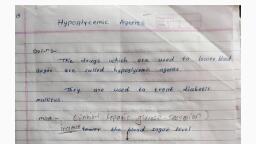
www.pharmanotes.org, , Chapter - 22, Hypoglycemic Agent, Hypoglycemic agents are the drugs which are used to lower the blood sugar level. They are used to treat diabetes, mellitus. Diabetes mellitus is characterized by persistant hyperglycemia, usually with glucosuria. The different factors, involved in its origin are hereditary, immunological, age, stress etc., during which either endogenous insulin secretion is, reduced or action of insulin is opposed. Diabetes mellitus is divided into following types:, Type I: Insulin dependent diabetes mellitus (IDDM)., Type II: Non Insulin dependent diabetes mellitus (NIDDM)., Type III: Malnutrition related diabetes mellitus (MRDM)., Type IV: Secondary diabetes due to certain pancreatic or certain genetic syndrome., CLASSIFICATION, 1) Hormones (Insulin and its preparation), a) Short acting: - Ex: Plain Insulin, Insulin zinc, suspension., b) Intermediate acting: - Ex: Globin zinc insulin, Isophane insulin, Insulin zinc suspension., c) Long acting: - Ex: Protamine zinc insulin, Insulin, zinc suspension., d) Newer Insulin:- Ex: Nuso, Actrapid, monotard, 2) Oral Hypoglycemic agents, a) Sulfonyl ureas, • First generation: - Ex: chlorpropamide., • Second generation :- Ex: Glibinclamide,, Glipizide, b) Biguanides:- Ex: Metformin, Phenformin, , CHLORPROPAMIDE, , 1-(P-chlorobenzene sulphonyl), 3-propyl urea, , PHENFORMIN, , 1-(2-phenyl ethyl) biguanide, , 3) Plant product :- Ex: Guargum, , Page 41 of 57
Page 42 :
www.pharmanotes.org, , Insulin: insulin is a hormone produced by beta cells of islets of langrehans. It is a polypeptide containing 51 amino, acids arranged in 2 chains namely A & B having 21 & 31 amino acids connected each other by two disulphide bridge., Insulin commonly obtained from pancreas of pig or ox., Properties: It is a white powder. It is slightly soluble in water, but soluble in dilute solutions of mineral acids. It is, inactivated by proteolytic enzymes., Stability & storage: Insulin is sensitive to heat & light and hence it is stored in well closed containers at a temperature, below 8oC ., Formulation: Insulin injection, Globin zinc insulin Injection, protamin zinc insulin injection, Isophane insulin injection ., Uses: To treat insulin dependent diabetes mellitus (IDDM), to treat diabetic coma., , Oral Hypoglycemic agents: Hypoglycemic agents are the drugs which lower the blood glucose level on oral, administration. Ex: chlorpropamide, glipizide, Phenformin., Classification of oral hypoglycemic agents:Oral hypoglycemic agents, a) Sulfonyl ureas, • First generation: - Ex: chlorpropamide., • Second generation :- Ex: Glibinclamide, Glipizide, b) Biguanides:- Ex: Metformin, Phenformin, , Page 42 of 57
Page 43 :
www.pharmanotes.org, , Properties, , Chlorpropamide, , Phenformin, , Physical properties, , White crystalline powdered, odourless and, tasteless. It is freely soluble in alcohol., , White crystalline powdered, odourless and, bitter taste. It is freely soluble in water and, alcohol., , Stability and storage, , It is stored in well closed containers., , It is stored in well closed containers., , Formulations, , Chlorpropamide tablet, , Phenformin tablet, , Brand name, , Diabetol, Diabetin., , Sucranase, Bislim., , Uses, , Used to treat:, a) Non Insulin dependent diabetes, mellitus (NIDDM)., b) Mild to moderate diabetes insipidus., , Used to treat non Insulin dependent diabetes, mellitus (NIDDM)., , WWW.PHARMANOTES.ORG, Page 43 of 57
Page 46 :
www.pharmanotes.org, , Properties, , Frusemide, , Hydrochlorthiazide, , Mannitol, , Urea, , Physical, properties, , White crystalline, powder, odourless, bitter, taste, soluble in water., , White crystalline, powder, odourless,, bitter taste, soluble in, water., , White crystalline powder, odourless, sweetish, taste, soluble in water., , Colorless crystal,, odorless saline taste,, soluble in water., , Stabilty &, storage, , Affected by light. Hence, stored in a well closed, light resistance, container., , Stable compound., Hence stored in well, closed container., , Stable compound., Hence stored in well, closed container., , It is slightly hygroscopic,, affected by heat. Hence, it is stored in tightly, closed container in a, cool place., , Formulation, , Frusemide tablet ,, frusemide injection, , Hydrochlorthiazide, tablet, , Mannitol injection, , Urea injection, urea, cream., , Brand name, , Lasix , salurex, , Biduret, Esidrex, , Osmitrol, , Cotaryl- H, Trazine., , Use, , It is used, a) As a diuretic t, b) for the, management of, hypertension, , It is used, a) As a diuretic, b) for the, management of, hypertension, , It is used, a) As a diuretic, b) As a diagonist, agent, c) For irrigation of, bladder, d) As a diluents and, excipients, , It is used, a) As a diuretic, b) To treat dry skin, condition., c) To treat eczema., d) To treat skin, ulceration., e) To get relief from, vomiting and, headache., , Page 46 of 57
Page 48 :
www.pharmanotes.org, , Properties, , Diphenhydramine, , Chlorpheniramine, , Physical properties, , White crystalline powder, odorless, bitter, taste, soluble in water., , White crystalline powder, odorless, bitter, taste, soluble in water., , Stability & storage, , It darkens slowly on exposure to light and, hence stored in tightly closed light resistance, container., , It darkens slowly on exposure to light and, hence stored in tightly closed light, resistance container., , Formulation, , Diphenhydramine capsule ,, Diphenhydramine Elixir, , Chlorpheniramine Injection, Chlorpheniramine Elixir, , Brand name, , Benadryl, Caladryl, , Corex, Alergin, , Used to treat:, • Allergic skin reaction, • Motion sickness and post operative, vomiting., • Cardiac arrhythmia in combination, with antazoline, , Used to treat:, • Allergic skin reaction, • Motion sickness and post operative, vomiting., • Cardiac arrhythmia in combination, with antazoline, , Use, , WWW.PHARMANOTES.ORG, Page 48 of 57
Page 49 :
www.pharmanotes.org, , Chapter - 25, Diagnostic Agents, Diagnostic agents are the chemicals or substances that are used to detect abnormalities in tissues or organ or to test on, organs. These agents do not usually have any medical values or pharmacological effects; they are useful for the clinical, diagnosis of diseases. The diagnostic agent can be discussed under following heads:, A) Radiopaques (X-ray contrast media), Ex: Iopanic acid, Propyliodone, B) Agents used to treat organ functions:, a) To test kidney function, Ex: Indigotindisulphonate (Indigo caramine), b) To test liver function, Ex: Sulphobromophthalein sodium, c) Miscellaneous, Ex: Fluorescein sodium, Evans blue, Congo red, Iopanic acid, , Indigo caramine, , Evans Blue, , Properties: White or cream coloured, powder, odour less, tasteless., Stability and storage: Affected by light., Hence stored in well closed light resistant, containers, Formulations: Iopanic acid tablet, Uses: It is used as a contrast medium in, radiography of gall bladder., , Properties: Purpulish blue powder or, blue granules. It is sparingly soluble, in water., Stability and storage: Affected by, light. Hence stored in well closed light, resistant containers, Formulations: Indigo caramine, injection, Uses: to test kidney functions, , Properties: green or bluish green, powder, odour less, soluble in water., Stability and storage: In dry form it, is hygroscopic. Hence stored in a, tightly closed containers., Formulations: Evans blue injection, Uses: It is used as a diagnostic, agent to determine blood volume., , Page 49 of 57
Page 50 :
www.pharmanotes.org, , Chapter - 26, Steroidal Drugs, A steroid is a type of organic compound that contains characteristic arrangements of four cyclo alkane rings, that are joint, to each other. The three cyclohexane rings (designated as ring A, B, C) and one cyclopentane ring (designated as D). The, methyl group present at position number 13 and 10 is numbered as 18 and 14 respectively. 100 of different steroid are, found in the plants, animals and fungi such as, • Dietary fat: cholesterol, • Sex hormones: estradiol, testosterone, • Anti-inflammatory: dexamethasone, CHEMICAL CLASSIFICATION OF STEROID, BASIC STRUCTURE OF STEROIDAL DRUG, Class, , Examples, , Cholestanes cholesterol, , Cholanes, , cholic acid, , Number of carbon atoms, , 27, , 24, , Pregnanes progesterone, , 21, , Androstanes testosterone, , 19, , Estranes, , estradiol, , 18, , Page 50 of 57
Page 52 :
www.pharmanotes.org, , Properties, Physical properties, , Stability & Storage, , Formulations, , Adrenaline, Creamy white microcrystalline, powder, odourless, bitter, taste, soluble in mineral acids, and of alkali hydroxides., , Isoprenaline, White crystalline powder,, odourless, bitter taste, soluble in, water., , Ephedrine, White crystalline powder,, odourless, bitter taste, soluble in, water., , It contains catechol nucleus, which can be oxidized readily, with air or oxygen to get pink, or red coloured complex. It, darkens on exposure to light, and air. Hence it is stored in, tightly-closed light-resistant, containers., Adrenaline injection,, Adrenaline eye drops,, Adrenaline solutions, , It gradually darkens on exposure, to air and light. Presence of, metal also causes discolouration., Hence it is stored in tightlyclosed light-resistant container., , It gradually decomposes on, exposure to light. Hence it is, stored in tightly-closed lightresistant container., , Isoprenaline hcl injection, Isoprenaline aerosol inhalation,, Slow release isoprenaline tablets, ., Autohaler, Neo-epinine, , Ephedrine tablet,, Ephedrine nasal drops, Ephedrine elixir, ., , 1 It is mainly used to treat, bronchospasm in bronchial, asthma, , It is used to treat:, 1 asthma, , Brand name, , Medicreme, Inhalant, , Uses, , It is used:, 1 To relieve bronchial spasm, 2 To treat heart block, 3 To treat acute allergic, reaction( rhinitis, hay fever), 4 To control superficial, haemorrhage of nose and, throat, 5 With local anaesthetics, to, prolong local anaesthetic, effect., , 2 nocturnal enuresis in children, , 2 In emergency, it is used to treat, cardiotoxic shock states, heart, 3 nasal con, block or severe bradycardia, , Page 52 of 57
Page 55 :
www.pharmanotes.org, , Properties, , Neostigmine, , Physostigmine, , Physical properties, , Colourless crystals, odourless, bitter taste, and soluble in water., , Colourless crystals, odourless, soluble in, water., , Stability & storage, , It is affected by light and air. Hence stored, in tightly closed light resistance container., , It becomes pink on exposure to light and air., Hence stored in tightly closed light resistance, container., , Formulation, , Neostigmine tablet, Neostigmine injection, , Physostigmine Injection, Physostigmine eye drops, , Brand name, , Prostigmine, , Eserine with pilocarpine, , It is used:, • To treat myasthenia gravis, • To treat paralytic ileus., • For post operative urinary retention, • As muscle relaxants, , Used to treat:, • Glaucoma, • Psychiatric and neurologic disorders, • Poisoning with anticholinergic drugs, , Use, , WWW.PHARMANOTES.ORG, Page 55 of 57
Page 57 :
www.pharmanotes.org, , Properties, , Atropine, , Physical properties, , White crystalline powder,, White powder, odourless, bitter, odourless, bitter taste, soluble taste, soluble in water., in chloroform.., , White crystalline powder,, odourless, bitter taste, soluble in, chloroform., , It is affected by light. Hence it, is stored in tightly-closed, light-resistant containers., , It is hygroscopic. Hence it is, stored in tightly-closed container., , It is affected by light. Hence it is, stored in tightly-closed lightresistant containers., , Formulations, , Atropine injection,, Atropine eye drops,, Atropine sulphate tablet,, Atropine eye ointment., , Propantheline injection, Propantheline tablet, , Biperiden hcl tablet, Biperiden lactate injection, , Brand name, , Eumydrin, , Profanthine, , Akineton, , Uses, , It is used:, 1 To treat parkinsonism, 2 CNS stimulant in small dose, 3 As a mydriatic, 4 As an antispasmodic, 5 As apre-anaesthetic, medication, 6 to treat organ phosphorous, poisoning., , It is used:, 1 To treat gastric and duodenal, ulcers, 2 To treat intestinal hyper motility, 3 To reduce gastric secretions., 4 To control excessive sweating, and salivation, 5 To prevent nocturnal enuresis, in children, 6 To reduce biliary and ureteric, spasm., , It is used:, 1 To treat all types of, parkinsonism diseases, , Stability & Storage, , Propantheline, , Biperiden, , WWW.PHARMANOTES.ORG, , Page 57 of 57



 Learn better on this topic