Page 1 :
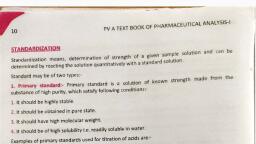
), , ea, , Pharmaceutical Analysis - | (SPPU), , 1-11 ,, 4. Volumetric analysis or titrametric analysis ; Introduction to Pharmaceutical Analysis, , 2., , Se, , Volumetric analysis is mi, leasurement of ‘, volume of solution of accurately known concentration required to react with unknow!, n, , sample solution. The measured volt i 01, ume is then used for the estimation qualitative and quantitati alysi i, ive analysis of sample solution., , Primary standard is also called as titrant. which highl 100., Y pure i.e 00 %, 0.01 to 0.02 % impurity is tolerable. Primary standard is, , is of unknown sample soluti i, WO etc ateaa, ple solutions to an extremely high, ao... if be stored for a very long period of time without changing their concentrations. Primary, other standards referred to as workin, : ig Standards. Standards are used i i i, primary standard is typically a reagent which can be weighed easily, eee, , used as a standard/reference substance to determine the concentration:, , the number of moles of substance contained. and which is so pure that its weight is truly representative of, ained. They should be not only stable to decomposition but also stable with regard to, , weight changes associated wi ini ; :, : ght ig oo Saining or losing water. Primary standards generally have high molar masses, and are relatively, inexpensive though this requirement is for economic reasons rather than chemical reasons., , Ideal Properties of primary standard substances are :, @) _It must be high pure i.e. 100.00 %, 0.01 to 0.02 % impurity is tolerable., , i) _ It should be not be hygroscopic. Neither easily oxidized, nor affected by CO,.The standard solution should maintain at its, exact composition during storage., , (ii) _ It must be stable at drying temperature i.e. the primary standard is always dried before weighing., (iv) It should be readily available., , (v) It should be an inexpensive., , (vi) It should have high equivalent weight. The relative error is small if weighting amount is greater., (vii) They should react completely with the sample solutions., , (viii) They should react in definite and unchanging proportions with.the analysing solutions., , (ix) The standard should be readily soluble and should give clear solution., , (x) _ It should react with indicator after equivalence point to determine end point of titration., , Some examples of primary standards are as follows :, , @_ Acid base titration :, Anhydrous sodium carbonate for acidic titration where as potassium hydrogen phthalate, benzoic acid for basic titration., , (i) _ Precipitation titration :, Sodium chloride and Silver nitrate., (iii) | Complexometric titration :, , Pure zinc, magnesium, manganese, lead nitrate salt., , (iv) " Redox titration :, , Potassium bromate, Arsenic trioxide, Sodium thiosulphate, Potassium dichromate, Potassium iodate, sodium oxalate., , Secondary standard : ), standards or titrate. A secondary standard is a solution that is not stable in its own form, and must, , ; They are also known as transfer, the solution of NaOH, , first be standardized before being used. It is prepared in the laboratory for a specific analysis. For example,, tandardized by using analytical grade potassium hydrogen phthalate and, , and HCl need to be standardized before use and are s, is standardized before use by using analytical grade sodium oxalate, , sodium carbonate as primary standard respectively. KMnO,