Page 1 :
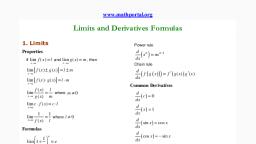
22, , Derivatives, Derivative or Differential Coefficient, The rate of change of a quantity y with respect to another quantity x is, called the derivative or differential coefficient of y with respect to x., , Differentiation, The process of finding derivative of a function is called differentiation., , Differentiation using First Principle, Let f ( x ) is a function, differentiable at every point on the real number, line, then its derivative is given by, d, f ( x + δx ) − f ( x ), f ( x ) = lim, f ′ (x) =, δx → 0, δx, dx, , Derivatives of Standard Functions, (i), (ii), (iii), (iv), (v), (vi), (vii), , d, ( x n ) = nx n − 1 , n ∈ R, dx, d, ( k) = 0, where k is constant., dx, d x, ( e ) = ex, dx, d, ( a x ) = a x loge a, where a > 0, a ≠ 1, dx, 1, d, (loge x ) = , x > 0, dx, x, d, 1, 1, , x> 0, (loga x ) = (loga e) =, dx, x, x loge a, d, (sin x ) = cos x, dx
Page 3 :
236, , Handbook of Mathematics, , d, (sinh−1 x ) = 1 / ( x 2 + 1), dx, d, (xxvi), (cosh−1 x ) = 1 / ( x 2 − 1), x > 1, dx, d, (xxvii), (tanh−1 x ) = 1 / (1 − x 2 ),|x|< 1, dx, d, (xxviii), (cot h−1 x ) = 1 / (1 − x 2 ),|x| > 1, dx, d, (xxix), (sec h−1x ) = − 1 / x (1 − x 2 ), x ∈( 0, 1), dx, d, (xxx), (cos ech−1x ) = − 1/|x| (1 + x 2 ), x ≠ 0, dx, (xxv), , Fundamental Rules for Derivatives, d, d, { cf ( x )} = c, f ( x ), where c is a constant., dx, dx, d, d, d, [sum and difference rule], (ii), f(x) ±, { f ( x ) ± g( x )} =, g( x ), dx, dx, dx, d, d, d, (iii), { f ( x ) g( x )} = f ( x ), g( x ) + g( x ), f(x), dx, dx, dx, (i), , [leibnitz product rule or product rule], , Generalisation If u1 , u 2 , u3 , ... , u n are functions of x, then, d, du , ( u1 u 2 u3 ... u n ) = 1 [u 2u3 ... u n ], dx , dx, du , du , + u1 2 [u3 ... u n ] + u1u 2 3 , dx , dx , du , [u 4u5K u n ] + K + [u1u 2 ... u n − 1 ] n , dx , d f ( x ), (iv), , =, dx g( x ), (v) If, , g( x ), , d, d, g( x ), f(x) − f(x), dx, dx, { g( x )} 2, , d, d, f ( x ) = φ ( x ), then, f ( ax + b) = a φ ( ax + b), dx, dx, , [quotient rule]
Page 4 :
Derivatives, , 237, , Derivatives of Different Types of Function, 1. Derivatives of Composite Functions (Chain Rule), If f and g are differentiable functions in their domain, then fog is also, differentiable, Also, ( fog)′ ( x ) = f ′ { g( x )} g ′ ( x ), More easily, if y = f ( u ) and u = g( x ), then, , dy dy du, ., =, ×, dx du dx, , Extension of Chain Rule, If y is a function of u , u is a function of v and v is a function of x. Then,, dy dy du dv, ., =, ×, ×, dx du dv dx, , 2. Derivatives of Inverse Trigonometric Functions, Sometimes, it becomes very tedious to differentiate inverse, trigonometric function. It can be made easy by using trigonometrical, transformations and standard substitution., Some Standard Substitution, S. No., , Expression, , (i), , a −x, , (ii), , a + x, , (iii), , x2 − a2, , 2, , 2, , Substitution, x = a sinθ or a cos θ, , 2, , x = a tanθ or a cot θ, , 2, , x = a sec θ or a cosec θ, , (iv), , a−x, or, a+ x, , (v), , a2 − x2, , (vi), , a + x, a −x, x −α, or (x − α) (x − β), β−x, 2, , (vii), , 2, , a+ x, a−x, or, , a sin x + b cos x, , x = a cos 2θ, , a2 + x2, 2, , x2 = a2 cos 2θ, , 2, , x = α cos2 θ + β sin2 θ, a = r cos α, b = r sinα, , 3. Derivatives of Implicit Functions, dy, of a function f ( x , y ) = 0, which can not be expressed in the, dx, form y = φ ( x ), we differentiate both sides of the given relation, dy, with respect to x and collect the terms containing, at one side and, dx, dy, ., find, dx, To find
Page 5 :
238, , Handbook of Mathematics, , 4. Derivatives of Parametric Functions, If the given function is of the form x = f ( t ), y = g( t ), where t is, parameter, then, dy , d, , g( t ), dy dt , g′ ( t ), =, = dt, =, d, dx dx , f ( t) f ′ ( t), , dt, dt , , Derivative of a Function with Respect to, Another Function, If y = f ( x ) and z = g( x ), then the differentiation of y with respect to z is, dy, dy dx, f ′ (x), =, =, dz dz g ′ ( x ), dx, , Logarithmic Differentiation, (i) If a function is the product or quotient of functions such as, f ( x ) f2( x ) f3 ( x )..., , we first take logarithm, y = f1( x ) f2( x )... fn ( x ) or 1, g1( x ) g2( x ) g3 ( x )..., and then differentiate it., (ii) If a function is in the form of [ f ( x )] g ( x ) , we first take logarithm, and then differentiate it., Note If { f ( x )} g( y ) = { g ( y )} f( x ), then, dy g ( y ) f ′ ( x ) f ( x )log g( y ) − g ( y ), =, ⋅, dx, f ( x ) g ′ ( y ) g ( y )log f ( x ) − f ( x ) , , Differentiation of Infinite Series, Sometimes, the function is given in the form of an infinite series, e.g., y=, , f(x) +, , f ( x ) +... ∞ , then the process to find the derivative of such, , infinite series is called differentiation of infinite series., e.g. Suppose y = log x + log x + log x +... ∞, Then, y = log x + y ⇒ y 2 = log x + y, Now, differentiate it by usual method.
Page 7 :
240, , Handbook of Mathematics, , nth Derivative of Some Functions, (i), , nπ, , [sin ( ax + b)] = a n sin , + ax + b, 2, , dx, , (ii), , nπ, , [cos( ax + b)] = a n cos , + ax + b, 2, , dx, , (iii), (iv), (v), (vi), , dn, , n, , dn, , n, , dn, dx, , n, , dn, dx n, dn, dx n, dn, dx n, , (vii) (a), (b), , ( ax + b)m =, , m!, a n ( ax + b)m − n, ( m − n )!, , [log( ax + b)] =, , ( −1)n −1( n − 1)! a n, ( ax + b)n, , ( eax ) = a n eax, ( a x ) = a x (log a )n, dn, , dx n, dn, dx n, , [eax sin( bx + c)] = r n eax sin ( bx + c + nφ ), [eax cos ( bx + c)] = r n eax cos( bx + c + nφ ), , b, where, r = a 2 + b2 and φ = tan−1 , a, , Partial Differentiation, The partial differential coefficient of f ( x , y ) with respect to x is the, ordinary differential coefficient of f ( x , y ) when y is regarded as a, ∂f, or fx ., constant. It is written as, ∂x, Thus,, , f(x + h , y) − f(x, y), ∂f, = lim, ∂x h → 0, h, , Similarly, the differential coefficient of f ( x , y ) with respect to y is, or fy , where, , ∂f, f ( x , y + k) − f ( x , y ), = lim, ∂y k → 0, k, , ∂f, ∂y
Page 8 :
Derivatives, , 241, , e.g. If z = f ( x , y ) = x 4 + y 4 + 3xy 2 + x 2 y + x + 2 y,, ∂z, ∂f, or, or fx = 4x3 + 3 y 2 + 2xy + 1, ∂x, ∂x, [here, y is consider as constant], ∂z, ∂f, and, or, or fy = 4 y3 + 6xy + x 2 + 2 [here, x is consider as constant], ∂y, ∂y, , then, , Higher Partial Derivatives, Let f ( x , y ) be a function of two variables such that, , ∂f ∂f, both exist., ,, ∂x ∂y, , (i) The partial derivative of, , ∂f, ∂2 f, w.r.t. x is denoted by 2 or fxx ., ∂x, ∂x, , (ii) The partial derivative of, , ∂f, ∂2 f, w.r.t. y is denoted by 2 or fyy ., ∂y, ∂y, , (iii) The partial derivative of, , ∂f, ∂2 f, w.r.t. y is denoted by, or fxy ., ∂x, ∂y ∂x, , (iv) The partial derivative of, , ∂f, ∂2 f, w.r.t. x is denoted by, or fyx ., ∂y, ∂x ∂y, , Euler’s Theorem on Homogeneous Function, If f ( x , y ) is a homogeneous function of x , y of degree n, then, ∂f, ∂f, = nf, +y, x, ∂y, ∂x