Page 1 :
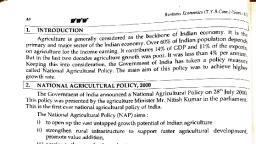
Q. Explain the role of agriculture in Indian economy., Unit 4.1 Role of Agriculture in Indian Economy, Agriculture sector plays an important role in Indian economy. Agriculture and, allied activities contributes higher GNP and direct and indirect employment. Major, proportions of the population depend upon agricultures for its livelihood Indian economy, is essentially a rural economy. India is a land of villages more than 70 percent of the total, population in India is living in villages. Since independence agriculture sector broken, their stagnation particularly after Green Revolution. We can witness the increase in area, under cultivation, rise in productivity and average production. As a primary sector,, agriculture has been playing different types of role as following., 1. Self sufficiency of food grains –, Agriculture is the source of food for millions of population It supplies, cereals and pulses, sugar edible oils, fruits and vegetables. Recently,, India achieves, the higher food grain capacity to cover maximum, requirement of huge population of India and now became self Sufficient, in production of food grains., 2. Providing large employment –, Near about 55 per cent at the working population is engaged in, agriculture. When we take into account the people who are indirectly, dependent upon agriculture it is more than three-fourths., 3. Share of National Income –, An average during 1960 to 2019 nearly 25 percent of total national, income comes from agriculture. The share of agriculture in India’s, national income has been decreasing till 17 percent recently. As, compared with the share of agriculture in the national income in, advanced countries, agriculture in India contributes very large amount in, national income., 4. Supplies of raw material –, Agriculture in India is considered to be mother of all industries. It, supplies essential raw materials to various industries like cotton textile,, jute, sugar and other processing industries like oil cursing, milk process,, rice, etc., 5. Major share in export –, Indian agricultural played a supreme role in the export trade for long, period of time. In traditional good export like tea, coffee, sugar tobacco, cotton, spices, and now export of vegetables and fruits. It contributes to, bring foreign reserves.
Page 2 :
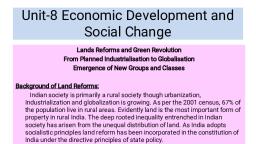
6. Source of Govt revenue., Agriculture is the main source of revenue for the Govt, especially for the, state Govt. Govt. gets a substantial income from land revenue and also, prosperity at the railways and other govt. undertakings., 7. Capital formation –, Agriculture sector is the primary source of domestic savings and growing, capital formation gradually, since independence large investment has, been made in agriculture by public and private sector., 8. Social and political contribution –, Agriculture in India has considerable social and political contribution., Agricultures to involve actively in India’s politics. They are the backbone, of society and work for social and political stability., Q. Discuss the features of land reforms in India, , 1.2 Land Reforms in India., Introduction:, At the eve of independence tenant system existed in agriculture. The term, ‘Tenant’ is related to land tenure which is used to refer to the terms and conditions on, which land is held or used. The system of agriculture exists as zamindari, rayatwari, (Ryotwari) and Mahalwari. The zamindari system was based on exploitation. Under the, Ryotwari and mahalwari system also the practice of cultivation by tenants became widly, exploited. After indepedance, there were need to abolish this system, so Govt. of India, introduced to legal provision by land reforms. As belowConcept of land reform –, The concept of land reforms aims at removing all these defects and the land reforms are, aimed following objectives., 1. To eliminate all forms of exploitation., 2. To give social justice within the agrarian system., 3. To remove such impediments to increase agriculture production the land reforms, policy in India has implemented as, Following, A) Abolition of Zamindari & Intermediaries., On the eve of independence near brut 57 percent area of the country was under, the zamindari system, in some states, legislation was passed for the abolition of, Zamindari system. If estimated that in all 62 laky acres of land was acquired from
Page 3 :
the intermediaries and consequent about 30 lakh tenants were brought into, direct relationship with the state. As per legislation, of Zemindari, compensation, was paid to the zamindares, Effects of Zamindari Abolitian:, i., ii., iii., , It has made revolutionary changes in the land system in the country., It has put an end to the exploitation of rural people, Since the land has gone to the tiller, land system becomes more, equitable., iv., The landlords have turned to trade and industry., B) Tenancy Reforms –, Under the Zamindari and ryatwari systems, tenancy, cultivation had been quite common in India. People who, had inadequate lands went on tenancy cultivation., Following measures taken for tenancy Reforms., i., The rate of rent of land fixed by Govt., ii., The security of Tenure will provide., iii., Tenancy reforms ultimately aim at conferring the right of ownership of land, on the tenants, iv., State Govt. has laid down compensation for permanent improvements of, land., v., Strictly prohibited future tenancy by legal provision., C) Ceiling on Holdings under land Reforms –, The main land reform that has been affected is the imposition of, ceiling on land holding which means placing the maximum limit on, the ownership and possession of land. If any individual possesses, land beyond the limit fixed, the surplus/excess land taken by the, Govt. and given justice to agrarian community. Which benefited as, following –?, i), ii), , Ceiling of holding helps to redistribute the land., The distribution of the land among landless helps to get, earning asset., iii), Ceiling on land holdings helps tenants., iv), Class conflict will be reduced considerably with the ceiling, of land holdings., D) Co-operative Farming –, Co-operative farming is an organization of the famers which came into, existence as a result of the conscious efforts to effect certain, socio-economic changes. It has used as a means to solve the problem of
Page 4 :
sub-division and fragmentation of holdings. In India, there are four types, of co-operative farming they are:, i), , ii), , iii), , iv), , Co-operative joint farming –, It is one in which the owners pool their land for, purposes of cultivation on a joint basis but the right of, the individual ownership of land is preserved, Co-operative collective farming –, It refers to a system where members compulsory, surrender their land along with cattle and equipment,, etc. work is common and no one has any right on land., Co-operative Tenant farming –, It is a system in which a society owns land, which is, divided into a number of small holdings. Each is divided, into a number of small holdings. Each of such small, holdings is then leased out to individual members of the, society., Co-operative Better farming –, It is one which all burners in village came together for, using improved methods of agricultural production., Every farmer is independent and retains this title to land., What is Economic Planning?, The concept of economic planning is broad. If is different, according to nature of country I.e. developed or, developing countries. In order to express the meaning of, economic planning., A.D Dickinson defined it is ‘Economic Planning is the, making of major economic decisions what and how, much is to be produced, when and where it is to be, produced and whom test is to be allocated by the, determinate authority with comprehensive survey., , Q. What is Green revolution? Examines its effects in Indian economy?, 4.3 Green Revolution, It’s impact on agricultural sector, Introduction and definition –, Green revolution is related is related agriculture production the term revolution, is used for structural changes of different fields. Green revolution in India refers to the
Page 5 :
technological changes in Indian agriculture by the development and use of high yielding, varieties of seeds, micro irrigation, and use of fertilizers. Plant protection and, mechanization of agriculture. Green revolution in India contributed for the, commercialization of agriculture; it contributed for increase of the agricultural output,, which leads for marketable surplus., According to Dr. M.S. Swamnathan the term Green Revolution using with, the growing practice of feeding plants better, crops are changing colour from light green, to dark green it means there are changes in quantity as well as quality., Green revolution refers in Indian agriculture as a result of the adoption of the, new agricultural strategy in 1964-65. This strategy aims at raising farm output through, the use of High-yielding varieties (HYV) of seeds, chemical fertilizers, pesticides,, implements and machinery, multiple cropping, irrigation facilities, agricultural credit, etc., Main Features of Green Revolution –, 1. HYV Program –, The high yielding varieties program has, accelerated the green revolution. Improved, strains of seeds are essential for increasing, agricultural, production., Particularly,, Hybridization technique for maize and millets, had been initiated during third plan. Hybrid, seeds began to be adopted during 1963. In, wheat a beginning of great importance was, made in 1963-64. The Govt. the infrastructure, for agricultural research and extension through, Agriculture University and colleges., 2. Multiple cropping –, Due to early maturing from of hybrid sees, it has, become possible to obtain two or three seasonal, crops in a year. The new multiple cropping plans, were taken up in 1967-68. It aims at the, development of short duration varieties of rice,, wheat, maize, Jawar, bajara, barly, oilseeds,, potato and vegetables for crop rotation., 3. Minor irrigation project –, Minor irrigation also constitutes an important, component of the new strategy of agricultural, development. It ensures better use of law and, ground water through multiple cropping
Page 6 :
2., , 3., , 4., , 5., , patterns. The additional area brought udder, minor irrigation increased considerately., 4. Use of fertilizers –, The increase in the consumption of fertilizers is, more significant. The per acre or hectare use of, fertilizers is widely accepted as one of the key, elements in the strategy for acerbating the, growth of agricultural output in short run. The, intensive cultivation brought a revolution in food, production while, massive increase in fertilizer, consumption per hectare in India is still much, lower than that of developed countries. But now, application of chemical fertilizer for both, commercial and food crops are common in India., 5. Plant protection – The use of pesticide is another, important aspect of green revolution. It leads to protect, the plants from various diseases. So agricultural output, goes up per hectare., 6. Modern Equipment and Machinery –, Modern machinery and implements like tractors, harvesters, pumping sets, tube wells, etc are, being increasingly used and are replacing the, use of bullock, wherever possible. It is being, time saving and help to multiple cropping., Minimum support prices –, The important aspect of the new strategy is the policy of support prices, for food grains and commercial crops. In 1965 the agricultural prices, commission and the food corporation of India were setup in pursuance, of this policy for the purpose of fixing prices of food grains., Processing, storage & Marketing facilities –, These facilities are being improved and extended so that the increase in, agricultural production is put to commercial use. It is easy, and time, saving processing machineries., Credit Facilities –, Farm finance is being given more attention so that the farmer is more, suitable to getting finance from institutional machinery. The share of, institutional credit in meeting the credit requirements of the agricultural, sector has rising rapidly., Farmers training & Education A pilot scheme for farmer’s training and education was started in, 1966-67. In five districts the scheme provided functional literacy, farm
Page 7 :
broadcasts and farmers training. In subsequent year, it was extended to, other districts., 6. Special programs –, The new strategy of agricultural development, which has led to the green, revolution in certain crops in India, was started as an intensive, Agricultural District Program (IADP) in 1960-61 In 1964-65 extend, program namely Intensive Agricultures Area program (IAAP) helps to, increase agriculture productivity., Impacts of Green Revolution on Agriculture., The green revolution has contributed much to the development of Indian, agriculture in recent year s. however, different opinions have been expressed as to, whether green revolution spared over country or not. So impact of green revolution can, classify in two sections., A) Passive impact., 1. Increase in production Green revolution increases the spread of carrying out operations and, agricultural work is completed in less time through modern techniques., So it leads to large increases in agricultural production., 2. Increase in labor productivityNew agriculture strategy helps in increasing labour productivity with the, consequence that less labour before is required to obtain same amount, of produce., 3. Transformation into commercial agriculture –, Introduction of High yielding varieties and mechanism such a use of, tractors and equipments leads the commercialization of agriculture. Due, to modern technology implication Indian agriculture transform, traditional to modern form., 4. Changing pattern of crops –, When Indian agriculture achieves the modernization, there are changing, cropping pattern, as well as land use pattern. Area under cultivation and, commercial crops has been increasing. Farmers grow various types of, crops and alternative use of crops method adopted at same extent., 5. To use of irrigation –, During green revolution period minor irrigation project have been billed, by Govt. so farmers used wells and tuber wells with large extent., Therefore, irrigation land has increased gradually. So farmers can, cultivate their land whole year and getting two or three crops., B) Negative Impact –
Page 8 :
1. Not suitable for small farmer –, Basically, Indian agriculture is divided in very small forms, due to small, holding size small and marginal farmer could not beneficiaries of green, revolution, 2. Big Investment required –, To use of modern technique of agriculture production have required big, initial investment. It can be possible to landlords or large farmers. Only, big farmers invest timely and get profit., 3. Lower productivity per hectare –, Same economists are of the view that mechanization does not lead to, greater productivity. As compared to developed countries per hectare, productivity of various crops are being very less. Where are as cost of, production comparably high., 4. Increase in regional inequality –, Just as farm modernization has responsible in increasing inequalities in, inter-personal income level, it was also responsible to inter-regional, disparities., 5. Increasing debt situation –, Since green revolution farmers try to invest more money which gets from, money lenders, Due to insufficient provision of institutional finance,, farmers bank crops, has been increasing, so farmer’s suicides problem, has risen., To sum up we may say, that in the present available situation, green revolution gave benefit as well as some defects are leads the, problem. Eventually, It can be remark that, green revolution has proved, to be success in some extent., Q. what are the problems agriculture labor suggest the agenda for improving the, condition of farm labor, , 1.4 Agriculture labour problems & suggestion., In order to understand the problem of agricultural labour and suggest agenda for, their improvement, it is necessary that we identity them by specific definition. In, view of the special features of agriculture, it is not possible to define agricultural, labour in precise term. However, it will be useful to refer to attempts made by, experts,, ●, , According to the first Agricultural labor Enquiry (1950-51), Those people are engaged in farm activities on payment of wages called, agricultural laboures.
Page 9 :
●, , According to second agricultural labour Enquiry (1956-57), This enlarged the definition. As people engaged agricultural activities as well as, allied activities such as, paltry farm, dairy farm and animal husbandry included, agricultural labours., Problems of agricultural labours., The following are the problems faced by the agricultural labours –, , Problems of farm labour, 1. Unorganized –, Agricultural labours are illiterate. They live in scattered villages. Hence,, they cannot easily be organized in union. Accordingly, it is difficult for, farm labors to bargain with the land owners and secure good labours to, bargain with the land owners and secure good wages., 2. Seasonal employment –, The agricultural labours do not have continuous work In an average a, farm labourer finds employments for about 180 days in year and rest at, period they became unemployment ., 3. Lack of mobility –, Due to illiteracy farm labourers do not have mobility to do the job in, substitute business. The absence of substitute opportunity of, employment they depends a seasonal farm activities., 4. Low wage rate –, The farm labours got very less payment as compared to industrial, unskilled labours. Even though, they could not earn minimum wage. The, minimum wage act has not implemented properly., 5. Indebtedness –, Agricultural labour is heavily –indebted. Normally, the farm labourers, borrow from the landlords under whom they work. Since they have no, security to offer without co-operation of land owners. So they ready to, work on low rate of wages., 6. bonded LaboursWhen farm labourers get advances from farm owners heavily. They could, not return payment long period. Therefore, whole family of labourers, works as a bonded labours and exploited not only economic but also, physically by landowners., Suggestions for improving the conditions of farm, Labourers –
Page 10 :
1. To abolish bonded labour system –, The abolition of banded labour and control of the activities of the money, lenders, strictly implementation is the one effective remedy to improve, the situation of landless laboures., 2. Better implementation of wage act –, Agricultural labourers have been getting very low wages except Kerala, and pan jab state. It is essential to implement the wage act as better and, efficiently., 3. Rehabilitations of farm labours –, In order to improve the conditions of agricultural labour, the landless, labours should be provided farm land, allot this can be done in many, ways. One way is the to allots. Reclaimed land to the,, 4. Improvement in Agriculture –, The agricultural labourers do not have full-employment because, seasonal nature of agriculture. It can be possible to apply the intensive, agriculture method to improvement of agriculture and the farmer’s, conditions. It would be helpful to farm laborers., 5. Public works program –, For the purpose of improving the wages and position of labourers it is, needed to proved substitute employment opportunity through public, work programs. The Govt. can prove employment by the project starts in, rural areas purposely. Such projects include. The constructions of roads,, digging and deepen of tanks and canals, etc., 6. Organization of farm labour co-operatives –, Till today there was no anyone farms labour co-operative in India. During, the plan period efforts were made to encourage the formation of labour, co-operatives but these exists in only Govt. works. The organization of, labour co-operative can leads to improve the position of landless, labourers., 7. Provides allied activates –, For the improvement of landless labours agriculture allied activates can, proved by Govt. schemes. Such as milk animals, poultry, sheep and, others self-business activities promotes for landless labours preferably., To sum up it may be remarked that agricultural labour, constitutes to poorest section of the rural population it can be possible, to focused the programs for improvement of farm labours separately., , 3.5 Of unit 3 Concept of S.E.Z., Special Economic Zone
Page 11 :
Special Economic Zones are especially duty free areas allotted to, be foreign investment for purposes of trade operation, duties and, tariffs. A scheme for setting up the SEZs in the country was, announced in the EXim Policy in Mar 2000 with the objectives of, developing integrated world-class infrastructure for export including, caring out manufacturing of goods and rendering of services., Components of SEZs include roads, airports, parts, transport system,, generation and distribution of power telecom, hospitals, hotels,, educational,, Institutions,, entertainment, units,, residential/industrial/commercial complexes, etc., The concept of special Economic Zones was given by People’s, Republic of chain which set up SEZ as early as in 1970 as a measure, to attract capital, technology, and managerial expertise, The Problems of SEZ’s, 1) Land Acquisition Acquisition of land has surfaced as the, biggest problem for setting up SEZ. The landholder’s organization, opposes to acquire land for SEZ. Severed state government, against land acquisition. The issue of land acquisition in the, name of promoting industrialization in totally depends upon, political will., 2) Social Movements obstacles - Social activist like media packer, have stressed the need to abolish the land acquisition Act 1894 it, is an outdated raw. In 2013 Govt. of India passed the land, acquisitive lands it totally infamous of farmers. Then Next Govt., has changed this low and amendment taken place. But there are, some queries to give protection of landholders., 3) Agriculture land for industrial use As, per, commerce, ministry figures, more than 1, 20,000 hectares of land will be, acquired by more than zoo SEZ projects across the country. As, the size of many SEZ is very large spared over hundreds of acres., 4) The issue of compensation –, An adequate compensation is, particularly difficult issue. There has been lot of resentment, among the farmers whose lands are proposed to be acquired for, setting up Seizes at a price determined y the Govt. which is very, less as compare to market price, 5) Displacement Compulsory acquisition of land for, public purpose including setting up SEZs and other infrastructure, projects displaces people foreign them to give up their homes as,, assets and means of livelihood, 6) Rehabilitation –, `, When Govt. land from people,, there no any provision to resettle affected people; many project, we not rehabilitee the displaced people.