Page 1 :
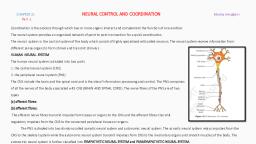
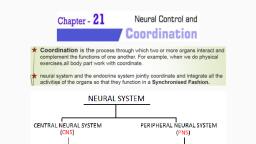
Second Semester B.Sc. Psychology- PSY2C01: Human Physiology –Nervous System, , THE NERVOUS SYSTEM, Nervous system is the major controlling, regulatory and communicating system, in the body. Nervous system controls all the activities of the body. It is quicker than, other control system in the body, namely endocrine system. Like other systems in the, body, Nervous system is composed of organs and cells, they are Brain, Spinal Cord and, Nerves (made up of neurons). Primarily, nervous system is divided into two parts. The, divisions of the nervous system are:, 1. Central nervous system, 2. Peripheral nervous system., Central nervous system (CNS), Central nervous system (CNS) includes Brain and Spinal cord. It is the site of, information processing and control. CNS is the supreme command centre of the body. It, is formed by neurons and supporting cells called neuroglia. Brain is situated in the, skull. It is continued as spinal cord in the vertebral canal through the foramen, magnum of the skull bone. Brain and spinal cord are enveloped and protected by three, layers of covering called meninges and a fluid inside which is called Cerebrospinal, fluid., Peripheral nervous system (PNS), Peripheral nervous system (PNS) is formed by neurons. The PNS comprises of all, the nerves of the body associated with the CNS. It consists of cranial nerves, arising, from brain and spinal nerves, arising from the spinal cord. The primary role of, the PNS is to connect the CNS to the organs, limbs, and skin. It is again divided into two, subdivisions:, 1. Somatic nervous system, 2. Autonomic nervous system., Somatic nervous system, Somatic Nervous System Somatic nervous system is concerned with somatic, functions. It includes the nerves supplying the skeletal muscles. Somatic nervous system, is responsible for muscular activities and movements of the body, Shibu Abdullah, Department of Psychology, Amal College of Advanced Studies, NIlambur, , 1