Notes of PUC 2nd Year Arts 2021-22, English japan and Brazil.pdf - Study Material
Page 2 :
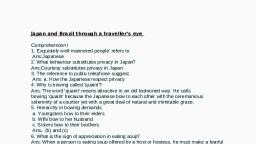
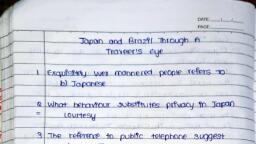
Springs, , , , , , Note on Travel Writing, , Travel writing is about writing one’s experiences of travelling and, visiting alien places. As a genre of writing it is as old as 2 Century, when travellers to Greece recorded their experiences in the form of a, diary. With the invention of new techniques of navigation and sea, voyages during the 9" and 10" centuries, travel writing became, popular as more number of people began to explore new places on, the globe. Soon such trips started getting royal patronage and support., New adventures and voyages were even commissioned. Thus travel, writing ceased to be just a description of a new place born out of, curiosity and gained political overtones. Now even after much of the, earth has been explored, and almost every piece on this earth has, been written about, its popularity has not waned as can be seen by, the immense viewership it has on modern media like TV and internet., , Travel writing has come under serious scholarly study in the past, 50 years, and has become a part of cultural studies programme in, many universities. Travel writing is no longer viewed as a product, of some innocent curiosity or an attempt to understand an alien, culture ‘objectively’. Rather, these narratives are telling comments on, how a culture gets represented by another, and in the process subtly, uphold some cultural values as somehow superior and universal than, the others., , JAPANESE MANNERS, , A QUARTER of an hour in Japan will convince you that you are, among exquisitely well-mannered people. People who live on a, hopelessly overcrowded island have to respect one another’s privacyor rather, would have to if they had any privacy. But they don’t. So, courtesy has a double function: it is courtesy and it is substitute, privacy. Take, for example, the little red telephones in the streets,, shops, halls of hotels. The instrument is situated on a table or on a, counter-they have no space to spare for booths. You conduct your, most confidential business transactions, your intimate love-quarrels, in public; yet in perfect privacy. Anybody, any passer-by, could listenin, but nobody does. A man’s telephone-receiver is his castle., , You will, of course, immediately notice their mania for bowing., , Everybody keeps bowing to everybody else, with the ceremonious, , 97, 2015-16
Page 3 :
PUC II YEAR, , , , , , , , , , solemnity of a courtier yet with a great deal of natural and inimitable, grace. Bowing is neither less nor more silly than shaking hands or, kissing the cheek, but it is quainter; more formal, more oriental; it is, also infectious. After a few hours you start bowing yourself. But you, bow too deeply or not deeply enough; you bow to the wrong man at the, wrong time; you do not clasp your hands in front of you which is bad;, or you do which is worse. You'll discover that the Japanese have a, complicated hierarchy in bowing: who bows to whom, how deeply and, for how long. One of the American states had an early traffic law which, laid down that if two cars met at an intersection, neither was to move, before the other had gone. Similarly, if two Japanese bow, neither is to, straighten up before the other stands erect in front of him. A little, complicated to us; they manage it without difficulty and even the, smallest difference in rank, standing, age, social position will be subtly, reflected in that split second one man’s bow is shorter than the other’s., In many cases there are clear-cut differences in position and no, difficulties. The basic rules inside the family : ‘The wife bows to her, husband, the child bows to his father, younger brothers to elder, brothers, the sister bows to all brothers of whatever age.’ I saw babies, carried in Japanese style on their mothers’ backs in clever little saddles,, and whenever mother bowed, baby bowed too, somewhat, condescendingly, from his majestic height. Japanese stores employ, bowing girls who stand at the top of escalators and whose only duty is, to bow deeply and deferentially to all and sundry (the Japanese, equivalent of our page-boys who turn revolving doors for us). On the, famous and fast Tokaido Line between Tokyo and Osaka two conductors, enter the carriage in a slightly theatrical scene. They march to the, middle of the coach, bow ceremoniously in both directions and then, start checking the tickets. In one of the parts of Nara I met a deer. I, bought a pack of food for him. He came up to me, looked into my eyes, and bowed deeply. It was no chance gesture: it was a proper and, courteous bow. Perhaps deer are more imitative than I knew; perhaps, if they see people bowing all the time they get into the habit too; perhaps, it is something genetic and is in the blood of Japanese deer. I do not, know; but I do know that the deer bowed to me, then jumped at me, , and snatched the little food-bag from my hand., , 98, 2015-16
Page 4 :
Springs, , In this, too, the deer was a true Japanese. You can often see, people bowing to each other with ceremonious serenity at bus-stops., As soon as the bus arrives, the bowing gentlemen are transformed, into savages, they push each other aside, tread on each other’s toes, and shove their elbows into each other’s stomachs..., , , , , , Eating Soup, , Eating soup has more dangers than almost anything else. When, eating soup you must make a fearful noise. It is a sign of appreciation., If you don’t, your hostess will think: ‘What an ill-mannered lout.’ But, if you do, she will think: ‘No reasonably well brought-up European, makes such disgusting noises when eating soup. He must be an illmannered lout’., , TRAFFIC IN BRAZIL, , NOBODY hurries in Brazil. It does not really matter whether, you reach your destination an hour too soon, a day late, or not at all., The grey pavements in the streets of Copacabana are often decorated, with beautiful black mosaics — a unique type of decoration. Only a, people alive to beauty in their surroundings and who have plenty of, time for contemplation during their meditative, ambulatory exercises, would take the trouble to decorate the pavements they walk on., , However, as soon as these easy going, leisurely characters get a, steering wheel in their hands no speed is fast enough for them. You, would then be inclined to believe that gaining a tenth of a second isa, matter of grave importance for all of them all the time., , Motor cars are extremely expensive in Brazil, import duties being, crippling and murderous. Only a few other, poorer, South American, states are in a worse position in this respect. Complaints are universal:, hardly anyone can afford a car. Yet this only means that the number, of motor vehicles is growing by leaps and bounds, almost as if cars, were distributed free of charge to all and sundry. Thus the pedestrian’s, life is becoming more hazardous every day., , It is not that drivers do not care about pedestrians. The trouble is, that they do care about them; they are, in fact, on the look-out for, them. As soon as a driver notices a pedestrian step off the pavement,, he regards him as fair game: he takes aim and accelerates. The, , 99, , 2015-16
Page 5 :
PUC II YEAR, , , , , , , , pedestrian has to jump, leap, and run for dear life. He does not, resent this in the least: driver and pedestrian - hunter and prey smile amicably at each other. I win today - you will win tomorrow., Fair enough..., , The war between drivers themselves is murderous but goodtempered. They cut in, they overtake on both sides, they force you, to brake violently and commit all the most heinous crimes of the, road and twenty times every hour. But they smile at you the same, time —there is no anger, no hostility, no mad hooting..., , The Avenida Presidente Vargas is the worst place of all. You, stand there, trying to cross the road and contemplating the truly, fascinating problem: how can crawling traffic proceed at such, terrifying speed? As hour after hour passes, without a ray of hope of, an auspicious crossing, you may witness a scene, something like, this: a man, on your side of the Avenida Vargas suddenly catches, sight of a friend of his on the other side and starts waving to him, at, the same time looking completely mystified:, , ‘How on earth did you get over there?’ he shouts across, trying, to make himself heard above the traffic., , It is the other fellow’s turn to be surprised by this naive question., He yells back:, , ‘How? | was born on this side!’, , , , George Mikes (emer véea*) (1912-1987) is an artist, author,, publisher, illustrator and journalist from, Hungary. Studied Law and received his doctorate, at Budapest University., His books include ‘The Hungarian Revolution’,, ‘Uber Alles’, ‘Shakespeare and Myself, ‘Italy for, Beginners’, ‘How to be An Artist’, ‘How to be, Inimitable’, How to scrape Skies’ and ‘How To, Tango’, ‘How To Be An Alien’., , These excerpts are chosen from ‘The Land of the Rising, Yen’ and ‘How To Tango’., , , , , , , , , , 100, 2015-16



 Learn better on this topic