Page 1 :
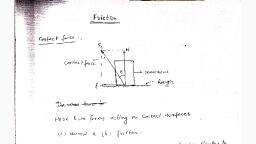
FRICTION :, , Definition:, , Friction is defined as the contact resistance exerted by one body upon a second body when the second, body moves or tends to move past the first body., , Friction is a retarding force always acting opposite to the motion or tendency to move., , Some types of machines we want to minimize the retarding effect of friction forces. Examples: bearings, of all types, power screws, gears, flow of fluid in pipes, propulsion of aircraft, missiles through the, atmosphere. In some situations we wish to maximize the effect of friction as in brakes, clutches, belt drives, and wedges. Wheeled vehicles depend on friction for both starting and stopping and ordinary walking, depends on friction between the shoe and ground., , Types of Friction:, , Dry Friction: Dry friction develops when dry surface (or unlubricated surface) of two solids are in contact, and there is a tendency for relative motion. This type of friction is also known as Coulomb friction., , Fluid Friction: Fluid friction is developed when a lubricating fluid (liquid or gas) is introduced between, the contact surfaces of the two solids. If thickness of the lubricating oil between two surfaces is small the, it is called greasy or non-viscous friction. If thick lubrication is used between two mating surfaces then it, is called viscous or fluid friction., , Mechanism of Friction:, , Friction exists primarily because of the roughness of the contact surface. Consider a block of weight w, resting on a horizontal surface. The contacting surface possesses a certain amount of roughness. Let P be, the horizontal force applied which will vary continuously from zero to a value sufficient to just move the, block and then to maintain the motion. The free body diagram of the block shows active forces (i.e, applied, force P and weight of block W) and reactive forces (i.e, normal reaction N and tangential frictional force, F., , , , , , , , , , W, y |p, x, , «—_, , #
Page 2 :
Static Friction, , Limiting Friction, (no motion) t (Impending motion), , , , , Kinetic Friction, (motion), , , , P( Applied Foree), , we first assume static equilibrium and take F as frictional force required to maintain the, equilibrium condition., , If F < Fmax = Body is in the static equilibrium condition which means body is purely at rest., , If F = Fmax = Body is in limiting equilibrium condition which means impending motion and hence, F = Fmax = us*N is valid equation., , If F > Fmax= Body is in motion which means F = Fk = 4, *N is valid equation the condition is, impossible, since the surfaces cannot support more force than the maximum frictional force., Therefore, the assumption of equilibrium is invalid, the motion occurs., , Limiting Friction: Here a body which is in equilibrium is on a verge of slipping which means, the body is in limiting equilibrium condition. “It is the maximum value of friction force that the, surface can exert on the block is called limiting friction and is designated as Fmax.”.This mainly, depends on roughness of the materials of the surfaces and of the normal contact force which, these surfaces exert on each other. Fmax =1;*N is valid equation., , Kinetic Friction: The condition of relative motion is known to exist between the contacting, surfaces. So, the body is in motion. Kinetic friction takes place Fk = 1, *N is valid equation., Hs-coefficient of static friction, , L-coefficient of kinetic friction, , LAWS OF FRICTION, , a, , The frictional force always acts in a direction opposite to that in which the body tends to move., Till the limiting value is reached, the magnitude of frictional force is exactly equal to the tangential, force which tends to move the body., , The magnitude of the limiting friction bears a constant ratio to the normal reaction between the, two contacting surfaces., , The force of friction depends upon the roughness/smoothness of the surfaces., , The force of friction is independent of the area of contact between the two surfaces., , After the body starts moving, the dynamic friction comes into play, the magnitude of which is less, than that of limiting friction and it bears a constant ratio to the normal force. This ratio is called, coefficient of dynamic friction.
Page 3 :
Static friction:, , When the applied force is less than the limiting friction, the body remains at rest and such frictional force, is called Static Friction, which will be having any value between zero and the limiting friction., , Dynamics Friction:, , If the value of applied force exceeds the limiting friction, the body starts moving over the other body and, the frictional resistance experienced by the body while moving is known as Dynamic Friction. Dynamic, friction is less than limiting friction., , Dynamic friction is classified into following two types:, , a) Sliding friction, , b) Rolling friction, , ¢ Sliding friction is the friction experienced by a body when it slides over the other body., Rolling friction is the friction experienced by a body when it rolls over a surface., , It is experimentally found that the magnitude of limiting friction bears a constant ratio to the normal, reaction between two surfaces and this ratio is called Coefficient of Friction., , , , , , , , , , , , 5 outa F, Coefficient of friction = —, where F is limiting friction and N is normal reaction between the contact surfaces., , Coefficient of friction is denoted by 1., , i F, Thus, «= —, us, =
Page 4 :
Angle of friction, The angle of friction is a measure of the limiting position of total reaction between the two, , contacting surfaces. It is defined as the angle which the resulta i mit, force of friction makes with the normal reaction. nto ermal reaction and limit, , , , , , , , , , / ; F Friction force), R =normal reaction;, = limiting force of friction ., E 8 : S$ =Total reaction R (Normal reaction), g= (R?+F?, al or resultant reaction ¥ Block A, = total or result nt reactior “ete oe ctuell, tang = F where dis the angle of friction jeceuiiaets, x \ ici Rough surface, |. The ratio F/R is also called:'the' coefficient of a, fiction, eseny ., pany _ * —, ‘Theabove correlation does suggest that angle of friction in radians is equal to the coefficient of, , , , fiction provided the angle has a small value., : p = tang ~ $ in radians, , Angle of Repose, , It is the minimum angle of inclination of a plane with the horizontal at which the, body kept will just slide down on it without the application of any external force, , ( Due to self-weight)., , ode a block of weight W resting on an inclined ; ., ons Let the angle o be increased gradually till the ean se unt etaite =, o hen in equilibrium state under the influence of following a, setof forces:, 0 weight W of the block acting vertically downwards,, (@ normal reaction R acting at right angles to the inclined, plane, and... .-— ssi 3, (ii limiting forces of friction, F =R;acting up the plane as, the block is to slide downwards., Resolving these forces along and perpendicular to the’plane ¢, BR = Wsinga 3 O°, R = Wcosa fey aggre. aetd FE, These two expressions give : 1 = tana - ehb.y” ., Interns of angle of friction 6, the coefficient of friction is given as: 1 = tang, tang'= tana or’ >=a : ., sateen @ of the inclined plane at which a block SE ine nee, i ae of repose, and: it is equal to the angle of fric, , 2, , , , , :, 5, ¥, , out to slide down the plane, etween the block and the
Page 5 :
Cone of Friction:, , , , , , , , , , , , When the applied force P is just sufficient to produce the impending motion of given, body, angle of friction o is obtained which is the angle made by resultant of limiting, frictional force with normal reaction as shown in Fig. If the direction of applied force, P is gradually changed through 360°, the resultant R generates a right circular cone, , with semi vertex angle equal to 9. This is called Cone of Friction.