Notes of SY E&TC 2021-22 Sem-I, Elctronics Devices & Cir & Elctronics Devices & Cir EXTC NEWSYLABUS.pdf - Study Material
Page 1 :
Department of Electronics and Telecommunication Engineering, , COURSE STRUCTURE AND SYLLABUS, For, , Bachelor of Technology, In, , Electronics and Telecommunication Engineering, , With effect from the Academic Year, 2020-2021 (First Year), 2021-2022 (Second Year),, 2022-2023 (Third Year), 2023-2024 (Final Year)., , Dr. Babasaheb Ambedkar Technological University, Lonere, ., , (Established as a University of Technology in the State of Maharashtra), (Under Maharashtra Act No. XXIX of 2014), P.O. Lonere, Dist. Raigad, Pin 402 103, Maharashtra Telephone and Fax. 02140 – 275142, www.dbatu.ac.in
Page 2 :
Vision Statement of the University, The University is committed to becoming a leading 'Center of Excellence' in the, field of Engineering, Technology and Science as a seat of learning with a national, character and international..., , Mission Statement of the University, The University is committed to provide quality technical education, research and, development services to meet the needs of industry, business, service sector and, the society, at large., , About the University, Dr. Babasaheb Ambedkar Technological University, with its headquarters, situated at Lonere, is now a statutory State Technical University established by, Government of Maharashtra through special Dr. Babasaheb Ambedkar, Technological University Act. The university has been accorded the status of an, ‘affiliating’ university of the entire State of Maharashtra from March 2, 2016, by, the Maharashtra Act No. XXIX of 2014.
Page 3 :
Vision Statement of the Department, The vision of the department is to achieve excellence in teaching, learning,, research and transfer of technology for development of society., , Mission Statement of the Department, The Electronics and Telecommunication Engineering Department constantly, aims at providing quality education and works towards the fulfillment of the goal, and objectives in pace with the modern scientific and technological development., , About the Department, The department of Electronics and Telecommunication Engineering was established in the year 1995, initially with B. Tech. programme with intake of 60 students. In 2001, M. Tech. programme in, Electronics & Telecommunication Engineering with an intake of 18 students was introduced. From, academic year 2008-2009, intake of B. Tech. has been increased to 120 students. The department has, started Ph.D. programme from the academic year 2003, presently 20 research scholars are working in, the research area of Signal Processing, Computer Network and Microwave Communication., Department is also offering fellowship to M. Tech. and Ph.D. students under TEQIP project. The, curriculum designed is a perfect blend of Electronics, Communication and Computing Technologies., The focus of the department is to produce graduates & post graduates with strong fundamentals in, Electronics and Communication domain. The department has received handful amount of funding from, AICTE, UGC, TEQIP and State Government for various research projects. The department has state of, the art laboratories to cater for curricular requirements as well as projects and research. The faculty, members are having strong background of research in the current issues of the discipline. The budding, graduates from this discipline have very good job opportunities in VLSI Technologies, Embedded, Systems, Signal Processing, Radio Frequency (RF) Communication, Mobile communication and in, Software Engineering. Many of our students placed in industries like Infosys, TCS, Cognizant,, Persistent, Siemens, Huawei, Reliance Communication, Prayas Software Ltd, JSW ISPAT, RCF,, Videocon, ONGC, BHEL, BEL, GE, L & T, Sasken, MBT, Texas, Accenture, Mahagenco, Motorola,, CapGemini, Flextronicx, NVIDIA, Patney Computers, Reliance Jio, Hexaware, Tataelxsi, BSE, City, bank, etc. and got admitted for higher education (M. Tech. / Ph. D. programme) in institute of high, repute such as IIMs, IITs and NITs. As an essential part of the academic schedule, the students have to, undergo industrial training at the end of second and third year.. To get an industrial exposure the, department also arranges Industrial Visits to reputed industries. There is an overwhelming participation, of students in conferences, seminars, workshops, paper publications, annual sports. The department, regularly organizes workshops, training, seminars, expert lectures and conference in the emerging areas, of electronics and communication engineering.
Page 4 :
Program Educational Objectives (PEOs), Graduates will able to–, 1. To equip graduates with a strong foundation in engineering sciences and, Electronics & Telecommunication Engineering fundamentals to become effective, collaborators, researchers and real-time problem solver with technical, competencies., 2. Perceive the limitation and impact of engineering solutions in social, legal,, environmental, economical and multidisciplinary contexts., 3. Excel in Industry/technical profession, higher studies, and entrepreneurship, exhibiting global competitiveness., , Program Outcomes, Engineering Graduate will be able to –, 1. Engineering knowledge: Apply the knowledge of mathematics, science,, engineering fundamentals, and an engineering specialization to the solution of, complex engineering problems., 2. Problem analysis: Identify, formulate, review research literature, and analyze, complex engineering problems reaching substantiated conclusions using first, principles of mathematics, natural sciences, and engineering sciences., 3. Design/development of solutions: Design solutions for complex engineering, problems and design system components or processes that meet the specified needs, with appropriate consideration for the public health and safety, and the cultural,, societal, and environmental considerations., 4. Conduct investigations of complex problems: Use research-based knowledge and, research methods including design of experiments, analysis and interpretation of, data, and synthesis of the information to provide valid conclusions., 5. Modern tool usage: Create, select, and apply appropriate techniques, resources,, and modern engineering and IT tools including prediction and modeling to complex, engineering activities with an understanding of the limitations., 6. The engineer and society: Apply reasoning informed by the contextual knowledge, to assess societal, health, safety, legal and cultural issues and the consequent, responsibilities relevant to the professional engineering practice., 7. Environment and sustainability: Understand the impact of the professional, engineering solutions in societal and environmental contexts, and demonstrate the, knowledge of, and need for sustainable development.
Page 5 :
8. Ethics: Apply ethical principles and commit to professional ethics and, responsibilities and norms of the engineering practice., 9. Individual and team work: Function effectively as an individual, and as a member, or leader in diverse teams, and in multidisciplinary settings., 10. Communication: Communicate effectively on complex engineering activities with, the engineering community and with society at large, such as, being able to, comprehend and write effective reports and design documentation, make effective, presentations, and give and receive clear instructions., 11. Project management and finance: Demonstrate knowledge and understanding of, the engineering and management principles and apply these to one’s own work, as, a member and leader in a team, to manage projects and in multidisciplinary, environments., 12. Life-long learning: Recognize the need for, and have the preparation and ability to, engage in independent and life-long learning in the broadest context of, technological change., , Program Specific Outcomes (PSOs), 1. Apply basic knowledge related to Electronic Circuits, Embedded & wireless, communication Systems and Signal Processing to solve engineering/ societal, problems in the field of Electronics and Telecommunication Engineering., 2. Recognize and adapt to technical developments and to engage in lifelong learning, and develop, , consciousness for professional, social, legal, , and ethical, , responsibilities., 3. Excellent adaptability to the changing industrial and real world requirement.
Page 6 :
Rules and Regulations, 1. The normal duration of the course leading to B.Tech degree will be EIGHT semesters., 2. The normal duration of the course leading to M.Tech. degree will be FOUR semesters., 3. Each academic year shall be divided into 2 semesters, each of 20 weeks duration,, including evaluation and grade finalization, etc. The Academic Session in each semester, shall provide for at least 90 Teaching Days, with at least 40 hours of teaching contact, periods in a five to six days session per week. The semester that is typically from MidJuly to November is called the ODD SEMESTER, and the one that is from January to, Mid-May is called the EVEN SEMESTER. Academic Session may be scheduled for, the Summer Session/Semester as well. For 1st year B. Tech and M. Tech the schedule, will be decided as per the admission schedule declared by Government of Maharashtra., 4. The schedule of academic activities for a Semester, including the dates of registration,, mid-semester examination, end-semester examination, inter-semester vacation, etc., shall be referred to as the Academic Calendar of the Semester, which shall be, prepared by the Dean (Academic), and announced at least TWO weeks before the, Closing Date of the previous Semester., 5. The Academic Calendar must be strictly adhered to, and all other activities including, co-curricular and/or extra -curricular activities must be scheduled so as not to interfere, with the Curricular Activities as stipulated in the Academic Calendar., , REGISTRATION:, 1. Lower and Upper Limits for Course Credits Registered in a Semester, by a Full-Time, Student of a UG/PG Programme:, A full time student of a particular UG/PG programme shall register for the appropriate, number of course credits in each semester/session that is within the minimum and, maximum limits specific to that UG/PG programme as stipulated in the specific, Regulations pertaining to that UG/PG programme., 2. Mandatory Pre-Registration for higher semesters:, In order to facilitate proper planning of the academic activities of a semester, it is, essential for the every institute to inform to Dean (Academics) and COE regarding
Page 7 :
details of total no. of electives offered (Course-wise) along with the number of students, opted for the same. This information should be submitted within two weeks from the, date of commencement of the semester as per academic calendar., 3. PhD students can register for any of PG/PhD courses and the corresponding rules of, evaluation will apply., 4. Under Graduate students may be permitted to register for a few selected Post Graduate, courses, in exceptionally rare circumstances, only if the DUGC/DPGC is convinced of, the level of the academic achievement and the potential in a student., , Course Pre-Requisites:, 1. In order to register for some courses, it may be required either to have exposure in, or, to have completed satisfactorily, or to have prior earned credits in, some specified, courses., 2. Students who do not register on the day announced for the purpose may be permitted, LATE REGISTRATION up to the notified day in academic calendar on payment of, late fee., 3. REGISTRATION IN ABSENTIA will be allowed only in exceptional cases with the, approval of the Dean (Academic) / Principal., 4. A student will be permitted to register in the next semester only if he fulfills, the following conditions:, (a), , Satisfied all the Academic Requirements to continue with the programme of, , Studies without termination, (b) Cleared all Institute, Hostel and Library dues and fines (if any) of the previous, semesters;, (c) Paid all required advance payments of the Institute and hostel for the current, semester;, (d) Not been debarred from registering on any specific ground by the Institute.
Page 8 :
EVALUATION SYSTEM:, 1. Absolute grading system based on absolute marks as indicated below will be, implemented from academic year 2019-20,starting from I year B.Tech., , Percentage of marks, , Letter grade, , Grade point, , 91-100, , EX, , 10.0, , 86-90, , AA, , 9.0, , 81-85, , AB, , 8.5, , 76-80, , BB, , 8.0, , 71-75, , BC, , 7.5, , 66-70, , CC, , 7.0, , 61-65, , CD, , 6.5, , 56-60, , DD, , 6.0, , 51-55, , DE, , 5.5, , 40-50, , EE, , 5.0, , <40, , EF, , 0.0, , 2. Class is awarded based on CGPA of all eight semester of B.Tech Program., CGPA for pass is minimum 5.0, CGPA up to <5.50, , Pass class, , CGPA ≥ 5.50 &<6.00, , Second-class, , CGPA ≥ 6.00 &<7.50, , First Class, , CGPA ≥ 7.50, , Distinction, , [Percentage of Marks =CGPA*10.0], , 3. A total of 100 Marks for each theory course are distributed as follows:, , 4., , 1. Mid-Semester Exam (MSE) Marks, , 20, , 2. Continuous Assessment Marks, , 20, , 3. End Semester Examination(ESE) Marks, , 60, , A total of 100 Marks for each practical course are distributed as follows:
Page 9 :
1., , Continuous Assessment Marks, , 60, , 2., , End Semester Examination (ESE)Marks, , 40, , It is mandatory for every student of B.Tech to score a minimum of 40 marks out, of 100, with a minimum of 20 marks out of 60 marks in End Semester, Examination for theory course., This will be implemented from the first year of B.Tech starting from Academic, Year 2019-20., , 5. Description of Grades:, EX Grade: An ‘EX’ grade stands for outstanding achievement., EE Grade: The ‘EE’ grade stands for minimum passing grade., The students may appear for the remedial examination for the subjects he/she failed for, the current semester of admission only and his/her performance will be awarded with, EE grade only., If any of the student remain Absent for the regular examination due to genuine reason, and the same will be verified and tested by the Dean (Academics) or committee, constituted by the University Authority., FF Grade: The ‘FF’ grade denotes very poor performance, i.e. failure in a course due, to poor performance .The students who have been awarded ‘FF’ grade in a course in, any semester must repeat the subject in next semester., , 6. Evaluation of Performance:, 1. Semester Grade Point Average (SGPA) and Cumulative Grade Point Average, (CGPA), (A) Semester Grade Point Average (SGPA) The performance of a student in a, semester is indicated by Semester Grade Point Average (SGPA) which is a, weighted average of the grade points obtained in all the courses taken by the, student in the semester and scaled to a maximum of 10. (SGPI is to be calculated, up to two decimal places). A Semester Grade Point Average (SGPA) will be, computed for each semester as follows:
Page 10 :
Where, ‘n’ is the number of subjects for the semester,, ‘ci’ is the number of credits allotted to a particular subject, and, ‘gi’ is the grade-points awarded to the student for the subject based on his, performance as per the above table., -SGPA will be rounded off to the second place of decimal and recorded as such., (B) Cumulative Grade Point Average (CGPA): An up to date assessment of the overall, performance of a student from the time he entered the Institute is obtained by, calculating Cumulative Grade Point Average (CGPA) of a student. The CGPA is, weighted average of the grade points obtained in all the courses registered by the, student since s/he entered the Institute. CGPA is also calculated at the end of every, semester (upto two decimal places).Starting from the first semester at the end of each, semester (S), a Cumulative Grade Point Average (CGPA) will be computed as, follows:, , Where, ‘m’ is the total number of subjects from the first semester onwards up to and, including the semester S,, ‘ci’ is the number of credits allotted to a particular subject, and, ‘gi’ is the grade-points awarded to the student for the subject based on his/her, performance as per the above table., -CGPA will be rounded off to the second place of decimal and recorded as such., , Award of Degree of Honors, Major Degree, The concept of Major and Minors at B.Tech level is introduced , to enhance learning, skills of students, acquisition of additional knowledge in domains other than the, discipline being pursued by the student, to make the students better employable with, additional knowledge and encourage students to pursue cross- discipline research., A. Eligibility Criteria for Majors
Page 11 :
1. The Student should have Minimum CGPA of 7.5 up to 4th Semester, 2. Student willing to opt for majors has to register at the beginning of 5th Semester, 3. The Student has to complete 5 additional advanced courses from the same discipline, specified in the curriculum. These five courses should be of 4 credits each amounting, to 20 credits. The students should complete these credits before the end of last, semester., 4. Student may opt for the courses from NPTEL/ SWAYAM platform. ( if the credits of, NPTEL/ SWAYAM courses do not match with the existing subject proper scaling, will be done), Student complying with these criteria will be awarded B.Tech (Honors) Degree., B. Eligibility Criteria for Minors, 1. The Student should have Minimum CGPA of 7.5 up to 4th Semester, 2. Student willing to opt for minors has to register at the beginning of 5th Semester, 3. The Student has to complete 5 additional courses from other discipline of their interest,, which are specified in the respective discipline. These five courses should be of 4 credits, each amounting to 20 credits., 4. Student may opt for the courses from NPTEL/ SWAYAM platform. ( if the credits of, NPTEL/ SWAYAM courses do not match with the existing subject proper scaling will, be done), Student complying with these criteria will be awarded with B.Tech Degree in ------Engineering with Minor in ---------- Engineering., (For e.g.: B. Tech in Civil Engineering with Minor in Computer Engineering), For applying for Honors and Minor Degree the student has to register themselves, through the proper system., , ATTENDANCE REQUIREMENTS:, 1. All students must attend every lecture, tutorial and practical classes., 2. To account for approved leave of absence (eg. representing the Institute in sports, games, or athletics; placement activities; NCC/NSS activities; etc.) and/or any other such, contingencies like medical emergencies, etc., the attendance requirement shall be a, minimum of 75% of the classes actually conducted., If the student failed to maintain 75% attendance, he/she will be detained for appearing, the successive examination.
Page 12 :
The Dean (Academics)/ Principal is permitted to give 10% concession for the genuine, reasons as such the case may be., In any case the student will not be permitted for appearing the examination if the, attendance is less than 65%., 3. The course instructor handling a course must finalize the attendance 3 calendar days, before the last day of classes in the current semester and communicate clearly to, the students by displaying prominently in the department and also in report writing to, the head of the department concerned., 4. The attendance records are to be maintained by the course instructor and he shall, show it to the student, if and when required., , TRANSFER OF CREDITS, The courses credited elsewhere, in Indian or foreign University/Institutions/, Colleges/Swayam Courses by students during their study period at DBATU may count, towards the credit requirements for the award of degree. The guidelines for such, transfer of credits are as follows:, a) 20 % of the total credit will be considered for respective calculations., b) Credits transferred will be considered for overall credits requirements of the, programme., c) Credits transfer can be considered only for the course at same level i.e. UG, PG etc., d) A student must provide all details (original or attested authentic copies)such as, course contents, number of contact hours, course instructor /project guide and, evaluation system for the course for which he is requesting a credits transfer. He shall, also provide the approval or acceptance letter from the other side. These details will, be evaluated by the concerned Board of Studies before giving approval. The Board, of Studies will then decide the number of equivalent credits the student will get for such, course(s) in DBATU. The complete details will then be forwarded to Dean for approval., e) A student has to get minimum passing grades/ marks for such courses for which the, credits transfers are to be made., f) Credits transfers availed by a student shall be properly recorded on academic, record(s) of the student., g) In exceptional cases, the students may opt for higher credits than the prescribed.
Page 13 :
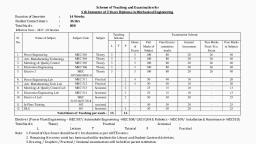
DR BABASAHEB AMBEDKAR TECHNOLOGICAL UNIVERSITY, LONERE, B. Tech in Electronics & Telecommunication Engineering, , Curriculum for First Year, Teaching and Evaluation Scheme for First Year B. Tech. (All Branches), Group A, Semester I, Course Code, , Mandatory, , Course Title, , Teaching Scheme Evaluation Scheme, T, P CA MSE ESE Total, L, , 1, 1, -, , 3-weeks duration in the beginning of, semester., 20, 20, 60, 100, 4, 20, 20, 60, 100, 4, 20, 20, 60, 100, 2, 20, 20, 60, 100, 2, , -, , -, , 20, , 20, , 60, , 100, , 2, , -, , -, , 50, , -, , -, , 50, , Audit, , -, , 60, 60, 60, 330, , 100, , 40, 40, 40, 420, , 100, 100, 100, 850, , 1, 2, 1, 18, , Induction Program, , BTBS101, BTBS102, BTES103, BTHM104, , Engineering Mathematics- I, Engineering Physics, Engineering Graphics, Communication Skills, BTES105 Energy and Environment, Engineering, BTES106 Basic Civil and Mechanical, Engineering, BTBS107L Engineering Physics Lab, BTES108L Engineering Graphics Lab, BTHM109L Communication Skills Lab., Total, , 3, 3, 2, 2, 2, , Credit, , 2, 14, , 2, , 2, 4, 2, 8, , 3, 3, 2, 2, -, , 1, 1, 1, -, , 4, , 20, 20, 20, 20, 60, , 20, 20, 20, 20, -, , 60, 60, 60, 60, 40, , 100, 100, 100, 100, 100, , 4, 4, 3, 2, 2, , -, , -, , 50, , -, , -, , 50, , Audit, , -, , 2, 2, 2, 2, , 60, 60, 60, 60, , -, , 40, 40, 40, 40, , 100, 100, 100, 100, , 1, 1, 1, 1, Credits, To be, evaluat, e d in, III, Sem., , 950, , 19, , Semester II, , BTBS201 Engineering Mathematics-II, BTBS202 Engineering Chemistry, BTES203 Engineering Mechanics, BTES204 Computer Programming in C, BTES205 Workshop Practices, BTES206 Basic Electrical and, Electronics Engineering, BTBS207L Engineering Chemistry Lab, BTES208L Engineering Mechanics Lab, BTES209L Computer Programming Lab, BTES210S Seminar, Field Training /, Internship/Industrial Training, BTES211P (minimum of 4 weeks which can be, completed partially in first, semester and second Semester or in, at one time)., Total, , 2, -, , 12, , -, , -, , 3, 27, , Department of Electronics & Telecommunication Engineering, , 12, , -, , 430, , -, , 80, , -, , 440, , Page 1
Page 14 :
DR BABASAHEB AMBEDKAR TECHNOLOGICAL UNIVERSITY, LONERE, , Group B, , Semester I, Course Code Course Title, Mandatory, , Teaching Scheme, L, T, P, , Induction Program, , Evaluation Scheme, CA MSE ESE Total, , Credit, , 3-weeks duration in the beginning of semester., , BTBS101 Engineering Mathematics- I, , 3, , 1, , -, , 20, , 20, , 60, , 100, , 4, , BTBS102 Engineering Chemistry, BTES103 Engineering Mechanics, , 3, 2, , 1, 1, , -, , 20, 20, , 20, 20, , 60, 60, , 100, 100, , 4, 3, , BTES104 Computer Programming in C, BTES105L Workshop Practices, Basic Electrical and Electronics, BTES106, Engineering, BTBS107L Engineering Chemistry Lab, BTES108L Engineering Mechanics Lab, , 2, -, , -, , 4, , 20, 60, , 20, -, , 60, 40, , 100, 100, , 2, 2, , 2, , -, , -, , 50, , -, , -, , 50, , Audit, , -, , -, , 2, , 60, , -, , 40, , 100, , 1, , -, , -, , 2, , 60, , -, , 40, , 100, , 1, , BTES109L Computer Programming Lab, , -, , -, , 2, , 60, , -, , 40, , 100, , 1, , 3, 25, , 10, , 370, , 80, , 400, , 850, , 18, , Total, , 12, , Semester II, BTBS201 Engineering Mathematics-II, , 3, , 1, , -, , 20, , 20, , 60, , 100, , 4, , BTBS202 Engineering Physics, BTES203 Engineering Graphics, , 3, 2, , 1, -, , -, , 20, 20, , 20, 20, , 60, 60, , 100, 100, , 4, 2, , BTHM204 Communication Skills, BTES205 Energy and Environment, Engineering, BTES206 Basic Civil and Mechanical, Engineering, BTBS207L Engineering Physics Lab, , 2, , -, , -, , 20, , 20, , 60, , 100, , 2, , 2, , -, , -, , 20, , 20, , 60, , 100, , 2, , 2, , -, , -, , 50, , -, , -, , 50, , Audit, , -, , -, , 2, , 60, , -, , 40, , 100, , 1, , BTES208L Engineering Graphics Lab, BTHM209L Communication Skills Lab., BTES210S Seminar, Field Training /, Internship/Industrial Training, BTES211P (minimum of 4 weeks which, can be completed partially in, first semester and second, Semester or in at one time), , -, , -, , 4, 2, , 60, 60, , -, , 40, 40, , 100, 100, , 2, 1, , -, , -, , 2, , 60, , -, , 40, , 100, , 1, , Total, , -, , -, , -, , -, , -, , -, , -, , Credits, To be, evaluate, d in III, Sem., , 14, , 2, , 10, , 390, , 100, , 460, , 950, , 19, , 26, , Department of Electronics & Telecommunication Engineering, , Page 2
Page 15 :
DR BABASAHEB AMBEDKAR TECHNOLOGICAL UNIVERSITY, LONERE, Semester III, Course, Category, , Course Code Course Title, , BSC, PCC 1, PCC 2, ESC, , BTBS301, BTETC302, BTETC303, BTES304, , LC, , BTETL305, , LC, Seminar, Internship, , BTETL306, BTETS307, BTES211P, , Teaching, Scheme, T, L, , P, , CA MSE, , 3, 3, 3, 3, , 1, 1, 1, 1, , -, , 20, 20, 20, 20, , -, , -, , 2, , -, , -, , 12, , 4, , Engineering Mathematics – III, Electronic Devices & Circuits, Digital Electronics, Electrical Machines and, Instruments, Electronic Devices &, Circuits Lab, Digital Electronics Lab, Seminar I, Internship – 1 Evaluation, Total, , Evaluation Scheme, Credit, ESE, , Total, , 20, 20, 20, 20, , 60, 60, 60, 60, , 100, 100, 100, 100, , 4, 4, 4, 4, , 60, , -, , 40, , 100, , 1, , 2, 4, -, , 60, 60, -, , -, , 40, 40, -, , 100, 100, -, , 1, 2, Audit, , 8, , 260, , 80, , 360, , 700, , 20, , Semester IV, Course, Category, , PCC 3, PCC 4, HSSMC, BSC, PEC 1, , LC, , Seminar, Internship, , Course Code Course Title, , BTETC401, BTETC402, BTHM403, BTBS404, , Network Theory, Signals and Systems, Basic Human Rights, Probability Theory and, Random Processes, BTETPE405 (A) Numerical Methods and, Computer Programming, (B) Data Compression &, Encryption, (C) Computer, Organization and, Architecture, (D) Introduction to MEMS, (E) Python Programming, BTETL406 Network Theory, Lab & Signals and, Systems Lab, BTETS407 Seminar II, BTETP408 Field Training, (Internship – /Internship/Industrial Training, 2), (minimum of 4 weeks which, can be completed partially in, third semester and fourth, semester or in at onetime)., Total, , Teaching, Scheme, T, L, , Evaluation Scheme, P, , CA MSE, , 3, 3, 3, 3, , -, , 20, 20, 20, 20, , 1, , -, , -, , -, , -, , Credit, ESE, , Total, , 20, 20, 20, 20, , 60, 60, 60, 60, , 100, 100, 100, 100, , 4, 4, 3, 3, , 20, , 20, , 60, , 100, , 4, , 4, , 60, , -, , 40, , 100, , 2, , -, , 4, , 60, , -, , 40, , 100, , 2, , -, , -, , -, , -, , -, , -, , -, , Audit, (evalua, t ion, will be, in V, Sem.), , 15, , 3, , 8, , 220, , 100, , 380, , 700, , 22, , 3, , 1, 1, -, , Department of Electronics & Telecommunication Engineering, , Page 3
Page 16 :
DR BABASAHEB AMBEDKAR TECHNOLOGICAL UNIVERSITY, LONERE, B. Tech in Electronics & Telecommunication Engineering, , Curriculum for Third Year, SEMESTER-V, Course Course Code, Category, PCC 5, PCC 6, PCC 7, PEC 2, OEC 1, LC, , BTETC501, BTETC502, BTETC503, BTETPE504, BTETOE505, BTETL506, , Project, Internship, , BTETM507, BTETP408, , Course Title, , Teaching Scheme, L, T, P, Electromagnetic Field Theory, 3, 1, Digital Signal Processing, 3, 1, Analog Communication, 3, 1, Group A, 3, 1, Group B, 3, 1, Digital Signal Processing Lab &, 4, Analog Communication Lab, Mini Project – 1, 4, Internship – 2 Evaluation, Total, 15, 5, 8, , Evaluation Scheme, CA MSE ESE Total Credit, 20, 20, 60 100, 4, 20, 20, 60 100, 4, 20, 20, 60 100, 4, 20, 20, 60 100, 4, 20, 20, 60 100, 4, 60, 40 100, 2, 60, 220, , 100, , 40, 380, , 100, 700, , 2, Audit, 24, , SEMESTER-VI, Course Course Code, Category, PCC 8, PCC 9, PEC 3, OEC 2, HSSMC, , BTETC601, BTETC602, BTETPE603, BTETOE604, BTHM605, , LC, , BTETL606, , Project, Internship, , BTETM607, BTETP608, (Internship –, 3), , Course Title, , Teaching Scheme, L, T, P, Antennas and Wave Propagation, 3, 1, Digital Communication, 3, 1, Group A, 3, 1, Group B, 3, 1, Employability and Skill, 3, Development, Digital Communication Lab &, 4, Professional Elective Course 3, Lab, Mini Project – 2, 4, Field Training /, Internship/Industrial Training, (minimum of 4 weeks which can, be completed partially in third, semester and fourth semester or in, at one time)., Total, 15, 4, 8, , Evaluation Scheme, CA MSE ESE Total Credit, 20, 20, 60 100, 4, 20, 20, 60 100, 4, 20, 20, 60 100, 4, 20, 20, 60 100, 4, 20, 20, 60 100, 3, 60, , -, , 40, , 100, , 60, -, , -, , 40, -, , 100, -, , 220, , 100, , 380, , 2, , 2, Audit, (evalua, t ion, will be, in VII, Sem.), 700, 23, , BSC = Basic Science Course, ESC = Engineering Science Course, PCC = Professional Core Course PEC =, Professional Elective Course, OEC = Open Elective Course, LC = Laboratory Course, HSSMC = Humanities and Social Science including Management Courses, , Department of Electronics & Telecommunication Engineering, , Page 4
Page 17 :
DR BABASAHEB AMBEDKAR TECHNOLOGICAL UNIVERSITY, LONERE, , Semester V, BTETPE504 Program Elective 2 (Group A), , BTETOE505 Open Elective 1 (Group B), , (A) Analog Circuits, , (A) Control System Engineering, , (B) Embedded System Design, , (B) Artificial Intelligence and Machine learning, , (C) Digital System Design, , (C) Optimization Techniques, , (D) Automotive Electronics, (E) Mixed Signal Design, , (D) Project Management and Operation, Research, (E) Augmented, Virtual and Mixed Reality, , (F) Power Electronics, , (F) Open Source Technologies, , Semester VI, BTETPE603 Program Elective 3 (Group A), , BTETOE604 Open Elective 2 (Group B), , (A) Microprocessors and Microcontrollers, , (A) IoT and Industry 4.0, , (B) CMOS Design, , (B) Deep Learning, , (C) Nano Electronics, , (C) Computer Network, , (D) Advanced Digital Signal Processing, , (D) Industrial Drives and Control, , (E) Information Theory and Coding, , (E) Robotics Design, , (F) VLSI Signal Processing, , (F) Patents and IPR, , (G) VLSI Design & Technology, , (G) Acoustic Engineering, , Department of Electronics & Telecommunication Engineering, , Page 5
Page 18 :
DR BABASAHEB AMBEDKAR TECHNOLOGICAL UNIVERSITY, LONERE, , B. Tech in Electronics & Telecommunication Engineering, , Curriculum for Final Year, Semester VII, Course, Category, , Course, Code, , PCC 10, PEC 4, OEC 3, OEC 4, HSSMC, HSSMC, LC, Project, Internship, , Course Title, , BTETC701, Microwave Engineering, BTETPE702, Group A, BTETOE703, Group B, BTETOE704, Group C, BTHM705 Engineering Economics and, Financial Mathematics, BTHM706 Foreign Language Studies, BTETL707, Microwave Engineering, Lab, BTETM708, Mini Project – 3, BTETP608 Internship – 3 Evaluation, Total, , L, 3, 3, 3, 3, 3, , Teaching, Scheme, T, P CA, 1, - 20, 1, - 20, 1, - 20, 1, - 20, - 20, , Evaluation Scheme, MSE, 20, 20, 20, 20, 20, , Credi, t, , ESE Total, 60, 100, 60, 100, 60, 100, 60, 100, 60, 100, , 4, 4, 4, 4, 3, , -, , 2, , 60, , -, , 40, , 100, , Audit, 1, , -, , -, , 4, -, , 60, -, , -, , 40, -, , 100, -, , 2, Audit, , 15, , 4, , 6, , 220, , 100, , 380, , 700, , 22, , -, , Semester VIII, Course, Category, Project/, Internship, , Course, Code, , Course Title, , BTETP801, , Project work/ Internship, , Total, , Teaching, Evaluation Scheme, Scheme, L, T, P CA, MSE ESE Total, 24 60, 40, 100, -, , -, , 24, , 60, , -, , 40, , 100, , Credi, t, 12, 12, , BSC = Basic Science Course, ESC = Engineering Science Course, PCC = Professional Core, Course PEC = Professional Elective Course, OEC = Open Elective Course, LC = Laboratory, Course HSSMC = Humanities and Social Science including Management Courses, BTETPE702 Program Elective 4, (Group A), , BTETOE703 Open Elective 3, (Group B), , BTETOE704 Open Elective 4, (Group C), , (A) Digital Image Processing, , (A) Wireless Sensor Networks, , (A) Soft Computing, , (B) RF Circuit Design, , (B) Block Chain Technology, , (B) Big Data Analytics, , (C) Satellite Communication, , (C) Cyber Security, , (C) Data Structure & Algorithms, Using Java Programming, , (D) Fiber Optic Communication, , (D) Mobile Computing, , (D) Entrepreneurship Development, , (E) Bio-medical Signal Processing, , (E) Mobile Communication and, Networks, , (E) Software Defined Radio, , (F) Principles of Modern Radar, Engineering, , (F) EMI and EMC, , (F) E Waste Management, , Department of Electronics & Telecommunication Engineering, , Page 6
Page 19 :
DR BABASAHEB AMBEDKAR TECHNOLOGICAL UNIVERSITY, LONERE, Guide to Induction Program, When new students enter an institution, they come with diverse thoughts, backgrounds and, preparations. It is important to help them adjust to the new environment and inculcate in them the, ethos of the institution with a sense of larger purpose. Precious little is done by most of the institutions,, except for an orientation program lasting a couple of days., We propose a 3-week long induction program for the UG students entering the institution, right at the, start. Normal classes start only after the induction program is over. Its purpose is to make the students, feel comfortable in their new environment, open them up, set a healthy daily routine, create bonding, in the batch as well as between faculty and students, develop awareness, sensitivity and understanding, of the self, people around them, society at large, and nature., The time during the Induction Program is also used to rectify some critical lacunas, for example,, English background, for those students who have deficiency in it., The following are the activities under the induction program in which the student would be fully, engaged throughout the day for the entire duration of the program., • Physical Activity This would involve a daily routine of physical activity with games and sports. It, would start with all students coming to the field at 6 am for light physical exercise or yoga. There, would also be games in the evening or at other suitable times according to the local climate. These, would help develop team work. Each student should pick one game and learn it for three weeks. There, could also be gardening or other suitably designed activity where labor yields fruits from nature., • Creative Arts Every student would chose one skill related to the arts whether visual arts ofperforming, arts. Examples are painting, sculpture, pottery, music, dance etc. The student would pursue it every, day for the duration of the program. These would allow for creative expression. It would develop a, sense of aesthetics and also enhance creativity which would, hopefully, flow into engineering design, later., • Universal Human Values: It gets the student to explore oneself and allows one to experience the, joy of learning, stand up to peer pressure, take decisions with courage, be aware of relationships with, colleagues and supporting staff in the hostel and department, be sensitive to others, etc. Need for, character building has been underlined earlier. A module in Universal Human Values provides the, base. Methodology of teaching this content is extremely important. It must not be through dos and, don’ts, but get students to explore and think by engaging them in a dialogue. It is best taught through, group discussions and real life activities rather than lecturing. The role of group discussions, however,, with clarity of thought of the teachers cannot be over emphasized. It is essential for giving exposure,, guiding thoughts, and realizing values. The teachers must come from all the departments rather than, only one department like HSS or from outside of the Institute. Discussions would be conducted in, small groups of about 20 students with a faculty mentor each. It is to open thinking towards the self., Universal Human Values discussions could even continue for rest of the semester as a normal course,, and not stop with the induction program. Besides drawing the attention of the student to larger issues, of life, it would build relationships between teachers and students which last for their entire 4-year, stay and possibly beyond., • Literary: Literary activity would encompass reading, writing and possibly, debating, enacting a play, etc., • Proficiency Modules: This period can be used to overcome some critical lacunas that studentsmight, have, for example, English, computer familiarity etc. These should run like crash courses, so that when, normal courses start after the induction program, the student has overcome the lacunas substantially., We hope that problems arising due to lack of English skills, wherein students start lagging behind or, failing in several subjects, for no fault of theirs, would, hopefully, become a thing of the past., • Lectures by Eminent People: This period can be utilized for lectures by eminent people, say,once a, week. It would give the students exposure to people who are socially active or in public life., • Visits to Local Area A couple of visits to the landmarks of the city, or a hospital or orphanage could, , Department of Electronics & Telecommunication Engineering, , Page 3
Page 20 :
DR BABASAHEB AMBEDKAR TECHNOLOGICAL UNIVERSITY, LONERE, be organized. This would familiarize them with the area as well as expose them to the under privileged., • Familiarization to Dept./Branch & Innovations : The students should be told about different method, of study compared to coaching that is needed at IITs. They should be told about what getting into a, branch or department means what role it plays in society, through its technology. They should also be, shown the laboratories, workshops & other facilities., , Schedule, The activities during the Induction Program would have an Initial Phase, a Regular, Phase and a Closing Phase. The Initial and Closing Phases would be two days each., , Initial Phase, Time, , Activity, , 9.00 AM to 3.00 PM, , Day 0, Students arrive - Hostel allotment. (Preferably do preallotment), Day 1, Academic Registration, , 4.30 PM to 6.00 PM, , Orientation, , Whole day, , Day 2, 9.00 AM to 10.00 AM, , Diagnostic test (for English, etc.), , 10.15 AM to 12.25 PM, , Visits to Respective Departments, , 12.30 PM to 2.00 PM, , Lunch time, , 2.00 PM to 3.00 PM, , Director’s Speech, , 3.00 PM to 4.00 PM, , Interaction with Parents, , 4.00 PM to 5.30 PM, , Mentor-Mentee groups- Introduction within group, , Regular Phase, After two days is the start of the Regular Phase of induction. With this phase there would, be regular program to be followed every day., , Daily Schedule, Some of the activities are on a daily basis, while some others are at specified periods, within the Induction Program. We first show a typical daily timetable., Session, Time, Activity, Remark, Day 3 Onwards, I, , 9.00 AM to 11.00 AM Creative Arts / Universal Human Values Half the groups will do, creative arts, , II, , 11.00 AM to 1.00 PM Universal Human Values/ Creative Arts Complementary, Alternate, , IV, , Lunch Time, 2.00 PM to 4.00PM Afternoon Session, , See below, , V, , 4.00 PM to 5.00PM Afternoon Session, , See below, , Department of Electronics & Telecommunication Engineering, , Page 4
Page 21 :
DR BABASAHEB AMBEDKAR TECHNOLOGICAL UNIVERSITY, LONERE, Sundays are off. Saturdays have the same schedule as above or have outings., Afternoon Activities (Non-Daily) : The following five activities are scheduled at different, times of the Induction Program, and are not held daily for everyone, 1. Familiarization to Dept./Branch &Innovations, 2. Visits to Local Area, 3. Lectures by Eminent People, 4. Literary, 5. Proficiency Modules, , Closing Phase, Time, , Activity, Last But one day, , 9.00 AM to 12.00 PM, , Discussions and finalizations of presentations within each group, , 2.00 PM to 5.00 PM, , Presentation by each group in front of 4 other groups besides, their own (about 100 students), , Whole day, , Last Day, Examinations if any, Follow Up after Closure, , A question comes up as to what would be the follow up program after the formal 3-week, Induction Program is over? The groups which are formed should function as mentor- mentee, network. A student should feel free to approach his faculty mentor or the student guide, when, facing any kind of problem, whether academic or financial or psychological 6etc. (For every, 10 undergraduate first year students, there would be a senior student as a student guide, and, for every 20 students, there would be a faculty mentor.) Such a group should remain for the, entire 4-5 year duration of the stay of the student. Therefore, it would be good to have groups, with the students as well as teachers from the same department/discipline Here we list some, important suggestions which have come up and which have been experimented with., • Follow Up after Closure – Same Semester: It is suggested that the groups meet with their, facultymentors once a month, within the semester after the 3-week Induction Program is over., This should be a scheduled meeting shown in the timetable. (The groups are of course free to, meet together on their own more often, for the student groups to be invited to their faculty, mentor’s home for dinner or tea, nature walked.), • Follow Up – Subsequent Semesters: It is extremely important that continuity be, maintained insubsequent semesters. It is suggested that at the start of the subsequent semesters, (up to fourth semester), three days be set aside for three full days of activities related to follow, up to Induction Program. The students be shown inspiring films, do collective art work, and, group discussions be conducted. Subsequently, the groups should meet at least once a month., , Summary, Engineering institutions were set up to generate well trained manpower in engineering with, a feeling of responsibility towards oneself, one’s family, and society. The incoming, undergraduate students are driven by their parents and society to join engineering without, , Department of Electronics & Telecommunication Engineering, , Page 5
Page 22 :
DR BABASAHEB AMBEDKAR TECHNOLOGICAL UNIVERSITY, LONERE, understanding their own interests and talents. As a result, most students fail to link up with, the goals of their own institution. The graduating student must have values as a human being,, and knowledge and meta-skills related to his/her profession as an engineer and as a citizen., Most students, who get de-motivated to study engineering or their branch, also lose interest, in learning., The Induction Program is designed to make the newly joined students feel comfortable,, sensitize them towards exploring their academic interests and activities, reducing competition, and making them work for excellence, promote bonding within them, build relations between, teachers and students, give a broader view of life, and building of character., The Universal Human Values component, which acts as an anchor, develops awareness and, sensitivity, feeling of equality, compassion and oneness, draw attention to society and 4, We are aware that there are advantages in mixing the students from different depts. However,, in mixing, it is our experience that the continuity of the group together with the faculty mentor, breaks down soon after. Therefore, the groups be from the same dept. but hostel wings have, the mixed students from different depts. For example, the hostel room allotment should be in, alphabetical order irrespective of dept. 7nature, and character to follow through. It also makes, them reflect on their relationship with their families and extended family in the college (with, hostel staff and others). It also connects students with each other and with teachers so that, they can share any difficulty they might be facing and seek help., , References:, Motivating UG Students Towards Studies, Rajeev Sangal, IITBHU Varanasi, Gautam, Biswas, IIT Guwahati, Timothy Gonsalves, IIT Mandi, Pushpak Bhattacharya, IIT Patna,, (Committee of IIT Directors), 31 March 2016, IIT Directors’ Secretariat, IIT Delhi., , Department of Electronics & Telecommunication Engineering, , Page 6
Page 23 :
DR BABASAHEB AMBEDKAR TECHNOLOGICAL UNIVERSITY, LONERE, Semester I and Semester II, BTBS101EngineeringMathematics-I, , 4 Credits, , Course Objectives:, 1. To know the application of the matrix technique (Linear algebra) to find solutions of, system of linear equations arising in many engineering problem, 2. To know and apply the concept partial derivatives and their applications to Maxima/, Minima , series expansion of multi valued functions., 3. To understand Computation of Jacobian of functions of several variables and their, applications to engineering problems, 4. To identify and sketch of curves in various coordinate system., 5. To evaluate multiple integrals and their applications to area and volume., Course Outcomes:, Students will be able to :, 1. Apply the matrix technique (Linear algebra) to find solutions of system of linear, equations arising in many engineering problem, 2. Demonstrate the concept partial derivatives and their applications to Maxima/ Minima ,, series expansion of multi valued functions., 3. Compute Jacobian of functions of several variables and their applications to, engineering problems, 4. Identify and sketch of curves in various coordinate system., 5. Evaluate multiple integrals and their applications to area and volume., Unit 1: Linear Algebra- Matrices, [07 Hours], Inverse of a matrix by Gauss-Jordan method; Rank of a matrix; Normal form of a matrix ;, Consistency of non- homogeneous and homogeneous system of linear equations ; Eigen values, and eigen vectors ; Properties of Eigen values and Eigen vectors (without proofs); CayleyHamilton’s theorem (without proof) and its applications., Unit 2: Partial Differentiation, [07 Hours], Partial derivatives of first and higher orders; Homogeneous functions – Euler’s Theorem for, functions containing two and three variables (with proofs); Total derivatives; Change of variables., Unit 3: Applications of Partial differentiation, [07Hours], Jacobians - properties; Taylor’s and Maclaurin’s theorems (without proofs) for functions of two, variables; Maxima and minima of functions of two variables; Lagrange’s method of undetermined, multipliers., Unit 4: Reduction Formulae and Tracing of Curves, , Unit 5: Multiple Integration, [08 Hours], Double integration in Cartesian and polar co-ordinates; Evaluation of double integrals by changing, the order of integration and changing to polar form; Triple integral; Applications of multiple integrals, to find area as double integral , volume as triple integral and surface area., , 1., 2., 3., 4., 5., , Text Books, Higher Engineering Mathematics by B. S. Grewal, Khanna Publishers, NewDelhi., Advanced Engineering Mathematics by Erwin Kreyszig, John Wiley & Sons, NewYork., A Course in Engineering Mathematics (Vol I) by Dr. B. B. Singh, Synergy, Knowledgeware,, Mumbai., A Text Book of Applied Mathematics (Vol I & II) by P. N. Wartikar and J. N. Wartikar,, Pune Vidyarthi Griha Prakashan,Pune., Higher Engineering Mathematics by H. K. Das and Er. Rajnish Verma, S. Chand & CO., Pvt. Ltd., New Delhi., , Department of Electronics & Telecommunication Engineering, , Page 7
Page 24 :
DR BABASAHEB AMBEDKAR TECHNOLOGICAL UNIVERSITY, LONERE, Reference Books, 1. Higher Engineering Mathematics by B. V. Ramana, Tata McGraw-Hill Publications, New, Delhi., 2. A Text Book of Engineering Mathematics by Peter O’ Neil, Thomson Asia Pte Ltd. ,, Singapore., 3. Advanced Engineering Mathematics by C. R. Wylie & L. C. Barrett, Tata Mcgraw-Hill, Publishing Company Ltd., New Delhi., , General Instructions:, , • The tutorial classes in Engineering Mathematics-I are to be conducted batch wise. Each, class should be divided into three batches for the purpose., • The internal assessment of the students for 20 marks will be done based on assignments,, surprise tests, quizzes, innovative approach to problem solving and percentage attendance., • The minimum number of assignments should be eight covering all topics., , BTBS102/202 Engineering Physics, , 4 Credits, , Course Objectives:, 1. To provide a firm grounding in the basic physics principles and concept to resolve many, Engineering and technological problems., 2. To understand and study the Physics principles behind the developments of Engineering, materials., Course Outcomes:, Students will be able to:, 1. Explain & apply the concept of types of Oscillation, Dielectric properties & ultrasonic, 2. Explain & compare between Interference & Polarization of light ,working Principle of Lasers & Fiber, optics Interpreter, apply &demonstrate principle of motion of charged particles in EF&MF, Bainbridge, Mass spectrograph &G M counter, 3. Identify Types of crystals & crystal planes using Miller indices, Experimental approach., Unit I: Oscillation and Ultrasonic’s:, (07 Hrs), Free oscillation, damped oscillation, Forced oscillation and Resonance, differential wave equation,, Ultrasonic waves, production of ultrasonic’s (Piezoelectric effect, Magnetostriction effect) and its, applications, Unit II: Optics, Fibre Optics and Laser:, (07 Hrs), Interference of light in thin film, wedge shaped film, Newton’s rings, polarization of light, methods, for production of polarized light(Reflection, Refraction& Double refraction), Huygens’s theory of, double refraction, Principle and structure of optical fiber, acceptance angle, acceptance cone,, numerical aperture. Principle of laser, Types of laser – Ruby and He-Ne laser and their applications., Unit III: Electron Optics, Nuclear and Quantum Mechanics:(07 Hrs), Motion of electron in Electric field (parallel and perpendicular), Motion of electron in magnetic field,, motion of electron in combined effect, Bainbridge mass spectrograph, G. M counter, Heisenberg’s, uncertainty principle, Schrӧdinger’s time dependent and time independent wave equations, physical, significance of wave function., Unit IV: Crystal Structure, X-rays and Electrodynamics, (07 Hrs), Unit cell, Bravais lattice, cubic system, number of atoms per unit cell, coordination number, atomic, radius, packing density, relation between lattice constant and density, lattice planes and Miller, indices, X-ray diffraction, Line and Continuous Spectrum of X-ray, Introduction of Maxwell, equations (no derivation)., Unit V: Magnetic, Superconducting and Semiconducting materials:, (07 Hrs), , Department of Electronics & Telecommunication Engineering, , Page 8
Page 25 :
DR BABASAHEB AMBEDKAR TECHNOLOGICAL UNIVERSITY, LONERE, Types of magnetic materials (Diamagnetic, Paramagnetic and Ferromagnetic), B-H curve,, Superconductivity, types of superconductors, Meissen effect, properties and applications of, superconductor, Band theory of solids, conductivity of semiconductors, Hall effect., Expected Outcome:1. The student will be able to understand Engineering problems based on the principle of, Oscillation, Ultrasonic’s, Optics, Laser, Fiber optics, Nuclear physics, Quantum mechanics., 2. The student will be able to understand Fundamental of Electrodynamics, Semiconductor,, Dielectric, Magnetic and Superconducting materials which forms the base of many modern, devices and technologies., , Text books:, 1. Engineering Physics M.N. Avadhanulu and P.G. Kshirsagar. S.Chand and Company LTD., 2. Engineering Physics – Dr. L. N. Singh. Synergy Knowledgeware-Mumbai., 3. Engineering Physics - R.K. Gaur and S. L. Gupta. Dhanpat Rai Publications Pvt., Ltd.-NewDelhi., , 4. Fundamental of Physics - Halliday and Resnik. Willey Eastern Limited., Reference books:, 1. Introduction to Electrodynamics –David R.Griffiths., 2. Concept of Modern Physics – Arthur Beizer.TataMcGraw-Hill Publishing Company, Limited., , 3. Optics – Ajoy Ghatak, MacGraw Hill Education (India) Pvt.Ltd., 4. Science of Engineering Materials- C.M. Srivastava and C. Srinivasan. New Age, International Pvt.Ltd., , 5. Solid State Physics – A.J. Dekker. McMillan India–Limited., 6. The Feynman Lectures on Physics VolI,II,III., 7. Introduction to solid state physics – Charles Kittel. John Willey and Sons, , Engineering physics Lab, At least 10 experiments should be performed from the following list, 1. Newton’s rings - Determination of radius of curvature of Plano convex lens / wavelength of light, 2. Wedge Shaped film - Determination of thickness of thin wire, 3. Half shade Polari meter - Determination of specific rotation of optically active material, 4. Laser - Determination of wavelength of He-Ne laser light, 5. Magnetron Tube - Determination of ‘e/m’ of electron, 6. G.M. Counter - Determination of operating voltage of G.M. tube, 7. Crystal Plane – Study of planes with the help of models related Miller Indices, 8. Hall Effect - Determination of Hall Coefficient, 9. Four Probe Method - Determination of resistivity of semiconductor, 10. Measurement of Band gap energy of Semiconductors, 11. Study of I-V characteristics of P-N junction diode, 12. Experiment on fibre optics, 13. Ultrasonic’s Interferometer, 14. B-H Curve Experiment, 15. Susceptibility measurement experiment, , BTES103/203 Engineering Graphics, , 2 Credits, , Course Objectives:, 1., 2., 3., , To make use of drawing instruments effectively for drawing and dimensioning., To understand the conventions and methods of engineering drawing., To know the concept of projections of points, lines, planes, solids and section of solids., , Department of Electronics & Telecommunication Engineering, , Page 9
Page 26 :
DR BABASAHEB AMBEDKAR TECHNOLOGICAL UNIVERSITY, LONERE, 4., , To understand the Construction isometric and orthographic views of given objects., , Course Outcomes:, Students will be able to :, 1., Use of drawing instruments effectively for drawing and dimensioning., 2., Explain conventions and methods of engineering drawing., 3., Apply concept of projections of points, lines, planes, solids and section of solids., 4., Construct isometric and orthographic views of given objects., Unit 1: Drawing standards and geometrical construction:, 4 hrs, Drawing standard SP: 46, Type of lines, lettering, dimensioning, scaling conventions. Geometrical, construction: Dividing a given straight line into any number of equal parts, bisecting a given angle,, drawing a regular polygon given one side, special methods of constructing a pentagon and a, hexagon., Unit 2: Orthographic Projections and Projections of Points:, 4hrs, Introduction to orthographic projection, drawing of orthographic views of objects from their, isometric views. Projection of points lying in four quadrants., Unit 3: Projections of Straight Lines and Planes and their Traces:, 4hrs, Projections of lines parallel and perpendicular to one or both planes, projections of lines inclined to, one or both planes. Traces of lines. Projections of planes parallel and perpendicular to one or both, planes, projection of planes inclined to one or both planes., Unit 4: Projections of Solids, 4hrs, Types of solids, projections of solids with axis perpendicular and parallel to HP and VP, solids with, axis inclined to one or both the planes. Projections of spheres touching each other., Unit5:Sectioning of Solids, Isometric Projections, 4hrs, Sectioning of solids: Section planes perpendicular to one plane and parallel or inclined to other, plane. Isometric projections: Isometric scale, drawing of isometric projections from given, orthographic views., Reference/Text Books:, 1. N. D. Bhatt, Engineering Drawing, Charotar Publishing House, 46th Edition,2003., 2. K. V. Nataraajan, A text book of Engineering Graphic, Dhanalakshmi Publishers, Chennai,, 2006., 3. K. Venugopal and V. Prabhu Raja, Engineering Graphics, New Age International (P) Ltd,, 2008., 4. DhananjayA.Jolhe,EngineeringDrawingwithanIntroductiontoAutocad,McGrawHill Education,, 2017, , BTES108L Engineering Graphics Lab, Practical Scheme:, Practical: 3 hrs/batch, , 1., 2., 3., 4., 5., 6., 7., 8., , Examination Scheme:, Internal Assessment: 60 Marks External Exam: 40 Marks, , List of Experiment, Lines, lettering and dimensioning., Geometrical Constructions., Orthographic projections., Projections of points and straight lines, Projections of planes., Projections of solids., Section of solids., Isometric Projections, , Department of Electronics & Telecommunication Engineering, , Page 10
Page 27 :
DR BABASAHEB AMBEDKAR TECHNOLOGICAL UNIVERSITY, LONERE, BTHM104/204 Communication Skills, , 2 Credits, , Course Objectives:, 1. To know and apply speaking and writing skills in professional as well as social situations, 2. To Overcome Mother Tongue Influence and demonstrate neutral accent while exercising, English, 3. To know and apply communication skills for Presentations, Group Discussion and, interpersonal interactions., 4. To know and apply grammar correctly during Speaking and Writing situations especially in, context with Presentations, Public Speaking, Report writing and Business Correspondence, Course Outcomes:, Students will be able to:, 1. Apply speaking and writing skills in professional as well as social situations, 2. Overcome Mother Tongue Influence and demonstrate neutral accent while exercising, English, 3. Apply communication skills for Presentations, Group Discussion and interpersonal, interactions., 4. Apply grammar correctly during Speaking and Writing situations especially in context with, Presentations, Public Speaking, Report writing and Business Correspondence, Unit 1: Communication and Communication Processes, (04 hrs), Introduction to Communication, Forms, and functions of Communication, Barriers to, Communication and overcoming them, Verbal and Non-verbal Communication Reading:, Introduction to Reading, Barriers to Reading, Types of Reading: Skimming, Scanning, Fast Reading,, Strategies for Reading, Comprehension. Listening : Importance of Listening, Types of Listening,, Barriers to Listening., Unit 2: Verbal & Non-verbal Communication, (04 hrs), Use of Language in Spoken Communication, Principles and Practice of Group Discussion, Public, Speaking (Addressing Small Groups and Making Presentation), Interview Techniques, Appropriate, Use of Non-verbal Communication, Presentation Skills, Extempore , Elocution., Unit 3: Study of Soundsin English, (02 hrs), Introduction to phonetics, Study of Speech Organs, Study of Phonemic Script, Articulation of, Different Sounds in English., Unit 4:English Grammar, (05 hrs), Grammar: Forms of Tenses, Articles, Prepositions, Use of Auxiliaries and Modal Auxiliaries,, Synonyms and Antonyms, Common Errors., Unit 5: Writing Skills, Reading Skills & Listening Skills, (04 hrs), Features of Good Language, Difference between Technical Style and Literary Style, Writing Emails,, Formal and Informal English, Technical Reports: Report Writing: Format, Structure and Types Letter, Writing: Types, Parts, Layouts, Letters and Applications, Use of Different Expressions and Style,, Writing Job Application Letter and Resume., Text book:, Mohd. Ashraf Rizvi, Communication Skills for Engineers, Tata McGraw Hill, Reference Books:, 1. Sanjay Kumar, Pushp Lata, Communication Skills, Oxford University Press,2016, 2. Meenakshi Raman, Sangeeta Sharma, Communication Skills, Oxford University Press,2017, 3. Teri Kwal Gamble, Michael Gamble, Communication Works, Tata McGraw Hill Education, 2010, 4. Anderson, Kenneth. Joan Maclean and Tossny Lynch. Study Speaking: A Course inSpoken, 5. English for Academic Purposes. Cambridge: CUP, 2004., 6. Aswalthapa, K. Organisational Behaviour, Himalayan Publication, Mumbai(1991)., 7. Atreya N and Guha, Effective Credit Management, MMC School of Management, Mumbai (1994)., 8. Balan,K.R. and Rayudu C.S., Effective Communication, Beacon New Delhi(1996)., 9. Bellare, Nirmala. Reading Strategies. Vols. 1 and 2. New Delhi. Oxford University Press, 1998., 10. Bhasker, W. W. S & Prabhu, N. S.: English through Reading, Vols. 1 and 2. Macmillan, 1975., , Department of Electronics & Telecommunication Engineering, , Page 11
Page 28 :
DR BABASAHEB AMBEDKAR TECHNOLOGICAL UNIVERSITY, LONERE, 11. Black, Sam. Practical Public Relations, E.L.B.S. London(1972)., 12. Blass, Laurie, Kathy Block and Hannah Friesan. Creating Meaning. Oxford: OUP,2007., 13. Bovee Courtland,L and Thrill, John V. Business Communication, Today McGraw Hill, New York,, Taxman Publication(1989)., , Communication Skill Lab:, At least 10 experiments should be performed from the following list, 1) How to introduce oneself?, 2) Introduction to Phonemic symbols, 3) Articulation of sounds in English with proper manner, 4) Practice and exercises on articulation of sounds, 5) Read Pronunciations/transcriptions from the dictionary, 6) Practice and exercises on pronunciations of words, 7) Introduction to stress and intonation, 8) Rapid reading sessions, 9) Know your friend, 10) How to introduce yourself, 11) Extempore, 12) Group discussion, 13) Participating in a debate, 14) Presentation techniques, 15) Interview techniques, , BTES105/205 Energy and Environment Engineering, , 2 Credits, , Course Objectives:, 1. To identify conventional, non conventional energy sources., 2. To understand the power consuming and power developing devices for effective utilization, and power consumption, 3. To identify various sources of air, water pollution and its effects., 4. To understand noise, soil, thermal pollution and Identify solid, biomedical and hazardous, waste., Course Outcomes:, Students will be able to:, 1. Identify conventional, non conventional energy sources., 2. Know and discuss power consuming and power developing devices for effective utilization, and power consumption, 3. Identify various sources of air, water pollution and its effects., 4. Know and discuss noise, soil, thermal pollution and Identify solid, biomedical and, hazardous waste., Unit 1: Conventional Power Generation:, (4 hours), Steam power station, Nuclear power plant – Gas turbine power plant- Hydro power station:, Schematic arrangement, advantages and disadvantages, Thermo electric and thermionic generators,, Environmental aspects for selecting the sites and locations of power plants., Unit 2: Renewable Power Generation:, (4 hours), Solar, Wind, Biogas and Biomass, Ocean Thermal energy conversion (OTEC), Tidal, Fuel cell,, Magneto Hydro Dynamics (MHD): Schematic arrangement, advantages and disadvantages., Unit 3: Energy conservation, (4 hours), Scope for energy conservation and its benefits Energy conservation Principle– Maximum energy, efficiency, Maximum cost effectiveness, Methods and techniques of energy conservation in, , Department of Electronics & Telecommunication Engineering, , Page 12
Page 29 :
DR BABASAHEB AMBEDKAR TECHNOLOGICAL UNIVERSITY, LONERE, ventilation and air conditioners, compressors, pumps, fans and blowers, Energy conservation in, electric furnaces, ovens and boilers., lighting techniques., Unit 4: Air Pollution, (4 hours), Environment and Human health - Air pollution: sources- effects- control measures - Particulate, emission, air quality standards, and measurement of air pollution., Unit 5: Water Pollution, (4 hours), Water pollution- effects- control measures- Noise pollution –effects and control measures, Disposal, of solid wastes, Bio-medical wastes-Thermal pollution – Soil pollution -Nuclear hazard., Reference/Text Books:, 1. A Chakrabarti, M. L Soni, P. V. Gupta, U. S. Bhatnagar, A Text book of Power System, Engineering, Dhanpat Rai Publication., 2. Rai. G. D., Non Conventional Energy Sources, Khanna Publishers, Delhi,2006., 3. Rao S., Parulekar B.B., Energy Technology-Non conventional, Renewable And, Conventional, Khanna Publishers, Delhi,2005., 4. Glynn Henry J., Gary W. Heinke, Environmental Science and Engineering, Pearson, Education, Inc,2004., 5. J. M. Fowler, Energy and the Environment, McGraw-Hill, 2 nd Edition,1984., 6. Gilbert M. Masters, Introduction to Environmental Engineering and Science, 2nd Edition,, Prentice Hall,2003., , BTES106/206Basic Civil and Mechanical Engineering, , Audit, , Course Objectives:, 1. To identify various Civil Engineering materials and choose suitable material among various, options., 2. To know and apply principles of surveying to solve engineering problem, 3. To Identify various Civil Engineering structural components and select appropriate structural, system among various options, 4. To Explain and define various properties of basic thermodynamics, materials and, manufacturing processes., 5. To know and discuss the working principle of various power consuming and power, developing devices, Course Outcomes:, Students will be able to:, 1. Identify various Civil Engineering materials and choose suitable material among various, options., 2. Apply principles of surveying to solve engineering problem, 3. Identify various Civil Engineering structural components and select appropriate structural, system among various options, 4. Explain and define various properties of basic thermodynamics, materials and manufacturing, processes., 5. Know and discuss the working principle of various power consuming and power developing, devices, Part I Basic Civil Engineering, Module 1: Introduction to civil engineering, (4hrs), Various Branches, role of civil engineer in various construction activities, basic engineering, properties and uses of materials: earth, bricks, timber, stones, sand, aggregates, cement, mortar,, concrete, steel, bitumen, glass, FRP, composite materials., Module 2: Building Components & Building Planning, (4 hrs), Foundation and superstructure, functions of foundation, types of shallow and deep foundations,, , Department of Electronics & Telecommunication Engineering, , Page 13
Page 30 :
DR BABASAHEB AMBEDKAR TECHNOLOGICAL UNIVERSITY, LONERE, suitability in different situation, plinth, walls, lintels, beams, columns, slabs, roofs, staircases, floors,, doors, windows, sills, Study of Building plans, ventilation, basics of plumbing and sanitation, Module3: Surveying, (4 hrs), Principles of survey, elements of distance and angular measurements, plotting of area, base line and, offsets, introduction to Plane table surveying, introduction to leveling, concept of bench marks,, reduced level, contours, Part II Basic Mechanical Engineering, Unit 1: Introduction to Mechanical Engineering:, (4 hrs), Introduction to Laws of Thermodynamics with simple examples pertaining to respective branches,, IC Engines: Classification, Applications, Basic terminology, 2 and 4 stroke IC engine working, principle, Power Plant: Types of Power plant; Gas power plant, Thermal power plant, Nuclear power, plant, Automobiles: Basic definitions and objectives, Unit 2:, (4 hrs), Design Basics, Machine and Mechanisms, Factor of safety, Engineering Materials: types and, applications, basics of Fasteners Machining and Mach inability, Introduction to Lathe machine,, Drilling machine, Milling machine, basics of machining processes such as turning, drilling and milling,, Introduction to casting, , Text Books, 1., 2., 3., 4., 5., 6., 7., 8., 9., 10., 11., 12., , Anurag Kandya, “Elements of Civil Engineering”, Charotar Publishing,Anand, M. G. Shah, C. M. Kale, and S. Y. Patki, “Building Drawing”, Tata McGrawHill, Sushil Kumar, “Building Construction”, Standard PublishersDistributors, M. S. Palani Gamy, “Basic Civil Engineering”, Tata Mc-Graw Hill Publication, Kanetkar T. P. and Kulkarni S. V., “Surveying and Levelling”, Vols. I, II and III, Vidyarthi Gruh, Prakashan,Pune, B. C. Punmia, “Surveying”, Vol.- I, Vol.-II, Vol.-III, Laxmi Publications, G. K. Hiraskar, “Basic Civil Engineering”, Dhanpat RaiPublications, Gopi Satheesh, “Basic Civil Engineering”, PearsonEducation, P. K. Nag “Engineering Thermodynamics”, Tata McGraw Hill, New Delhi 3rd ed.2005, Ghosh, A K Malik, “Theory of Mechanisms and Machines”, Affiliated East West Press Pvt. Ltd., NewDelhi., Serope Kalpakaji and Steven R Schimd “ Amanufacturing Engineering and Techology” Addision, Wsley Laongman India 6th Edition2009, V. B. Bhandari, “ Deisgn of Machine Elements”, Tata McGraw Hill Publications, NewDelhi., , BTBS201Engineering Mathematics – II, , 4 Credits, , Course Objectives:, 1. To know and discuss the need and use of complex variables to find roots ,to separate complex, quantities and to establish relation between circular and hyperbolic functions., 2. To understand and solve first and higher order differential equations and apply them as a, mathematical modelling in electric and mechanical systems., 3. To determine Fourier series representation of periodic functions over different intervals., 4. To Demonstrate the concept of vector differentiation and interpret the physical and geometrical, meaning of gradient, divergence &curl in various engineering streams., 5. To know and apply the principles of vector integration to transform line integral to surface, integral, surface to volume integral &vice versa using Green’s , Stoke’s and Gauss divergence, theorems., Course Outcomes:, Students will be able to:, , Department of Electronics & Telecommunication Engineering, , Page 14
Page 31 :
DR BABASAHEB AMBEDKAR TECHNOLOGICAL UNIVERSITY, LONERE, 1. Discuss the need and use of complex variables to find roots ,to separate complex quantities and to, establish relation between circular and hyperbolic functions., 2. Solve first and higher order differential equations and apply them as a mathematical modelling in, electric and mechanical systems., 3. Determine Fourier series representation of periodic functions over different intervals., 4. Demonstrate the concept of vector differentiation and interpret the physical and geometrical, meaning of gradient, divergence &curl in various engineering streams., 5. Apply the principles of vector integration to transform line integral to surface integral ,surface to, volume integral &vice versa using Green’s , Stoke’s and Gauss divergence theorems., Unit 1: Complex Numbers, [07 Hours], Definition and geometrical representation ; De-Moivre’s theorem(without proof) ; Roots of complex, numbers by using De-Moivre’s theorem ; Circular functions of complex variable – definition ;, Hyperbolic functions ; Relations between circular and hyperbolic functions ; Real and imaginary, parts of circular and hyperbolic functions ; Logarithm of Complex quantities., Unit 2: Ordinary Differential Equations of First Order and First Degree and Their, Applications, Linear equations; Reducible to linear equations (Bernoulli’s equation); Exact differential equations;, Equations reducible to exact equations ; Applications to orthogonal trajectories , mechanical systems, and electrical systems., Unit 3: Linear Differential Equations with Constant Coefficients, [07 Hours], Introductory remarks - complementary function, particular integral; Rules for finding, complementary functions and particular integrals ; Method of variation of parameters ; Cauchy’s, homogeneous and Legendre’s linear equations., Unit 4: Fourier Series, [07 Hours], Introductory remarks- Euler’s formulae ; Conditions for Fourier series expansion - Dirichlet’s, conditions ; Functions having points of discontinuity ; Change of interval ; Odd and even functions, expansions of odd and even periodic functions ; Half-range series., Unit 5: Vector Calculus, [07 Hours], Scalar and vector fields: Gradient , divergence and curl ; Solenoid and irrotational vector fields;, Vector identities (statement without proofs) ; Green’s lemma , Gauss’ divergence theorem and, Stokes’ theorem (without proofs), Text Books, 1. Higher Engineering Mathematics by B. S. Grewal, Khanna Publishers, NewDelhi., 2. Advanced Engineering Mathematics by Erwin Kreyszig, John Wiley & Sons, NewYork., 3. A Course in Engineering Mathematics (Vol II) by Dr. B. B. Singh, Synergy Knowledge, ware,Mumbai., 4. A Text Book of Applied Mathematics (Vol I & II) by P. N. Wartikar and J. N. Wartikar,, Pune Vidyarthi Griha Prakashan,Pune., 5. Higher Engineering Mathematics by H. K. Das and Er. Rajnish Verma, S. Chand & CO., Pvt. Ltd., New Delhi., Reference Books, 1. Higher Engineering Mathematics by B. V. Ramana, Tata McGraw-Hill Publications, New, Delhi., 2. A Text Book of Engineering Mathematics by Peter O’ Neil, Thomson Asia Pte Ltd. ,, Singapore., 3. Advanced Engineering Mathematics by C. R. Wylie & L. C. Barrett, Tata Mcgraw-Hill, Publishing Company Ltd., NewDelhi., General Instructions:, 1. The tutorial classes in Engineering Mathematics-II are to be conducted batch wise. Each, class should be divided into three batches for the purpose., 2. The internal assessment of the students for 20 marks will be done based on assignments,, surprise tests, quizzes, innovative approach to problem solving and percentage attendance., 3. The minimum number of assignments should be eight covering all topics., , Department of Electronics & Telecommunication Engineering, , Page 15
Page 32 :
DR BABASAHEB AMBEDKAR TECHNOLOGICAL UNIVERSITY, LONERE, BTBS102/202Engineering Chemistry, , 4 Credits, , Course Objectives:, 1. To know the demonstration of knowledge of chemistry in technical fields., 2. To bring adaptability to new developments in Engineering Chemistry and to acquire the, skills required to become a perfect engineer., 3. To understand and develop the importance of water in industrial and domestic usage., 4. To identify the concepts of Chemistry to lay the ground work for subsequent studies in, various engineering fields., 5. To examine a fuel and suggest alternative fuels., , Course Outcomes:, Students will be able to:, 1. Demonstrate knowledge of chemistry in technical fields., 2. Bring adaptability to new developments in Engineering Chemistry and to acquire the skills, required to become a perfect engineer., 3. Develop the importance of water in industrial and domestic usage., 4. Identify the concepts of Chemistry to lay the ground work for subsequent studies in various, engineering fields., 5. Examine a fuel and suggest alternative fuels., Unit 1: Water Treatment, (07 Hours), Introduction , hard and soft water, softening of water – Zeolite process, Ion exchange process, Hot, Lime –Soda process, water characteristics- Hardness and its determination by EDTA method, Dissolve, oxygen (DO) and its determination by Winkler’s method., Unit 2: Phase Rule, (07 Hours), Phase Rule, statement, Explanation of the terms – Phase, Components, Degrees of freedom. One, component system – Water and Sulphur. Reduced phase rule equation, Two components alloy systemPhase diagram of Silver- Lead alloy system., Unit3: Metallurgy, (07 Hours), Introduction, Occurrence of metals, types of ores, concentration of ores by physical methods- Crushing, and Sizing, Froth- Flotation, Magnetic Separation, Gravity separation method. Chemical methodsCalcinations, Roasting, Reduction of Ore- by Pyrolysis, Chemical reductions, Electrolytic Refining of, Metals., Unit 4: Fuels and Lubricants, (07 Hours), Fuels: Introduction, classification of fuel, Calorific value of a fuel, characteristics of a good fuel, solid, fuel- Coal , Various types of Coal, Analysis of coal- Proximate and Ultimate analysis, liquid fuelRefining of Petroleum Lubricants: Introduction, classification of lubricants - Solid, Semi –solid and, Liquid Lubricants , properties of lubricants ,Physical properties – Viscosity, Viscosity index, surface, tension, Flash point and Fire point. Chemical properties – Acidity, Saponification., Unit5: Electrochemistry, (07 Hours), Introduction - Basic concepts: Definition and units of Ohm’s law, Specific resistance, Specific, Conductance, Equivalent conductance, Molecular conductance, Method of conductance measurement, by Wheatstone bridge method, Cell constant., Debye- Hackle theory of strong electrolyte, Conduct metric titrations, Ostwald’s theory of acid- base, indicator, Quinonoid theory, Glass electrode., , Text books:, 1. Jain P.C & Jain Monica, Engineering Chemistry, Dhanpat Rai & Sons, Delhi,1992., 2. Bhal &Tuli, Text book of Physical Chemistry (1995), S. Chand &Company,, NewDelhi., 3. O. G. Palanna , Engineering Chemistry, Tata McGraw-Hill Publication, NewDelhi., 4. S. S. Dara, A textbook of Engineering Chemistry, McGraw-Hill Publication,, NewDelhi., Reference books:, 1. Barrow G.M., Physical Chemistry, McGraw-Hill Publication, NewDelhi., , Department of Electronics & Telecommunication Engineering, , Page 16
Page 33 :
DR BABASAHEB AMBEDKAR TECHNOLOGICAL UNIVERSITY, LONERE, 2. Shikha Agarwal, Engineering Chemistry- Fundamentals and applications, Cambridge, Publishers -2015., 3. WILEY, Engineering Chemistry, Wiley India, New Delhi2014., 4. Atkins, Physical chemistry., , Engineering Chemistry Lab:, At least 10 experiments should be performed from the following list, 1., 2., 3., 4., 5., 6., 7., 8., 9., 10., 11., 12., 13., 14., 15., , Determination of hardness of water sample by E.D.T.A. method., Determination of chloride content in water sample by precipitation titration method., Determination of Viscosity of a given sample of liquid by using Ostwald’s Viscometer., Determination of Acid value of an Oil sample., Conduct metric Titration (Acid Base titration)., Determination of dissolved oxygen present in given water sample by Iodometric method, (Winkler’s Method)., To determine alkalinity of water sample., To determine the percentage of available Chlorine in bleaching powder., To determine acidity of water sample., To determine the surface tension of given liquid at room temperature by drop number, method., pH –metric Titration (Acid Base titration)., To determine calorific value of a fuel., Determination of saponification value of an oil sample., Experiment on water treatment by using ion exchange resins., To find out P-T curve diagram of steam, , BTES103/203Engineering Mechanics, , 3 Credits, , Course Objectives:, 1. To know and apply fundamental Laws of Engineering Mechanics, 2. To know and apply Conditions of static equilibrium to analyze given force system, 3. To compute Centre of gravity and Moment of Inertia of plane surfaces, 4. To compute the motion characteristics of a body/particle for a Rectilinear and Curvilinear, Motion, 5. To know and discuss relation between force and motion characteristics, Course Outcomes:, Students will be able to:, 1. Apply fundamental Laws of Engineering Mechanics, 2. Apply Conditions of static equilibrium to analyze given force system, 3. Compute Centre of gravity and Moment of Inertia of plane surfaces, 4. Compute the motion characteristics of a body/particle for a Rectilinear and Curvilinear, Motion, 5. Know and discuss relation between force and motion characteristics, Module1: Basic Concepts, (7Lectures), Objectives of Engineering Analysis and Design, Idealization of Engineering Problems,, Simplification of real 3D problems to 2-D and 1-D domain, Basis of Assumptions, types of supports,, types of load, free body diagram, Laws of Motion, Fundamental principles, Resolution and, composition of a forces, Resultant, couple, moment, Varignon’s theorem, force systems, Centroid of, composite shapes, moment of inertia of planer sections and radius of gyration, , Department of Electronics & Telecommunication Engineering, , Page 17
Page 34 :
DR BABASAHEB AMBEDKAR TECHNOLOGICAL UNIVERSITY, LONERE, Module2: Equilibrium, (7 Lectures), Static equilibrium, analytical and graphical conditions of equilibrium, Lami’s theorem, equilibrium, of coplanar concurrent forces, coplanar non concurrent forces, parallel forces, beams reactions, Simple trusses (plane and space), method of joints for plane trusses, method of sections for plane, trusses Friction: Coulomb law, friction angles, wedge friction, sliding friction and rolling resistance, Module3:Kinematics, (7 Lectures), Types of motions, kinematics of particles, rectilinear motion, constant and variable acceleration,, relative motion, motion under gravity, study of motion diagrams, angular motion, tangential and radial, acceleration, projectile motion, kinematics of rigid bodies, concept of instantaneous center of rotation,, concept of relative velocity,, Module4:Kinetics, (6 Lectures), Mass moment of inertia, kinetics of particle, D'Alembert’s principle:applications in linear motion,, kinetics of rigid bodies, applications in translation, applications in fixed axisrotation, Module5: Work, Power, Energy, (6 Lectures), Principle of virtual work, virtual displacements for particle and rigid bodies, work done by a force,, spring, potential energy, kinetic energy of linear motion and rotation, work energyequation,, conservation of energy, power, impulse momentum principle, collision of elasticbodies., Text Books, 1. S. Timoshenko, D. H. Young, “Engineering Mechanics”, McGraw Hill,1995., 2. Tayal A. K., “Engineering Mechanics”, Umesh Publications,2010., 3. Bhavikatti S. S., Rajashekarappa K. G., “Engineering Mechanics”, New Age, International Publications, 2ndEdition., 4. Beer, Johnston, “Vector Mechanics for Engineers”, Vol. 1: Statics and Vol. 2: Dynamics,, McGraw HilCompany Publication, 7th edition,1995., 5. Irving H. Shames, “Engineering Mechanics - Statics and Dynamics”, Pearson, Educations, Fourthedition, 2003., 6. McLean, Nelson, “Engineering Mechanics”, Schaum’s outline series, McGraw Hill, Book Company, N.Delhi, Publication., 7. Singer F. L., “Engineering Mechanics - Statics & Dynamics”, Harper and Row, Pub.York., 8. Khurmi R. S., “Engineering Mechanics”, S. Chand Publications, N.Delhi, , Engineering Mechanics Lab:, At least 10 experiments should be performed from the following list, 1., 2., 3., 4., 5., 6., 7., 8., 9., 10., 11., 12., 13., 14., , .Polygon law of coplanar forces, Bell crank lever., Support reaction for beam., Problems on beam reaction by graphics statics method, Simple / compound pendulum., Inclined plane (to determine coefficient of friction)., Collision of elastic bodies (Law of conservation of momentum)., Moment of Inertia of fly wheel, Verification of law of Machine using Screw jack, Assignment based on graphics statics solutions, Any other innovative experiment relevant to Engineering Mechanics., Centroid of irregular shaped bodies., Verification of law of Machine using Worm and Worm Wheel, Verification of law of Machine using Single and Double Gear Crab., 15. Application of Spreadsheet Program for concepts like law of moments, beam reactions,, problems in kinematics, etc, , Department of Electronics & Telecommunication Engineering, , Page 18
Page 35 :
DR BABASAHEB AMBEDKAR TECHNOLOGICAL UNIVERSITY, LONERE, BTES104/204Computer Programming in C, , 2 Credits, , Course Objectives:, 1. To give a broad perspective about the uses of computers in engineering industry and C, Programming., 2. To develop the basic concept of algorithm, algorithmic thinking and flowchart., 3. To apply the use of C programming language to implement various algorithms and develops, the basic concepts and terminology of programming in general., 4. To make familiar the more advanced features of the C language., 5. To identify tasks in which the numerical techniques learned are applicable and apply them to, write programs and hence use computers effectively to solve the task., Course Outcomes:, Students will be able to:, 1. Gain a broad perspective about the uses of computers in engineering industry and C, Programming., 2. Develop the basic concept of algorithm, algorithmic thinking and flowchart., 3. Apply the use of C programming language to implement various algorithms and develops the, basic concepts and terminology of programming in general., 4. Use the more advanced features of the C language., 5. Identify tasks in which the numerical techniques learned are applicable and apply them to, write programs and hence use computers effectively to solve the task., Unit 1: Process of programming:, (4 Lectures), Editing, Compiling, Error Checking, executing, testing and debugging of programs. IDE commands., Eclipse for C Program development, Flowcharts, Algorithms. (4 Lectures), Unit 2: Types, Operators and Expressions:, (4 Lectures), Variable names, Data types, sizes, constants, declarations, arithmetic operators, relational and logical, operators, type conversions, increment and decrement operators, bitwise operators, assignment, operators and expressions, conditional expressions precedence and order of evaluation., Unit 3: Control Flow:, (4 Lectures), Statements and Blocks. If-else, else-if switch Loops while and for, do-while break and continue go to, and Labels. Functions and Program Structure: Basic of functions, functions returning non- integers, external variables scope rules., Unit 4: Arrays in C:, (4 Lectures), Initializing arrays, initializing character arrays, multidimensional arrays., Unit 5: Structures C:, (4 Lectures), Basics of structures, structures and functions array so structures, Pointer in C. Pointers to integers,, characters, floats, arrays, structures., Special Note: Topic of Pointers in C is only for lab exercises and not for end semester examinations., Reference/Text Books:, 1. Brain W. Kernighan & Dennis Ritchie, The C Programming Language, Prentice Hall, 2nd, Edition, 1988., 2. R. S. Bichkar, Programming with C, Orient Blackswan, 1st Edition,2012., 3. Herbert Schildit, C the Complete Reference, McGraw-Hill Publication,2000., 4. Balguruswamy, Programming in C,PHI., 5. Yashwant Kanitkar, Let Us C,PHI, , Department of Electronics & Telecommunication Engineering, , Page 19
Page 36 :
DR BABASAHEB AMBEDKAR TECHNOLOGICAL UNIVERSITY, LONERE, Computer Programming in C Lab:, At least 10 experiments should be performed from the following list, 1. Assignment on Flow Chart., 2. A Simple program to display a message “Hello world” on screen., 3. A Program to take input from user and display value entered by user on screen., 4. Basic example for performing different C Operations using operator. (With and without, using scanf ())., 5. Basic Program on Operator. (Using scanf())., a) Program to find and print area, perimeter and volume of geometric objects., b) Program to check a number entered by user is Perfect number or not., 6. Program to find maximum and minimum between two numbers given by user using if-else, and conditional Operators., 7. Program to swap two numbers., 8. Program to print square and factorial of an entered number using while loop., 9. Program to check a number is Palindrome number or not., 10. Program to check Armstrong number., 11. Program to check and generate prime numbers up to n., 12. Program to find GCD of two entered numbers., 13. Program to find maximum and minimum from n entered numbers., 14. Program to print alternate numbers from n entered numbers., 15. Program to search an element in an Array using linear and binary search., 16. Program to print entered numbers in ascending order using sorting., 17. Program to print addition, subtraction and multiplication of Matrices., 18. Program to find length of string. (With and without using library function)., 19. Programs demonstrating use of Structures, Arrays of Structures and Structure containing, arrays., 20. Programs demonstrating use of pointers to integers, floats, char, strings, structures and arrays., , BTES106/206Basic Electrical and Electronics Engineering, , Audit, , Course Objectives:, 1. To know and apply basic ideas and principles of electrical engineering., 2. To identify protection equipment and energy storage devices., 3. To differentiate electrical and electronics domains and explain the operation of diodes and, transistors., 4. To acquire knowledge of digital electronics, 5. To design simple combinational and sequential logic circuits., Course Outcomes:, Students will be able to:, 1. Apply basic ideas and principles of electrical engineering., 2. Identify protection equipment and energy storage devices., 3. Differentiate electrical and electronics domains and explain the operation of diodes and, transistors., 4. Acquire knowledge of digital electronics, 5. Design simple combinational and sequential logic circuits., Unit 1: Elementary Electrical Concepts:, [07 Hours], Fundamental of Electrical system Potential difference, Ohm's law, Effect of temperature on resister,, resistance temperature coefficient, Electrical wiring system: Study of different wire gauges and their, applications in domestic and industry. Energy Resources and Utilization: Conventional and, nonconventional energy resources; Introduction to electrical energy generation from different resources,, , Department of Electronics & Telecommunication Engineering, , Page 20
Page 37 :
DR BABASAHEB AMBEDKAR TECHNOLOGICAL UNIVERSITY, LONERE, transmission, distribution and utilization,Advantages & Disadvantages of AC & DC transmission., Concept of Supply Demand, Power Factor, Need of unityfactor., Unit 2: Measurement of Electrical Quantities:, [07 Hours], Measurement of Voltage, Current, and Power; Measurement of 3 phase power; Study of Energy meters., Study of Electrical Storage devices: Batteries such as Nickel-cadmium (NiCd), Lithium- ion (Li-ion),, Lithium Polymer (Li-pol.) batteries. Study of circuit breakers & Actuators (MCB & MPCB, Power, Contactors & Aux contactors, Electro-Mechanical & Solid state Relays), Unit 3: Diodes and Circuits:, [07 Hours], The P-N Junction Diode, V-I characteristics, Diode as Rectifier, specifications of Rectifier Diodes, Half, Wave, Full wave, Bridge rectifiers, Equations for IDCVDC VRMS, IRMS, Efficiency and RippleFactor for each, configuration. Filters: Capacitor Filter, Choke Input Filter, Capacitor InputFilter(Π Filter), Zener Diode,, Characteristics, Specifications, Zener Voltage Regulator, Types of Diodes: LED,Photodiode, Unit 4: Semiconductor Devices and Applications:, [07 Hours], Transistors: Introduction, Classification, CE, CB, and CC configurations, α, β, concept of gain and, bandwidth. Operation of BJT in cut-off, saturation and active regions (DC analysis). BJT as an amplifier,, biasing techniques of BJT, BJT as a switch., Introduction to Digital Electronics: Number System, Basic logic Gates, Universal Gates, Boolean, Postulates, De-Morgan Theorems, Reference/Text Books:, 1. V. N. Mittal and Arvind Mittal, Basic Electrical Engineering, McGraw-HillPublication., 2. Brijesh Iyer and S. L. Nalbalwar, A Text book of Basic Electronics, Synergy Knowledgeware, Mumbai, 2017.ISBN:978-93-8335-246-3, 3. Vincent DelToro, Electrical engineering Fundamentals, PHI Publication, 2nd Edition,2011., 4. Boylstad, Electronics Devices and Circuits Theory, PearsonEducation., 5. Edward Hughes, Electrical Technology, PearsonEducation., 6. D. P. Kothari and Nagrath, Theory and Problems in Electrical Engineering, PHI Publication,2011., 7. B. L. Theraja, Basic Electronics, S. Chand Limited,2007., 8. Millman Halkias, Integrated Electronics-Analog and Digital Circuits and Systems, McGraw-Hill, Publication,2000., 9. Donald Neaman, Electronic Circuit Analysis and Design, McGraw-Hill Publication, 3rd Edition., 10. Donald Neaman, Electronic Circuit Analysis and Design, McGraw-Hill Publication, 3rd Edition., 11. Printed Circuit Boards Design &Technology,WalterC. Bosshart, McGraw-Hill Publication., 12. Note: Students are advised to use internet resources whenever required, , BTES206L Workshop Practice, Teaching Scheme:, , Examination Scheme:, , Practical: 4 hrs/batch, , Internal Assessment: 60 Marks, External Exam: 40 Marks, , Instruction to Students:, Each student is required to maintain a „workshop diary‟ consisting of drawing / sketches of the jobs, and a brief description of tools, equipment, and procedure used for doing the job., List of Practical: (any six), 1. Wood sizing exercises in planning, marking, sawing, chiseling and grooving to make half, lap joint and cross lapjoint., 2. A job involving cutting, filing to saw cut, filing all sides and faces, corner rounding,, drilling and tapping on M. S.plates., 3. A job on use of plumbing tools and preparation of plumbing line involving fixing of water, , Department of Electronics & Telecommunication Engineering, , Page 21
Page 38 :
DR BABASAHEB AMBEDKAR TECHNOLOGICAL UNIVERSITY, LONERE, tap and use of elbow, tee, union and coupling, etc., 4. Making a small parts using GI sheet involving development, marking, cutting, bending,, brazing and soldering operations- i)Tray ii) Funnel and similar articles., 5. Exercise in Arc welding (MMAW) to make a square butt joint., 6. Exercise in Resistance (Spot) welding to make a lap joint., 7. Arousing power operated tools related to sheet metal work, Welding, Fitting, Plumbing,, Carpentry and patternmaking., 8. A job on turning of a Mild Steel cylindrical job using center lathe., , Contents:, 1. Carpentry: Technical Terms related to wood working, Types of wood, Joining materials,, Types of joints - Mortise and Tenon, Dovetail, Half Lap, etc., Methods of preparation and, applications, Wood working lathe, safety precautions., 2. Welding: Arc welding - welding joints, edge preparation, welding tools and equipment, Gas, welding - types of flames, tools and equipment, Resistance welding - Spot welding, joint, preparation, tools and equipment, safety precautions., 3. Fitting and Plumbing: Fitting operation like chipping, filing, right angle, marking, drilling,, tapping etc., Fitting hand tools like vices, cold chisel, etc. Drilling machine and its operation,, Different types of pipes, joints, taps, fixtures and accessories used in plumbing, safety, precautions., 4. Sheet Metal Work: Simple development and cutting, bending, Beading, Flanging, Lancing, and shearing of sheet metal, Sheet metal machines - Bending Machine, Guillotine shear,, Sheet metal joints, Fluxes and their use., 5. Machine shop: Lathe machine, types of lathes, major parts, cutting tool, turning operations,, safety precautions, , Reference/Text Books:, 1., K. C. John, Mechanical Workshop Practice, Prentice Hall Publication, New Delhi,2010., Hazra and Chaudhary, Workshop Technology-I, Media promoters & Publisher private limited, , Department of Electronics & Telecommunication Engineering, , Page 22
Page 39 :
DR BABASAHEB AMBEDKAR TECHNOLOGICAL UNIVERSITY, LONERE, , Semester III, BTBS301 Engineering Mathematics-III, , 4 Credits, , Course Objectives:, After completion of the course, students will have adequate background, conceptual clarity and knowledge of, appropriate solution techniques related to:, 1. Linear differential equations of higher order using analytical methods and numerical methods applicable to, Control systems and Network analysis., 2. Transforms such as Fourier transform, Laplace transform and applications to Communication systems and, Signal processing., 3. Vector differentiation and integration required in Electro-magnetics and Wave theory., , 4. Complex functions, conformal mappings, contour integration applicable to Electrostatics, Digital filters,, Signal and Image processing., Course Outcomes:, On completion of the course, students will be able to:, , •, •, •, •, •, , Solve higher order linear differential equation using appropriate techniques for modeling and analyzing, electrical circuits., Solve problems related to Fourier transform, Laplace transform and applications to Communication systems, and Signal processing., Obtain Interpolating polynomials, numerically differentiate and integrate functions, numerical solutions of, differential equations using single step and multi-step iterative methods used in modern scientific computing., Perform vector differentiation and integration, analyze the vector fields and apply to Electromagnetic fields., Analyze conformal mappings, transformations and perform contour integration of complex functions in the, study of electrostatics and signal processing., , Unit 1: Laplace Transform, 09 Hours, Definition – conditions for existence ; Transforms of elementary functions ; Properties of Laplace transforms, - Linearity property, first shifting property, second shifting property, transforms of functions multiplied by, tn, scale change property, transforms of functions divided by t, transforms of integral of functions, transforms, of derivatives ; Evaluation of integrals by using Laplace transform ; Transforms of some special functionsperiodic function, Heaviside-unit step function, Dirac delta function., Unit 2: Inverse Laplace Transform, 09, Hours, Introductory remarks ; Inverse transforms of some elementary functions ; General methods of finding, inverse transforms ; Partial fraction method and Convolution Theorem for finding inverse Laplace, transforms ; Applications to find the solutions of linear differential equations and simultaneous linear, differential equations with constant coefficients., Unit 3:Fourier Transform, 09 Hours, Definitions – integral transforms ; Fourier integral theorem (without proof) ; Fourier sine and cosine, integrals ; Complex form of Fourier integrals ; Fourier sine and cosine transforms ; Properties of Fourier, transforms ; Parseval’s identity for Fourier Transforms., Unit 4: Partial Differential Equations and Their Applications, 09, Hours, Formation of Partial differential equations by eliminating arbitrary constants and functions; Equations, solvable by direct integration; Linear equations of first order (Lagrange‟s linear equations); Method of, , Department of Electronics & Telecommunication Engineering, , Page 25
Page 40 :
DR BABASAHEB AMBEDKAR TECHNOLOGICAL UNIVERSITY, LONERE, , separation of variables – applications to find solutions of one dimensional, and one dimensional wave equation, , heat, , flow, , equation, , (),, , Unit 5: Functions of Complex Variables, 09 Hours, Analytic functions; Cauchy- Riemann equations in Cartesian and polar forms; Harmonic, functionsinCartesianform;Cauchy‟sintegraltheorem;Cauchy‟sintegralformula;Residues; Cauchy‟s residue, theorem (All theorems without proofs)., Text Books, 1. Higher Engineering Mathematics by B. S. Grewal, Khanna Publishers, NewDelhi., 2. Higher Engineering Mathematics by H. K. Das and Er. Rajnish Verma, S. Chand & CO. Pvt. Ltd., New Delhi., 3. A course in Engineering Mathematics (VolIII) by Dr. B. B. Singh, Synergy Knowledge ware, Mumbai., 4. Higher Engineering Mathematics by B. V. Ramana, Tata McGraw-Hill Publications, New Delhi., Reference Books, 1. Advanced Engineering Mathematics by Erwin Kreyszig, John Wiley & Sons, NewYork., 2. A Text Book of Engineering Mathematics by PeterO‟Neil, Thomson Asia Pte Ltd. , Singapore., 3. Advanced Engineering Mathematics by C. R. Wylie & L. C. Barrett, Tata Mcgraw-Hill Publishing Company, Ltd., NewDelhi., 4. Integral Transforms and their Engineering Applications by Dr. B. B. Singh, Synergy Knowledge ware,, Mumbai., 5. Integral Transforms by I. N. Sneddon, Tata McGraw-Hill , NewYork., General Instructions:, 1. The tutorial classes in Engineering Mathematics-III are to be conducted batchwise. Each class should be, divided into three batches for the purpose., 2. The internal assessment of the students for 20 marks will be done based on assignments, surprise tests, quizzes,, innovative approach to problem solving and percentage attendance., The minimum number of assignments should be eight covering all topics., , BTETC302 Electronic Devices and Circuits, , 4 Credits, , Prerequisites: Basic knowledge of Semiconductor Physics., Course Objectives:, , 1. To introduce Static characteristics of ideal two terminal and three terminal devices., 2. To introduce semiconductor devices BJT, JFET and MOSFET, their characteristics, operations,, circuits and applications., , 3. To analyze and interpret BJT, FET and MOSFET circuits for small signal at low and high, frequencies., , 4. To simulate electronics circuits using computer simulation software and verify desired results., Course Outcomes:, On completion of the course, students will be able to:, , 1., 2., 3., 4., , Comply and verify parameters after exciting devices by any stated method., Implement circuit and test the performance., Analyze BJT, JFET and MOSFET for various applications., Analyze Feeback amplifiers and oscillators.., , UNIT – 1 Bipolar Junction Transistor:, 07 Hours, BJT: construction, working, characteristics, Transistor as switch, Transistor configurations, current gain, equation, stability factor., , Department of Electronics & Telecommunication Engineering, , Page 26
Page 41 :
DR BABASAHEB AMBEDKAR TECHNOLOGICAL UNIVERSITY, LONERE, , BJT Biasing and basic amplifier configurations: Need for biasing BJT, Transistor biasing methods, Transistor, as amplifier , Analysis of Single Stage Amplifier, RC coupled Amplifiers, Effects of bypass and coupling, capacitors, Frequency response of CE amplifier, Emitter follower, Cascaded Amplifier, Need for multistage, amplifiers and suitability of CE, CC and CB configurations in multistage amplifiers., UNIT – 2 Junction Field Effect Transistor and MOSFET, 07 Hours, JFET: JFET and its characteristics, Pinch off voltage, Drain saturation current, JFET amplifiers, CS,CD,CG, amplifiers ,their analysis using small signal JFET model ,Biasing the FET, The FET as VVR., MOSFET: Overview of DMOSFET, EMOSFET, Power MOSFET, n MOSFET, p -MOSFET and CMOS, devices, Handling precautions of CMOS devices, MOSFET as an Amplifier and Switch, Biasing in MOSFET,, Small signal operation and models, Single stage MOS amplifier, MOSFET capacitances, CMOS Inverter,, Comparison of FET with MOSFET and BJT w.r.t. to device and Circuit parameter., UNIT – 3 Power amplifiers:, 07 Hours, Introduction, classification of power amplifiers -A, B, AB, C and D, transformer coupled class A amplifier, Class, B push pull and complementary symmetry amplifier, efficiency, calculation of power output, power dissipation,, cross over distortion and its elimination methods, need of heat sink and its design., UNIT – 4 Feedback amplifiers:, 07 Hours, Principle of Negative feedback in electronic circuits, Voltage series, Voltage shunt, Current series, Current shunt, types of Negative feedback, Typical transistor circuits effects of Negative feedback on Input and Output, impedance, Voltage and Current gains, Bandwidth, Noise and Distortion, UNIT – 5 Oscillators & Voltage Regulator Circuits, 07 Hours, Principle of Positive feedback, Concept of Stability in electronics circuits, Barkhausen criteria for oscillation,, RC, Clapp, Wien Bridge, Colpitt, Hartley, Tuned LC, UJT, Relaxation Oscillators., Transistor application: Discrete transistor voltage Regulation, series voltage regulator, shunt voltage, regulator., IC Voltage Regulators: Three terminal voltage regulator, Variable voltage regulator, TEXT/REFERENCE BOOKS:, 1. D. A. Neamen, Semiconductor Physics and Devices (IRWIN), Times Mirror High Education Group,, Chicago)1997., 2. E.S. Yang, Microelectronic Devices, McGraw Hill, Singapore, 1988., 3. Brijesh Iyer, S. L. Nalbalwar, R. Dudhe, “Electronics Devices & Circuits”, Synergy Knowledge ware Mumbai,, 2017.ISBN:9789383352616, 4. B.G. Streetman, Solid State Electronic Devices, Prentice Hall of India, New Delhi,1995., 5. J. Millman and A. Grabel, Microelectronics, McGraw Hill, International,1987., 6. A.S. Sedra and K.C. Smith, Microelectronic Circuits, Saunder's College Publishing, 1991., 7. R.T. Howe and C.G. Sodini, Microelectronics: An integrated Approach, Prentice Hall International,1997., , BTETC303 Digital Electronics, , 4 Credits, , Course Objectives:, 1. To acquaint the students with the fundamental principles of two-valued logic and various devices, used to implement logical operations on variables., 2. To lay the foundation for further studies in areas such as communication, VHDL, computer., Course Outcomes:, On completion of the course, students will be able to:, 1. Use the basic logic gates and various reduction techniques of digital logic circuit in detail., 2. Design combinational and sequential circuits., , Department of Electronics & Telecommunication Engineering, , Page 27
Page 42 :
DR BABASAHEB AMBEDKAR TECHNOLOGICAL UNIVERSITY, LONERE, , 3. Design and implement hardware circuit to test performance and application., 4. Understand the architecture and use of VHDL for basic operations and Simulate using simulation, software., UNIT – 1 Combinational Logic Design:, 07 Hours, Standard representations for logic functions, k map representation of logic functions (SOP and POS forms),, minimization of logical functions for min-terms and max-terms (upto 4 variables), don’t care conditions, Design, Examples: Arithmetic Circuits, BCD - to - 7 segment decoder, Code converters. Adders and their use as, subtractor, look ahead carry, ALU, Digital Comparator, Parity generators/checkers, Design of Multiplexers and, De- multiplexers, Decoders., UNIT – 2 Sequential Logic Design:, 07 Hours, 1 Bit Memory Cell, Clocked SR, JK, MS J-K flip flop, D and T flip-flops. Use of preset and clear terminals,, Excitation Table for flip flops and Conversion of flip flops. Application of Flip- flops: Registers, Shift registers,, Counters (ring counters, twisted ring counters), Sequence Generators, ripple counters, up/down counters,, synchronous counters, definitions of lock out, Clock Skew, and Clock jitter., UNIT – 3 State Machines:, 07 Hours, Basic design steps- State diagram, State table, State reduction, State assignment, Mealy and Moore machines, representation, Implementation, finite state machine implementation, Sequence detector., UNIT – 4 Digital Logic Families:, 07 Hours, Classification of logic families, Characteristics of digital ICs-Speed of operation, power dissipation, figure of, merit, fan in, fan out, current and voltage parameters, noise immunity, operating temperatures and power supply, requirements. TTL logic, Operation of TTL NAND gate, active pull up, wired AND, open collector output,, unconnected inputs. Tri-State logic. CMOS logic – CMOS inverter, NAND, NOR gates, unconnected inputs,, wired logic, open drain output. Interfacing CMOS and TTL, Comparison table of Characteristics of TTL, CMOS,, ECL, RTL, I2L and DCTL, UNIT – 5 Programmable Logic Devices, Semiconductor Memories and Introduction to VHDL:, 07Hours, Programmable logic devices: Detail architecture, Study of PROM, PAL, PLA, Designing combinational circuits, using PLDs. General Architecture of FPGA and CPLD Semiconductor memories: memory organization and, operation, expanding memory size, Classification and characteristics of memories, RAM, ROM, EPROM,, EEPROM, NVRAM, SRAM, DRAM. Introduction to VHDL: Behavioral – data flow, and algorithmic and, structural description, lexical elements, data objects types, attributes, operators; VHDL coding examples,, combinational circuit design examples in VHDL and simulation., TEXT/REFERENCE BOOKS:, 1. R.P. Jain, ―Modern digital electronics‖, 3rd edition, 12threprint Tata McGraw Hill Publication,2007., 2. M. Morris Mano, ―Digital Logic and Computer Design‖ 4th edition, Prentice Hall of India,2013., 3. Anand Kumar, ―Fundamentals of digital circuits‖ 1st edition, Prentice Hall of India, 2001., 4. Pedroni V.A., “Digital Circuit Design with VHDL”, Prentice Hall India, 2nd 2001 Edition., , BTES304 Electrical Machines and Instruments, , 4 Credits, , Course Objectives:, 1. Model and Analyze the performance of different types of DC machines, 2. Learn the applications of DC generators, 3. Analyze the performance of different types of DC motors, 4. Analyze the performance of different types of Sensors and Transducers, 5. Familiarize with the applications of DC machines, 6. To prepare students to perform the analysis of any electromechanical system., , Department of Electronics & Telecommunication Engineering, , Page 28
Page 43 :
DR BABASAHEB AMBEDKAR TECHNOLOGICAL UNIVERSITY, LONERE, , 7. To empower students to understand the working of electrical equipment used in everyday life., Course Outcomes:, On completion of the course, students will be able to:, 1. The ability to formulate and then analyze the working of any electrical machine using mathematical, model under loaded and unloaded conditions., 2. The skill to analyze the response of any electrical machine., 3. The ability to troubleshoot the operation of an electrical machine., 4. The ability to select a suitable measuring instrument for a given application., 5. The ability to estimate and correct deviations in measurements due to the influence of the instrument, and due to the accuracy of the instrument., UNIT – 1 DC Machines:, 07 Hours, DC machines construction, working principle (motor & generator), EMF equation of DC Machine (motor and, generator), Types and its characteristics of DC machines (motor and generator), back emf, starters of dc machine,, Speed control of DC motor Breaking of DC motor, applications of DC machines (motor and generator)., UNIT – 2 Induction Motor and Synchronous Motor:, 07 Hours, Induction Motor: Construction, working principle, types, torque equation, torque slip characteristics, power, stages, losses and efficiency, starters speed control, breaking, applications., Synchronous motor: Construction, working principle, starting methods, effect of load, hunting, V-curve,, synchronous condenser, applications., UNIT – 3 Special Purpose Machines:, 07 Hours, Construction, working and application of steeper motor, variable reluctance motor, servo motor, FHP motor,, hysteresis, repulsion, linear IM., UNIT – 4 Sensors and Transducers:, 07 Hours, Classification selection of transducers strain gauges, LVDT, Temperature transducers, piezoelectric,, photosensitive transducers, Hall Effect transducers, proximity devices Digital transducers need of signal, conditioning and types, interfacing techniques of transducers with microprocessor and controller., UNIT – 5 Industrial Measurement and Industrial Applications:, 07 Hours, Measurement of vibration, electrical telemetry thickness, humidity, thermal conductivity and gas analysis, emission computerized tomography, smoke and fire detection, burglar alarm, object counter level measurement,, on /off timers, RTC, sound level meter, tachometer, VAW meter, Recorder X- Y plotters and its applications,, optical oscillograph., TEXT/REFERENCE BOOKS:, 1. A course in Electrical and Electronic Measurement and Instrumentation" by A. K. Sawhney (Publisher, name: Dhanpat Rai&Co.), 2. Electronics Instrumentation by H.S. Kalsi (Publisher McGrawHill), 3. Electrical Machines by Ashfaqu Husain, Dhanpatrai andpublication, 4. Instrumentation Devices System edition C. S. Rajan, G. R.sharma, 5. AbhijitChakrabarti&SudiptaDebnath, “Electrical Machines”, Tata McGraw-hill Publication., 6. William H Hayt, Jack E Kimmerly and Steven M. Durbin, “Engineering Circuit Analysis”, Tata, McGrawHill., 7. A.E. Fitzgerald, Charles Kingsley & Jr. Stephen D. Umans, “Electrical Machinery”, Tata McGraw-hill, Publication 6thEdition., 8. I.J Nagarath & D.P Kothari, “Electrical Machines”, Tata McGraw-hill Publication 4th Edition., 9. T. J. E. Miller, “Brushless permanent-magnet and reluctance motor drives”, Oxford University, Press(1989)., 10. Ned Mohan, “Electric Machines and Drives”: A first course,Wiley. B. L. Theraja, “Electrical technology”, , Department of Electronics & Telecommunication Engineering, , Page 29
Page 44 :
DR BABASAHEB AMBEDKAR TECHNOLOGICAL UNIVERSITY, LONERE, volume 2, S.Chand., , Semester IV, BTETC401 Network Theory, , 4 Credits, , Course Objectives:, 1. To learn about the basic laws of electric circuits as well as the key fundamentals of the, communication channels, namely transmission lines., 2. To understand the need of simplification techniques of complicated circuits, 3. To learn about the comprehensive insight into the principle techniques available for characterizing, circuits, networks and their implementation in practice., 4. To learn about the use of mathematics, need of different transforms and usefulness of differential, equations for analysis of networks., 5. To train the students for handling analog filter design through theory of NA along with practical, this, is basic requirement of signal processing field., Course Outcomes:, On completion of the course, students will be able to:, 1. Apply knowledge of mathematics to solve numerical based on network simplification and it will be, used to analyze thesame., 2. Design passive filters and attenuators theoretically and practically. To apply knowledge for design of, active filters as well as digital filters and even extend this to advance adaptive filters., 3. Identify issues related to transmission of signals, analyze different RLC networks., 4. Find technology recognition for the benefit of the society., UNIT – 1 Network Theorems:, 07 Hours, Basic nodal and mesh analysis, linearity, superposition and source transformation, Thevinin‟s, Norton‟s and, maximum power transfer theorem and useful circuit analysis techniques, network topology, introduction to, SPICE in circuit analysis., UNIT – 2 Transient Analysis and Frequency Domain Analysis:, 07 Hours, Transient Analysis: Source free RL and RC circuits, unit step forcing function, source free parallel and series, RLC circuit, complete response of the RLC circuit, lossless LC circuit. Frequency Domain Analysis: The, phasor concept, sinusoidal steady state analysis; AC circuit power analysis., UNIT – 3 Laplace transform and its circuit applications:, , 07 Hours, , Laplace transform, initial and final value theorem, circuit analysis in s domain, frequency response., UNIT – 4 Two Port Networks:, 07 Hours, Two Port Networks: Z, Y, h and ABCD parameters, analysis of interconnected (magnetically coupled) two port,, three terminal networks., UNIT – 5 State Variable Analysis and RL & RC Network Synthesis:, 07 Hours, State Variable Analysis: State variables and normal-form equations, matrix-based solution of the circuit, equations. RL & RC Network Synthesis: Synthesis of one-port networks, transfer function synthesis, basics of, filter design., TEXT/REFERENCE BOOKS:, 1. Hayt, Kemmerley and Durbin, “Engineering Circuit Analysis”, 8th 2012 Ed., Tata McGraw-Hill, 2. DeCarlo, R.A. and Lin, P.M., “Linear Circuit Analysis: Time Domain, Phasor and Laplace Transform, Approaches”, Oxford University Press.2003., 3. M.E. Van Valkenburg, “Network Analysis”, 3rd ed., Pearson2006., , Department of Electronics & Telecommunication Engineering, , Page 30
Page 45 :
DR BABASAHEB AMBEDKAR TECHNOLOGICAL UNIVERSITY, LONERE, , 4., 5., 6., 7., 8., , M.E. Van Valkenburg, “Network Synthesis,” PHI2007., Kuo, F.F., “Network Analysis and Synthesis”, 2nd Ed., Wiley India.2008., D Roy Choudary, “Network and Systems” 1st edition, New Age International,1988, Boylestead, “Introductory Circuit Analysis”, 4th edition, Charles & Merrill,1982., Royal Signal Handbook on Line Communication., , BTETC402 Signals and Systems, , 4 Credits, , Course Objectives:, 1. To understand the mathematical description of continuous and discrete time signals and systems., 2. To classify signals into different categories., 3. To analyze Linear Time Invariant (LTI) systems in time and transform domains., 4. To build basics for understanding of courses such as signal processing, control system and, communication., Course Outcomes:, On completion of the course, students will be able to:, 1. Understand mathematical description and representation of continuous and discrete time signals and, systems., 2. Develop input output relationship for linear shift invariant system and understand the convolution, operator for continuous and discrete time system., 3. Understand and resolve the signals in frequency domain using Fourier series and Fourier transforms., 4. Understand the limitations of Fourier transform and need for Laplace transform and develop the, ability to analyze the system in s-domain., UNIT – 1 Introduction to Signals and Systems:, 07 Hours, Introduction and Classification of signals: Definition of signal and systems, Continuous time and discrete, time signal, Classification of signals as even, odd, periodic and non-periodic, deterministic and nondeterministic, energy and power, elementary signals used for testing: exponential, sine, impulse, step and its, properties, ramp, rectangular, triangular, signum, sinc Operations on signals: Amplitude scaling, addition,, multiplication, differentiation, integration (Accumulator for DT), time scaling, time shifting and time folding,, Sampling Theorem and reconstruction of sampled signal, Concept of aliasing, examples on under sampled and, over sampled signals., Systems: Definition, Classification: linear and non-linear, time variant and invariant, causal and non-causal,, static and dynamic, stable and unstable, invertible., , Department of Electronics & Telecommunication Engineering, , Page 31
Page 46 :
DR BABASAHEB AMBEDKAR TECHNOLOGICAL UNIVERSITY, LONERE, , UNIT – 2 Time domain representation of LTI System:, 07 Hours, System modeling: Input-output relation, definition of impulse response, convolution sum, convolution integral,, computation of convolution integral using graphical method, Computation of convolution sum. Properties of, convolution, properties of the system based on impulse response, step response in terms of impulse response., UNIT – 3 Fourier Series:, 07 Hours, Fourier series (FS) representation of periodic Continuous Time (CT) signals, Dirichlet condition for existence of, Fourier series, FS representation of CT signals using exponential Fourier series, Fourier spectrum representation,, properties of Fourier series, Gibbs phenomenon, Discrete Time Fourier Series and its properties. UNIT – 4, Fourier Transform:, 07 Hours, Fourier Transform (FT) representation of a periodic CT signals, Dirichlet condition for existence of Fourier, transform, evaluation of magnitude and phase response, FT of standard CT signals, FT of standard periodic CT, signals, Introduction to Fourier Transform of DT signals, Properties of CTFT and DTFT, Fourier Transform of, periodic signals. Concept of sampling and reconstruction in frequency domain, sampling of band pass signals., UNIT – 5 Laplace and Z-Transform:, 07 Hours, Definition of Laplace Transform (LT), Limitations of Fourier transform and need of Laplace transform, ROC and, its properties, properties of Laplace transform, Laplace transform evaluation using properties, Inverse Laplace, transform based on partial fraction expansion, Application of Laplace transforms to the LTI system analysis., Introduction to Z-transform, and its properties, Inverse Z-transform, different methods of inverse Z- transform,, Z-transform for discrete time system LTI analysis., TEXT/REFERENCE BOOKS:, 1. Alan V. Oppenheim. Alan S. Willsky and S. Hamid Nawab, “Signals and Systems”,PHI, 2. Dr. S. L. Nalbalwar, A.M. Kulkarni and S.P. Sheth, “Signals and Systems”, 2nd Edition, Synergy, Knowledgeware,2017, 3. Simon Haykins and Barry Van Veen, “Signals and Systems”, 2nd Edition, WileyIndia., 4. ShailaApte, “Signals and Systems-principles and applications”, Cambridge University press,2016., 5. Mrinal Mandal and Amir Asif, Continuous and Discrete Time Signals and Systems, Cambridge, University Press,2007., 6. Peyton Peebles, “Probability, Random Variable, Random Processes”, 4th Edition, Tata McGraw Hill., 7. A. NagoorKanni “Signals and Systems”, 2nd edition, McGrawHill., 8. NPTEL video lectures on Signals andSystems., 9. Roberts, M.J., “Fundamentals of Signals & Systems”, Tata McGraw Hill.2007., 10. Ziemer, R.E., Tranter, W.H. and Fannin, D.R., “Signals and Systems: Continuous and Discrete”, 4th, 2001 Ed., Pearson Education., , BTHM403 Basic Human Rights, , 3 Credits, , Course Objectives:, 1. To train the young minds facing the challenges of the pluralistic society and the rising conflicts and, tensions in the name of particularistic loyalties to caste, religion, region and culture., 2. To give knowledge of the major "signposts" in the historical development of human rights, the range, of contemporary declarations, conventions, and covenants., 3. To enable them to understand the basic concepts of human rights (including also discrimination,, equality, etc.), the relationship between individual, group, and national rights., 4. To develop sympathy in their minds for those who are denied rights., 5. To make the students aware of their rights as well as duties to the nation, Course Outcomes:, 1. Students will be able to understand the history of human rights., , Department of Electronics & Telecommunication Engineering, , Page 32
Page 47 :
DR BABASAHEB AMBEDKAR TECHNOLOGICAL UNIVERSITY, LONERE, , 2., 3., 4., 5., , Students will learn to respect others caste, religion, region and culture., Students will be aware of their rights as Indian citizen., Students will be able to understand the importance of groups and communities in the society., Students will be able to realize the philosophical and cultural basis and historical perspectives of, human rights., , UNIT – 1, The Basic Concepts: - Individual, group, civil society, state, equality, justice. Human Values, Human, rights and Human Duties: - Origin, Contribution of American bill of rights, French revolution., Declaration of independence, Rights of citizen, Rights of working and exploited people, UNIT – 2, Fundamental rights and economic programme. Society, religion, culture, and their inter relationship., Impact of social structure on human behavior, Social Structure and Social Problems: - Social and, communal conflicts and social harmony, rural poverty, unemployment, bonded labor., UNIT – 3, Migrant workers and human rights violations, human rights of mentally and physically challenged. State,, Individual liberty, Freedom and democracy. NGOs and human rights in India: - Land, Water, Forest, issues., UNIT – 4, Human rights in Indian constitution and law:i) The constitution of India: Preamble ii) Fundamental rights. iii) Directive principles of state policy., iv) Fundamental duties. v) Some other provisions., UNIT – 5, Universal declaration of human rights and provisions of India. Constitution and law. National human, rights commission and state human rights commission., Reference books:, 1. Shastry, T. S. N., India and Human rights: Reflections, Concept Publishing Company India (P, Ltd.), 2005, 2. Nirmal, C.J., Human Rights in India: Historical, Social and Political Perspectives(Law in, India), Oxford India., , BTBS404 Probability Theory and Random Processes, , 3 Credits, , Course Objectives:, 1. To develop basic of probability and random variables., 2. The primary objective of this course is to provide mathematical background and sufficient experience, so that the student can read, write, and understand sentences in the language of probability theory, as, well as solve probabilistic problems in engineering and applied science., Course Outcomes:, At the end of this course students will demonstrate the ability to, 1. Understand representation of random signals, 2. Investigate characteristics of random processes, 3. Make use of theorems related to random signals, 4. To understand propagation of random signals in LTI systems., , Department of Electronics & Telecommunication Engineering, , Page 33
Page 48 :
DR BABASAHEB AMBEDKAR TECHNOLOGICAL UNIVERSITY, LONERE, , UNIT – 1 Introduction to Probability:, 07 Hours, Definitions, scope and history; limitation of classical and relative-frequency-based definitions, Sets, fields, sample, space and events; axiomatic definition of probability, Combinatorics: Probability on finite sample spaces, Joint, and conditional probabilities, independence, total probability; Bayes‟ rule and applications, UNIT – 2 Random variables:, 07 Hours, Definition of random variables, continuous and discrete random variables, cumulative distribution function (cdf), for discrete and continuous random variables; probability density functions (pdf) and properties, Jointly, distributed random variables, conditional and joint density and distribution functions, Function of one random, variable, pdf of the function of one random variable; Function of two random variables; Sum of two independent, random variables, Expectation: mean, variance and moments of a random variable, conditional expectation;, covariance and correlation; independent,, UNIT – 3 Random vector and distributions:, 07 Hours, Random vector: mean vector, covariance matrix and properties, Some special distributions: Uniform, Gaussian, and Rayleigh distributions; Binomial, and Poisson distributions; Multivariate Gaussian distribution, Vector- space, representation of random variables, linear independence, inner product, Schwarz Inequality, Moment- generating, functions, Bounds and approximations: Tchebysheff inequality and Chernoff Bound, UNIT – 4 Sequence of random variables, 07 Hours, Almost sure convergence and strong law of large numbers; convergence in mean square sense with examples, from parameter estimation; convergence in probability with examples; convergence in distribution, Central limit, theorem and its significance., UNIT – 5 Random process:, 07 Hours, Random process: Probabilistic structure of a random process; mean, autocorrelation and auto - covariance, functions, Stationary: strict - sense stationary (SSS) and wide- sense stationary (WSS) processes, Autocorrelation, function of a real WSS process and its properties, cross- correlation function, Ergodicity and its importance,, Power spectral density, properties of power spectral density, cross- power spectral density and properties; autocorrelation function and power spectral density of a WSS random sequence, examples with white - noise as input;, Examples of random processes: white noise process and white noise sequence; Gaussian process; Poisson process,, Markov Process., TEXT/REFERENCE BOOKS:, 1. T. Veerrajan, “Probability, Statistics and Random Processes”, Third Edition, McGraw Hill., 2. Probability and Random Processes by Geoffrey Grimmett, DavidStirzaker, 3. Probability, random processes, and estimation theory for engineers by Henry Stark, John WilliamWoods., 4. H. Stark and J. Woods, ``Probability and Random Processes with Applications to Signal Processing,'', Third Edition, PearsonEducation, 5. A. Papoulis and S. Unnikrishnan Pillai, “Probability, Random Variables and Stochastic Processes,'', Fourth Edition, McGrawHill., 6. K. L. Chung, Introduction to Probability Theory with Stochastic Processes, Springer International, 7. P. G. Hoel, S. C. Port and C. J. Stone, Introduction to Probability, UBSPublishers., 8. P. G. Hoel, S. C. Port and C. J. Stone, Introduction to Stochastic Processes, UBS Publishers, 9. S. Ross, Introduction to Stochastic Models, Harcourt Asia, AcademicPress., , BTETPE405A Numerical Methods and Computer Programming 4 Credits, Course Objectives:, 1. To prepare students for successful career in industries, for Post Graduate programmes and to work in, , Department of Electronics & Telecommunication Engineering, , Page 34
Page 49 :
DR BABASAHEB AMBEDKAR TECHNOLOGICAL UNIVERSITY, LONERE, , research institutes., , 2. To understand different numerical techniques used for solving algebraic and transcendental, 3., 4., 5., 6., 7., , equations., To understand numerical methods to solve a system of linear equations., To understand numerical integration and differentiation techniques., To understand various difference operators and interpolation techniques., To understand object-oriented programming fundamentals and features., To mold students professionally by course contents and sufficient problem solving and programming, exercises and to acquaint them with different types of numerical techniques and programming concepts., , Course Outcomes:, On completion of the course, students will be able to:, 1. Able to solve algebraic and transcendental equations by using numerical techniques and will be able to, compare different numerical techniques used for this purpose and also will be able to choose a proper, one as per the requirement of the problem., 2. Able to solve a system of linear equations with any number of variables using different direct and, iterative numerical techniques., 3. Understand the concept of interpolation, finite difference operators and their relations, and can apply, different interpolation techniques on equi-spaced or non equi-spaced data values., 4. Prepare them to write computer programs for the numerical computational techniques., 5. Understand application of the NMCP course in many engineering core subjects like signal, processing, digital communication, numerical techniques in electromagnetics etc., 6. Understand procedure-oriented and object-oriented programming concepts., 7. Capable of writing C and C++ programs efficiently., UNIT – 1 Introduction to Computational Methods and Errors:, 07 Hours, Computational Methods: General principles of computational techniques, Introduction, common ideas and, concepts of computational methods, various computational techniques. Errors: Types and sources of errors,, Concept in error estimation, Error propagation, Error due to floating point, Representation of errors, Elementary, uses of series in calculation of errors., UNIT – 2 Solutions of Transcendental / Polynomial Equations and System of Linear Equation:, 07Hours, Solution of Transcendental / Polynomial Equations: Finding root of polynomial equations deploying, computational methods such as Bisection, Regula-falsi, Newton-Raphson, Seccant, Successive approximation., System of linear equation: Solving linear equations deploying computational methods such as Gauss elimination,, Gauss Jordan, Partial pivoting, Matrix triangularisation (LU decomposition), Cholesky, Gauss Seidel and Jacobi, methods., UNIT – 3 Interpolations and Polynomial Approximation:, 07 Hours, Least square approximation, Orthogonal polynomials Chebyshev polynomials, Finite difference operator and, their relations, Forward, backward, central and divided difference, Newton's forward divided difference,, Backward difference interpolation, Sterling interpolation, Lagrange‟sinterpolation polynomials, Spline, interpolation, Least square approximation., UNIT – 4 Numerical Integration and Differentiation:, 07 Hours, Numerical Integration: Methods based on interpolation such as Trapezoidal rule, Simsons 1/3 and 3/8 rules., Numerical differentiation: Euler's method, Modified Euler's method, Taylor's series, RungeKutta 2ndand 4th, order, Stability analysis of above methods., UNIT – 5 Object Oriented Programming:, 07 Hours, , Department of Electronics & Telecommunication Engineering, , Page 35
Page 50 :
DR BABASAHEB AMBEDKAR TECHNOLOGICAL UNIVERSITY, LONERE, , Software Evaluation, Object oriented programming paradigm, Basic concepts of object oriented programming,, Benefits of OOP, Object oriented languages, Applications of OOP Beginning with C++: Structure of C++, program, Creating the source file, Compiling & linking, Basic data types, User defined data types, Symbolic, constants, Declaration of variables, Dynamic initialization of variables, Reference variables, Operators in C++,, Scope resolution operator, Type cast operator. Functions in C++: Function prototyping, Inline functions, Function, overloading, Friend and virtual functions. Classes and Objects: Specifying a class, Defining member functions,, C++ program with class, Arrays within a class, Memory allocation for objects, Constructors, Multiple constructor, in class, Dynamic initialization of objects, Dynamic constructor, Destructors., TEXT/REFERENCE BOOKS:, 1. S. S. Sastry, "Introductory Methods of Numerical Analysis", PHI, 1990, 3rdedition., 2. V. Rajaraman, "Computer Oriented Numerical Methods, PHI, New Delhi", 2000, 3rdEdition., 3. E. V. Krishnamurthy, and Sen S. K., "Numerical Algorithm: Computations in Science and Engg",, Affiliated East West, New Delhi,1996., 4. D. Ravichandran, "Programming with C++",TMH, 5. E. Balagurusamy, "Object-Oriented Programming with C++", TMH, New Delhi, 2001,2ndEdition, 6. YeshwantKanetkar, "Let us C++, BPB Pub.", Delhi, 2002,4thEdition., 7. StroupstrupBjarne, "C++ Programming Language", Addison Wesley, 1997, 3rdEdition., 8. Horton, "Beginning C++: The Complete Language", Shroff Pub., Navi Mumbai,1998., , BTETPE405B Data Compression & Encryption, , 4 Credits, , Course Objectives:, 1. The concept of security, types of attack experienced., 2. Encryption and authentication for deal with attacks, what is data compression, need and techniques of, data compression., Course Outcomes:, At the end of this course, 1. The student will have the knowledge of Plaintext, cipher text, RSA and other cryptographic, algorithm., 2. The student will have the knowledge of Key Distribution, Communication Model, Various models, for data compression., UNIT – 1 Data Compression and Encryption:, 07 Hours, Need for data compression, Lossy /lossless compression, symmetrical compression and compression ratio, run, length encoding for text and image compression, relative encoding and its applications in facsimile data, compression and telemetry, scalar and quantization., UNIT – 2 Statistical Methods and Dictionary Methods:, 07 Hours, Statistical Methods: Statistical modeling of information source, coding redundancy, variable size codes, prefix, codes, Shannon- Fano coding, Huffman coding, adaptive Huffman coding, arithmetic coding and adaptive, arithmetic coding, text compression using PP Mmethod., Dictionary Methods: String compression, sliding window compression, LZ77, LZ78 and LZW algorithms and, applications in text compression, zip and Gzip, ARC and Redundancy code., UNIT – 3 Image Compression:, 07 Hours, Lossless techniques of image compression, gray codes, two-dimensional image transform, Discrete cosine, transform and its application in lossy image compression, quantization, Zig- Zag coding sequences, JPEG and, JPEG-LS compression standards, pulse code modulation and differential pulse code modulation methods of image, compression, video compression and MPEG industry standard., UNIT – 4 Audio Compression:, 07 Hours, , Department of Electronics & Telecommunication Engineering, , Page 36
Page 51 :
DR BABASAHEB AMBEDKAR TECHNOLOGICAL UNIVERSITY, LONERE, , Digital audio, lossy sound compression, M-law and A-law companding, DPCM and ADPCM audio compression,, MPEG audio standard, frequency domain coding, format of compressed data., UNIT – 5 Conventional Encryption:, 07 Hours, Security of information, security attacks, classical techniques, caeser Cipher, block cipher principles, data, encryption standard, key generation for DES, block cipher principle, design and modes of operation, S-box, design, triple DES with two three keys, introduction to international data encryption algorithm, key distribution., TEXT/REFERENCE BOOKS:, 1. Data compression- David Solomon Springer Verlagpublication., 2. Cryptography and network security- William Stallings Pearson Education Asia Publication., 3. Introduction to data compression-Khalid Sayood Morgan kaufmannpublication., 4. The data compression book- Mark Nelson BPBpublication., 5. Applied cryptography-Bruce schnecer, John Wiley and sons Inc., publications., , BTETPE405C Computer Organization and Architecture, , 4 Credits, , Prerequisites: Digital Electronic Circuits., Course Objectives:, 1. To introduce basic concepts of computer organization and to illustrate the computer organization, concepts by Assembly Language programming., 2. To understand operating systems and how they work with the computer and students will understand, the relationship between hardware and software specifically how machine organization impacts the, efficiency of applications written in a high-level language., 3. Students will be able to make use of the binary number system to translate values between the binary, and decimal number systems, to perform basic arithmetic operations and to construct machine code, instructions and students will be able to design and implement solutions for basic programs using, assembly language., 4. Students will be able to design logical expressions and corresponding integrated logic circuits for a, variety of problems including the basic components of a CPU such as adders, multiplexers, the ALU,, a register file, and memory cells and to explain the fetch-execute cycle performed by the CPU and how, the various components of the data path are used in this process., Course Outcomes:, At the end of this course students will demonstrate the ability to, 1. learn how computers work, 2. know basic principles of computer working, 3. analyze the performance of computers, 4. know how computers are designed and built., UNIT – 1 Overview of computer organization:, 07 Hours, Overview of computer organization – components and system buses; Concepts of assembly and machine, language programs. Machine language program execution – instruction cycles, machine cycles and bus cycles., Overview of memory and I/O addressing; CPU organization – components and subsystems, register banks,, internal bus structure, information flow;, UNIT – 2 Instruction set:, 07 Hours, Instruction set – characteristics and functions, types of operation and operands. Addressing modes – various, ways of addressing memory and input-output devices and their timing characteristics;, UNIT – 3 CISC and RISC architectures:, 07 Hours, CISC and RISC architectures – examples; ALU – flags, logical operations, fixed point number representations, and arithmetic, floating point number representations and arithmetic, exceptions. Control Unit – how it, , Department of Electronics & Telecommunication Engineering, , Page 37
Page 52 :
DR BABASAHEB AMBEDKAR TECHNOLOGICAL UNIVERSITY, LONERE, , operates, hardwired control unit, concepts of micro programs and micro programmed control unit;, UNIT –4 Memory:, 07 Hours, Memory hierarchy – main memory – types and interfacing; Cache memory – its organizations and operations,, levels of caches; Memory management module – paging and segmentation, virtual memory; Disk memory,, RAIDs. Back-up memory., UNIT – 5 Interrupts and interrupt structures and DMA controller:, 07 Hours, Interrupts and interrupt structures – interrupt cycles, handling multiple simultaneous interrupts, programmable, interrupt controllers; I/O interfacing and modes of I/O data transfer. Direct memory access – DMA controller;, Instruction level parallelism – instruction pipelining, pipeline hazards; Concepts of multiprocessor systems;, Examples will be drawn from real life RISC and CISC processors., TEXT/REFERENCE BOOKS:, 1. Carl Hamacher, ZvonkoVranesic and SafwatZaky, “Computer Organization,” McGraw Hill, 2011., 2. D A Patterson and J L Hennessy, “Computer Architecture – A Quantitative Approach,” Morgan, Kaufmann,2011., 3. W Stallings, “Computer Organization and Architecture – Designing for Performance,” Pearson,2013., 4. J. P. Hayes, “Computer Architecture and Organization,” McGraw-Hill,1998., 5. D A Patterson and J L Hennessy, “Computer Organization and Design – The Hardware/Software, Interface,” ARM Edition, Morgan Kaufmann,2012., 6. S. Tannenbaum, “Structured Computer Organization,” EEE Ed., Prentice Hall,2013., 7. Mano, M.M., “Computer System Architecture” 3rd Ed., Prentice-Hall of 2004India, , BTETPE405D Introduction to MEMS, , 4 Credits, , Course Objectives:, 1. The objective of this course is to make students to gain basic knowledge on overview of MEMS (Micro, electro Mechanical System) and various fabrication techniques., 2. This enables them to design, analysis, fabrication and testing the MEMS based components and to, introduce the students various opportunities in the emerging field of MEMS., 3. This will enable student to study applications of micro-sensors and micro-actuators, various MEMS, fabrication technologies, MEMS-specific design issues and constraints, Dynamics and modeling of, Microsystems, getting access to fabrication and testing in academia and industry., Course Outcomes:, At the end of the course the students will be able to, 1. Appreciate the underlying working principles of MEMS and NEMS devices., 2. Design and model MEM devices., UNIT – 1 Introduction to MEMS:, 07 Hours, Introduction, History, Concepts of MEMS: Principles, application and design, Scaling Properties/Issues,, Micromachining Processes: Substrates, lithography, wet/dry etching processes, deposition processes, film stress,, exotic processes. Mechanical Transducers: transduction methods, accelerometers, gyroscopes, pressure sensors,, MEMS microphones, mechanical structures, actuators., UNIT – 2 Control and Materials of MEMS:, 07 Hours, Controls of MEMS: Analog control of MEMS, Sliding mode control of MEMS, Digital control of MEMS,, Materials for MEMS: Substrate and wafers, Active substrate material, silicon, Silicon compound, Silicon, pezoresisters, Gallium arsenide, Quartz, piezoelectric crystals, Polymers., UNIT – 3 Review of Basic MEMS fabrication modules:, 07 Hours, , Department of Electronics & Telecommunication Engineering, , Page 38
Page 53 :
DR BABASAHEB AMBEDKAR TECHNOLOGICAL UNIVERSITY, LONERE, , MEMS fabrication modules, Oxidation, Deposition Techniques, Lithography (LIGA), and Etching., UNIT –4 Micromachining:, 07 Hours, Micromachining, Surface Micromachining, sacrificial layer processes, Stiction; Bulk Micromachining, Isotropic, Etching and Anisotropic Etching, Wafer Bonding, UNIT – 5 Mechanics of solids in MEMS/NEMS:, 07 Hours, Mechanics of solids in MEMS/NEMS: Stresses, Strain, Hookes‟s law, Poisson effect,Linear Thermal Expansion,, Bending, Energy methods. Overview of Finite Element Method, Modeling of Coupled Electromechanical, Systems., TEXT/REFERENCE BOOKS:, 1. G. K. Ananthasuresh, K. J. Vinoy, S. Gopalkrishnan K. N. Bhat, V. K. Aatre, Micro and Smart Systems,, Wiley India,2012., 2. S. E.Lyshevski, Nano-and Micro-Electromechanical systems: Fundamentals of Nano-and, Microengineering (Vol. 8). CRC press, (2005)., 3. S. D. Senturia, Microsystem Design, Kluwer Academic Publishers,2001., 4. M. Madou, Fundamentals of Microfabrication, CRC Press,1997., 5. G. Kovacs, Micromachined Transducers Sourcebook, McGraw-Hill, Boston,1998., 6. M.H. Bao, Micromechanical Transducers: Pressure sensors, accelerometers,and Gyroscopes, Elsevier,, New York,2000., , BTETPE405E Python Programming, , 4 Credits, , Course Objectives:, 1. Provide an understanding of the role computation can play in solving problems., 2. Help students, including those who do not plan to major in Computer Science and Electrical, Engineering, feel confident of their ability to write small programs that allow them to accomplish useful, goals., 3. Position students so that they can compete for research projects and excel in subjects with programming, components., Course Outcomes:, 1. Experience with an interpreted Language., 2. To build software for real needs, 3. Prior Introduction to testing software, UNIT –1Introduction:, 07 Hours, History of Python, Need of Python Programming, Applications Basics of Python Programming Using the, REPL(Shell), Running Python Scripts, Variables, Assignment, Keywords, Input-Output, Indentation., UNIT – 2 Types, Operators and Expressions:, 07 Hours, Types – Integers, Strings, Booleans; Operators- Arithmetic Operators, Comparison (Relational) Operators,, Assignment Operators, Logical Operators, Bitwise Operators, Membership Operators, Identity Operators,, Expressions and order of evaluations Control Flow- if, if-elif-else, for, while break, continue, pass., Data Structures Lists – Operations, Slicing, Methods; Tuples, Sets, Dictionaries, Sequences, Comprehensions, UNIT – 3 Default Arguments:, 07 Hours, Default Arguments, Variable-length arguments, Anonymous Functions, Fruitful Functions (Function Returning, Values), Scope of the Variables in a Function- Global and Local Variables. Modules: Creating modules, import, statement, from. Import statement, name spacing, Python packages, Introduction to PIP, Installing Packages via, , Department of Electronics & Telecommunication Engineering, , Page 39
Page 54 :
DR BABASAHEB AMBEDKAR TECHNOLOGICAL UNIVERSITY, LONERE, , PIP, Using Python Packages., UNIT – 4 Object-Oriented Programming OOP in Python:, 07 Hours, Classes, self-variable‟, Methods, Constructor Method, Inheritance, Overriding Methods, Data hiding, Error, and, Exceptions: Difference between an error and Exception, Handling Exception, try except for block, Raising, Exceptions, User Defined Exceptions., UNIT – 5 Brief Tour of the Standard Library:, 07 Hours, Operating System Interface – String Pattern Matching, Mathematics, Internet Access, Dates and Times, Data, Compression, Multithreading, GUI Programming, Turtle Graphics Testing: Why testing is required? Basic, concepts of testing, Unit testing in Python, Writing Test cases, Running Tests., TEXT/REFERENCE BOOKS:, 1. Python Programming: A Modern Approach, Vamsi Kurama, Pearson, 2. Learning Python, Mark Lutz, Orielly, 3. Think Python, Allen Downey, Green Tea Press, 4. Core Python Programming, W. Chun, Pearson, 5. Introduction to Python, Kenneth A. Lambert, Cengage., , Department of Electronics & Telecommunication Engineering, , Page 40
Page 55 :
DR BABASAHEB AMBEDKAR TECHNOLOGICAL UNIVERSITY, LONERE, , Semester V, BTETC501, , Electromagnetic Field Theory, , 4 Credits, , Course Objectives:, 1. Learners can be able to explore their knowledge in the area of EM Waves and its analysis., 2. To learn basic coordinate system, significance of divergence, gradient, curl and its, applications to EM Waves., 3. To understand the boundary conditions for different materials/surfaces., 4. To get insight on finding solution for non-regular geometrical bodies using Finite Element, Method, Method of Moments, Finite Difference Time Domain., 5. To get the basics of microwave, transmission lines and antenna parameters., 6. Students get acquainted with different physical laws and theorems and provide basic, platform for upcoming communication technologies., Course Outcomes:, At the end of this course students will demonstrate the ability to, 1. Understand characteristics and wave propagation on high frequency transmission lines, 2. Carryout impedance transformation on TL, 3. Use sections of transmission line sections for realizing circuit elements, 4. Characterize uniform plane wave, 5. Calculate reflection and transmission of waves at media interface, 6. Analyze wave propagation on metallic waveguides in modal form, 7. Understand principle of radiation and radiation characteristics of an antenna, Unit -1 Mathematical Fundamentals and Static Electric Fields:, Introduction, Vector Analysis, Coordinate systems and Transformations, Line, surface and volume, integrals, Divergence Theorem, Stoke's theorem, Columb's Law, Electric Field, Electric flux density,, Gauss's Law with Application, Electrostatic Potential and Equipotential Surfaces, Boundary, conditions for Electrostatic fields, Capacitance and Capacitors, Electrostatic Energy and Energy, Density., Unit -2 Steady Electric Currents and Static Magnetic Fields:, Current Density and Ohm's Law, Electromotive force and Kirchhoff's Voltage Law,, ContinuityEquationandKirchhoff‟sCurrentLaw,PowerDissipationandJoule'sLaw,Biot-Savart Law, and its Application, Ampere's Circuital Law and its Application, Magnetic Flux Density, Magnetic, Scalar and Vector Potentials, Boundary Condition Magnetic Fields, Inductance and Inductor, Energy, stored in Magnetic Field., Unit -3 Time Varying Field &Maxwell's Equations, Introduction, Faraday's Law of electromagnetic Induction, Maxwell's Equation, Boundary, Conditions for Electromagnetic fields, Time Harmonic Fields, Unit -4 Transmission Lines:, Equations of Voltage and Current on TX line, Propagation constant and characteristic impedance,, and reflection coefficient and VSWR, Impedance Transformation on Loss-less and Low loss, Transmission line, Power transfer on TX line, Smith Chart, Admittance Smith Chart, Applications, of transmission lines: Impedance Matching, use transmission line sections as circuit elements., Unit -5 Electromagnetic Waves:, Maxwell Equations in phasor form, Wave Equation, Uniform Plane wave in Homogeneous, free, space, dielectric, conducting medium. Polarization: Linear, circular & Elliptical polarization,, unpolarized wave. Reflection of plane waves, Normal incidence, oblique incidence, Electromagnetic, Power and Pointing theorem and vector., , Department of Electronics & Telecommunication Engineering, , Page 41
Page 56 :
DR BABASAHEB AMBEDKAR TECHNOLOGICAL UNIVERSITY, LONERE, , TEXT/REFERENCE BOOKS, 1. R.K. Shevgaonkar, Electromagnetic Waves, Tata McGraw Hill India,2005, 2. E.C. Jordan & K.G. Balmain, Electromagnetic waves & Radiating Systems, Prentice Hall, India, 3. Narayana Rao, N: Engineering Electromagnetics, 3rd ed., Prentice Hall,1997., 4. David Cheng, “Electromagnetics”, PrenticeHall., 5. Sadiku, "Elements of Electromagnetics",Oxford., 6. Krauss, "Electromagnetics", McGraw Hill, New York, 4th edition., 7. W. H. Hayt, "Engineering Electromagnetics", McGraw Hill, New Delhi,1999., 8. Edminister, Schaum series, "Electromagnetics", McGraw Hill, New York, 1993, 2nd edition., 9. Sarvate, "Electromagnetism", WileyEastern., , BTETC502, , Digital Signal Processing, , 4 Credits, , Course Objectives:, To introduce students with transforms for analysis of discrete time signals and systems., To understand the digital signal processing, sampling and aliasing., To use and understand implementation of digital filters., To understand concept of sampling rate conversion and DSP processor architecture., Course Outcomes:, After successfully completing the course students will be able to, 1. Understand use of different transforms and analyze the discrete time signals and systems., 2. Realize the use of LTI filters for filtering different real-world signals., 3. Capable of calibrating and resolving different frequencies existing in any signal., 4. Design and implement multistage sampling rate converter., 5. Design of different types of digital filters for various applications., , 1., 2., 3., 4., , UNIT – 1 DSP Preliminaries:, Discrete time signals: Sequences; representation of signals on orthogonal basis; Sampling and, reconstruction of signals, Basic elements of DSP and its requirements, advantages of Digital over, Analog signal processing., UNIT – 2 Discrete Fourier Transform:, DTFT, Definition, Frequency domain sampling, DFT, Properties of DFT, circular convolution, linear, convolution, Computation of linear convolution using circular convolution, FFT, decimation in time, and decimation in frequency using Radix-2 FFT algorithm, UNIT – 3 Z transform:, Need for transform, relation between Laplace transform and Z transform, between Fourier transform, and Z transform, Properties of ROC and properties of Z transform, Relation between pole locations, and time domain behavior, causality and stability considerations for LTI systems, Inverse Z, transform, Power series method, partial fraction expansion method, Solution of difference equations., UNIT – 4 IIR Filter Design:, Concept of analog filter design (required for digital filter design), Design of IIR filters from analog, filters, IIR filter design by impulse invariance method, Bilinear transformation method., Characteristics of Butterworth filters, Chebyshev filters, Butterworth filter design, IIR filter, realization using direct form, cascade form and parallel form, Lowpass, High pass, Bandpass and, Bandstop filters design using spectral transformation (Design of all filters using Low pass filter), , Department of Electronics & Telecommunication Engineering, , Page 42
Page 57 :
DR BABASAHEB AMBEDKAR TECHNOLOGICAL UNIVERSITY, LONERE, , UNIT – 5 FIR Filter Design and introduction to MDSP:, Ideal filter requirements, Gibbs phenomenon, windowing techniques, characteristics and comparison, of different window functions, Design of linear phase FIR filter using windows and frequency, sampling method. FIR filters realization using direct form, cascade form and lattice form., Introduction to Multirate signal processing: Concept of Multirate DSP, Introduction to Up sampler,, Down sampler and two channel filter banks, Application of Multirate signal processing in, communication, Music processing, Image processing and Radar signal processing., TEXT/REFERENCE BOOKS:, , 1. S. K. Mitra, Digital Signal Processing: A computer-based approach,TMH, 2. A.V. Oppenheim and Schafer, Discrete Time Signal Processing, Prentice Hall,1989., 3. John G. Proakis and D.G. Manolakis, Digital Signal Processing: Principles, Algorithms and, Applications, Prentice Hall,1997., 4. L. R. Rabiner and B. Gold, Theory and Application of Digital Signal Processing, Prentice, Hall,1992., 5. J. R. Johnson, Introduction to Digital Signal Processing, Prentice Hall,1992., 6. D. J. DeFatta, J. G. Lucas and W. S. Hodgkiss, Digital Signal Processing, John Wiley& Sons,, 1988., , BTETC503, , Analog Communication, , 4Credits, , Course Objectives:, 1. To introduce the concepts of analog communication systems., 2. To equip students with various issues related to analog communication such as modulation,, demodulation, transmitters and receivers and noise performance., 3. To understand the concepts of modulation and demodulation techniques of angle modulation, (frequency and phase), Course Outcomes:, On completion of the course, students will be able to:, 1. Understand and identify the fundamental concepts and various components of analog, communication systems., 2. Understand the concepts of modulation and demodulation techniques., 3. Design circuits to generate modulated and demodulated wave., 4. Equip students with various issues related to analog communication such as modulation,, demodulation, transmitters and receivers and noise performance., 5. Understand the concepts of modulation and demodulation techniques of angle modulation, (frequency and phase)., 6. Explain signal to noise ratio, noise figure and noise temperature for single and cascaded stages in, a communication system., 7. Develop the ability to compare and contrast the strengths and weaknesses of various, , communication systems., UNIT – 1 Introduction to Communication System, Block schematic of communication system, Simplex and duplex systems, Modes of, communication: Broadcast and point to point communication, Necessity of modulation,, , Department of Electronics & Telecommunication Engineering, , Page 43
Page 58 :
DR BABASAHEB AMBEDKAR TECHNOLOGICAL UNIVERSITY, LONERE, , Classification of modulation, sampling theorem and pulse analog modulation, multiplexing: TDM,, FDM., UNIT – 2 Amplitude Modulation, Introduction, Mathematical analysis and expression for AM, Modulation index, Frequency spectrum, and bandwidth of AM, Power calculations, Generation of AM using nonlinear property, Low and, high level modulation, Balance Modulator.Types of AM: DSB-FC, DSB-SC, SSB-SC, ISB and VSB,, their generation methods and comparison., UNIT – 3 Angle Modulation, Introduction, Mathematical analysis of FM and PM, Modulation index for FM and PM, Frequency, spectrum and bandwidth of FM, Narrow band and wide band FM, Direct and indirect methods of FM, generation, Pre emphasis and de-emphasis, Comparison of AM, FM and PM., UNIT – 4 Radio Receivers and Demodulators, Introduction, Performances characteristic of receivers: Sensitivity, Selectivity, Fidelity, Image, frequency and IFRR, Tracking and Double spotting, TRF, Super heterodyne receivers, RF amplifier,, Local oscillator and mixer, IF amplifier, AGC., UNIT – 5 AM and FM Detectors and noise, AM Detectors: Envelop detector and practical diode detector. FM Detectors: Slope detector, phase, discriminator and ratio detector. Noise: Introduction, Sources of noise, Classification of noise, Noise, calculations (thermal noise), SNR, Noise figure, Noise Factor, Noise Temperature., TEXT/REFERENCE BOOKS:, 1. Kennedy, "Electronics Communications Systems", McGraw-Hill New Delhi-1997, 4th Edition., 2. Anokh Singh, "Principles of communication engineering"S.Chand, 3. Roddy&Coolen, "Electronic communication"PHI, 4. Taub & Schilling "Principles of communication systems" Tata Mc GrawHill, 5. Beasley & Miller, "Modern Electronic Communication", Prentice-Hall India-2006, 8th Edition., 6. Wayne Tomasi, "Electronic Communication Systems", Pearson Education-2005, 5th Edition., 7. R. G. Gupta, "Audio & Video Systems" Tata McGraw-Hill NewDelhi-2008., , BTETPE504A, , Analog Circuits, , 4 Credits, , Course Objectives:, To understand characteristics of IC and Op-Amp and identify the internal structure., To introduce various manufacturing techniques., To study various op-amp parameters and their significance for Op-Amp., To learn frequency response, transient response and frequency compensation techniques for OpAmp., 5. To analyze and identify linear and nonlinear applications of Op-Amp., Course Outcomes:, On completion of the course, students will be able to:, 1. Understand the characteristics of IC and Op-Amp and identify the internal structure., 2. Understand and identify various manufacturing techniques., 3. Derive and determine various performances-based parameters and their significance forOp-Amp., 4. Verify parameters after exciting IC by any stated method., 5. Analyze and identify the closed loop stability considerations and I/O limitations., 6. Analyze and identify linear and nonlinear applications of Op-Amp., , 1., 2., 3., 4., , Department of Electronics & Telecommunication Engineering, , Page 44
Page 59 :
DR BABASAHEB AMBEDKAR TECHNOLOGICAL UNIVERSITY, LONERE, , 7. Understand and verify results (levels of V & I) with hardware implementation., 8. Implement hardwired circuit to test performance and application for what it is being designed., UNIT – 1 Introduction to operational Amplifiers:, Introduction to operational amplifiers: The difference amplifier and the ideal operational amplifier, models, concept of negative feedback and virtual short; Analysis of simple operational amplifier, circuits; Frequency response of amplifiers, Bode plots., Feedback: Feedback topologies and analysis for discrete transistor amplifiers; stability of feedback, circuits using Barkhausen criteria., UNIT – 2 linear applications of operational amplifiers:, Linear applications of operational amplifiers: Inverting and non-inverting amplifier configurations,, voltage follower, summing, averaging scaling amplifier, difference amplifier, integrator,, differentiator, instrumentation amplifiers, and Active filters., UNIT – 3 Non-linear applications of operational amplifiers:, Non-linear applications of operational amplifiers: Comparators, clippers and clampers; Linearization, amplifiers; Precision rectifiers; Logarithmic amplifiers, multifunction circuits and true rms, convertors., UNIT –4 Oscillators:, Waveform Generation: sinusoidal feedback oscillators; Relaxation oscillators, square- triangle, oscillators, UNIT – 5 Analog and Digital interface circuits:, Analog and Digital interface circuits: Analog-to-digital converters (ADC): Single slope, dual slope,, successive approximation, flash type, Digital-to-analog converters (DAC): Weighted resistor, R-2R, ladder, resistor string etc., V-F, I-V and V-I converter., TEXT/REFERENCE BOOKS:, , 1. J. V. Wait, L. P. Huelsman and GA Korn, Introduction to Operational Amplifier, theory and applications, 2nd edition, McGraw Hill, New York,1992., 2. J. Millman and A. Grabel, Microelectronics, 2nd edition, McGraw Hill,1988., 3. P.Horowitz, and, W., Hill, The Art, of, Electronics, 2nd, edition, Cambridge University Press,1989., 4. S. Sedra and K.C. Smith, Microelectronic Circuits, Saunder's College Publishing,, EditionIV., 5. Paul R. Gray & Robert G. Meyer, Analysis and Design of Analog Integrated, Circuits, Wiley, 3 rdEdition., 6. Ramakant A. Gaikwad, “Op Amps and Linear Integrated Circuits”, Pearson, Education 2000., 7. Salivahanan and KanchanaBhaskaran, “Linear Integrated Circuits”, Tata McGraw, Hill, India2008., 8. George Clayton and Steve Winder, “Operational Amplifiers”, 5th EditionNewnes., 9. Sergio Franco, “Design with Operational Amplifiers and Analog Integrated, Circuits”, Tata McGrawHill., 10. Bali, “Linear Integrated Circuits”, McGraw Hill 2008.Gray, Hurst, Lewise, Meyer,, “Analysis & Design of Analog Integrated Circuits”, Wiley Publications on, Education., Department of Electronics & Telecommunication Engineering, , Page 45
Page 60 :
DR BABASAHEB AMBEDKAR TECHNOLOGICAL UNIVERSITY, LONERE, , BTETPE504B, , Embedded System Design, , 4 Credits, , Prerequisites: Good understanding of the concepts of basic electronics such as circuits, logic, gates, Number systems, fundamentals of C programming, Course Objectives:, 1. To understand Embedded Design Specification., 2. Understand the ARM Design Philosophy, 3. Understand the ARM architecture and the pipeline structure, 4. Understand the instruction sets of ARM Processor, Course Outcomes:, 1. The student will study ARM Processor based Embedded System design, 2. The student will be able to do programming in Embedded programming in C,C++, 3. The student will understand Linux operating system and device driver, 4. The student will demonstrate the knowledge of Real Time Operating System, UNIT – 1 INTRODUCTION TO EMBEDDED SYSTEMS, Introduction to Embedded Systems, Architecture of Embedded System, Design Methodology,, Design Metrics, General Purpose Processor, System On chip. Embedded system design and, development: Embedded system design, Life-Cycle Models, Problem solving, The design process,, Requirement identification, Formulation of requirements specification. Development tools. System, design specifications: System specifications versus system requirements, Partitioning and, decomposing a system, Functional design, Architectural design, Functional model versus, architectural model, Prototyping, Other considerations, Archiving the project, UNIT – 2 ARM PROCESSOR FUNDAMENTALS AND INSTRUCTION SET, Registers, Current Program Status Registers(CPSR), Pipeline, exceptions, Interrupts and the vector, table, Data Processing Instruction, Branch Instruction, Load-Store Instructions, Software Interrupts, instructions, Program Status Register Instructions, Loading Constants, Thumb register usage, ARMThumb Interworking, other branch instructions, Data Processing instructions, Stack instructions,, Single -register load -store instruction, multiple -register load- store instruction, software interrupt, instructions, UNIT – 3 EMBEDDED LINUX, Embedded Linux: System architecture, BIOS versus boot-loader, Booting the kernel, Kernel, initialization, Space initialization, Boot loaders, Storage considerations, Linux kernel construction: Kernel build system, Obtaining a custom Linux kernel, File systems,, Device drivers, Kernel configuration., UNIT – 4 COMMUNICATION PROTOCOLS, Use of communication protocols in embedded systems, Serial communication basics,, synchronous/asynchronous interfaces, UART Protocol, I2C protocol, SPI protocol, USB Protocol,, SPI protocol, CAN Protocol, 1 Wire protocol, UNIT – 5 REAL TIME OPERATING SYSTEMS, RTOS fundamentals, Multitasking in small embedded systems, Memory management, Task, management, Queue management, software timer management, interrupt management, resource, management, event, Task notification, , Department of Electronics & Telecommunication Engineering, , Page 46
Page 61 :
DR BABASAHEB AMBEDKAR TECHNOLOGICAL UNIVERSITY, LONERE, , TEXT BOOKS:, , 1. Steve Furber, “ARM System-on-Chip Architecture”, Second Edition, Pearson, EducationPublication, 2. James K. Peckol, “Embedded Systems: A Contemporary Design Tool”, WILEY, Student EditionPublication, 3. Andrew, N., Sloss,, “ARM, system, developer's, guide”,, Morgan, Kaufmannelsevier.com, 4. Tammy Noergaard, “Embedded Systems Architecture”, ElsevierPublication, 5. Christopher Hallinan, “Embedded Linux Primer: A Practical Real-World, Approach”, Second Edition, Pearson EducationPublication, 6. “Real -Time System Design and analysis -Tools for the practioner ” By Phillip A, Laplante (WileyPublication), REFERENCE BOOKS:, , 1. Mastering the Free RTOS Real time Kernel A hands on tutorial guide by Richard, Barry, 2. The Free RTOS Reference manual API functions and configuration options, , BTETPE504C, , Digital System Design, , 4 Credits, , Course Objectives:, 1. The concept and theory of digital Electronics are needed in almost all electronics and, telecommunication engineering fields and in many other engineering and scientific, disciplines as well., 2. The main objective of this course is to lay the foundation for further studies in areas such as, communication, VLSI, computer, microprocessor etc. One of the most important reasons, for the unprecedented growth of digital electronics is the advent of integrated circuit., 3. This course will explore the basic concepts of digital electronics., Course outcomes:, At the end of this course students will demonstrate the ability to, 1. Design and analyze combinational logic circuits, 2. Design & analyze modular combinational circuits with MUX/DEMUX, Decoder, Encoder, 3. Design & analyze synchronous sequential logic circuits, 4. Use HDL & appropriate EDA tools for digital logic design and simulation., UNIT – 1 Introduction to VHDL:, 07 Hours, Introduction to VHDL, design units, data objects, signal drivers, inertial and transport delays, delta, delay, and VHDL data types, concurrent and sequential statements., UNIT –2 Subprograms:, 07 Hours, Subprograms – Functions, Procedures, attributes, generic, generate, package, IEEE standard logic, library, file I/O, test bench, component declaration, instantiation, configuration., UNIT – 3 Combinational logic circuit design and VHDL implementation:, 7 Hours, , Department of Electronics & Telecommunication Engineering, , Page 47
Page 62 :
DR BABASAHEB AMBEDKAR TECHNOLOGICAL UNIVERSITY, LONERE, , Combinational logic circuit design and VHDL implementation of following circuits – first adder,, Subtractor, decoder, encoder, multiplexer, ALU, barrel shifter, multiplier, divider., UNIT – 4 Synchronous sequential circuits design:, 07 Hours, Synchronous sequential circuits design – finite state machines, Mealy and Moore, state, assignments, design and VHDL implementation of FSMs, Linear feedback shift register, (Pseudorandom and CRC)., UNIT – 5 Asynchronous sequential circuit designs:, 07Hours, Asynchronous sequential circuit design – primitive flow table, concept of race, critical race and, hazards, design issues like meta stability, synchronizers, clock skew and timing considerations,, Introduction to place & route process, Introduction to ROM, PLA, PAL, Architecture of CPLD, (Xilinx / Altera), TEXT/REFERENCE BOOKS:, 1. R.P. Jain, “Modern digital Electronics”, Tata McGraw Hill, 4th edition,2009., 2. Douglas Perry, “VHDL”, Tata McGraw Hill, 4th edition,2002., 3. W.H. Gothmann, “Digital Electronics- An introduction to theory and practice”, PHI,2nd, edition, 2006., 4. D.V. Hall, “ Digital Circuits and Systems” , Tata McGraw Hill,1989, 5. Charles Roth, “Digital System Design using VHDL”, Tata McGraw Hill 2nd edition 2012., 6. Bhasker J, “VHDL Primer” Prentice-Hall of India Pvt. Ltd 3rdEdition., , BTETPE504D, , Automotive Electronics, , 4 Credits, , Course Objectives:, 1. To understand the concepts of Automotive Electronics and it‟s evolution and trends, automotive systems & subsystems overview., 2. To understand sensors and sensor monitoring mechanisms aligned to automotive systems,, different signal conditioning techniques, interfacing techniques and actuator mechanisms., 3. To understand, design and model various automotive control systems using Model based, development technique., 4. To understand role of Microcontrollers in ECU design and choice of appropriate Hardware, and Software., 5. To describe various communication systems, wired and wireless protocols used in vehicle, 6. To understand Safety standards, advances in towards autonomous vehicles., 7. To understand vehicle on board and off board diagnostics., Course Outcomes:, 1. At the end of the course, students will be able to:, 2. Acquire an overview of automotive components, subsystems, and basics of Electronic, Engine Control in today’s automotive industry., 3. Use available automotive sensors and actuators while interfacing with microcontrollers /, microprocessors during automotive system design., 4. Understand the networking of various modules in automotive systems, communication, protocols and diagnostics of the subsystems., 5. Design and implement the electronics that attribute the reliability, safety, and smartness to, the automobiles, providing add-on comforts and get fair idea on future Automotive, Electronic Systems., , Department of Electronics & Telecommunication Engineering, , Page 48
Page 63 :
DR BABASAHEB AMBEDKAR TECHNOLOGICAL UNIVERSITY, LONERE, , UNIT – 1 Automotive Fundamentals Overview:, 07 Hours, Evolution of Automotive Electronics, Automobile Physical Configuration, Survey of Major, Automotive Systems, The Engine – Engine Block, Cylinder Head, Four Stroke Cycle, Engine, Control, Ignition System - Spark plug, High voltage circuit and distribution, Spark pulse, generation, Ignition Timing, Diesel Engine, Drive Train - Transmission, Drive Shaft, Differential,, Suspension, Brakes, Steering System , Starter Battery –Operating principle, UNIT – 2 The Basics of Electronic Engine Control:, 07 Hours, Motivation for Electronic Engine Control – Exhaust Emissions, Fuel Economy, Concept of an, Electronic Engine control system, Definition of General terms, Definition of Engine performance, terms, Engine mapping, Effect of Air/Fuel ratio, spark timing and EGR on performance, Control, Strategy, Electronic Fuel control system, Analysis of intake manifold pressure, Electronic Ignition., UNIT – 3 Automotive Sensors and Actuators:, 07 Hours, Airflow rate sensor, Strain Gauge MAP sensor, Engine Crankshaft Angular Position Sensor,, Magnetic Reluctance Position Sensor, Hall effect Position Sensor, Shielded Field Sensor, Optical, Crankshaft Position Sensor, Throttle Angle Sensor (TAS), Engine Coolant Temperature (ECT), Sensor, Exhaust Gas Oxygen (O2/EGO) Lambda Sensors, Piezoelectric Knock Sensor, Solenoid,, Fuel Injector, EGR Actuator, Ignition System, UNIT – 4 Digital Engine Control Systems:, 07 Hours, Digital Engine control features, Control modes for fuel Control (Seven Modes), EGR Control,, Electronic Ignition Control - Closed loop Ignition timing, Spark Advance Correction Scheme,, Integrated Engine Control System - Secondary Air Management, Evaporative Emissions Canister, Purge, Automatic System Adjustment, System Diagnostics, UNIT – 5 Vehicle Motion Control:, 07 Hours, Typical Cruise Control System, Digital Cruise Control System, Digital Speed Sensor, Throttle, Actuator, Digital Cruise Control configuration, Cruise Control Electronics (Digital only), Antilock, Brake System(ABS), TEXT/REFERENCE BOOKS:, 1. William B. Ribbens, ―Understanding Automotive Electronics‖, 6th Edition, Elsevier, Publishing., 2. Robert Bosch Gmbh (Ed.) Bosch Automotive Electrics and Automotive Electronics Systems, and Components, Networking and Hybrid Drive, 5th edition, John Wiley& Sons Inc.,2007., , BTETPE504E, , Mixed Signal Design, , 4 Credits, , Course Objectives:, , 1. To introduce how to handle the practical situations where mixed signal analysis is, required., 2. To analyze and handle the inter-conversions between signals., 3. To introduce the students how to design systems involving mixed signals., Course Outcomes:, 1. At the end of the course, students will demonstrate the ability to:, , 2. Understand the practical situations where mixed signal analysis is required., 3. Analyze and handle the inter-conversions between signals., 4. Design systems involving mixed signals., , Department of Electronics & Telecommunication Engineering, , Page 49
Page 64 :
DR BABASAHEB AMBEDKAR TECHNOLOGICAL UNIVERSITY, LONERE, , UNIT – 1 Analog and discrete-time signal processing:, , 07 Hours, , Analog and discrete-time signal processing, introduction to sampling theory; Analog, continuous-time filters: passive and active filters. Basics of analog discrete-time filters and, Z-transform., UNIT – 2 Switched-capacitor filters:, , 07 Hours, , Switched-capacitor filters- Non idealities in switched-capacitor filters, Switched-capacitor, filter architectures, Switched-capacitor filter applications., UNIT – 3 Basics of data converters:, , 07 Hours, , Basics of data converters; Successive approximation ADCs, Dual slope ADCs, Flash, ADCs, Pipeline ADCs, Hybrid ADC structures, High-resolution ADCs, DACs., UNIT – 4 Mixed-signal data transmission:, , 07 Hours, , Mixed-signal layout, Interconnects and data transmission, Voltage-mode signaling and, data transmission, Current-mode signaling and data transmission., UNIT –5 PLLs:, 07 Hours, Introduction to frequency synthesizers and synchronization, Basics of PLL, Analog PLLs, Digital, PLLs, DLLs., TEXT/REFERENCE BOOKS:, 1. R. Jacob Baker, CMOS mixed-signal circuit design, Wiley India, IEEE press, reprint2008., 2. Behzad Razavi, Design of analog CMOS integrated circuits, McGraw-Hill,2003., 3. R. Jacob Baker, CMOS circuit design, layout and simulation, revised second edition,IEEE, press, and2008., 4. Rudy V. de Plassche, CMOS Integrated ADCs and DACs, Springer, Indian edition,2005., 5. Arthur B. Williams, Electronic Filter Design Handbook, McGraw-Hill,1981., 6. R. Schauman, Design of analog filters by, Prentice-Hall 1990 (or new era editions)., 7. M. Burns et al., An introduction to mixed-signal IC test and measurement by, Oxford, University Press, First Indian edition,2008., , BTETPE504F, , Power Electronics, , 4Credits, , Course Objectives:, 1. To introduce students to different power devices to study their construction,characteristics, and turning on circuits., 2. To give an exposure to students of working & analysis of controlled rectifiers for different, loads, inverters, DC choppers, AC voltage controllers and resonant converters., 3. To study the different motor drives, various power electronics applications like UPS,SMPS,, etc. and some protection circuits., Course Outcomes:, At the end of this course students will demonstrate the ability to, 1. Build and test circuits using power devices such as SCR, 2. Analyze and design-controlled rectifier, DC to DC converters, DC to AC inverters., 3. Learn how to analyze these inverters and some basic applications., 4. Design SMPS., UNIT – 1 Characteristic of Semiconductor Power Devices:, 07 Hours, Thyristor, power MOSFET and IGBT- Treatment should consist of structure, Characteristics,, , Department of Electronics & Telecommunication Engineering, , Page 50
Page 65 :
DR BABASAHEB AMBEDKAR TECHNOLOGICAL UNIVERSITY, LONERE, , operation, ratings, protections and thermal considerations. Brief introduction to power devices viz., TRIAC, MOS controlled thyristor (MCT), Power Integrated Circuit (PIC) (Smart Power),, Triggering/Driver, commutation and snubber circuits for thyristor, power MOSFETs and IGBTs, (discrete and IC based). Concept of fast recovery and schottky diodes as freewheeling and feedback, diode., UNIT – 2 Controlled Rectifiers:, 07 Hours, Single phase: Study of semi and full bridge converters for R, RL, RLE and level loads. Analysis of, load voltage and input current- Derivations of load form factor and ripple factor, Effect of source, impedance, input current Fourier series analysis of input current to derive input supply power factor,, displacement factor and harmonic factor., UNIT –3 Choppers:, 07 Hours, Quadrant operations of Type A, Type B, Type C, Type D and type E choppers, Control techniques, for choppers – TRC and CLC, Detailed analysis of Type A chopper. Step up chopper. Multiphase, Chopper., UNIT – 4Single-phaseinverters:, 07 Hours, Principle of operation of full bridge square wave, quasi-square wave, PWM inverters and comparison, of their performance. Driver circuits for above inverters and mathematical analysis of output (Fourier, series) voltage and harmonic control at output of inverter (Fourier analysis of output voltage). Filters, at the output of inverters, Single phase current source inverter., UNIT – 5 Switching Power Supplies and Applications:, 07 Hours, , Analysis of fly back, forward converters for SMPS, Resonant converters - need, concept of, soft switching, switching trajectory and SOAR, load resonant converter - series loaded half, bridge DC-DC converter. Applications: Power line disturbances, EMI/EMC, power, conditioners. Block diagram and configuration of UPS, salient features of UPS, selection of battery, and charger ratings, sizing of UPS, Separately excited DC motor drive. P M Stepper Motor Drive., TEXT/REFERENCE BOOKS:, 1. Muhammad H. Rashid, “Power electronics” Prentice Hall of India., 2. Ned Mohan, Robbins, “Power electronics”, edition III, John Wiley and sons., , 3.P.C. Sen., “Modern Power Electronics”, edition II, Chand&Co., 4.V. R. Moorthi, “Power Electronics”, Oxford University Press., 5. Cyril W., Lander,” Power Electronics”, edition III, McGraw Hill., 6. G K Dubey, S R Doradla,: Thyristorised Power Controllers”, New Age International, Publishers. SCR manual from GE,USA., , BTETOE505A, , Control System Engineering, , 4 Credits, , Course Objectives:, 1. To introduce the elements of control system and their modeling using various, Techniques., 2. To introduce methods for analyzing the time response, the frequency response and, thestability of systems., 3. To introduce the concept of root locus, Bode plots, Nyquist plots., 4. To introduce the state variable analysis method., 5. To introduce concepts of PID controllers and digital and control systems., Department of Electronics & Telecommunication Engineering, , Page 51
Page 66 :
DR BABASAHEB AMBEDKAR TECHNOLOGICAL UNIVERSITY, LONERE, , 6. To introduce concepts programmable logic controller., Course Outcomes:, At the end of this course, students will demonstrate the ability to, , 1. Understand the modeling of linear-time-invariant systems using transfer function, andstate-space representations., 2. Understand the concept of stability and its assessment for linear-time invariant, systems., 3. Design simple feedback controllers., UNIT – 1 Introduction to control problem:, 07 Hours, Industrial Control examples, Mathematical models of physical systems, Control hardware andtheir, models, Transfer function models of linear time-invariant systems. Feedback Control: Open-Loop, and Closed-loop systems. Benefits of Feedback, Block diagram reduction techniques, Signal flow, graph analysis., UNIT – 2 Time Response Analysis and Stability Analysis:, 07 Hours, Standard test signals, Time response of first and second order systems for standard test inputs., Application of initial and final value theorem, Design specifications for second-order systems, based on the time-response. Concept of Stability, Routh-Hurwitz Criteria, Relative Stability, analysis, Root-Locus technique. Construction of Root-loci, Dominant Poles, Application of Root, Locus Diagram., UNIT – 3 Frequency-response analysis:, 07 Hours, Relationship between time and frequency response, Polar plots, Bode plots. Nyquist stability, criterion, Relative stability using Nyquist criterion – gain and phase margin. Closed-loop frequency, response., UNIT – 4 Introduction to Controller Design:, 07 Hours, Stability, steady-state accuracy, transient accuracy, disturbance rejection, insensitivity and, robustness of control systems, Application of Proportional, Integral and Derivative Controllers,, Designing of Lag and Lead Compensator using Root Locus and Bode Plot., UNIT – 5 State variable Analysis:, 07 Hours, Concepts of state variables, State space model. Diagonalization of State Matrix, Solution of state, equations, Eigen values and Stability Analysis, Concept of controllability and observability, Poleplacement by state feedback, Discrete-time systems, Difference Equations, State-space models of, linear discrete-time systems. Stability of linear discrete- time systems., TEXT/REFERENCE BOOKS:, 1. N. J. Nagrath and M. Gopal, “Control System Engineering”, New Age International, Publishers, 5th Edition,2009., 2. Benjamin C. Kuo, “Automatic control systems”, Prentice Hall of India, 7thEdition,1995., 3. M. Gopal, “Control System – Principles and Design”, Tata McGraw Hill, 4th Edition,2012., 4. Schaum‟sOutlineSeries,“FeedbackandControlSystems”TataMcGraw-Hill,2007., 5. John J. D‟Azzo& Constantine H. Houpis, “Linear Control System Analysis andDesign”,, Tata McGraw-Hill, Inc.,1995., 6. Richard C. Dorf and Robert H. Bishop, “Modern Control Systems”, Addison – Wesley,, 1999., , Department of Electronics & Telecommunication Engineering, , Page 52
Page 67 :
DR BABASAHEB AMBEDKAR TECHNOLOGICAL UNIVERSITY, LONERE, , BTETOE505B, , Artificial Intelligence and Machine Learning, , 4 Credits, , Course Objectives:, 1. Apply AI techniques to solve the given problems., 2. Implement trivial AI techniques on relatively large system, 3. Explain uncertainty and Problem-solving techniques., 4. Compare various learning techniques., Course Outcomes:, 1. This course will enable students to, 2. Identify the AI based problems., 3. Apply techniques to solve the AI problems., 4. Define learning and explain various logic inferences., 5. Discuss different learning techniques., UNIT –1 Introduction:, 07 Hours, What Is AI? Thinking humanly: The cognitive modeling approach. Thinking rationally: The “laws, of thought” approach, Acting rationally: The rational agent approach. The Foundations of Artificial, Intelligence, Mathematics, Economics, Neuroscience, Computer engineering, The History of, Artificial Intelligence. AI becomes an industry (1980-- present). Agents and Environments, Good, Behavior: The Concept of Rationality. The Nature of Environments. The Structure of Agents., UNIT – 2 Search Techniques:, 07 Hours, Problem-Solving Agents, Well-defined problems and solutions, Formulating problems, Real- world, problems. Uninformed Search Strategies, Breadth-first search, Uniform-cost search, Depth-first, search, Depth-limited search, Iterative deepening depth-first search, Bidirectional search, Informed, (Heuristic) Search Strategies, Greedy best-first search, A* search: Minimizing the total estimated, solution cost, Heuristic Functions. The effect of heuristic accuracy on performance. Beyon Classical, Search, Local Search Algorithms and Optimization Problems, Local Search in Continuous Spaces., UNIT – 3 Game Playing:, 07 Hours, Games, Optimal Decisions in Games, The minimax algorithm, Optimal decisions in multiplayer, games, Alpha Beta Pruning, Move ordering, Imperfect Real-Time Decisions, Cutting off search,, Forward pruning, Stochastic Games, Evaluation functions for games of chance, Partially Observable, Games, Krieg spiel: Partially observable chess, Card games, State-of-the-Art Game Programs,, Alternative Approaches., UNIT – 4 Logic and inference:, 07 Hours, Defining Constraint Satisfaction Problems, Constraint Propagation: Inference in CSPs,, Backtracking Search for CSPs, Local Search for CSPs, The Structure of Problems, KnowledgeBased Agents, The Wumpus World, Logic, Propositional Logic: A Very Simple Logic, Propositional, Theorem Proving, Effective Propositional Model Checking, Agents Based on Propositional Logic., Forward Chaining, Backward Chaining, Definition of Classical Planning. Algorithms for Planning, as State-Space Search, Planning Graphs., UNIT –5 Learning:, 07 Hours, Forms of Learning, Supervised Learning, Learning Decision Trees, Evaluating and Choosing the, Best Hypothesis, Model selection: Complexity versus goodness of fit, From error rates to loss,, Regularization, The Theory of Learning, Regression and Classification with Linear Models, Artificial, Neural Networks, Nonparametric Models, Ensemble Learning, Online Learning, Practical Machine, Learning, A Logical Formulation of Learning. Knowledge in Learning. Explanation- Based, Learning, Learning Using Relevance Information. Inductive Logic Programming. Statistical, Learning. Learning with Complete Data. Learning with Hidden Variables: The EM Algorithm., , Department of Electronics & Telecommunication Engineering, , Page 53
Page 68 :
DR BABASAHEB AMBEDKAR TECHNOLOGICAL UNIVERSITY, LONERE, , TEXT/REFERENCE BOOKS:, 1. Stuart Russell and Peter Norvig, Artificial Intelligence: A Modern Approach. IIIEdition, 2. E. Rich, K. Knight & S. B. Nair - Artificial Intelligence, 3/e, McGrawHill., 3. Dan W. Patterson, Introduction to Artificial Intelligence and Expert Systems, Prentice Hal, of India., 4. G. Luger, “Artificial Intelligence: Structures and Strategies for complex problemSolving”,, Fourth Edition, Pearson Education,2002., 5. N.P. Padhy “Artificial Intelligence and Intelligent Systems” , Oxford University Press-2015, , BTETOE505C, , Optimization Techniques, , 4 Credits, , Course Objectives:, 1. Introduction to optimization techniques using both linear and non-linear programming, 2. The focus of the course is on convex optimization though some techniques will becovered, for non-convex function optimization., , Course Outcomes:, After completion of this course students will be able to, 1. Cast engineering minima/maxima problems into optimization framework., 2. Learn efficient computational procedures to solve optimization problems., UNIT – 1 Introduction and Basic Concepts, 07 Hours, Historical Development; Engineering applications of Optimization; Art of Modeling, Objective, function; Constraints and Constraint surface; Formulation of design problems as mathematical, programming problems, Classification of optimization problems, Optimization techniques –, classical and advanced techniques., UNIT – 2 Optimization using Calculus:, 07 Hours, Stationary points; Functions of single and two variables; Global Optimum, Convexity and, concavity of functions of one and two variables, Optimization of function of one variable and, multiple variables; Gradient vectors; Examples, Optimization of function of multiple variables, subject to equality constraints; Lagrangian function, Optimization of function of multiple variables, subject to equality constraints; Hessian matrix formulation; Eigen values, Kuhn-Tucker Conditions;, Examples., UNIT – 3 Linear Programming:, Standard form of linear programming (LP) problem; Canonical form of LP problem; Assumptions in, LP Models; Elementary operations, Graphical method for two variable optimization problem;, Examples, Motivation of simplex method, Simplex algorithm and construction of simplex tableau;, Simplex criterion; Minimization versus maximization problems, Revised simplex method; Duality, in LP; Primal-dual relations; Dual Simplex method; Sensitivity or post optimality analysis, Other, algorithms for solving LP problems – Karmarkar‟s projective scaling method., UNIT – 4 Dynamic Programming:, Sequential optimization; Representation of multistage decision process; Types of multistage decision, problems; Concept of sub optimization and the principle of optimality, Recursive equations –, Forward and backward recursions; Computational procedure in dynamic programming (DP),, Discrete versus continuous dynamic programming; Multiple state variables; curse of dimensionality, in DP., UNIT – 5 Integer Programming and Advanced Topics in Optimization, 07 Hours, , Department of Electronics & Telecommunication Engineering, , Page 54
Page 69 :
DR BABASAHEB AMBEDKAR TECHNOLOGICAL UNIVERSITY, LONERE, , Integer linear programming; Concept of cutting plane method, Mixed integer programming;, Solution algorithms; Examples. Advanced Topics in Optimization: Piecewise linear, approximation of a nonlinear function, Multi objective optimization – Weighted and constrained, methods; Multi level optimization, Direct and indirect search methods, Evolutionary algorithms for, optimization and search., TEXT/REFERENCE BOOKS:, 1. S.S. Rao, "Engineering Optimization: Theory and Practice", New Age International, New, Delhi, 2000., 2. G. Hadley, "Linear programming", Narosa Publishing House, New Delhi, 1990., 3. H.A. Taha, "Operations Research: An Introduction", 5th Edition, Macmillan, New York,, 1992., 4. K. Deb, "Optimization for Engineering Design-Algorithms and Examples", Prentice-Hallof, India Pvt. Ltd., New Delhi,1995., 5. K. Srinivasa Raju and D. Nagesh Kumar, "Multicriterion Analysis in Engineering and, Management", PHI Learning Pvt. Ltd., New Delhi, India, ISBN 978-81-203-3976-7, pp.288,, 2010., , BTETOE505D, , Project Management and Operation Research, , 4 Credits, , Course Objectives:, 1. To help students understand Evolution of Management Thought, Concepts, basic functions, 2., 3., , and recent trends managerial concepts and practices for better business decisions., To introduce students to framework those are useful for diagnosing problems involving, human behavior., To enable the students apply mathematical, computational and communication skillsneeded, for the practical utility of Operations Research., To teach students about networking, inventory, queuing, decision and replacement models., To introduce students to research methods and current trends in Operations Research., , 4., 5., Course Outcomes:, , Student will be able to, 1. Apply operations research techniques like L.P.P, scheduling and sequencing in industrial, optimization problems., 2. Solve transportation problems using various OR methods., 3. Illustrate the use of OR tools in a wide range of applications in industries., 4. Analyze various OR models like Inventory, Queuing, Replacement, Simulation, Decision, etc and apply them for optimization., 5. Gain knowledge on current topics and advanced techniques of Operations Research for, industrial solutions., UNIT– 1, 07 Hours, Introduction: Operations Research: Development, history, definitions, objectives, characteristics,, limitations, phases and applications. Optimization models and their classifications, Linear Models: Formation of an L.P model- graphical solution – simplex algorithm – artificial, variables technique– Big M method, two phase method, Duality in LPP. ., , Department of Electronics & Telecommunication Engineering, , Page 55
Page 70 :
DR BABASAHEB AMBEDKAR TECHNOLOGICAL UNIVERSITY, LONERE, , UNIT– 2, , 07 Hours, , Replacement Models:, Replacement of items that deteriorates with time, Value of money changing with time and not, changing with time, Optimum replacement policy , Individual and group replacement.Introduction:, Solution methods, Variations of the assignment problem, Traveling salesman problem, UNIT– 3, 07 Hours, Transportation Problems: Introduction, Methods for finding initial solution, Test of optimality,, Maximization and Minimization Transportation problems, Transshipment problems, Degeneracy., Queuing Theory: Queuing models – queuing systems and structures – notation –parameter –single, server and multiserver models – Poisson input – exponential service – constant rate service –, infinite population.Game Theory: Introduction, Two-person zero-sum game, Minimum and, Maximum principle, Saddle point, Methods for solving game problems with pure and mixed, strategies, UNIT– 4, 07 Hours, Sequencing Models: Scheduling and sequencing. Assumptions in sequencing models, Processing 'n', jobs on 'm' machines. Processing of two jobs on machines with each having different processing, order.Inventory Models: Types of Inventory- EOQ –ERL- Deterministic inventory problems, Price, breaks, stochastic inventory problems, Selective inventory control techniques.., UNIT– 5, 07 Hours, Network Models: Introduction to PERT/CPM & its importance in project management. Concept &, construction of network diagrams. Critical path & project duration, floats, network crashing,, optimum project duration & cost, PERT activity, time estimate, probability of completion of a project, on or before specified time., TEXT/REFERENCE BOOKS:, 1. Wayne. L. Winston, Operations research applications and algorithms, Thomson, learning,4thedition 2007., 2. Taha H.A, “Operation Research”, Pearson Education sixth edition, 2003, 3. S. D. Sharma, “Introduction to Operations Research”, Discovery Publishing House, New, Delhi, 4. P. K. Gupta, D. S. Hira, “Operations Research”, S Chand and Co. Ltd., ISBN 81-219-02819., , BTETOE505E, , Augmented, Virtual and Mixed Reality, , 4 Credits, , Course Objectives:, 1., An ability to use current techniques, skills, and tools necessary for computing practice, with an understanding of the limitations, Course Outcomes:, After completion of this course students will be able to, , 1., 2., , To develop 3D virtual environments., To develop 3D interaction techniques and immersive virtual reality applications., , UNIT – 1 Introduction & Geometry of Virtual Worlds:, 07 Hours, Course mechanics, Goals and VR definitions, Historical perspective, Birds-eye view Geometric, modeling, transforming models, Matrix algebra and 2D rotations, 3D rotations andyaw, pitch, and, , Department of Electronics & Telecommunication Engineering, , Page 56
Page 71 :
DR BABASAHEB AMBEDKAR TECHNOLOGICAL UNIVERSITY, LONERE, , roll, 3D rotations and yaw, pitch, and roll, Axis-angle representations, Quaternions, Converting and, multiplying rotations, Homogeneous transforms, The chain of viewing transforms, Eye transforms,, Canonical view transform, View port transform, UNIT – 2 Light and Optics:, 07 Hours, Three interpretations of light, Refraction, Simple lenses, Diopters, Imaging properties of lenses,, Lens aberrations, Optical system of eyes, UNIT – 3 Visual Physiology &Visual Perception:, 07 Hours, , Photoreceptors, Sufficient resolution for VR, light intensity, Eye movements, Eye, movements, Eye movement issues for VR, Neuroscience of vision, Depth perception,, Depth Perception, Motion perception, Frame rates and displays, Frame rates and displays, UNIT – 4 Tracking Systems &Visual Rendering:, 07 Hours, Overview, Orientation tracking, Tilt drift correction, Yaw drift correction, Tracking with a camera,, Perspective n-point problem, Filtering, Lighthouse approach, Visual Rendering-overview, Shading, models, Rasterization, Pixel shading, VR-specific problems, Distortion shading, Post-rendering, image warp, UNIT – 5 Audio & Interfaces and Augmented Reality:, 07 Hours, Physics and physiology, auditory perception, Auditory localization, Rendering, Specializationand, display, combining other senses, Interfaces, Locomotion, Manipulation, System control, Social, interaction, Evaluation of VR Systems.Augmented Reality: System Structure of Augmented, Reality; Key Technology in AR; General solution for calculating geometric & illumination, consistency in the augmented environment., TEXT/REFERENCE BOOKS:, , 1. http://msl.cs.uiuc.edu/vr/, 2. George Mather, Foundations of Sensation and Perception: Psychology Press; 2, edition,2009., 3. Peter Shirley, Michael Ashikhmin, and Steve Marschner, Fundamentals of, ComputerGraphics, A K Peters/CRC Press; 3 edition,2009., , BTETOE505F, , Open Source Technologies, , 4 Credits, , Course Objectives:, 1. Understand the difference between open source software and commercial software., 2. Familiarity with Linux operating system., 3. Understanding and development of web applications using open source web technologies, Course Outcomes:, Student will be able to, 1. Define the development model of Open source software, and tell about the open-source, licensing, 2. Understand the difference between open source software and commercial software., 3. To get acquainted with Linux OS by understanding configuration and troubleshooting of, LinuxOperating System., 4. Identify, install and implementation of open source technologies., UNIT– 1 Fundamentals of Open Source Technology 07 Hours, History of Open Source Software, Introduction – Need and Advantage of Open-Source Software,, Open Source Movement- Open Source Licensing Certification, Comparing OSS with other, , Department of Electronics & Telecommunication Engineering, , Page 57
Page 72 :
DR BABASAHEB AMBEDKAR TECHNOLOGICAL UNIVERSITY, LONERE, , Software-OSS Licenses., UNIT– 2 Introduction to Open source operating system - Linux OS 07 Hours, Introduction & types of OS, Interfaces of OS: CLI, GUI, Brief history of Linux, Architecture of, Linux, Features of Linux, Difference between Linux and other OS, Linux Distributions, Boot process, & run levels, Major application areas of Linux.., UNIT– 3 Linux Basics Usage, 07 Hours, User & password management & Logging into the system, GNOME and KDE desktop environment,, Basic desktop operations, Text editors: vi and gedit, File system, File system architecture, File types,, File attributes, File naming conventions, Shell as interpreter, Types of shell, Command line,, Command syntax, Running commands and getting help, Basic commands, File-directory handling, commands, Locating Files, File access permissions, UNIT– 4 Open Source Operating System (SHELL PROGRAMMING):, 07 Hours, Bash Shell Scripting, Executing Script, Working with Variables and Input, Using Control Structures,, Handling signals, creating functions, working sed and gawk, working with web using shell script:, Downloading web page, Converting Web page content to a text file, parsing data, working URL., UNIT– 5 Open Source Database And Application:, 07 Hours, MySQL: Configuring MySQL Server, working with MySQL Databases, MySQL Tables, SQL, Commands – INSERT, SELECT, UPDATE, REPLACE, DELETE. Date and Time functions in, MySQL. PHP MySQL Application Development: Connecting to MySQL with PHP, Inserting, data with PHP, Retrieving data with PHP., , TEXT/REFERENCE BOOKS:, 1. Linux the complete reference’ by Richard Mathews, McGraw Hill Publication. Sixth, Edition, 2008, , 2. Linux with Operating System Concepts’ by Richard Fox, CRC Press Publication. Second, Edition ,2006, 3. PHP6 and MySQL Bible by Steve Suehring and Joyce Park Wiley-India, New Delhi 2000., , Department of Electronics & Telecommunication Engineering, , Page 58
Page 73 :
DR BABASAHEB AMBEDKAR TECHNOLOGICAL UNIVERSITY, LONERE, , SEMESTER-VI, BTETC601, , Antennas and Wave Propagation, , 4Credit, , Course Objectives:, 1. To understand the applications of electromagnetic engineering., 2. To formulate and solve the Helmholtz wave equation and solve it for Uniform PlaneWave., 3. To analyze and understand the Uniform plane wave propagation in various media., 4. To solve the electric field and magnetic fields for a given wire antenna., Course Outcomes:, After successfully completing the course students will be able to, , 1. Formulate the wave equation and solve it for uniform plane wave., 2. Analyze the given wire antenna and its radiation characteristics., 3. Identify the suitable antenna for a given communication system., UNIT – 1 Wave Propagation:, 07 Hours, Fundamental equations for free space propagation, Friis Transmission equation, Attenuation over, reflecting surface, Effect of earth’s curvature. Ground, sky & space wave propagations. Structure of, atmosphere. Characteristics of ionized regions. Effects of earth’s magnetic field. Virtual height,, MUF, Skip distance. Ionospheric abnormalities. Multi-hop propagation. Space link geometry., Characteristics of Wireless Channel: Fading, Multipath delay spread, Coherence Bandwidth, and, Coherence Time., UNIT – 2 Antenna Fundamentals and Wire Antennas:, 07 Hours, Introduction, Types of Antenna, Radiation Mechanism, Antenna Terminology: Radiation, pattern, radiation power density, radiation intensity, directivity, gain, antenna efficiency, half, power beam width, bandwidth, antenna polarization, input impedance, antenna radiation efficiency,, effective length, effective area, reciprocity. Radiation Integrals: Vector potentials A, J, F, M,, Electric and magnetic fields electric and magnetic current sources, solution of inhomogeneous, vector potential wave equation, far field radiation.Wire Antennas: Analysis of Linear and Loop, antennas: Infinitesimal dipole, small dipole, andfinite length dipole half wave length dipole, small, circular loop antenna. Complete Analyticaltreatment of all these elements., UNIT – 3 Antenna Arrays:, 07 Hours, Antenna Arrays: Two element array, pattern multiplication N-element linear array, uniform, amplitude and spacing, broad side and end-fire array, N-element array: Uniform spacing, nonuniform amplitude, array factor, binomial and Dolph Tchebyshev array. Planar Array, Circular Array,, Log Periodic Antenna, YagiUda Antenna Array., UNIT – 4 Concepts of Smart Antennas:, 07 Hours, Introduction, Smart Antenna Analogy, Cellular Radio System Evolution, benefits and drawbacks of, smart antennas, fixed weight beam forming basics, Antenna beam forming, UNIT – 5 Antennas and Applications:, 07 Hours, Structural details, dimensions, radiation pattern, specifications, features and applications of, following Antennas: Hertz & Marconi antennas, V- Antenna, Rhombic antenna. TW, antennas. Loop antenna, Whip antenna, Biconical, Helical, Horn, Slot, Micro strip, Turnstile,, Super turnstile & Lens antennas. Antennas with parabolic reflectors., , TEXT/REFERENCE BOOKS:, 1. C. A. Balanis, “Antenna Theory - Analysis and Design", JohnWiley., Department of Electronics & Telecommunication Engineering, , Page 59
Page 74 :
DR BABASAHEB AMBEDKAR TECHNOLOGICAL UNIVERSITY, LONERE, , 2., 3., 4., 5., 6., 7., , Mathew N O Sadiku, “Elements of Electromagnetics” 3rd edition, Oxford UniversityPress., John D Kraus, Ronald J Marhefka, Ahmad S Khan, Antennas for All Applications, 3rd, Edition, the McGraw Hill Companies., K. D. Prasad, “Antenna & Wave Propagation”, Satya Prakashan, NewDelhi., John D Kraus, “Antenna& Wave Propagation”, 4th Edition, McGraw Hill,2010., Vijay K Garg, Wireless Communications and Networking, Morgan Kaufmann Publishers,, An Imprint of Elsevier, 2008., , BTETC602, , Digital Communication, , 4 Credits, , Course Objectives:, 1. To understand the building blocks of digital communication system., 2. To prepare mathematical background for communication signal analysis., 3. To understand and analyze the signal flow in a digital communication system., 4. To analyze error performance of a digital communication system in presence ofnoise and, other interferences., , 5. To understand concept of spread spectrum communication system., Course Outcomes:, 1. Analyze the performance of a baseband and pass band digital communication system in, terms of error rate and spectral efficiency., 2. Perform the time and frequency domain analysis of the signals in a digitalcommunication, system., 3. Select the blocks in a design of digital communication system., 4. Analyze Performance of spread spectrum communication system., UNIT – 1 Digital Transmission of Analog Signal:, 07 Hours, Introduction to Digital Communication System: Why Digital?, Block Diagram and transformations,, Basic Digital Communication Nomenclature. Digital Versus Analog Performance Criteria,, Sampling Process, PCM Generation and Reconstruction, Quantization Noise, Non-uniform, Quantization and Companding, PCM with noise: Decoding noise, Error threshold, Delta, Modulation, Adaptive Delta Modulation, Delta Sigma Modulation, Differential Pulse Code, Modulation, LPC speech synthesis., UNIT – 2 Baseband Digital Transmissions:, 07 Hours, Digital Multiplexing: Multiplexers and hierarchies, Data Multiplexers. Data formats and their, spectra, synchronization: Bit Synchronization, Scramblers, Frame Synchronization. Inter- symbol, interference, Equalization., UNIT – 3 Random Processes:, 07 Hours, Introduction, Mathematical definition of a random process, Stationary processes, Mean, Correlation, & Covariance function, Ergodic processes, Transmission of a random process through a LTI filter,, Power spectral density, Gaussian process, noise, Narrow band noise, Representation of narrowband, noise in terms of in phase & quadrature components., UNIT – 4 Baseband Receivers:, 07 Hours, Detection Theory: MAP, LRT, Minimum Error Test, Error Probability, Signal space representation:, Geometric representation of signal, Conversion of continuous AWGN channel to vector channel,, Likelihood functions, Coherent Detection of binary signals in presence of noise, Optimum Filter,, Matched Filter, Probability of Error of Matched Filter, Correlation receiver., UNIT – 5 Pass band Digital Transmission & Spread Spectrum Techniques:, 07 Hours, , Department of Electronics & Telecommunication Engineering, , Page 60
Page 75 :
DR BABASAHEB AMBEDKAR TECHNOLOGICAL UNIVERSITY, LONERE, , Pass band transmission model, Signal space diagram, Generation and detection, Error Probability, derivation and Power spectra of coherent BPSK, BFSK and QPSK. Geometric representation,, Generation and detection of - M-ary PSK, M-ary QAM and their error probability, Generation and, detection of -Minimum Shift Keying, Gaussian MSK, Non- coherent BFSK, DPSK and DE PSK, ,Introduction to OFDM.Spread Spectrum Techniques: Introduction, Pseudo noise sequences, A, notion of spread spectrum, Direct sequence spread spectrum with coherent BPSK, Signal space, dimensionality & processing gain, Probability of error, Concept of jamming, Frequency hop spread, spectrum, Wireless Telephone Systems, Personal Communication System., , TEXT/REFERENCE BOOKS:, 1. Simon Haykin, “Digital Communication Systems”, John Wiley & Sons, FourthEdition., 2. A.B Carlson, P B Crully, J C Rutledge, “Communication Systems”, Fourth Edition,, 3., 4., 5., 6., 7., , McGraw Hill Publication., Ha Nguyen, Ed Shwedyk, “A First Course in Digital Communication”, Cambridge, University Press., B P Lathi, Zhi Ding “Modern Analog and Digital Communication System”, Oxford, University Press, Fourth Edition., Bernard Sklar, Prabitra Kumar Ray, “Digital Communications Fundamentals and, Applications” Second Edition, Pearson Education., Taub, Schilling, “Principles of Communication System”, Fourth Edition, McGrawHill., P RamkrishnaRao, Digital Communication, Mc Graw Hill Publication., , BTETPE603A, , Microprocessors and Microcontrollers, , 4 Credits, , Course Objectives:, 1. Objective of this course is to introduce to the students the fundamentals ofmicroprocessor, 2., 3., 4., 5., 6., 7., , and Microcontrollers., After learning Microprocessors and Microcontrollers course, students will get advantage to, pursue higher studies in Embedded Systems or employment in core industries., The students can design and develop processor which can be used in Robotics,, Automobiles, Space and many research areas., The students will get acquainted with recent trends in microprocessor like pipelining, cache, memories., To understand the applications of Microprocessors and Microcontrollers., To learn interfacing of real-world input and output devices., The learner can microcontroller design-based systems and thus can become successful, entrepreneur and meet needs of Indian and multinational industries., , Course Outcomes:, 1. Students get ability to conduct experiments based on interfacing of devices to, 2., 3., 4., 5., 6., 7., , or, interfacing to real world applications., Students get ability to interface mechanical system to function in multidisciplinarysystem, like in robotics, Automobiles., Students can identify and formulate control and monitoring systems usingmicroprocessors., Learn use of hardware and software tools., Develop interfacing to real world devices., Graduates will be able to design real time controllers using microcontroller-basedsystem., Learn importance of microcontroller in designing embedded application., , Department of Electronics & Telecommunication Engineering, , Page 61
Page 76 :
DR BABASAHEB AMBEDKAR TECHNOLOGICAL UNIVERSITY, LONERE, , UNIT– 1, 07Hours, CISC and RISC Processor Architectures. Harvard and Von Neumann memory architectures., Introduction to 8085 Microprocessor based System: Architecture, Pin Description. Addressing, modes. Instruction set and assembler directives. Timing Diagram., UNIT– 2, 07 Hours, Introduction to 8085 Assembly language programming. Programming examples using Data Transfer,, Arithmetic, Logical, Branching and control instructions. Stacks and subroutine related programs., Serial data transfer. Interrupts., UNIT– 3, 07 Hours, Introduction to 8051 Microcontroller based System: Architecture, Pin Description, Internal Memory, Organization. Addressing modes. Instruction set and assembler directives. Assembly Language, Programming examples. I/O port structure and programming. Embedded C Programming with I/O, port programming examples., UNIT– 4, 07Hours, Introduction to 8051 Timers. Timer programming in assembly and C. Introduction to 8051 serial, communication. Serial Programming in assembly and C. Introduction to 8051 interrupts. Interrupt, Programming in assembly and C., UNIT– 5, 07Hours, Interfacing of 8255, 8254, 8259 with 8085 microprocessor. External memory interfacing with8085, microprocessor and 8051 microcontroller. Interfacing of LED, 7 Segment display, LCD, Keypad,, ADC, DAC, DC Motor, Stepper Motor, Temperature sensors, Motion detectors, Relay, Buzzer,, Opto-isolators with 8051microcontroller., , TEXT/REFERENCE BOOKS:, 1. Douglas V. Hall, Microprocessors & Interfacing, McGraw Hill International Edition,1992., 2. Microprocessor-Architecture, programming and application with 8085, gaonkar, penram, international., , 3. M. A. Mazidi, The 8085 microcontroller & embedded system, using assembly and C, 2nd, 4., 5., 6., 7., , edi, pearsonedu., Jonathan W Valvano, Embedded Microcomputer Systems: Real Time Interfacing,Cengage, Learning, Jan2011., David Calcutt, 8051 microcontrollers: Applications based introduction,Elsevier., Udayashankara V., MallikarjunaSwamy, 8051 microcontroller,TMH., K. J. Ayala, 8051 microcontroller, Cenage (Thomson), , BTETPE603B, , CMOS Design, , 4 Credits, , Course Objectives:, 1. Model the behaviour of a MOS Transistor, 2. Design combinational and sequential circuits using CMOSgates., 3. Analyze SRAM cell and memoryarrays., 4. To develop an understanding of design different CMOS circuits using various logicfamilies, along with their circuitlayout., , 5. To introduce the student how to use tools for VLSI IC design., , Department of Electronics & Telecommunication Engineering, , Page 62
Page 77 :
DR BABASAHEB AMBEDKAR TECHNOLOGICAL UNIVERSITY, LONERE, , Course Outcomes:, At the end of the course the students will be able to, , 1. Design different CMOS circuits using various logic families along with their circuit, layout., 2. Identify the sources of power dissipation in a CMOS circuit., 3. Analyze SRAM cell and memory arrays, 4. Use tools for VLSI IC design., UNIT– 1, 07 Hours, MOS Transistors, CMOS Logic, CMOS Fabrication and Layout, Design Partitioning, Fabrication,, Packaging, and Testing, MOS transistor Theory, Long Channel I-V Characteristics, C-V, Characteristics, Non-Ideal I-V Effects, DC Transfer Characteristics, UNIT– 2, 07 Hours, CMOS Processing Technology, CMOS Technologies, Layout Design Rules, CMOS Process, Enhancements, Technology-Related CAD Issues, Manufacturing Issues, Circuit Simulation, A, SPICE Tutorial, Device Models, Device Characterization, Circuit Characterization, Interconnect, Simulation. Combinational Circuit Design, Circuit Families, Silicon-On- Insulator Circuit Design,, Sub Threshold Circuit Design. Sequential Circuit Design, Circuit Design of Latches and Flip- Flops,, Static Sequencing Element Methodology, Sequencing Dynamic Circuits, Synchronizers, Wave, Pipelining, UNIT– 3, 07 Hours, Power, Sources of Power Dissipation, Dynamic Power, Static Power, Energy-Delay Optimization,, Low Power Architectures, Robustness, Variability, Reliability, Scaling, Statistical Analysis of, Variability, Variation-Tolerant Design. Delay, Transient Response, RCDelay Model, Linear Delay, Model, Logical Effort of Paths, Timing Analysis Delay Models, Datapath Subsystems,, Addition/Subtraction, One/Zero Detectors, Comparators, Counters, Boolean Logical Operations,, Coding, Shifters, Multiplication, UNIT– 4, 07 Hours, Array Subsystems, SRAM, DRAM, Read-Only Memory, Serial Access Memories, Content, Addressable Memory, Programmable Logic Arrays, Robust Memory Design, Special- Purpose, Subsystems., UNIT– 5, 07 Hours, Packaging and Cooling, Power Distribution, Clocks, PLLs and DLLs, I/O, High-Speed Links,, Random Circuits, Design Methodology and Tools, Testing, Debugging, and Verification., , TEXT/REFERENCE BOOKS:, 1. N.H.E. Weste and D.M. Harris, CMOS VLSI design: A Circuits and Systems Perspective,, 2., 3., 4., 5., , 4th Edition, Pearson Education India,2011., C. Mead and L. Conway, Introduction to VLSI Systems, Addison Wesley,1979., J. Rabaey, Digital Integrated Circuits: A Design Perspective, Prentice Hall India,1997., P. Douglas, VHDL: programming by example, McGraw Hill,2013., L. Glaser and D. Dobberpuhl, The Design and Analysis of VLSI Circuits, Addison, Wesley,1985., , Department of Electronics & Telecommunication Engineering, , Page 63
Page 78 :
DR BABASAHEB AMBEDKAR TECHNOLOGICAL UNIVERSITY, LONERE, , BTETPE603C, , Nano Electronics, , 4 Credits, , Course Objectives:, 1. To convey the basic concepts of Nano electronics to engineering students with no, 2., 3., 4., 5., , background in quantum mechanics and statistical mechanics., Main objective of this is to provide the basic platform and deep information of different, Nano electronics devices like MOSFET, FINFET, Nano metrology tools used to designthe, recently developing VLSI applications., This subject gives idea about the role and importance of the Nano electronic devices system, in engineering world to develop the research ideas in VLSI., Recent technology proceeds with MOSFET with 64nm technology, the need Nano, electronic Devices and Material subject to achieve transistor size which is less than current, technology., The content of this course gives platform to the Nano electronics world and innovative ideas, to ensure the knowledge of real time applications which helps students to stand them in, Indian and multinational industries., , Course Outcomes:, At the end of the course, students will demonstrate the ability to:, , 1. Understand various aspects of nano-technology and the processes involved in, makingnano components and material., 2. Leverage advantages of the nano-materials and appropriate use in solving practical, problems., 3. Understand various aspects of nano-technology and the processes involved in, makingnano components and material., 4. Leverage advantages of the nano-materials and appropriate use in solving practical, problems., UNIT – 1 Overview Nano Technology and Basics of Quantum Mechanics:, 07 Hours, Introduction to nanotechnology, Nano devices, Nano materials, Nano characterization, Definition, of Technology node, Basic CMOS Process flow, meso structures.Basics of Quantum Mechanics:, Schrodinger equation, Density of States, Particle in a box Concepts, Degeneracy, Band Theory of, Solids, Kronig-Penny Model. Brillouin Zones, UNIT – 2 MOS Scaling theory:, 07 Hours, Shrink-down approaches: Introduction, CMOS Scaling, The nanoscale MOSFET, Finfets, Vertical, MOSFETs, limits to scaling, system integration limits (interconnect issues etc.), UNIT – 3 Nano electronics Semiconductor devices:, 07 Hours, Resonant Tunneling Diode, Coulomb dots, Quantum blockade, Single electron transistors, Carbon, nanotube electronics, Band structure and transport, devices, applications, 2D semiconductors and, electronic devices, Graphene, atomistic simulation, UNIT – 4 Properties of Nano devices:, 07 Hours, Vertical transistors, Fin FET and Surround gate FET. Metal source/drain junctions – Properties of, schottky functions on Silicon, Germanium and compound semiconductors - Work function, pinning., UNIT – 5 Characterization techniques for Nano materials:, 07 Hours, FTIR, XRD, AFM, SEM, TEM, EDAX Applications and interpretation of results, Emerging nano, material, nano tubes, Nano rods and other Nano structures, LB technique, Soft lithography, Microwave assisted synthesis, Self-assembly., , Department of Electronics & Telecommunication Engineering, , Page 64
Page 79 :
DR BABASAHEB AMBEDKAR TECHNOLOGICAL UNIVERSITY, LONERE, , TEXT/REFERENCE BOOKS:, 1. G.W. Hanson, Fundamentals of Nanoelectronics, Pearson, 2009., 2. W. Ranier, Nanoelectronics and Information Technology (Advanced ElectronicMaterial, and Novel Devices), Wiley-VCH,2003., 3. K.E. Drexler, Nanosystems, Wiley,1992., 4. J.H. Davies, The Physics of Low-Dimensional Semiconductors, Cambridge University, Press,1998., , BTETPE603D, , Advanced Digital Signal Processing, , 4 Credits, , Course Objectives:, 1. This Multirate Signal Processing course covers advanced techniques for the design of digital, 2., 3., , filters, which are essential components in almost every digital signal processing system, as, well as cyclostationary signals, so important to the understanding of modulation systems., The course then moves on to treat multi-rate systems and presents multi-rate processingof, both deterministic and random signals, culminating in a full case study exercise., To analyze multi-rate systems and the effects of interpolation and decimation on, deterministic signals., To analyze the effects of interpolation and decimation on random signals., To design interpolation and decimation filters to a given specification., , 4., 5., Course Outcomes:, , After successfully completing the course students will have:, 1. Ability to understand the concepts of sampling rate conversions, Decimation and, Interpolation as part of Signal Processing techniques., 2. Able to explain how the multirate implementation of ADC and DAC converters works., 3. Able to describe basic sampling rate conversion algorithms., 4. Able to draw and describe different kinds of interpolator and decimator., 5. Able to analyze how the interpolated FIR filter works., 6. Able to do sampling rate conversion., UNIT – 1 Fundamental of Multirate Systems:, 07 Hours, Introduction, Basic multirate operations, Interconnection of building blocks, Polyphase, representation, Multiage implementation, Some application of multirate systems, Special, filter and filter banks., UNIT – 2 Maximally Decimaled Filter Banks:, 07Hours, Introduction, Errors created in the QMF bank, A simple alias free QMF system, Power, symmetric QMF banks, M-channel filter banks, Polyphase representation, Perfect reconstruction, system, alias free filter banks, Tree structured filter banks, Tran multiplexer., UNIT – 3 Paranitary Perfect Reconstruction Filter Banks:, 07 Hours, Introduction, Lossless transfer matrices, Filter banks properties induced by paraunitariness, Two, channel FIR paraunitary QMF banks, Two channel para unitary QMF lattice, M - channel FIR, paraunitary filter banks, Transform coding and LOT., UNIT – 4 Linear Phase and Cosine Modulated Filter Banks:, 07 Hours, , Department of Electronics & Telecommunication Engineering, , Page 65
Page 80 :
DR BABASAHEB AMBEDKAR TECHNOLOGICAL UNIVERSITY, LONERE, , Introduction, Some necessary conditions, Lattice structure for linear phase FIR PR banks,, formalsynthesisoflinearphaseFIRPRQMFLattice.PseudoQMFbanks,Designofthe, , Pseudo QMF bank, Efficient poly phase structure, Cosine modulated perfect, reconstruction system., UNIT – 5 The Wavelet Transform and its Relation to Multirate Filter Banks: 07 Hours, Introduction, Background and outline, Short time fourier transform, The Wavelet transform, DT, orthonomal Wavelets, Continuous time orthonormal Wavelet basis. Multidimensional,, Multivariable and Lossless Systems: Introduction, Multidimensional signals, Sampling a, multidimensional Signals, Multirate fundamentals. Review of discrete time multi-input multioutput LTI System, Para UNITary and lossless system., , TEXT/REFERENCE BOOKS:, 1. P. P. Vaidyanathan , PTR Prentice Hall, Englewood Cliffs , New Jersey, MultirateSystem, and FilterBanks., 2. N. J. Fliege , John Wiley & Sons, Multirate Digital SignalProcessing., 3. RaghuveerRao, AjitBopardikar, Pearson Education Asia, Wavelet TransformsIntroduction, to Theory andApplication., 4. C. Sidney Burrus ,R.A.Gopianath , Pretice Hall, Introduction to wavelet and wavelet, Transform., , BTETPE603E, , Information Theory and Coding, , 4Credits, , Course Objectives:, 1. To provide in-depth understanding of principles and applications of information theory., 2. To provide in-depth understanding of how information is measured in terms of probability, and entropy and how these are used to calculate the capacity of a communication channel., 3. To provide in-depth understanding of different coding techniques for error detection and, correction., , Course Outcomes:, At the end of the course, students will demonstrate the ability to:, , 1., 2., 3., 4., , Understand the concept of information and entropy., Understand Shannon‟s theorem for coding., Calculation of channel capacity., Apply coding techniques., , UNIT – 1 Theory of Probability and Random Processes:, 07Hours, Concept of probability, random variables, random process, power spectral density of a random, process, probability models, statistical averages, central limit theorem, correlation, linear mean, square estimation., UNIT – 2 Noise in Communication Systems:, 07 Hours, Behavior of analog and digital communication systems in the presence of noise, Sources of noise,, Noise representation, Noise filtering, Noise bandwidth, Performance of analog and digital, communication systems in the presence of noise., UNIT – 3InformationTheory:, 07 Hours, Measure of information, Joint entropy and conditional entropy, Relative entropy and mutual, information, Markov sources, Source encoding, Shannon-Fano coding and Huffman coding,, , Department of Electronics & Telecommunication Engineering, , Page 66
Page 81 :
DR BABASAHEB AMBEDKAR TECHNOLOGICAL UNIVERSITY, LONERE, , Shannon's first and second fundamental theorems, Channel capacity theorem., UNIT – 4 Error Correcting Codes and Markov sources:, , 07 Hours, , Galois fields, Vector spaces and matrices, Block codes, Cyclic codes, Burst-error detecting and, correcting codes, Multiple error correcting codes, Convolution codes, ARQ, Markov sources: Shannon's noisy coding theorem and converse for discrete channels; Calculation, of channel capacity and bounds for discrete channels; Application to continuous channels, UNIT – 5 Speech Coding:, 07 Hours, Characteristics of speech signal, Quantization techniques, Frequency domain coding, Vocoders,, Linear predictive coders, Codecs for mobile communication, GSM codec, USDC codec,, Performance evaluation of speech coders., , TEXT/REFERENCE BOOKS:, 1. B. P. Lathi; Modern Digital and Analog Communication Systems; OxfordPublication., 2. Das, Mullick, Chaterjee; Principles of Digital Communication; New AgeInternational., 3. nd, 4. Taub, Schilling, Principles of CommunicationEngineering(2, Edition), TMH., 5. Thomas M. Cover, Joy A. Thomas, Elements of Information Theory, Wiley Interscience., 6. R.P.Singh, S.D. Sapre; Communication systems: Analog and Digital;TMH., 7. Theodore S. Rappaport; Wireless Communication: Principles and Practice (2ndEdition),, Pearson India., , 8. N. Abramson, Information and Coding, McGraw Hill,1963., 9. M. Mansurpur, Introduction to Information Theory, McGraw Hill, 1987., , BTETPE603F, , VLSI Signal Processing, , 4 Credits, , Course Objectives:, 1. Introduce students to the fundamentals of VLSI signal processing and expose them to, examples of applications., , 2. Design and optimize VLSI architectures for basic DSP algorithms., 3. Design and optimize VLSI architectures for basic DSP algorithms., Course Outcomes:, 1. Understand VLSI design methodology for signal processing systems., 2. Be familiar with VLSI algorithms and architectures for DSP., UNIT– 1, 07 Hours, Pipelining and Parallel Processing: Introduction, Pipelining of FIR Digital Filters, Parallel, Processing. Pipelining and Parallel Processing for Low Power. Retiming: Introduction, Definition, and Properties, Solving System of Inequalities, Retiming Techniques., UNIT– 2, 07 Hours, Unfolding: Introduction an Algorithms for Unfolding, Properties of Unfolding, Critical Path,, Unfolding and Retiming Application of Unfolding., UNIT– 3, 07 Hours, Folding: Introduction to Folding Transformation, Register Minimization Techniques, Register, Minimization in Folded Architectures, Folding in Multirate Systems., UNIT– 4, 07 Hours, , Department of Electronics & Telecommunication Engineering, , Page 67
Page 82 :
DR BABASAHEB AMBEDKAR TECHNOLOGICAL UNIVERSITY, LONERE, , Systolic Architecture Design: Introduction, Systolic Array Design Methodology, FIR Systolic, Arrays, Selection of Scheduling Vector, Matrix Multiplication and 2D Systolic Array Design,, Systolic Design for Space Representations Containing Delays., UNIT– 5, 07 Hours, Fast Convolution: Introduction, Cook, Toom Algorithm, Winogard Algorithm, Iterated, Convolution, Cyclic Convolution Design of Fast Convolution Algorithm by Inspection, , TEXT/REFERENCE BOOKS:, 1. Keshab K. Parhi. VLSI Digital Signal Processing Systems, Wiley-Inter Sciences,1999., 2. Mohammed Ismail, Terri, Fiez, Analog VLSI Signal and Information Processing,McGraw, Hill, 1994., , 3. Kung. S.Y., H.J. While house T.Kailath, VLSI and Modern singal processing, Prentice, Hall,1985., 4. Jose E. France, YannisTsividls, Design of Analog Digital VLSI Circuits for, Telecommunications andSignal Processing‟Prentice Hall, 1994., , BTETPE603G, , VLSI Design & Technology, , 4 Credits, , Course Objectives:, 1. To study HDL based design approach., 2. To learn digital CMOS logic design., 3. To nurture students with CMOS analog circuit designs., 4. To realize importance of testability in logic circuit design., 5. To overview SoC issues and understand PLD architectures with advanced features., Course Outcomes:, After successfully completing the course, students will be able to, , 1. Model digital circuit with HDL, simulate, synthesis and prototype in PLDs., 2. Understand chip level issues and need of testability., 3. Design analog & digital CMOS circuits for specified applications, UNIT – 1 VHDL Modeling:, 07 Hours, Data objects, Data types, Entity, Architecture & types of modeling, Sequential statements,, Concurrent statements, Packages, Sub programs, Attributes, VHDL Test bench, Test benchesusing, text files. VHDL modeling of Combinational, Sequential logics & FSM, Meta-stability., UNIT – 2PLDArchitectures:, 07 Hours, PROM, PLA, PAL: Architectures and applications. Software Design Flow, CPLDArchitecture,, Features, Specifications, Applications, FPGA Architecture, Features,, , Specifications, Applications., UNIT – 3 SoC & Interconnect:, 07 Hours, Clock skew, Clock distribution techniques, clock jitter, Supply and ground bounce, power, distribution techniques. Power optimization, Interconnect routing techniques; wire parasitic, Signal, integrity issues, I/O architecture, pad design, Architectures for low power., UNIT – 4 Digital CMOS Circuits:, 07 Hours, MOS Capacitor, MOS Transistor theory, C-V characteristics, Non ideal I-V effects, Technology, Scaling. CMOS inverters, DC transfer characteristics, Power components, Power delay product,, Transmission gate. CMOS combo logic design, Delays: RC delay model, Effective resistance, Gate, and diffusion capacitance, Equivalent RC circuits; Linear delay model, Logical effort,, , Department of Electronics & Telecommunication Engineering, , Page 68
Page 83 :
DR BABASAHEB AMBEDKAR TECHNOLOGICAL UNIVERSITY, LONERE, , Parasitic delay, Delay in a logic gate, Path logicalefforts., UNIT – 5 Analog CMOS Design and Testability:, 07 Hours, Current sink and source, Current mirror, Active load, Current source and Push-pull inverters,, Common source, Common drain, Common gate amplifiers. Cascade amplifier, Differential, amplifier and Operational amplifier.Testability: Types of fault, Need of Design for Testability, (DFT), Testability, Fault models, Path sensitizing, Sequential circuit test, BIST, Test pattern, generation, JTAG & Boundary scan, TAP Controller., , TEXT/REFERENCE BOOKS:, 1. Charles H. Roth, “Digital systems design using VHDL”,PWS., 2. Wyane Wolf, “Modern VLSI Design (System on Chip)”, PHI Publication., 3. Allen Holberg, “Analog CMOS Design”, Oxford University Press., 4. NeilH. E. Weste, David Money Harris, “CMOS VLSI Design: A Circuit & System, Perspective”, Pearson Publication., , BTETOE604A, , IoT and Industry4.0, , 4 Credits, , Course Objectives:, 1. Industry 4.0 concerns the transformation of industrial processes through the, integration of modern, technologies such as, sensors,communication,and, Computational processing. Technologies such as Cyber Physical Systems (CPS), 2. Internet of Things (IoT), Cloud Computing, Machine Learning, and Data Analytics are, considered to be the different drivers necessary for the transformation., 3. Industrial Internet of Things (IIoT) is an application of IoT in industries to modify the, various existing industrial systems. IIoT links the automation system with enterprise,, planning and product lifecycle., , Course Outcomes:, 1. Understand the drivers and enablers of Industry4.0, 2. Appreciate the smartness in Smart Factories, Smart cities, smart products and smart services, 3. Able to outline the various systems used in a manufacturing plant and their role in an, Industry 4.0world, , 4. Appreciate the power of Cloud Computing in a networked economy., 5. Understand the opportunities, challenges brought about by Industry 4.0 and how, organizations and individuals should prepare to reap the benefits, UNIT – 1 Introduction and Industry4.0:, 07 Hours, Introduction: Sensing & actuation, Communication-Part I, Part II, Networking-Part I, Part II, Industry 4.0: Globalization and Emerging Issues, The Fourth Revolution, LEAN Production, Systems, Smart and Connected Business Perspective, Smart Factories, Industry 4.0: Cyber, Physical Systems and Next Generation Sensors, Collaborative Platform and Product Lifecycle, Management, Augmented Reality and Virtual Reality, Artifical Intelligence, Big Data and, Advanced Analysis, Cyber security in Industry4.0, UNIT – 2 Basics of Industrial IoT and Introduction:, 07 Hours, Basics of Industrial IoT: Industrial Processes-Part I, Part II, Industrial Sensing & Actuation,, , Department of Electronics & Telecommunication Engineering, , Page 69
Page 84 :
DR BABASAHEB AMBEDKAR TECHNOLOGICAL UNIVERSITY, LONERE, , Industrial Internet Systems. IIoT-Introduction, Industrial IoT: Business Model and, RefereceArchiterture: IIoT-Business Models-Part I, Part II, IIoT Reference Architecture-Part I, Part, II, Industrial IoT- Layers: IIoT Sensing-Part I, Part II, IIoT Processing-Part I, Part II, IIoT, Communication-Part I., UNIT – 3 Industrial IoT-Layers:, 07 Hours, Industrial IoT- Layers: IIoT Communication-Part II, Part III, IIoT Networking-Part I, Part II,, Part III., Industrial IoT: Big Data Analytics and Software Defined Networks: IIoT Analytics Introduction, Machine Learning and Data Science - Part I, Part II, R and Julia Programming, Data, Management with Hadoop., UNIT – 4 Industrial IoT: Big Data Analytics and Software Defined Networks: 07 Hours, Industrial IoT: Big Data Analytics and Software Defined Networks: SDN in IIoT-Part I, Part II,, Data Center Networks, Industrial IoT: Security and Fog Computing: Cloud Computing in IIoTPart I, Part II, Industrial IoT: Security and Fog Computing - Fog Computing in IIoT, Security in, IIoT-Part I, Part II, Industrial IoT- Application Domains: Factories and Assembly Line, Food, Industry., UNIT – 5 Industrial IoT-Application Domains:, 07 Hours, Industrial IoT- Application Domains: Healthcare, Power Plants, Inventory Management & Quality, Control, Plant Safety and Security (Including AR and VR safety applications), Facility, Management. Industrial IoT- Application Domains: Oil, chemical and pharmaceutical industry,, Applications of UAVs in Industries, Real case studies: Case study - I : Milk Processing and, Packaging Industries Case study - II: Manufacturing Industries - Part ICase study - III :, Manufacturing Industries - Part II Case study - IV : Student Projects - Part I Case study - V :, Student Projects - Part IICase study - VI : Virtual Reality Lab Case study - VII : Steel Technology, Lab, , TEXT/REFERENCE BOOKS:, 1. “Industry 4.0: The Industrial Internet of Things”, by Alasdair Gilchrist(Apress), 2. “Industrial Internet of Things: Cyber manufacturing Systems”by Sabina Jeschke,Christian, Brecher, Houbing Song, Danda B. Rawat(Springer), , 3. Research papers., BTETOE604B, , Deep Learning, , 4Credits, , Pre-Requisites: Machine Learning, Course Objectives:, , 1. The objective of this course is to cover the fundamentals of neural networks as well as some, advanced topics such as recurrent neural networks, long short term memory cells and, convolution neural networks., Course Outcomes:, 2. After successfully completing the course, students will be able to, 3. Understand the fundamentals of neural networks as well as some advanced topics such as, recurrent neural network., 4. Understand convolution neural networks., UNIT –1 Basics:, 07 Hours, Biological Neuron, Idea of computational units, McCulloch–Pitts unit and Thresholding logic,, Linear Perception, Perceptron Learning Algorithm, Linear reparability. Convergence theorem for, Perception Learning Algorithm., , Department of Electronics & Telecommunication Engineering, , Page 70
Page 85 :
DR BABASAHEB AMBEDKAR TECHNOLOGICAL UNIVERSITY, LONERE, , UNIT – 2 Feed forward Networks:, 07 Hours, Multilayer Perception, Gradient Descent, Back propagation, Empirical Risk Minimization,, regularization, auto encoders., UNIT – 3 Deep Neural Networks and Better Training of Neural Networks:, 07 Hours, Deep Neural Networks: Difficulty of training deep neural networks, Greedy layer wise training., Better Training of Neural Networks: Newer optimization methods for neural networks (Adagrad,, adadelta, rmsprop, adam, NAG), second order methods for training, Saddle point problem in, neural networks, Regularization methods (dropout, drop connect, batch normalization)., UNIT – 4 Recurrent Neural Networks and Convolution Neural Networks:, 07 Hours, Recurrent Neural Networks: Back propagation through time, Long Short Term Memory, Gated, Recurrent Units, Bidirectional LSTMs, Bidirectional RNNs Convolution Neural Networks: LeNet,, AlexNet., UNIT – 5 Generative models, recent trends and Applications:, 07 Hours, Generative models: Restrictive Boltzmann Machines (RBMs), Introduction to MCMC and Gibbs, Sampling, gradient computations in RBMs, Deep Boltzmann Machines., Recent trends: Variation Auto encoders, Generative Adversarial Networks, Multi-task Deep, Learning, Multi-view Deep Learning Applications: Vision, NLP, Speech (just an overview of, different applications in 2-3 lectures), , TEXT/REFERENCE BOOKS:, 1. Deep Learning, Ian Goodfellow and YoshuaBengio and Aaron Courville, MIT Press,2016., 2. Neural Networks: A Systematic Introduction, Raúl Rojas,1996, 3. Pattern Recognition and Machine Learning, Christopher Bishop,2007, , BTETOE604C, , Computer Network, , 4, , CreditsCourse Objectives:, 1. To develop an understanding of modern network architectures from a design and, performance perspective., , 2. To introduce the student to the major concepts involved in wide-area networks, (WANs), local area networks (LANs) and Wireless LANs (WLANs)., 3. To provide an opportunity to do network programming, 4. To provide a WLAN measurement idea., Course Outcomes:, 1. To master the terminology and concepts of the OSI reference model and the TCP‐IP, 2., 3., 4., 5., 6., 7., , reference model., To master the concepts of protocols, network interfaces, and design/performance issues in, local area networks and wide area networks., To be familiar with wireless networking concepts., To be familiar with contemporary issues in networking technologies., To be familiar with network tools and network programming., For a given requirement (small scale) of wide-area networks (WANs), local area networks, (LANs) and Wireless LANs (WLANs) design it based on the market available component., For a given problem related TCP/IP protocol developed the network programming., , Department of Electronics & Telecommunication Engineering, , Page 71
Page 86 :
DR BABASAHEB AMBEDKAR TECHNOLOGICAL UNIVERSITY, LONERE, , 8. Configure DNS DDNS, TELNET, EMAIL, File Transfer Protocol (FTP), WWW, HTTP,, SNMP, Bluetooth, Firewalls using open source available software and tools., UNIT – 1 Physical Layer:, 07 Hours, Data Communications, Networks, Network types, Protocol layering, OSI model, Layers in OSI, model, TCP / IP protocol suite, Addressing, Guided and Unguided Transmission media. Switching:, Circuit switched networks, Packet Switching, Structure of a switch., UNIT – 2 Data Link Layer:, 07 Hours, Introduction to Data Link Layer, DLC Services, DLL protocols, HDLC, PPP, Media Access, Control: Random Access, Controlled Access, Channelization. Wired LAN: Ethernet Protocol,, Standard Ethernet, Fast Ethernet, Giagabit Ethernet, 10 Gigabit Ethernet., UNIT– 3 Wireless LANS & Virtual Circuit Networks and Network Layer:, 07 Hours, Introduction, Wireless LANS: IEEE 802.11 project, Bluetooth, Zigbee, connecting devicesand, Virtual LANS: Connecting devices, Virtual LANS.Network Layer: Switching, Logical addressing, – IPV4, IPV6; Address mapping – ARP, RARP, BOOTP and DHCP–Delivery, Forwarding and, Unicast Routing protocols., UNIT – 4Transport Layer:, 07Hours, Process to Process Communication, User Datagram Protocol (UDP), Transmission Control Protocol, (TCP), SCTP Congestion Control; Quality of Service, QoS improving techniques: Leaky Bucket, and Token Bucket algorithm., UNIT – 5ApplicationLayer:, 07Hours, Domain Name Space (DNS), DDNS, TELNET, EMAIL, File Transfer Protocol (FTP), WWW,, HTTP, SNMP, Bluetooth, Firewalls, Basic concepts of Cryptography., , TEXT/REFERENCE BOOKS:, 1. Data Communication and Networking, 4th Edition, Behrouz A. Forouzan,McGraw-Hill., 2. TCP/IP Protocol Suite, 4th Edition, Behrouz A. Forouzan, TataMcGraw-Hill., 3. Data and Computer Communication, 8th Edition, William Stallings, Pearson Prentice, HallIndia., , 4. Computer Networks, 8th Edition, Andrew S. Tanenbaum, Pearson New InternationalEdition., 5. Internetworking with TCP/IP, Volume 1, 6th Edition Douglas Comer, Prentice Hall ofIndia., 6. TCP/IP Illustrated, Volume 1, W. Richard Stevens, Addison-Wesley, United States of, America., , BTETOE604D, , Industrial Drives and Control, , 4, , CreditsCourse Objectives:, 1. To expose the students to the Engineering fundamentals of various Drives and its control,, Dynamic operation and their Applications., , Course Outcomes:, 2. At the end of the course, students will demonstrate the ability to gain an ability to design, and conduct performance experiments, as well as to identify, formulate and solve drives, related problems., , Department of Electronics & Telecommunication Engineering, , Page 72
Page 87 :
DR BABASAHEB AMBEDKAR TECHNOLOGICAL UNIVERSITY, LONERE, , UNIT – 1 Electrical Drives:, 07 Hours, Introduction &Dynamics Introduction, Advantages of Electrical Drives, Parts of Electrical Drives,, Choice of Electrical Drives, Status of DC and AC Drives, Fundamental Torque equations, Speed, Torque conventions and Multi-quadrant Operation, Equivalent values of Drive Parameter,, Measurement of Moment of Inertia, Components of Load Torques, Nature and Classification of, Load Torques, Calculation of Time and Energy-Loss in Transient Operations, Steady State Stability,, Load Equalization., UNIT – 2 Selection of Motor Power Rating and Control of Electrical Drives:, 07 Hours, Thermal Model of Motor for Heating and Cooling, Classes of Motor Rating, Determinationof Motor, Rating. Control of Electrical Drives: Modes of Operation, Speed Control, Drive Classification, and, Closed loop Control of Drives, UNIT – 3 DC Drives:, 07 Hours, Review of Speed Torque relations for Shunt, Series and Separately excited Motors, Review of, Starting, Braking (Regenerative, Dynamic, Plugging), Review of Speed control, Controlled rectifier, fed DC drives (separately excited only): Single phase fully-controlled Rectifier, Single phase Half, controlled Rectifier, Three phase fully-controlled Rectifier, Three phase Half- controlled Rectifier,, Dual Converter Control, Chopper Control – Motoring and Braking of separately excited and Series, Motor. (No numerical from this module)., UNIT – 4 AC Drives:, 07 Hours, Induction Motor drives, Review of Speed-Torque relations, Review of Starting methods, Braking, (Regenerative, Plugging and AC dynamic braking), Transient Analysis, Speed Control: Stator, voltage control, Variable frequency control from voltage source, Static Rotor Resistance control,, Slip Power Recovery - Static Scherbius Drive, Review of d-q model of Induction Motor, Principle, of Vector Control, Block diagram of Direct Vector Control Scheme, Comparison of Scalar control, and Vector control, Basic Principle of Direct Torque Control (block diagram) of induction motor., Introduction to Synchronous Motor Variable Speed drives., UNIT – 5 Special Motor Drives:, 07Hours, Stepper Motor drives- Types, Torque vs. Stepping rate characteristics, Drive circuits, Introduction, to Switched reluctance motor drives and Brushless DC motor drives., , TEXT/REFERENCE BOOKS:, 3. Fundamentals of Electrical Drives by G. K. Dubey, NarosaPublication, 4. A First Course on Electrical Drives by S. K. Pillai, New AgeInternational., 5. Electrical Drives: Concepts and Applications by VedamSubramanyam,T.M.H, 6. Modern Power Electronics and AC Drives by B. K. Bose, Prentice HallPTR, 7. Special Electrical Machines by E.G. Janardanan,PHI, 8. Electric Motor Drives: Modeling, Analysis and Control by Krishnan. R,PHI, 9. Power Electronics by Joseph Vithayathil, Tata McGrawHill, 10. Power Semiconductor Controlled Drives by G. K. Dubey, Prentice HallInternational., , BTETOE604E, , Robotics Design, , 4Credits, , Course Objectives:, 1. To prepare students with basics of robotics, 2. To familiarize students with kinematics & dynamics of robots, Department of Electronics & Telecommunication Engineering, , Page 73
Page 88 :
DR BABASAHEB AMBEDKAR TECHNOLOGICAL UNIVERSITY, LONERE, , 3. To familiarize students with path & Trajectory planning of robots, 4. To familiarize students with robot vision, Course Outcomes:, 1. At the end of the course, students will demonstrate the ability to:, 2. Describe kinematics and dynamics of stationary and mobile robots, 3. Describe trajectory planning for robots., 4. Implement trajectory generation and path planning various algorithms, 5. Work in interdisciplinary projects., UNIT – 1 Fundamentals of Robotics:, 07 Hours, Robot Classification, Robot Components, Degrees of freedom, Joints, Coordinates, Coordinate, frames, workspace, applications., UNIT – 2 Forward & Inverse Kinematics of Robots:, 07 Hours, Homogeneous transformation matrices, Inverse transformation matrices, Forward and inverse, kinematic equations – position and orientation, Denavit-Hatenberg representation of forward, kinematics, Inverse kinematic solutions, Casestudies, UNIT – 3 Velocity Kinematics & Dynamics and Robot Motion Planning:, 07 Hours, Differential motions and velocities: Differential relationship, Jacobian, Differential motion of a, frame and robot, Inverse Jacobian, Singularities. Dynamic Analysis of Forces: Lagrangian, mechanics, Newton Euler formulation, Dynamic equations of robots, Transformation offorces and, moment between coordinate frames.Robot Motion Planning: Concept of motion planning,, , Bug Algorithms – Bug1, Bug2, Tangent Bug, UNIT – 4 Potential Functions andVisibilityGraphs:, 07 Hour, Attractive/Repulsive potential, Gradient descent, wave-front planner, navigation potential, functions, Visibility map, Generalized Voronoi diagrams and graphs, Silhouette methods, UNIT – 5 Trajectory planning and Robot Vision:, 07 Hours, Trajectory planning: Trajectory planning, Joint-space trajectory planning, Cartesian-space, trajectories. Robot Vision Image representation, Template matching, Polyhedral objects, Shape, analysis, Segmentation, Iterative processing, Perspective transform., , TEXT/REFERENCE BOOKS:, 1. Robert Shilling, Fundamentals of Robotics - Analysis and control, Prentice Hall of India, 2. Saeed Benjamin Niku, “Introduction to Robotics – Analysis, Control, Applications”, Wiley India, Pvt. Ltd., Second Edition,2011, , 3. Howie Choset, Kevin M. Lynch, Seth Hutchinson, George Kantor, Wolfram Burgard, Lydia E., 4., 5., 6., 7., , Kavraki and Sebastian Thrun, “Principles of Robot Motion – Theory, Algorithms and, Implementations”, Prentice-Hall of India, 2005., Mark W. Spong , Seth Hutchinson, M. Vidyasagar, “Robot Modeling & Control ”, Wiley India, Pvt. Ltd.,2006, John J. Craig, “Introduction to Robotics – Mechanics & Control”, Third Edition, Pearson, Education, India,2009, Aaron Martinez & Enrique Fernandez, “Learning ROS for Robotics Programming”, Shroff, Publishers, First Edition,2013., Mikell P. Groover et.al,” Industrial Robots-Technology, Programming & applications”, McGraw, Hill, New York, 2008, , Department of Electronics & Telecommunication Engineering, , Page 74
Page 89 :
DR BABASAHEB AMBEDKAR TECHNOLOGICAL UNIVERSITY, LONERE, , BTETOE604F, , Patents and IPR, , 4Credits, , Course Objectives:, 1. The course has been developed with orientation towards research related activities and, recognizing the ensuing knowledge as property., 2. It will create consciousness for Intellectual Property Rights and its constituents., 3. Learners will be able to perform documentation and administrative proceduresrelating to IPR, in India as well as abroad., , Course Outcomes:, At the end of the course, students will demonstrate their ability to:, , 1. Understanding that when IPR would take such important place in growth of, individuals & nation, it is needless to emphasis the need of information about, Intellectual Property Right to be promoted among students in general & engineering, in particular., 2. Understand that IPR protection provides an incentive to inventors for further research, work and investment in R & D, which leads to creation of new and better products,, and in turn brings about, economic growth and social benefits., UNIT –1 Patents:, 07 Hours, Designs, Trade and Copyright, Classification of patents in India, Categories of Patent, Special, Patents, Patent document, Granting of patent, Rights of a patent, Patent Searching, Patent Drafting,, filing of a patent, different layers of the international patent system, Utility models, UNIT – 2 Patent Rights:, 07 Hours, Scope of Patent Rights. Licensing and transfer of technology. Patent information and databases., Geographical Indications., UNIT – 3 Overview of Intellectual Property:, 07 Hours, Introduction of IPR, Need for intellectual property right (IPR), IPR in India – Genesis and, Development IPR in abroad,, UNIT – 4 New Developments in IPR:, 07 Hours, Administration of Patent System. New developments in IPR; IPR of Biological Systems, Computer, Software etc. Traditional knowledge, Case Studies., UNIT – 5 Case studies:, 07 Hours, Case studies related to patents and IPR, , TEXT/REFERENCE BOOKS:, 1. Halbert, “Resisting Intellectual Property”, Taylor & Francis Ltd ,2007.Saeed Benjamin Niku,, 2., 3., 4., 5., 6., , “Introduction to Robotics – Analysis, Control, Applications”, Wiley India Pvt. Ltd., Second, Edition,2011, Mayall, “Industrial Design”, McGraw Hill,1992, Niebel , “Product Design”, McGraw Hill,1974., Asimov, “Introduction to Design”, Prentice Hall,1962., Robert P. Merges, Peter S. Menell, Mark A. Lemley, “Intellectual Property in New, Technological Age”,2016., T. Ramappa, “Intellectual Property Rights Under WTO”, S. Chand,2008, , Department of Electronics & Telecommunication Engineering, , Page 75
Page 90 :
DR BABASAHEB AMBEDKAR TECHNOLOGICAL UNIVERSITY, LONERE, , BTETOE604G, , Acoustic Engineering, , 4 Credits, , Course Objectives:, 1. The learner develops a basic understanding of audio production equipment andsoftware., 2. The Learner develops a basic understanding sound and acoustics, 3. Learners will become proficient with an industry standard DAW user interface andrelated, peripheral technology, 4. Learners will demonstrate project management skills., Course Outcomes:, At the end of the course, students will demonstrate their ability to:, 1. understanding of audio production, 2. basic understanding sound and acoustics, 3. learners will come to know about Radiation and diffraction of acoustic, Cavities and, waveguides, Resonators and filters, UNIT – 1 Fundamentals of Acoustics:, 07 Hours, Equation of state, Equation of continuity , Euler‟s equation , Linearized wave equation , Speed of, sound in fluids , Harmonic plane waves , Energy density , Acoustic intensity , Specific acoustic, impedance, Spherical waves , Decibel scales, UNIT – 2 Transmission and reflection:, 07 Hours, Transmission from one fluid to another - normal incidence , Transmission through a fluid layer normal incidence , Transmission from one fluid to another - oblique incidence , Transmission, through a fluid layer - oblique incidence , Reflection at a solid surface – normal incidence ,, Reflection at a solid surface – oblique incidence, UNIT – 3 Radiation and diffraction:, 07 Hours, Pulsating sphere , Acoustic reciprocity , Simple sources , Acoustic dipoles , Acoustic line source ,, Directivity and beam patterns , Plane circular piston , Near field and far field , Acoustic radiation, impedance , Phased arrays, UNIT – 4 Cavities and waveguides:, 07 Hours, Resonance in pipes , Open-ended pipes , Standing waves , Absorption in pipes , Pipes with drivers, UNIT – 5 Resonators and filters:, 07 Hours, Helmoltz resonator, Acoustic impedance (radiation impedance and mechanical impedance), Waves, in a pipe , Acoustic filters, , TEXT/REFERENCEBOOKS:, 1. Kinsler and Frey, „Fundamentals of Acoustics‟, 4thedition, BTHM605, , Employability & Skill Development, , 3 Credits, , Course Objectives:, 1. To develop analytical abilities., 2. To develop communication skills., 3. To introduce the students to skills necessary for getting, keeping and being successfulin a, profession., , Department of Electronics & Telecommunication Engineering, , Page 76
Page 91 :
DR BABASAHEB AMBEDKAR TECHNOLOGICAL UNIVERSITY, LONERE, , 4. To expose the students to leadership and team-building skills., , Course Outcomes:, On completion of the course, student will be able to:, 1. Have skills and preparedness for aptitude tests., 2. Be equipped with essential communication skills (writing, verbal and non-verbal), 3. Master the presentation skill and be ready for facing interviews., 4. Build team and lead it for problem solving., UNIT – 1 Soft Skills & Communication basics:, 07 Hours, Soft skills Vs hard skills, Skills to master, Interdisciplinary relevance, Global and national, perspectives on soft skills, Resume, Curriculum vitae, How to develop an impressive resume,, Different formats of resume – Chronological, Functional, Hybrid, Job application or cover letter,, Professional presentation- planning, preparing and delivering presentation, Technical writing., UNIT – 2, 07 Hours, Interpersonal Skills: Critical Thinking, Assertiveness, Decision Making, Problem Solving,, Negotiation, Building Confidence, Time Management, Personal Presentation, Assertiveness,, negotiation, avoiding Stress. Commercial Awareness: Professional etiquettes and manners,, Global negotiating and Persuading, Integrity. Global trends and statistics about civil engineering, businesses., UNIT – 3 Grammar and Comprehension:, 07 Hours, English sentences and phrases, Analysis of complex sentences, Transformation of sentences,, Paragraph writing, Story writing, Reproduction of a story, Letter writing, précis writing,, Paraphrasing and e-mail writing., UNIT – 4 Skills for interviews:, 07 Hours, Interviews- types of interviews, preparatory steps for job interviews, interview skill tips, Group, discussion- importance of group discussion, types of group discussion, difference between group, discussion, panel discussion and debate, personality traits evaluatedin group discussions, tips for, successful participation in group discussion, Listening skills- virtues of listening, fundamentals of, good listening, Non-verbal communication-body movement, physical appearance, verbal sounds,, closeness, time., UNIT – 5 Problem Solving Techniques:, 07 Hours, Problem solving model: 1. Define the problem, 2. Gather information, 3. Identify various solution,, 4. Evaluate alternatives, 5. Take actions, 6. Evaluate the actions., Problem solving skills: 1. Communicate. 2. Brain storming, 3. Learn from mistakes., , TEXT/REFERENCE BOOKS:, 1. R. Gajendra Singh Chauhan, Sangeeta Sharma, “Soft Skills- An integrated approach to, maximize personality”, ISBN: 987-81-265-5639-7, First Edition 2016, WileyWren and, Martin, "English grammar and Composition", S. Chandpublications., 2. R. S. Aggarwal, "A modern approach to verbal reasoning", S. Chandpublications., 3. Philip Carter, "The Complete Book of Intelligence Test", John Willey & SonsLtd., 4. Philip Carter, Ken Russell, "Succeed at IQ test", KoganPage., 5. Eugene Ehrlich, Daniel Murphy, "Schaum‟s Outline of English Grammar", McGrawHills., 6. David F. Beer, David A. McMurrey, “A Guide to Writing as an Engineer”, ISBN: 978-1118-30027-5 4th Edition, 2014, Wiley., , Department of Electronics & Telecommunication Engineering, , Page 77
Page 92 :
DR BABASAHEB AMBEDKAR TECHNOLOGICAL UNIVERSITY, LONERE, , Semester VII, BTETC701 Microwave Engineering, , 4 Credits, , Course Objectives:, , 1. To lay the foundation for microwave engineering., 2. To understand the applications of microwave engineering., 3. Carryout the microwave network analysis., Course Outcomes:, After successfully completing the course students will be able to, 1. Formulate the wave equation in wave guide for analysis., 2. Identify the use of microwave components and devices in microwave applications., 3. Understand the working principles of all the microwave tubes., 4. Understand the working principles of all the solid-state devices., 5. Choose a suitable microwave tube and solid-state device for a particular application., 6. Carry out the microwave network analysis., 7. Choose a suitable microwave measurement instruments and carry out the required, measurements., UNIT – 1 Transmission Lines and Waveguides:, 10 Hours, RF and Microwave transmission Lines, Standing Waves, General Analysis of Time Harmonic waves,, Introduction to coaxial line, Equivalent circuit parameters of Transmission Lines, Smith Chart, Single, stub and Double stub matching, Microwave Frequency bands. General solution for TEM, TE and TM, waves, Rectangular waveguide, Circular waveguide, Wave guide parameters, Rectangular, waveguide cavity resonators, Circular waveguide cavity resonators., UNIT – 2 Microwave Network Theory and Passive Devices:, 07 Hours, Introduction Properties of Z and Y matrices for reciprocal Networks, Scattering or S Metric, representation of Multiport Network, Microwave Passive Components. Introduction and applications, of Impedance and Equivalent voltages and currents, Impedance and Admittance matrices, The, Transmission (ABCD) matrix Scattering Matrix: -Significance, formulation and properties. S-Matrix, calculations for-2 port network junction, E plane, H-plane and E-H (Magic Tee) Tees, Directional, coupler, Isolator and Circulator. Related problems., UNIT – 3 Microwave Tubes:, 10 Hours, Limitations of conventional tubes, O and M type classification of microwave tubes, reentrant cavity,, velocity modulation. O type tubes Two cavity Klystron: Construction and principle of operation,, velocity modulation and bunching process Applegate diagram. Reflex Klystron: Construction and, principle of operation, velocity modulation and bunching process, Applegate diagram, Oscillating, modes, o/p characteristics, efficiency, electronic & mechanical tuning. M-type tubes Magnetron:, Construction and Principle of operation of 8 cavity cylindrical travelling wave magnetron, hull cutoff, condition, modes of resonance, PI mode operation, o/p characteristics, Applications. Slow wave, devices Advantages of slow wave devices, Helix TWT: Construction and principle of operation,, Applications., UNIT – 4 Measurement devices and Microwave Measurements:, 07 Hours, Measurement devices: Slotted line, Tunable detector, VSWR meter, Power Meter, S- parameter, measurement, frequency measurements, Power measurement, Attenuation measurement, Phase shift, measurement, VSWR measurement, Impedance measurement, Q of cavity resonator measurement., UNIT – 5 Microwave Strip Lines Network Analysis and Microwave Hazards: 07 Hours, Strip lines: Structural details and applications of Strip lines, Micro strip line, Parallel Strip line,, , Department of Electronics & Telecommunication Engineering, , Page 78
Page 93 :
DR BABASAHEB AMBEDKAR TECHNOLOGICAL UNIVERSITY, LONERE, Coplanar Strip line, Shielded Strip Line. Hazards: Hazards of Electromagnetic Radiation, Radiation, Hazard Levels for Personnel, Radiation Hazard Limits and Radiation Protection., TEXT/REFERENCE BOOKS:, , 1. Microwave Engineering – Annapurna Das, Sisir K Das TMH Publication, 2nd,2010, 2. Microwave Devices and circuits- Liao / PearsonEducation, 3. Antennas and Wave Propagation, John D. Krauss, Ronald J Marhefka and Ahmad S Khan,, 4thSpecial Indian Edition, McGraw- Hill Education Pvt. Ltd.,2010., 4. Microwave Engineering – David M Pozar, John Wiley India Pvt. Ltd., 3rdEdn,2008, 5. Microwave Engineering – Sushrut Das, Oxford Higher Education, 2ndEdn,2015, 6. Antennas and Wave Propagation – Harish and Sachidananda: Oxford University Press, 2007., , BTETPE702A Digital Image Processing, , 4Credits, , Course Objectives:, An ability to use current techniques, skills, and tools necessary for computing practice with an, understanding of the limitations, Course Outcomes:, After completion of this course students will be able to, 1. Review the fundamental concepts of digital image processing system., 2. Analyze images in the frequency domain using various transforms., 3. Categories various compression techniques., 4. Interpret image segmentation and representation techniques., UNIT –1 Introduction:, 07 Hours, Introduction to Digital Image Processing & Applications, Image Digitalization, Sampling,, Quantization, Signal Reconstruction from Samples: Convolution Concept, Signal Reconstruction, from Image using convolution, Basic Relationship Between Pixels: Relationship of Adjacency and, Connected Components Labeling, Basic Transform: Translation, Rotation, Scaling, Image, Formation, UNIT – 2 Image Transformation:, 07 Hours, Image Geometry, Stereo Imaging Model, Interpolation and Re-sampling, Interpolation Techniques,, Separable Transformation, Basis Images, Fourier transformation, Properties of FT, Rotation, Invariance Property, DCT and Walsh Transform, Hadamard Transformation, KL- transform, UNIT – 3 Image Enhancement and morphological image processing:, 07 Hours, Dilation, Erosion, Opening, Closing, Hit-miss transformation, Thinning, Thickening, Point, Processing Techniques, Contrast Stretching Operation, Histogram Equalization, Histogram, Implementation, Mask Processing Techniques: Linear smoothing filter, median filter, sharpening, filter, Unsharp masking, High boost filter, first order derivative operator, Frequency Domain, Processing Techniques: Smoothening (Ideal low pass filter, Butterworth LPF), Sharpening filters:, (Ideal high pass filter, Butterworth HPF), Laplacianmask, UNIT – 4 Image Restoration and colour image processing:, 07 Hours, Image restoration techniques: Inverse filtering, minimum mean square error (wiener) filtering,, constrained least square filter, difference between image enhancement and image restoration, Image, formation process, Estimation of degradation Model: by observation, by experimentation,, Mathematical modelling, Primary and Secondary colours, colour characteristics, chromaticity, , Department of Electronics & Telecommunication Engineering, , Page 79
Page 94 :
DR BABASAHEB AMBEDKAR TECHNOLOGICAL UNIVERSITY, LONERE, , diagram, RGB colour model, HIS colour model, conversion from one model to another, Pseudo, color image processing, UNIT – 5 Image Segmentation and Object Recognition, 07 Hours, Different approaches for image segmentation: discontinuity based (point, line and edge detection), and region based, global thresholding, local thresholding, Adaptive thresholding, Edge detection:, Roberts operator, prewitt operator, sobel operator, Laplacian operator, linking of edge points: local, processing and global processing (Hough transform), region based segmentation: region growing, technique, region merging and splitting technique, object recognition., TEXT/REFERENCE BOOKS:, 1. Rafael C. Gonzalez and Woods, "Digital Image Processing", Addison Wesley,1998, 2. K. Jain, "Digital Image Processing", PHI, New Delhi, 1997, 3. Pratt W.K., "Digital Image Processing", 2nd Edition, John Wiley, New York,2001, 4. Edward R. Dougherty, "Random Processes for Image and Signal Processing",PHI-2001, , BTETPE702B RF Circuit Design, , 4 Credits, , Course Objectives:, , 1. To study RF issues related to active and passive components., 2. To study circuit design aspects at RF, 3. To learn design and modeling of circuits at RF., Course Outcomes:, UNIT – 2 Bandwidth Estimation:, 07 Hours, Open Circuit Time Constant Method: Observations & Interpretations, Accuracy of OC τs,, Considerations, and Design examples. Short Circuit Time Constant Method: Background,, Observations & Interpretations, Considerations. Delay of a system in cascade, Rise time of systems, in cascade, Relation between Rise Time and Bandwidth., UNIT – 3 High Frequency Amplifier Design:, 07 Hours, Shunt Peaked Amplifier, Shunt Series peak Amplifier, Two port bandwidth enhancement, Design, example. Bandwidth enhancement techniques. Tuned Amplifier: Common Source Amplifier with, Single Tuned Load, Analysis of Tuned Amplifier. Neutralization and uni lateralization., Characteristics of RF amplifier. Amplifier power relations. Stability considerations, Stabilization, methods., UNIT – 4 Low Noise Amplifier Design:, 07 Hours, MOSFET two port noise parameters, LNA topologies, Power-constrained noise optimization. Design, examples: Single ended LNA, Differential LNA. Linearity and large signal performance. Spurious, free dynamic range., UNIT – 5 Oscillators and Mixers:, 07 Hours, Problem with Purely Linear Oscillators, Describing Functions, Describing Function for MOS., , Department of Electronics & Telecommunication Engineering, , Page 80
Page 95 :
DR BABASAHEB AMBEDKAR TECHNOLOGICAL UNIVERSITY, LONERE, , Colpitts Oscillator: Describing Function Model and Start-up Model of Colpitts Oscillator., Resonators: Quarter-Wave Resonators, Quartz Crystals. Tuned Oscillators: Basic LC Feedback, Oscillators, Crystal Oscillator. Negative Resistance Oscillator., Mixers: Mixer Fundamentals. Significant Characteristics of Mixer: Conversion Gain, Noise Figure,, Linearity and Isolation, Spurs. Non-Linear Systems as Linear Mixers. Multiplier Based Mixers:, Single Balanced Mixer, Linearization techniques of Mixer, Active Double Balanced Mixer. Passive, Double Balanced Mixer, Diode Ring Mixers., TEXT/REFERENCE BOOKS:, 1. Reinhold Ludwig, Pavel Bretchko, “RF Circuit Design Theory and Applications”, Pearson, Education., 2. Thomas H. Lee, “The Design of CMOS Radio-Frequency Integrated Circuits”, Second, Edition, Cambridge Publications., 3. T. Yettrdal, Yunhg Cheng, “Devices modeling for analog and RF COMS circuits design”,, John Wiley publication., 4. Calvin Plett, “Radio frequency Integrated Circuits Design”, Artech house., , BTETPE702C Satellite Communication, , 4 Credits, , Course Objectives:, 1. To provide students with good depth of knowledge in radar and Satellite communication., 2. Knowledge of theory and practice of advanced communication techniques e.g. TDMA,, CDMA,FDMA., 3. This will equip the students for further studies and research knowledge of modern, applications in radar and Satellite communication., Course Outcomes:, At the end of the course, the students will have:, 1. Knowledge of theory and practice related to radar and Satellite communication., 2. Ability to identify, formulate and solve engineering problems related to radar and Satellite, communication., 3. The student would be able to analyze the various aspects of establishing a geo- stationary, satellite communication link., 4. Acquired knowledge about Satellite Navigation System., 5. Acquired knowledge about Radar and Radar Equations., UNIT – 1 Basic Principles and Earth Station:, 07 Hours, Basic Principles: General features, frequency allocation for satellite services, properties of satellite, communication systems. Earth Station: Introduction, earth station subsystem, different types of, earth stations., UNIT – 2Satellite Orbits:, 07 Hours, Introduction, Kepler's laws, orbital dynamics, orbital characteristics, satellite spacing and orbital, capacity, angle of elevation, eclipses, launching and positioning, satellite drift and station keeping., UNIT – 3 Satellite Construction (Space Segment):, 07 Hours, Introduction; attitude and orbit control system; Telemetry Tracking and command; Power systems,, communication subsystems, antenna subsystem, equipment reliability and space, , Department of Electronics & Telecommunication Engineering, , Page 81
Page 96 :
DR BABASAHEB AMBEDKAR TECHNOLOGICAL UNIVERSITY, LONERE, , qualification., UNIT – 4 Satellite Links:, 07 Hours, Introduction, general link design equation, system noise temperature, uplink design, downlink, design, complete link design, effects of rain., UNIT – 5 The Space Segment Access and Utilization:, 07 Hours, Introduction, space segment access methods: TDMA, FDMA, CDMA, SDMA, assignment, methods. The Role and Application of Satellite Communication Introduction to Digital Satellite, and Mobile Satellite Communication., TEXT/REFERENCE BOOKS:, 1. Timothy Pratt, Charles W. Bostian, Satellite Communications, John Wiley &Sons., 2. Dennis Roddy, Satellite Communications, 3rd Ed., McGraw-Hill International Ed.2001., 3. W. L. Pritchard, J. A. Sciulli, Satellite Communication Systems Engineering, Prentice- Hall,, Inc.,NJ., 4. M. O. Kolawole, Satellite Communication Engineering, Marcel Dekker, Inc.NY., 5. Robert Gagliardi, "Satellite Communication" , CBSPublication., 6. Ha, "Digital Satellite Communication", McGraw- Hill., 7. Timothy Pratt and Charles Bostian, "Satellite Communications", John Wiley and Sons., , BTETPE702D Fiber Optic Communication, , 4 Credits, , Course Objectives:, 1. To learn the basic elements of optical fiber transmission link, fiber modes configurations, and structures., 2. To understand the different kind of losses, signal distortion in optical wave guides and, other signal degradation factors., 3. To learn the various optical source materials, LED structures, quantum efficiency, Laser, diodes, 4. Understand the functionality of each of the components that comprise a fiber-optic, communication system: transmitter, fiber, amplifier, and receiver., 5. Understand the properties of optical fiber that affect the performance of a communication, link., 6. Understand basic optical amplifier operation and its effect on signal power and noise in the, system., 7. Apply concepts listed above to the design of a basic communication link., Course Outcomes:, 1. At the end of the course, students will demonstrate the ability to:, 2. Understand the principles fiber-optic communication, the components and the bandwidth, advantages., 3. Understand the properties of the optical fibers and optical components., 4. Understand operation of lasers, LEDs, and detectors., 5. Analyze system performance of optical communication systems., 6. Design optical networks and understand non-linear effects in optical fibers., UNIT –1Introduction:, 07 Hours, Introduction to vector nature of light, propagation of light, propagation of light in a cylindrical, dielectric rod, Ray model, wave model., , Department of Electronics & Telecommunication Engineering, , Page 82
Page 97 :
DR BABASAHEB AMBEDKAR TECHNOLOGICAL UNIVERSITY, LONERE, , UNIT – 2 Types of optical fibers:, 07 Hours, Different types of optical fibers, Modal analysis of a step index fiber, Signal degradation on optical, fiber due to dispersion and attenuation. Fabrication of fibers and measurement techniques like OTDR., UNIT – 3 Optical sources:, 07 Hours, LEDs and Lasers, Photo-detectors - pin-diodes, APDs, detector responsively, noise, optical, receivers. Optical link design - BER calculation, quantum limit, power penalties, UNIT – 4 Optical switches and Optical amplifiers:, 07 Hours, Coupled mode analysis of directional couplers, electro-optic switches. Optical amplifiers: EDFA,, Raman amplifier, WDM and DWDM systems, Principles of WDM networks., UNIT – 5 Non linear effects in fiber optic links:, 07 Hours, Nonlinear effects in fiber optic links, Concept of self-phase modulation, group velocity dispersion, and solution based communication., TEXT/REFERENCE BOOKS:, 1. J. Keiser, Fibre Optic communication, McGraw-Hill, 5th Ed. 2013 (Indian Edition)., 2. T. Tamir, Integrated optics, (Topics in Applied Physics Vol.7), Springer-Verlag,1975., 3. J. Gowar, Optical communication systems, Prentice Hall India,1987., 4. S.E. Miller and A.G. Chynoweth, eds., Optical fibres telecommunications, Academic, Press,1979., 5. G. Agrawal, Nonlinear fibre optics, Academic Press, 2nd Ed.1994., 6. G. Agrawal, Fiber optic Communication Systems, John Wiley and sons, New York,1997, 7. F.C. Allard, Fiber Optics Handbook for engineers and scientists, McGraw Hill, New York, (1990)., , BTETPE702E Bio-medical Signal Processing, , 4 Credits, , Course Objectives:, 1. To understand the basic signals in the field of biomedical., 2. To study origins and characteristics of some of the most commonly used biomedical, signals, including ECG, EEG, evoked potentials, and EMG., 3. To understand Sources and characteristics of noise and artifacts in bio signals., 4. To understand use of bio signals in diagnosis, patient monitoring and physiological, investigation., 5. To explore research domain in biomedical signal processing., 6. To explore application of established engineering methods to complex biomedical signal, problems., Course Outcomes:, After successfully completing the course students will be able to:, 1. The student will be able to model a biomedical system, 2. The student will be able to understand various methods of acquiring bio signals., 3. The student will be able to understand various sources of bio signal distortions and its, Remedial techniques, 4. The students will be able to analyze ECG and EEG signal with characteristic feature, points., 5. The student will have a basic understanding of diagnosing bio-signals and classifying, them., , Department of Electronics & Telecommunication Engineering, , Page 83
Page 98 :
DR BABASAHEB AMBEDKAR TECHNOLOGICAL UNIVERSITY, LONERE, , UNIT – 1 Introduction to Biomedical Signals:, 07 Hours, ECG, EEG, EMG, ENG etc. Event related potentials Biomedical Signal Analysis- Computer Aided, Diagnosis. Concurrent, coupled and correlated processes - illustration with case studies. Noise, Filtering: Random noise structured noise and physiological interference- noise and artifacts in ECG., UNIT – 2 Time domain filters and Frequency domain Filters:, 07 Hours, Principles of adaptive filters- Winer Filtering- Steepest Descent algorithms- Widrow Hopf Least, mean square adaptive algorithms- Adaptive noise canceller- Interference cancellation in, Electrocardiography- noise cancellation in electro surgery., UNIT – 3 Events Detection:, 07 Hours, Detection of P, QRS and T waves in ECG- EEG rhythms- Correlation and coherence analysis, of EEG channels- Detection of EEG spike and wave complexes- Homomorphism filtering. Analysis, of event related potential – Morphological analysis of ECG waves- Envelope extraction and analysisAnalysis of activity: zero crossing rates., UNIT – 4 Fourier Spectrum, Estimation of power spectral density and Modeling of, Biomedical systems:, 07Hours, Moments and spectral power ratio. Power Cestrum- Complex Cestrum Biomedical applications of, Cepstrum analysis. Modeling of Biomedical systems: Point processes- Parametric system modelingAll-pole, pole zero modeling, electromechanical models of signal generation. Analysis of nonstationary signals: Characterization- Fixed segmentation- Short Time Fourier Transform- Adaptive, segmentation Adaptive filters for segmentation- RLS and Lattice Filter., UNIT – 5 Pattern classification and diagnostic decision:, 07 Hours, Supervised and unsupervised pattern classification Probabilistic models and statistical decisionsLogistic regression analysis- training and test steps neural networks- Measures of diagnostic accuracy, and cost- Reliability of classifiers and decisions. Application: Normal versus Ectopic ECG beatsDetection of Knee Joint cartilage pathology., TEXT/REFERENCE BOOKS:, 1. Rangaraj M. Rangayyan, “Biomedical Signal Analysis: A case study Approach”, Wiley, Interscience2002.24., 2. D. C. Reddy, “Biomedical Signal Processing: Principles and techniques”, Tata, McGrawHill, NewDelhi,2005., 3. MetinAkay, “Biomedical Signal Processing”, Academic press,Inc., 4. Bruce, “Biomedical Signal Processing & Signal Modeling,” Wiley,2001., 5. Sornmo, “Bioelectrical Signal Processing in Cardiac & Neurological Applications”,, Elsevier., 6. Semmlow, Marcel Dekker “Biosignal and Biomedical Image Processing”,2004., 7. Enderle, “Introduction to Biomedical Engineering,” 2/e, Elsevier,2005., , BTETPE702F Principles of Modern Radar Engineering, , 4 Credits, , Course Objectives:, 1. To list basic terminology, principles and concepts related to the modern RADAR systems, and operation, 2. To describe theory of operation of a simple RADAR including RADAR range equation,, waveform design, Doppler effect, resolution, coverage and multipath, 3. To explain how RADAR works and compare different type of RADAR system, functionality, and configurations along with associated applications, 4. To discuss principles, procedures, techniques and evolution of RADAR technology, , Department of Electronics & Telecommunication Engineering, , Page 84
Page 99 :
DR BABASAHEB AMBEDKAR TECHNOLOGICAL UNIVERSITY, LONERE, , 5. To sketch a high-level architecture of a simple RADAR system covering components and, subsystems including transmitters, receivers, antennas, clutter and noise, detection, signal, processing modules, 6. To provide detection, identification, and classification of objects/targets using different, RADAR systems, 7. To understanding environmental and terrain effects on RADAR operations RADAR, countermeasures target probability of detection and probability of false alarm., Course Outcomes:, 1. Demonstrate an understanding of the factors affecting the radar performance using Radar Range, Equation., 2. Analyze the principle of FM-CW radar and apply it in FM- CW Altimeter., 3. Differentiate between a MTI Radar and a Pulse Doppler Radar based on their working principle., 4. Demonstrate an understanding of the importance of Matched Filter Receivers in Radars., 5. Familiarize with the different types of Radar Displays and their application in real time scenario, 6. Know the suitable measurement methodologies to characterize and verify the performance of, radar systems, 7. Design radar systems and to undertake measurements to characterize and verify the performance, of radar systems, UNIT– 1, 07 Hours, Basic Principles: Radar equation, Radar Cross section, CW Radar, FMCW Radar, Pulsed Radar, Principles., UNIT– 2, 07 Hours, Clutter Analysis, MTI Improvement Factor, Pulsed Doppler Radar, Tracking Radar, Angular, resolution, Mono pulse Technique., UNIT– 3, 07 Hours, Detection Theory: Match Filtering, Radar Ambiguity Function, Imaging Radar: Resolution, Concept, Pulse Compression, Synthetic Aperture Processing, ISAR Imaging, UNIT– 4, 07 Hours, Probability of false alarm and Detection, Modified Radar Range Equation with Swerling Models,, Ground Penetrating Radar for close sensing, UNIT– 5, 07 Hours, Radar Tomography and Radar based Microwave Imaging, Emerging and Modern Applications of, Radar Principles, TEXT/REFERENCE BOOKS:, 1. Introduction to Radar Systems, M.I. Skolnik, 3rdEdition, Tata Mcgraw hill edition,2001, 2. Radar Systems Analysis and Design using MATLAB, B.R.Mahafza, 3rd Edition, CRC, Press,2013, 3. Monopulse Principles and Techniques, S.M.sherman and D.K.Barton, 2ndEdition,Artech, house, 2011, 4. Fundamentals of Radar Signal Processing, M.A.Richards, TMH,2005, 5. Ground Penetrating Radar: Theory and Applications, Ed: H.M. Jolt, Elsevier,2009, 6. Microwave Imaging, M.Pastorino, John Wiley,2010, , BTETOE703A Wireless Sensor Networks, Department of Electronics & Telecommunication Engineering, , 4 Credits, Page 85
Page 100 :
DR BABASAHEB AMBEDKAR TECHNOLOGICAL UNIVERSITY, LONERE, , Course Objectives:, 1. To introduce the emerging research areas in the field of wireless sensor networks, 2. To understand different protocols and there uses in WSN., Course Outcomes:, At the end of the course the students will be able to, 1. Design wireless sensor networks for a given application, 2. Understand emerging research areas in the field of sensor networks, 3. Understand MAC protocols used for different communication standards used in WSN, 4. Explore new protocols for WSN., UNIT –1 Introduction:, 07 Hours, Introduction to Sensor Networks, unique constraints and challenges, Advantage of Sensor Networks,, Applications of Sensor Networks, Types of wireless sensor networks, UNIT –2 Networks:, 07 Hours, Mobile Ad-hoc Networks (MANETs) and Wireless Sensor Networks, Enabling technologies for, Wireless Sensor Networks. Issues and challenges in wireless sensor networks., UNIT –3 Protocols:, 07 Hours, Routing protocols, MAC protocols: Classification of MAC Protocols, S-MAC Protocol, B- MAC, protocol, IEEE 802.15.4 standard and ZigBee., UNIT – 4 Dissemination protocol:, 07 Hours, Dissemination protocol for large sensor network, Data dissemination, data gathering, and data fusion;, Quality of a sensor network; Real-time traffic support and security protocols., UNIT – 5 Design Principles for WSNs:, 07 Hours, Design Principles for WSNs, Gateway Concepts Need for gateway, WSN to Internet, Communication, and Internet to WSN Communication., Single-node architecture, Hardware components & design constraints, Operating systems and, execution environments., TEXT/REFERENCE BOOKS:, , 1. WaltenegusDargie, Christian Poellabauer, “Fundamentals of Wireless Sensor Networks Theory, 2., 3., 4., 5., , and Practice”, By John Wiley & Sons Publications,2011., SabrieSoloman, “Sensors Handbook" by McGraw Hill publication.2009, Feng Zhao, Leonidas Guibas, “Wireless Sensor Networks”, ElsevierPublications,2004, KazemSohrby, Daniel Minoli, “Wireless Sensor Networks”: Technology, Protocols and, Applications, Wiley-Interscience, Philip Levis, And David Gay "Tiny OS Programming” by Cambridge University Press 2009., , BTETOE703B Block Chain Technology, , 4 Credits, , UNIT – 1 Introduction to Block chain:, 07 Hours, History: Digital Money to Distributed Ledgers, Design Primitives: Protocols, Security, Consensus,, Permissions, and Privacy., UNIT – 2 Block chain Architecture and Design and Consensus:, 07 Hours, Basic crypto primitives: Hash, Signature, Hash chain to Block chain, Basic consensus mechanisms., Requirements for the consensus protocols, Proof of Work (PoW), Scalability aspects, , Department of Electronics & Telecommunication Engineering, , Page 86
Page 101 :
DR BABASAHEB AMBEDKAR TECHNOLOGICAL UNIVERSITY, LONERE, , of Block chain consensus protocols, Permission Block chains: Design goals, Consensus protocols, for Permission Block chains, UNIT – 3 Hyper ledger Fabric:, 07 Hours, Hyper ledger Fabric I: Decomposing the consensus process, Hyper ledger fabric components,, Chain code Design and Implementation, Hyper ledger Fabric II: Beyond Chain code: fabric SDK and Front End, Hyper ledger composer, tool, UNIT – 4 Use Cases:, 07 Hours, Use case I: Block chain in Financial Software and Systems (FSS): Settlements, KYC, Capital, markets, Insurance., Use case II: Block chain in tradesupply chain: Provenance of goods, visibility, trade supply chain, finance, invoice management discounting, etc, Use case III: Block chain for Government: Digital identity, land records and other kinds of record, keeping between government entities, public distribution system social welfare systems., UNIT – 5 Block chain Cryptography Privacy and Security on Block chain: 07 Hours, Research aspects I: Scalability of Block chain consensus protocols, Case Study “Various recent, works on scalability,, Research aspects II: Secure cryptographic protocols on Block chain, Case Study “Secured Multiparty Computation, Block chain for science: making better use of the data-mining network, Case, Studies: Comparing Ecosystems - Bit coin, Hyper ledger, Ethereal and more., TEXT/REFERENCE BOOKS:, 1. Mastering Bitcoin: Unlocking Digital Crypto currencies, by Andreas Antonopoulos, 2. Blockchain by Melanie Swa,O'Reilly, 3. Hyperledger Fabric -https://www.hyperledger.org/projects/fabric, 4. Zero to Blockchain - An IBM Redbooks course, by Bob Dill, David Smits, https://www.redbooks.ibm.com/Redbooks.nsf/RedbookAbstracts/crse0401.html, , BTETOE703C Cyber Security, , -, , 4 Credits, , Course Objectives:, 1. For secured and under control since the information stored and conveyed is ultimately an, invaluable resource of the business., 2. The growing number of the computer Network(internet/intranet) attacks and sophistication in, attack technologies has made this task still more complicated, 3. To update the knowledge of the personnel manning networks and systems on the network, security issues and solutions., Course Outcomes:, Students should be able to understand:, 1. The difference between threat, risk, attack and vulnerability., 2. How threats materialize into attacks., 3. Where to find information about threats, vulnerabilities and attacks., 4. Typical threats, attacks and exploits and the motivations behind them., UNIT – 1 Introduction to Cyber Security:, 07 Hours, Overview of Cyber Security, Internet Governance – Challenges and Constraints, Cyber Threats –, Cyber Warfare-Cyber Crime-Cyber Terrorism-Cyber Espionage, need for a Comprehensive Cyber, Security Policy, Need for a Nodal Authority, Need for an International convention on Cyberspace., , Department of Electronics & Telecommunication Engineering, , Page 87
Page 102 :
DR BABASAHEB AMBEDKAR TECHNOLOGICAL UNIVERSITY, LONERE, , UNIT – 2 Cyber Security Vulnerabilities and Cyber Security Safeguards: 07 Hours, Cyber Security Vulnerabilities-Overview, vulnerabilities in software, System administration,, Complex Network Architectures, Open Access to Organizational Data, Weak Authentication,, Unprotected Broadband communications, Poor Cyber Security Awareness. Cyber Security, Safeguards- Overview, Access control, Audit, Authentication, Biometrics, Cryptography, Deception,, Denial of Service Filters, Ethical Hacking, Firewalls, Intrusion Detection Systems, Response,, Scanning, Security policy, Threat Management., UNIT – 3 Securing Web Application, Services and Servers:, 07 Hours, Introduction, Basic security for HTTP Applications and Services, Basic Security for SOAP Services,, Identity Management and Web Services, Authorization Patterns, Security Considerations,, Challenges. Intrusion Detection and Prevention: Intrusion, Physical Theft, Abuse of Privileges,, Unauthorized Access by Outsider, Malware infection, Intrusion detection and Prevention, Techniques, Anti-Malware software, Network based Intrusion detection Systems, Network based, Intrusion Prevention Systems, Host based Intrusion prevention Systems, Security Information, Management, Network Session Analysis, System Integrity Validation., UNIT – 4 Cryptography and Network Security:, 07 Hours, Introduction to Cryptography, Symmetric key Cryptography, Asymmetric key Cryptography,, Message Authentication, Digital Signatures, Applications of Cryptography. Overview of FirewallsTypes of Firewalls, User Management, VPN Security Protocols: - security at the Application LayerPGP and S/MIME, Security at Transport Layer- SSL and TLS, Security at Network Layer- IPSec., UNIT – 5 Cyberspace and the Law, Cyber Forensics:, 07 Hours, Introduction, Cyber Security Regulations, Roles of International Law, the state and Private Sector in, Cyberspace, Cyber Security Standards. The INDIAN Cyberspace, National Cyber Security Policy, 2013 Introduction to Cyber Forensics, Handling Preliminary Investigations, Controlling an, Investigation, Conducting disk-based analysis, Investigating Information-hiding, Scrutinizing Email, Validating E-mail header information, Tracing Internet access, Tracing memory in real-time., TEXT/REFERENCE BOOKS:, 1. Charles P. Pfleeger Shari Lawrence Pfleeger Jonathan Margulies, Security in Computing, 5th, Edition, Pearson Education,2015, 2. George K.Kostopoulous, Cyber Space and Cyber Security, CRC Press,2013., 3. MarttiLehto, Pekka, Neittaanmäki, Cyber, Security:, Analytics, Technology and, Automation edited, Springer International Publishing Switzerland2015., 4. NelsonPhillipsandEnfingerSteuart,―ComputerForensicsandInvestigations‖,Cengage Learning, New, Delhi,2009., , BTETOE703D Mobile Computing, , 4 Credits, , Course Objectives:, 1. To provide guidelines, design principles and experience in developing applications for small,, mobile devices, including an appreciation of context and location aware services., 2. To introduce wireless communication and networking principles, that support connectivity to, cellular networks, wireless internet and sensor devices., 3. To appreciate the social and ethical issues of mobile computing, including privacy., , Department of Electronics & Telecommunication Engineering, , Page 88
Page 103 :
DR BABASAHEB AMBEDKAR TECHNOLOGICAL UNIVERSITY, LONERE, , Course Outcomes:, , 1. At the end of the course, the student will be able to demonstrate:, 2. A working understanding of the characteristics and limitations of mobile hardware devices, including their user-interface modalities, , 3. The ability to develop applications that are mobile-device specific and demonstrate current, practice in mobile computing contexts., 4. A comprehension and appreciation of the design and development of context-aware solutions for, mobile devices., 5. An awareness of professional and ethical issues, in particular those relating to security and, privacy of user data and user behavior., UNIT– 1, 07 Hours, Mobile Computing, Mobile Computing vs. wireless Networking, Mobile Computing Applications,, Characteristics of Mobile computing, Structure of Mobile Computing Application., UNIT– 2, 07 Hours, MAC Protocols, Wireless MAC Issues, Fixed Assignment Schemes, Random Assignment Schemes,, Reservation Based Schemes., UNIT– 3, 07 Hours, Overview of Mobile IP, Features of Mobile IP, Key Mechanism in Mobile IP, route Optimization., Overview of TCP/IP, Architecture of TCP/IP- Adaptation of TCP Window, Improvement in TCP, Performance, Global System for Mobile Communication (GSM), General Packet Radio Service, (GPRS), Universal Mobile Telecommunication System (UMTS)., UNIT– 4, 07 Hours, Ad-Hoc Basic Concepts, Characteristics, Applications, Design Issues, Routing, Essential of, Traditional Routing Protocols, Popular Routing Protocols, Vehicular Ad Hoc networks (VANET),, MANET vs. VANET, Security., UNIT– 5, 07 Hours, Mobile Device Operating Systems, Special Constrains & Requirements, Commercial Mobile, Operating Systems, Software Development Kit: iOS, Android, BlackBerry, Windows Phone, M, Commerce, Structure, Pros & Cons, Mobile Payment System, Security Issues., TEXT/REFERENCE BOOKS:, 1. Principles of Mobile Computing, 2nd Edition, UweHansmann, LotharMerk, Martin Nicklous,, Thomas Stober, Springer, 2. Mobile Computing, Tomasz Imielinski, Springer., , BTETOE703E Mobile Communication and Networks, , 4 Credits, , Course Objectives:, 1. To provide an overview of Mobile Communication Networks area and its applications in, communication engineering., 2. To appreciate the contribution of mobile communication networks to overall technological, growth., 3. To explain the various terminology, principles, devices, schemes, concepts, algorithms and, different methodologies used in Mobile Communication Networks., Course Outcomes:, At the end of the course, students will demonstrate the ability to:, , Department of Electronics & Telecommunication Engineering, , Page 89
Page 104 :
DR BABASAHEB AMBEDKAR TECHNOLOGICAL UNIVERSITY, LONERE, , 1. Understand the working principles of the mobile communication systems., 2. Understand the relation between the user features and underlying technology., 3. Analyze mobile communication systems for improved performance., UNIT – 1Cellularconcept:, 07 Hours, Cell structure, frequency reuse, cell splitting, channel assignment, handoff, interference, capacity,, power control; Wireless Standards: Overview of 2G and 3G cellular standards., UNIT – 2 Signal propagation:, 07 Hours, Propagation mechanism- reflection, refraction, diffraction and scattering, large scale signal, propagation and lognormal shadowing. Fading channels-Multipath and small scale fading- Doppler, shift, statistical multipath channel models, narrowband and wideband fading models, power delay, profile, average and rms delay spread, coherence bandwidth and coherence time, flat and frequency, selective fading, slow and fast fading, average fade duration and level crossing rate, Capacity of flat, and frequency selective channels., UNIT – 3 Antennas and Multiple access schemes:, 07 Hours, Antennas for mobile terminal- monopole antennas, PIFA, base station antennas and arrays. FDMA,, TDMA, CDMA and SDMA, Modulation schemes- BPSK, QPSK and variants, QAM, MSK and, GMSK, multicarrier modulation, OFDM, UNIT – 4 Receiver structure:, 07 Hours, Diversity receivers- selection and MRC receivers, RAKE receiver, equalization: linear-ZFE and, adaptive, DFE. Transmit diversity-Altamonte scheme, MIMO and space time signal processing,, spatial multiplexing, diversity/multiplexing tradeoff, UNIT – 5 Performance measures:, 07 Hours, Outage, average SNR, average symbol/bit error rate, System examples- GSM, EDGE, GPRS, IS95, CDMA 2000 and WCDMA., TEXT/REFERENCE BOOKS:, , 1. WCY Lee, Mobile Cellular Telecommunications Systems, McGraw Hill,1990., 2. WCY Lee, Mobile Communications Design Fundamentals, Prentice Hall,1993., 3. Raymond Steele, Mobile Radio Communications, IEEE Press, New York,1992., 4. AJ Viterbi, CDMA: Principles of Spread Spectrum Communications, Addison Wesley, 1995., 5. VK Garg &JE Wilkes, Wireless & Personal Communication Systems, Prentice Hall, 1996., , BTETOE703F EMI and EMC, , 4 Credits, , Course Objectives:, , 1. To provide an overview of EMI and EMC, 2. To provide the knowledge to compare and contrast the strengths and weaknesses of various, errors correcting code, Course Outcomes:, At the end of the course, students will demonstrate the ability to:, 1. Be familiar with importance of error correction methods in data communication and storage., 2. Have gained experience of use of mathematical tools from from groups and finite fields, in the, design of codes and sequences., 3. Develop an ability to compare and contrast the strengths and weaknesses of various errors, correcting code for a given application., 4. Develop and model different error correcting codes for appraise of reaching data rate to, , Department of Electronics & Telecommunication Engineering, , Page 90
Page 105 :
DR BABASAHEB AMBEDKAR TECHNOLOGICAL UNIVERSITY, LONERE, , Shannon limit., 5. Demonstrate competence in analyzing and evaluating the practice of different error correcting, coded in digital communication system, UNIT –1 Introduction:, 07 Hours, History of EMI/EMC, Analysis of EMI, Type of Noise and Interference, Electromagnetic, Compatibility, Benefits of Good EMC Design, EMC Regulations (Government, Commercial And, Military), Examples of EMC Related Problems., UNIT–2 EMC requirements for electronic systems:, 07 Hours, Radiated Emission Limits For Class A, Class B, FCC And CICPR, Measurement of Emissions For, Verification of Compliance, Radiated Emission And Susceptibility, Conducted Emissions And, Susceptibility, Typical Product Emissions, Additional Product Requirements, Design Constraints For, Products, Advantages of EMC Design., UNIT–3 Conducted emission and susceptibility:, 07 Hours, Measurement of Conducted Emission: LISN, Common And Differential Mode Currents, Power, Supply Filters, Basic Properties of Filters, A Generic Topology, Effect of Filter Elements on, Common And Differential Mode Currents, Separation of Conducted Emissions In to Common And, Differential Mode Components For Diagnostic Purpose, Power Supplies: Linear And SMPS, Effect, of Power Supply Components on Conducted Emissions, Power Supply And Filter Placement,, Conducted Susceptibility., UNIT–4 Radiated emission and susceptibility:, 07, Hours, Simple Emission Models For Wires and PCB Lands: Differential Mode versus Common Mode, Currents, Differential Mode Current Emission Model, Common Mode Current Emission Model,, Current Probes, Simple Susceptibility Models for Wires and PCB Lands: Shielded Cables and, Surface Transfer Impedance., UNIT–5 Shielding and system design for EMC:, 07, Hours, Shielding Effectiveness, Far Field Sources, Exact Solution, and Approximate Solution, Near Field, Sources: Near Field Versus Far Field, Electric Sources, Magnetic Sources, Low Frequency, Magnetic, Fielding Shielding, And Effect of Apertures Shielding and Grounding, PCB Design, System, Configuration and Design, Electrostatic Discharge, Diagnostic Tools., TEXT/REFERENCE BOOKS:, 1. Paul Clayton,"Introduction to Electromagnetic Compatibility", Wiley Interscience, 2nd Ed., 2006., 2. Ott H. W.,"Noise Reduction Techniques in Electronic Systems", Wiley Interscience, 2nd Ed., 1988., 3. Goedbloed,"Electromagnetic Compatibility", Prentice Hall, 1st English Language Ed., 1993, 4. Kaiser K. L.,"Electromagnetic Shielding", CRC Press, 1st Ed.,2006., 5. Stallings W.,"Cryptography and Network Security Principles and Practices", Pearson Education,, 3rd Ed.,2007., 6. Michel Mardiguian,"EMI Troubleshooting Techniques", McGraw-Hill Professional, 1st Ed., 1999., , BTETOE704A Soft Computing, , 4Credits, , Course Objectives:, 1. Introduce a relatively new computing paradigm for creating intelligent machines useful for, solving complex real-world problems., 2. Insight into the tools that make up the soft computing technique: fuzzy logic, artificial neural, , Department of Electronics & Telecommunication Engineering, , Page 91
Page 106 :
DR BABASAHEB AMBEDKAR TECHNOLOGICAL UNIVERSITY, LONERE, , networks and hybrid systems Techniques., , 3. To create awareness of the application areas of soft computing technique., 4. Provide alternative solutions to the conventional problem-solving techniques in image/signal, processing, pattern recognition/classification, control system., Course Outcomes:, After the successful completion of this course, students will be able to:, 1. Use a new tool /tools to solve a wide variety of real-world problems., 2. Find an alternate solution, which may offer more adaptability, resilience and optimization., 3. Identify the suitable antenna for a given communication system., 4. Gain knowledge of soft computing domain which opens up a whole new career option., 5. Tackle real world research problems., UNIT – 1 Artificial Neural Network–I:, 07 Hours, Biological neuron, Artificial neuron model, concept of bias and threshold, McCulloch‐ Pits Neuron, Model, implementation of logical AND, OR, XOR functions Soft Topologies of neural networks,, learning paradigms: supervised, unsupervised, reinforcement, Linear neuron model: concept of error, energy, gradient descent algorithm and application of linear neuron for linear regression, Activation, functions: binary, bipolar (linear, signup, log sigmoid, tan sigmoid)Learning mechanisms: Hebbian,, Delta Rule o Perception and its limitations Draft., UNIT – 2 Artificial Neural Network-II:, 07 Hours, Multilayer perception (MLP) and back propagation algorithm o Application of MLP for classification, and regression o Self‐ organizing Feature Maps, k‐ means clustering o Learning vector quantization, Radial Basis Function networks: Cover‟s theorem, mapping functions (Gaussian, Multi-quadrics,, Inverse multi quadrics, Application of RBFN for classification and regression o Hopfield network,, associative memories., UNIT – 3 Fuzzy Logic –I:, 07 Hours, Concept of Fuzzy number, fuzzy set theory (continuous, discrete) o Operations on fuzzy sets,, Fuzzy membership functions (core, boundary, and support), primary and composite linguistic, terms, Concept of fuzzy relation, composition operation (T-norm,T‐conorm) o Fuzzy if‐then rules., UNIT – 4 Fuzzy Logic –II:, 07 Hours, Fuzzification, Membership Value Assignment techniques, De‐fuzzification (Max membership, principle, Centroid method, Weighted average method), Concept of fuzzy inference, Implication, rules- Dienes‐Rescher Implication, Mamdani Implication, Zadeh Implication, Fuzzy Inference, systems ‐Mamdani fuzzy model, Sugeno fuzzy model , Tsukamoto fuzzy model, Implementation of, a simple two‐input single output FIS employing Mamdani model Computing., UNIT – 5 Fuzzy Control Systems and Adaptive Neuro-Fuzzy Inference Systems (ANFIS):, 07Hours, Control system design problem 1.5, Control (Decision) Surface, Assumptions in a Fuzzy Control, System Design V, Fuzzy Logic Controllers Soft o Comparison with traditional PID control,, advantages of FLC, Architecture of a FLC: Mamdani Type, Example Aircraft landing, controlproblem. ANFIS architecture, Hybrid Learning Algorithm, Advantages and Limitations of, ANFIS Application of ANFIS/CANFIS for regression., TEXT/REFERENCE BOOKS:, , 1. Fundamentals of Neural Networks: Architectures, Algorithms and Applications, LaureneFausett,, Pearson Education, Inc,2008., 2. Fuzzy Logic with Engineering Applications, Third Edition Thomas, Timothy Ross, John Wiley &, Sons,2010., 3. Neuro- Fuzzy and Soft Computing, J.S. Jang, C.T. Sun, E. Mizutani, PHI Learning Private Limited., , Department of Electronics & Telecommunication Engineering, , Page 92
Page 107 :
DR BABASAHEB AMBEDKAR TECHNOLOGICAL UNIVERSITY, LONERE, , 4. Principles of Soft Computing, S. N. Sivanandam, S. N. Deepa, John Wiley & Sons,2007., 5. Introduction to the theory of neural computation, John Hertz, Anders Krogh, Richard Palmer,, Addison –Wesley Publishing Company,1991., 6. Neural Networks A comprehensive foundation,, Simon Haykin, Prentice Hall, InternationalInc-1999., 7. NeuralandAdaptiveSystems:FundamentalsthroughSimulations,JoséC.PrincipeNeil, 8. R. Euliano, W. Curt Lefebvre, John-Wiley & Sons, 2000., 9. Pattern Classification, Peter E. Hart, David G. Stork Richard O. Duda, Second Edition, 2000., 10. Pattern Recognition, Sergios Theodoridis, Konstantinos Koutroumbas, Fourth Edition, Academic, Press,2008., 11. A First Course in Fuzzy Logic, Third Edition, Hung T. Nguyen, Elbert A. Walker, Taylor &, Francis Group, LLC,2008., 12. Introduction to Fuzzy Logic using MATLAB, S. N. Sivanandam, S. Sumathi, S. N. Deepa,, Springer Verlag,2007., , BTETOE704B Big Data Analytics, , 4 Credits, , Course Objectives:, 1. To provide an overview of an exciting growing field of Big Data analytics., 2. To discuss the challenges traditional data mining algorithms face when analyzing Big Data., 3. To introduce the tools required to manage and analyze big data like Hadoop, NoSql Map Reduce., 4. To teach the fundamental techniques and principles in achieving big data analytics with, scalability and streaming capability, 5. To introduce to the students several types of big data like social media, web graphs and data, streams, 6. To enable students to have skills that will help them to solve complex real-world problems in for, decision support., Course Outcomes:, At the end of this course, Students will able to:, 1. Explain the motivation for big data systems and identify the main sources of Big Data in the real, world., 2. Demonstrate an ability to use frameworks like Hadoop, NOSQL to efficiently store retrieve and, process Big Data for Analytics., 3. Implement several Data Intensive tasks using the Map Reduce Paradigm, 4. Apply several newer algorithms for Clustering Classifying and finding associations in BigData., UNIT – 1 Big Data Platforms:, 07 Hours, Big Data Platforms for the Internet of Things: network protocol- data dissemination –current state of, art- Improving Data and Service Interoperability with Structure, Compliance, Conformance and, Context Awareness: interoperability problem in the IoT context- Big Data Management Systems for, the Exploitation of Pervasive Environments - Big Data challenges and requirements., UNIT – 2YATRAP:, 07 Hours, YA TRAP – Necessary and sufficient condition for false authentication prevention - Adaptive, Pipelined Neural Network Structure in Self-aware Internet of Things: self-healing systems Role of, adaptive neural network- Spatial Dimensions of Big Data: Application of Geographical Concepts, and Spatial Technology to the Internet of Things- Applying spatial relationships,, , Department of Electronics & Telecommunication Engineering, , Page 93
Page 108 :
DR BABASAHEB AMBEDKAR TECHNOLOGICAL UNIVERSITY, LONERE, , functions, and models., UNIT – 3 Fog computing:, 07 Hours, Fog Computing: A Platform for Internet of Things and Analytics: a massively distributed number of, sources - Big Data Metadata Management in Smart Grids: semantic inconsistencies - role of, metadata., UNIT – 4 Web Enhanced Building and Technologies for Healthcare:, 07 Hours, Toward Web Enhanced Building Automation Systems: heterogeneity between existing installations, and native IP devices - loosely-coupled Web protocol stack –energy saving in smart buildingIntelligent Transportation Systems and Wireless Access in Vehicular Environment Technology for, Developing Smart Cities: advantages and achievements. Emerging Technologies in Health, Information Systems: Genomics Driven Wellness Tracking and Management System (GO-WELL), – predictive care – personalized medicine., UNIT – 5 Sustainability Data and Analytics:, 07 Hours, Sustainability Data and Analytics in Cloud-Based M2M Systems - potential stakeholders and their, complex relationships to data and analytics applications - Social Networking Analysis - Building a, useful understanding of a social network - Leveraging Social Media and IoT to Bootstrap Smart, Environments: lightweight Cyber Physical Social Systems - citizen actuation., TEXT/REFERENCE BOOKS:, 1. Stackowiak, R., Licht, A., Mantha, V., Nagode, L.,” Big Data and the Internet of Things, Enterprise Information Architecture for A New Age”, Apress, 2015. 2. Dr. John Bates,, “Thingalytics - Smart Big Data Analytics for the Internet of Things”, john Bates,2015., 2. Dr. John Bates, “Thingalytics - Smart Big Data Analytics for the Internet of Things”, john, Bates,2015., , BTETOE704C Data Structure & Algorithms Using Java Programming, 4 Credits, Prerequisites: Basic knowledge of Java Programming fundamentals required., Course Objectives:, 1. To assess how the choice of data structures and algorithm design methods impacts the, performance of programs., 2. To choose the appropriate data structure and algorithm design method for a specified, application., 3. To study the systematic way of solving problems, various methods of organizing large, amounts of data., 4. To solve problems using data structures such as linear lists, stacks, queues, binary trees,, binary search trees, and graphs and writing programs for these solutions., 5. To employ the different data structures to find the solutions for specific problems, Course Outcomes:, On completion of the course, student will be able to:, 1. To impart the basic concepts of data structures and algorithms., 2. To understand concepts about searching and sorting techniques, 3. Describe how arrays, records, linked structures are represented in memory and use them in, algorithms., 4. To understand basic concepts about stacks, queues, lists trees and graphs., 5. To enable them to write algorithms for solving problems with the help of fundamental data, , Department of Electronics & Telecommunication Engineering, , Page 94
Page 109 :
DR BABASAHEB AMBEDKAR TECHNOLOGICAL UNIVERSITY, LONERE, , structures., UNIT –1 Introduction:, 07 Hours, Basic Terminologies: Elementary Data Organizations, Data Structure Operations: insertion, deletion,, traversal etc.; Analysis of an Algorithm, Asymptotic Notations, Time-Space trade off. Searching:, Linear Search and Binary Search Techniques and their complexity analysis, UNIT – 2 Stacks and Queues:, 07 Hours, ADT Stack and its operations: Algorithms and their complexity analysis, Applications of Stacks:, Expression Conversion and evaluation – corresponding algorithms and complexity analysis. ADT, queue, Types of Queue: Simple Queue, Circular Queue, Priority Queue; Operations on each type of, Queues: Algorithms and their analysis., UNIT – 3 Linked Lists:, 07 Hours, Singly linked lists: Representation in memory, Algorithms of several operations: Traversing,, Searching, Insertion into, Deletion from linked list; Linked representation of Stack and Queue,, Header nodes, doubly linked list: operations on it and algorithmic analysis; Circular Linked Lists: all, operations their algorithms and the complexity analysis., UNIT –4Trees:, 07 Hours, Basic Tree Terminologies, Different types of Trees: Binary Tree, Threaded Binary Tree, Binary, Search Tree, AVL Tree; Tree operations on each of the trees and their algorithms with complexity, analysis. Applications of Binary Trees, B Tree, B+ Tree: definitions, algorithms and analysis., UNIT – 5 Sorting and Hashing:, 07 Hours, Objective and properties of different sorting algorithms: Selection Sort, Bubble Sort, Insertion Sort,, Quick Sort, Merge Sort, Heap Sort; Performance and Comparison among all the methods, Hashing., Graph: Basic Terminologies and Representations, Graph search and traversal algorithms and, complexity analysis., TEXT/REFERENCE BOOKS:, 1. Algorithms, Data Structures, and Problem Solving with C++”, Illustrated Edition by Mark Allen, Weiss, Addison-Wesley PublishingCompany, 2. “How to Solve it by Computer”, 2nd Impression by R. G. Dromey, PearsonEducation., 3. Ellis Horowitz, SartajSahni, “Fundamentals of Data Structures”, Galgotia Books Source. ISBN, 10:0716782928., 4. Richard F. Gilberg&Behrouz A. Forouzan, Data Structures: A Pseudocode Approach with C,, Cengage Learning, second edition. ISBN-10:0534390803., 5. Seymour Lipschutz, Data Structure with C, Schaum‟s Outlines, Tata Mc Graw Hill. ISBN10:1259029964., 6. E Balgurusamy - Programming in ANSI C, Tata McGraw-Hill, Third Edition. ISBN-10:, 1259004619., 7. YedidyahLangsam, Moshe J Augenstein, Aaron M Tenenbaum – Data structures using C and C++, - PHI Publications, Second Edition). ISBN 10:8120311779., , BTETOE704D Entrepreneurship Development, , 4Credits, , Course Objectives:, 1. To Develop and Strengthen Entrepreneurial Quality and Motivation in Students and To Impart, Basic Entrepreneurial Skills and Understanding to Run a Business Efficiently and Effectively., , Department of Electronics & Telecommunication Engineering, , Page 95
Page 110 :
DR BABASAHEB AMBEDKAR TECHNOLOGICAL UNIVERSITY, LONERE, , 2. The students develop and can systematically apply an entrepreneurial way of thinking that will, allow them to identify and create business opportunities that may be commercialized, successfully., Course Outcomes:, After the completion of the course, the students will be able to:, 1. Have the ability to discern distinct entrepreneurial traits., 2. Know the parameters to assess opportunities and constraints for new business ideas., 3. Understand the systematic process to select and screen a business idea., 4. Design strategies for successful implementation of ideas., 5. Write a business plan., UNIT –1Entrepreneurship:, 07 Hours, Entrepreneur – Types of Entrepreneurs – Difference Between Entrepreneur and Intrapreneur, Entrepreneurship in Economic Growth, Factors Affecting Entrepreneurial Growth., UNIT –2 Motivation:, 07 Hours, Major Motives Influencing an Entrepreneur – Achievement Motivation Training, Self- Rating,, Business Games, Thematic Apperception Test – Stress Management, Entrepreneurship Development, Programs – Need, Objectives., UNIT –3 Business:, 07 Hours, Small Enterprises – Definition, Classification – Characteristics, Ownership Structures – Project, Formulation – Steps Involved in Setting Up A Business – Identifying, Selecting A Good Business, Opportunity, Market Survey and Research, Techno Economic Feasibility Assessment – Preparation, of Preliminary Project Reports – Project Appraisal – Sources of Information – Classification of Needs, and Agencies., UNIT – 4 Financing and Accounting:, 07 Hours, Need – Sources of Finance, Term Loans, Capital Structure, Financial Institution, Management of, Working Capital, Costing, Break Even Analysis, Taxation – Income Tax, Excise Duty – Sales Tax., UNIT – 5 Support to Entrepreneurs:, 07 Hours, Sickness in Small Business – Concept, Magnitude, Causes and Consequences, Corrective Measures, – Business Incubators – Government Policy for Small Scale Enterprises – Growth Strategies in Small, Industry – Expansion, Diversification, Joint Venture, Merger And Sub Contracting., , 1., 2., 3., 4., 5., 6., 8., 9., , TEXT/REFERENCE BOOKS:, Khanka. S.S., “Entrepreneurial Development” S. Chand & Co. Ltd., Ram Nagar, New Delhi,2013., Donald F Kuratko, “Entreprenuership – Theory, Process and Practice”, 9th Edition, Cengage, Learning2014., Hisrich R D, Peters M P, “Entrepreneurship” 8th Edition, Tata McGraw-Hill,2013., Mathew J Manimala, “Entrepreneurship Theory At Cross Roads: Paradigms and Praxis” 2nd, Edition Dream Tech,2005., Rajeev Roy, „Entrepreneurship‟ 2nd Edition, Oxford University Press,2011., EDII “Faulty and External Experts – A Hand Book For New Entrepreneurs Publishers:, Entrepreneurship Development”, Institute of India, Ahmadabad,1986., , Design of analog filters by, Prentice-Hall 1990 (or newer additions)., M. Burns et al., An introduction to mixed-signal IC test and measurement by, Oxford University, Press, First Indian edition,2008., , BTETOE704E Software Defined Radio, Department of Electronics & Telecommunication Engineering, , 4 Credits, Page 96
Page 111 :
DR BABASAHEB AMBEDKAR TECHNOLOGICAL UNIVERSITY, LONERE, , Course Objectives:, 1. The objective of this course is to provide knowledge of fundamental and state-of the art, concepts in software defined radio., 2. To understand the various components of software-defined-radios with the understanding of, their limitation and application of „software-defined-solutions‟ to overcome such limitations., 3. To Understanding the interplay of analog and digital signal processing for power as well as, spectrum efficient transmission and reception of signal leads to an optimized, yet, practical, radio solution., Course Outcomes:, 1. The student will study Needs, Characteristics, Benefits and Design Principles of a Software, Radio., 2. The student will be study design aspects of software radios., 3. The student will understand concept of Smart Antennas., 4. The student will study key hardware elements and related Trade-Offs., UNIT – 1 Fundamentals of SDR:, 07 Hours, Software Radios, Needs, Characteristics, Benefits, Design Principles of a Software Radio, Radio, frequency implementation issues, Principal Challenge of Receiver Design, UNIT – 2 RF and SDR:, 07 Hours, RF Receiver Front-End Topologies, Enhanced Flexibility of the RF Chain with Software Radios,, Transmitter Architectures and their issues, Noise and Distortion in the RF Chain, Timing Recovery, in Digital Receivers Using MultiMate Digital Filters, UNIT – 3 Signals in SDR:, 07 Hours, Approaches to Direct Digital Synthesis, Analysis of Spurious Signals, Spurious Components due to, Periodic Jitter, Band-pass Signal Generation, Hybrid DDS-PLL Systems, Generation of Random, Sequences, Parameters of data converters, UNIT – 4 Smart Antennas:, 07 Hours, Concept of Smart Antennas, Structures for Beam-forming Systems, Smart Antenna Algorithms,, Digital hardware choices, Key Hardware Elements, DSP Processors, Field Programmable Gate, Arrays, Trade-Offs in Using DSPs, FPGAs and ASICs., UNIT – 5 Case studies in Radio System:, 07 Hours, Power Management Issues, Object-oriented representation of radios and network resources, Mobile, Application Environments, Joint Tactical Radio System, Case studies in software radio design., TEXT/REFERENCE BOOKS:, 1. Jeffrey H. Reed, “Software Radio: A Modern Approach to Radio Engineering”, Prentice, Hall PTR; May 2002 ISBN:0130811580, 2. Dillinger, Madani, Alonistioti (Eds.), “Software Defined Radio, Architectures, Systems, and Functions”, Wiley2003, 3. Bard, Kovarik, “Software Defined Radio, The Software Communications Architecture”,, Wiley2007, 4. Johnson, C.R. and W.A. Sethares, “Telecommunication Breakdown: Concepts of, Communication Transmitted via Software-Defined Radio, Pearson Prentice Hall,2004, 5. Bard, John and, Kovarik, Vincent,, “Software Defined Radio:The, Software Communications Architecture”, Wiley Series in Software Radio,2007., , Department of Electronics & Telecommunication Engineering, , Page 97
Page 112 :
DR BABASAHEB AMBEDKAR TECHNOLOGICAL UNIVERSITY, LONERE, , BTETOE704F, , E Waste Management, , 4 Credits, , Course Objectives:, 1. To understand the problems of municipal waste, biomedical waste, hazardous waste, ewaste, industrial waste etc, 2. To understand health and environmental issues related to E waste and management., UNIT– 1, E-Waste Overview, E-waste Management Overview, UNIT– 2, Environmental and Public Health Issues, E-waste Health Risk Assessment, UNIT– 3, Environmental and Public Health Issues, Recovery of Materials from E-Waste, UNIT– 4, Metal Recovery Process, Recovery of Metals from Electronic Waste, UNIT– 5, E-waste Management, Electronics and LCA, LCA applications for Electronics, , 07 Hours, 07 Hours, 07 Hours, 07 Hours, 07 Hours, , TEXT BOOKS/REFERENCES:, 1. G H Eduljee, R M Harrison, “Electronic Waste Management” 2ndedition., 2. HugoMarcelo Veit, AndréaMouraBernardes, “Electronic Waste: Recycling Techniques”, Springer., 3. Anish Khan, Inamuddin, Abdullah M. Asiri, “E-waste Recycling and Management: Present, Scenarios and Environmental Issues”Springer., , BTHM705 Engineering Economics and Financial Mathematics, , 3 Credits, , Course Objective:, 1. After completing this course, students will be able to conduct simple economic studies. They, will also be able to make evaluation of engineering projects and make decisions related to, investment., UNIT – 1 Introduction Engineering Economy:, 07 Hours, Introduction to Economics- Flow in an economy, Law of supply and demand, Concept of Engineering, − Economics − Engineering efficiency, Economic efficiency, Scope of engineering economics −, Element of costs, Marginal cost, Marginal Revenue, Sunk cost, Opportunity cost, Break-even, analysis, P − V ratio, Elementary economic Analysis− Material selection for product, Design, selection for a product, Process planning., UNIT – 2 Value Engineering:, 07 Hours, Make or buy decision, Value engineering − Function, aims, Value engineering procedure. Interest, formulae and their applications− Time value of money, Single payment compound amount factor,, Single payment present worth factor, Equal payment series sinking fund, factor,EqualpaymentseriespaymentPresentworthfactor–equalpaymentseriescapital, recovery factor − Uniform gradient series annual equivalent factor, Effective interest rate, Examples, in all the methods., , Department of Electronics & Telecommunication Engineering, , Page 98
Page 113 :
DR BABASAHEB AMBEDKAR TECHNOLOGICAL UNIVERSITY, LONERE, , UNIT – 3 Cash Flow:, 07 Hours, Methods of comparison of alternatives − Present worth method (Revenue dominated cash flow, diagram), Future worth method (Revenue dominated cash flow diagram, Cost dominated cash flow, diagram), Annual equivalent method (Revenue dominated cash flow diagram, Cost dominated cash, flow diagram), rate of return method, Examples in all the methods., UNIT – 4 Replacement And Maintenance Analysis:, 07 Hours, Replacement and Maintenance analysis − Types of maintenance, types of replacement problem,, determination of economic life of an asset, Replacement of an asset with an ewasset, − capital recovery with return and concept of challenger and defender, Simple probabilistic model, for items which fail completely., UNIT –5 Depreciation:, 07 Hours, Depreciation − Introduction, Straight line method of depreciation, − Declining balance method of, depreciation − Sum of the years digits method of depreciation, − Sinking fund method of, depreciation/Annuity method of depreciation, service output method of depreciation − Evaluation of, public alternatives − Introduction − Examples – Inflation adjusted decisions − Procedure to adjust, inflation, Examples on comparison of alternatives and determination of economic life of asset., TEXT BOOKS/REFERENCES:, 1., 2., 3., 4., 5., 6., 7., 8., 9., , Panneer Selvam, R, “Engineering Economics”, Prentice Hall of India Ltd, New Delhi,2001., Suma Damodaran, “ Managerial economics”, Oxford university press2006, A Text book of Economic Theory: by stonier and hauge,pearsonPublication., Modern Economic Theory: by Sampat Mukherjee, New Age InternationalPublisher, Engineering Economics: by Degramo, prenticeHall., International Economics: by Bo Sodersten,Macmillan., Principle of Macroeconomics : by Rangarajan and Dholokia, Tata McGrawHill., Monetary Economics: by SurajB.Gupta, Schand., Project planning analysis, Selection, Implementation and review: by Prasanna Chandra, Tata, McGraw Hill Education.8.Cost Accounting: by Jawahar Lal , McGrawHill., , Department of Electronics & Telecommunication Engineering, , Page 99



 Learn better on this topic