Page 1 :
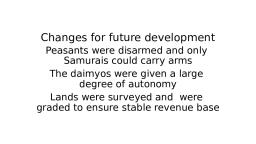
Social, Political and Economic condition of Japan during the mid 19th century, Japan was no longer traditional, but neither was it western during the mid 19th century. Japanese schools began to advance the idea that filial loyalty to the emperor set them apart from other nations. Thus allegiance to the emperor became an intrinsic part of Japanese nationalism., Social Condition, Culturally, Japan had two things going for it, 1. Neo-Confucianism grew among the elite: hierarchy of , with the ruling elite at the top, followed by the peasants who made up 80% of the population, then artisans, and merchants at the bottom. Court nobles, clerics, outcasts, entertainers, and workers of the licensed quarters fell outside this structure. Different legal codes applied to different classes, marriage between classes was prohibited, and towns were subdivided into different class areas. The social stratification had little bearing on economic conditions: many samurai lived in poverty and the wealth of the merchant class grew throughout the period as the commercial economy developed and urbanization grew. The Edo-era social power structure proved untenable and gave way following the Meiji Restoration to one in which commercial power played an increasingly significant political role., 2. Japan was homogenous ethnically: The society share same racial ethnicity, same language and a series of beliefs, Japan’s window to Europe continued to be the port city of Nagasaki where Dutch Studies continued. Otherwise, its isolation continued until mid 19th century., In 1853 American Matthew Perry threatened to bombard the Japanese capital if they did not open up to American trade and with this situation Japan opened itself to foreign influence and, however unlike China westerners residing in Japan were not subject to Japanese laws., There was a backlash against foreigners in the 1860s. The samurai group, using surplus weapons from America’s Civil War—which had just ended, defeated the shogun’s army. And the Meiji seized control in 1871 thus began a period of reforms. The so-called Meiji Restoration included the following reforms in the Japanese society:, feudalism was abolished, political power was centralized, the samurai were sent abroad to learn about western science and tech, the samurai were then abolished as a class, New nobility, One of the biggest impacts the Meiji period brought was the end of the feudal system. With a relatively loose social structure, the Japanese people were able to advance through the ranks of society more easily than before. In the Meiji period, leaders inaugurated a new Western-based education system for all young people, sent thousands of students to the United States and Europe, and hired more than 3,000 Westerners to teach modern science, mathematics, technology, and foreign languages in Japan, Political Condition:, A Tokugawa Shogun ruled through a central bureaucracy tied by feudal alliances to local daimyos(lords) and samurai (Military nobility) until the mid 19th century. Taxes were based on agriculture and the samurai were sustained by stipends paid to them by the shogunate. However after the Meiji rule was restored, the government was modernized into a centralized imperial government with limited parliamentary rule., New Constitution was created, New Parliament, Diet, created based on German models. The parliament could advise government, but ultimate authority was given to the emperor. This combination gave great power to wealthy businessmen who would influence Japanese industrialization accordingly., Only 5% of Japanese men had the wealth requirement to vote, Thus Japan borrowed from the West but retained aspects of its own identity., Economic Condition:, The economic history of Japan is most studied for the spectacular in the 1800s after the . It became the first non-Western great power, and expanded steadily until its defeat in the ., After 1854, when the first opened the country to Western commerce, Japan went through two periods of economic development. When the Tokugawa shogunate was overthrown in 1868 and the was founded, Japanese began., In the first half of the , most occurred in the and and took the form of small-scale and spontaneous . The second half of the period witnessed rapid , the development of a , and the transformation of many workers to . The use of strike action increased, and in 1897, with the establishment of a union for metalworkers, saw the beginnings of the modern ., The industrial revolution first appeared in textiles, including cotton and especially silk, which was based in home workshops in rural areas. By the 1890s, Japanese textiles dominated the home markets and competed successfully with British products in China and India, as well. Japanese shippers were competing with European traders to carry these goods across Asia and even to Europe., Japan's industrial sector grew significantly. Implementing the Western ideal of capitalism into the development of technology and applying it to their military helped make Japan into both a militaristic and economic powerhouse by the beginning of the 20th century. The government also built railroads, improved roads, and inaugurated a land reform program to prepare the country for further development. The development of banking and reliance on bank funding have been at the centre of Japanese economic development since the Meiji era. The New Currency Act of Meiji 4 did away with local currencies and established the as the new decimal currency. The national Bank was given a monopoly on controlling the in 1884, Although all social classes were legally abolished at the start of the Meiji period, income inequality greatly increased. New economic class divisions were formed between capitalist business owners who formed the new middle class, small shopkeepers of the old middle class, the working class in factories, rural landlords, and tenant farmers. The great disparities of income between the classes dissipated during and after World War II, eventually declining to levels that were among the lowest in the industrialized world.