Page 1 :
1|Page, , Chemistry Notes for class 12 Chapter 5, Surface Chemistry, , Surface Chemistry is the branch of chemistry which deals with the phenomenon that occurs on, the surfaces or interfaces, such phenomenon includes corrosion. catalysis, crystallisation, etc, , Adsorption, , Due to unbalanced attraction forces, accumulation of molecular species at the surface rather, than in the bulk of a solid or liquid is termed as adsorption. The molecular species accumulates, at the surface is termed as adsorbate and the material on the surface of which the adsorption, , takes place is called adsorbent, e.g.., , (i) O2, Hz, Cly, NB; gases are adsorbed on the surface of charcoal., (ii) Silica gels adsorb water molecules from air., , Charcoal, silica gel, metals such as Ni, Cu, Ag, Pt and colloids are some adsorbents., Important Characteristics of Adsorption, , 1. It is specific and selective in nature., 2. Adsorption is spontaneous process, therefore change in free energy (AG)is negative., , AG= AH - TAS,, , For the negative value of AG, in a system, in which randomness decreases, AH must be, negative. Hence, adsorption is always exothermic., , Adsorption of hydrogen over Pt is called occlusion., Desorption, , It is a process of removing an adsorbed substance from a surface on which it is adsorbed, is, known as desorption., , Distinction between Adsorption and Absorption, , Scanned with Cases
Page 2 :
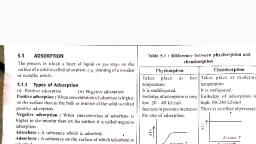
E % : pone, 1. | It involves unequat distribution of the It involves uniform distribution of the, molecular species in bulk and at the molecular species throughout the bulk., surface., 2. |It is a surface phenomenon. It occurs throughout the body of, material., , , , , , 3. |It is rapid in the beginning., , , , {t occurs at a uniform rate., , , , Sorption, , It is a process in which both adsorption and absorption take place simultaneously, the term, , sorption is simply used., , Positive and Negative Adsorption, , When the concentration of the adsorbate is more on the surface of the adsorbent than in the, , bulk, it is called positive adsorption., , On the other hand, if the concentration of the adsorbate is less relative to its concentration in, the bulk, it is called negative adsorption, e.g., when a dilute solution of KCI is shaken with, , blood charcoal, it shows negative adsorption., , Distinction between Physisorption and Chemisorption, , , , It arises when the adsorbate molecules, , , , It arises when the adsorbate molecules, , , , accumulate on the surface of adsorbent on | accumulate on the surface of adsorbent on, account of weak van der Waals’ forces. | account of chemical bonds., 2. | It occurs at low temperature. It occurs at high temperature., , , , Heat of adsorption is low and It is in the, range of 20-40 kJ/mol., , Heat of adsorption is high and it is in the, range of 80-240 kJ/mol., , , , 4. It Is reversible process., , Itis an irreversible process., , , , , , , , , , 5. |Multilayer adsorption and thus, adsorbed} Monolayer adsorption. Thus, adsorbed, layer is several molecules thick. layer is only unimolecular in thickness., Factors Affecting Adsorption, , (a) Nature of adsorbent Same gas may be adsorbed to different extents on different adsorbent., , (b) Surface area of the adsorbent Greater the surface area, greater is the extent of adsorption., , Scanned with Cases
Page 3 :
3|Page, , (c) Nature of the gas being adsorbed Greater is the critical temperature of a gas, greater are, the van der Waals’ forces of attraction and thus, greater is the adsorption., , , , Gas H; N, CO CH, CO, HCl NH, SQ,, Critical temp. (Ky 33. 126 134 190 304 324 406 430, , (d) Temperature Adsorption is an exothermic process involving the equilibrium :, Gas (adsorbate) + Solid (adsorbent) <> Gas adsorbed on solid + Heat, , Applying Le-Chatelier principle, increase of temperature decreases the adsorption and viceversa., , (e) Pressure Adsorption increases with pressure at constant temperature. The effect is large if, temperature is kept constant at low value., , (f) Activation of the solid adsorbent Activation means increasing the adsorbing power of the, solid adsorbent. This can be done by subdividing the solid adsorbent or by removing the gases, already adsorbed by passing superheated steam., , Adsorption Isotherms, , It is the plot of the mass of gas adsorbed per gram of adsorbent (x / m) versus equilibrium, pressure at constant temperature., , Freundlich Adsorption Isotherm, , It gave an empirical relationship between the quantity of gas adsorbed by unit mass of solid, adsorbent and pressure at a particular temperature. It can be expressed by the equation., , x/m=kp' ...(i), , Where, x is the mass of the gas adsorbed on mass m of the adsorbent at pressure p, k and n are, constants which depend on the nature of the adsorbent and the gas at a particular temperature., , 196 K, 244K, 273K, , 3 [>_>, , Scanned with Cases
Page 4 :
4|Page, , At low pressure, n= 1, i.e.,x/m=kp, At high pressure, n > 1, i.e., x/m=k (independent of p), , Taking logarithm of Eq. (i), x 1 :, log — = log k + — log p, m n, , Plot of log us log pis a straight line with x, m oor;, , slope - and intercept on y-axis = log k., , , , The factor.can have values between 0 and 1., n, , Freundlich Adsorption Equation for Solutions, x/m=kC'", , where, C is the equilibrium concentration, On taking logarithm of the above equation, we have, log 2 ag + dog 8, m n, , langmuir Adsorption Isotherm, , According to Langmuir, the degree of adsorption is directly ProPOrtional to e, i.e., the fraction, of surface area occupied., , x/ma0=ké, , Scanned with Cases
Page 5 :
5|Page, , , , , , __*P, , aa . 1+k,, = es, m 1+k,, , if —P is plotted against p, it will give a straight line, xi m, , | B, (ein, |_ 8 ,, , A, , , , , , At very high pressure, 1+k,=k,, , 3s. WR. constant, m kp, At low pressure, l+kp=1, “=k p, At moderate p,, = =hkp'",, m, , where, 1Lot 1., n, , Adsorption Isobars, , These are plots of x / m us temperature t at constant pressure. For physical and chemical, adsorption, they are shown below.