Page 1 :
SOLUTIONS, Solution: Solution is a homogeneous mixture of two or more than two components., Solvent: Component that is present in the large quantity in a solution is called solvent., Solvent determines the physical state in which solution exists., Solute: One or more components present in the solution other than solvent are called, solutes.(minor component), Binary solution: Homogeneous mixture of two components is called binary solution., Example: Sugar solution, ethanol in water., Aqueous Solution: When solute is dissolved in water, it is called aqueous solution., Example: Sugar solution, ethanol in water, Non-aqueous solution-When the solute is dissolved in solvent other than water, it is called, non-aqueous solution., Example: iodine dissolved in alcohol (Tincture of iodine), Types of solution:, Types of solution, *Gaseous solution, *Liquid solution, *Solid solution, , solute, Gas, Liquid, Solid, Gas, Liquid, Solid, Gas, Liquid, Solid, , Solvent, Gas, Gas, Gas, Liquid, Liquid, Liquid, Solid, Solid, Solid, , Example, Mixture of oxygen and nitrogen gases, Chlorine mixed with nitrogen gas, Camphor in nitrogen gas, Oxygen dissolved in water, Ethanol dissolved in water, Glucose dissolved in water, Solution of hydrogen in palladium, Amalgam of mercury with sodium, Copper dissolved in gold, , Concentration: is amount of solute present in given quantity of solution., EXPRESSING CONCENTRATION OF SOLUTIONS, (I), Mass percentage(w/w): It is defined as, Mass % of a component =, , x 100, , Example: 10% glucose in water by mass means that 10g of glucose is dissolved in 90g of, water resulting in a 100g solution, (II), Volume percentage(v/v): It is defined as, Volume % of a component =, , x 100, , Example: 10% ethanol solution in water means that 10ml ethanol is dissolved in water such, that the total volume of the solution is 100ml., 35 % (v/v) ethylene glycol solution used as antifreeze, it is used in cars for cooling engine.
Page 2 :
(III) Mass by volume percentage: It is the mass of solute dissolved in 100mL of the, solution., (IV) Parts per million: It is defined as the mass of the solute present in one million (10 ), parts by ,ass of the solution, Parts per million (ppm) =, x 100, The concentration of pollutants in water or atmosphere is often expressed in terms of ppm ., (V), Mole fraction :It is the ratio of number of moles of a particular component to total, number of moles of all components, Mole fraction of a component=, Example: In a binary mixture, if the number of moles of A and B are 𝑛 and 𝑛 respectively,, the mole fraction of A will be, 𝑥 =, For a solution x containing i number of components, we have, 𝑥 =, =∑, ⋯, , Note: sum of all the mole fractions is unity i.e 𝑥 + 𝑥 + ⋯ + 𝑥 = 1, (VI) Molarity(M): It is expressed as the number of moles of solute per litre of solution, Molarity(m) =, Example: 0.25 𝑚𝑜𝑙 solution of NaOH means that 0.25 mol of NaOH has been dissolved in, one litre of solution., Note: Mass % ppm, mole fraction an molality are independent of temperature,, Where as molarity is a function of temperature, (VII) Molality(m): It is defined as number of moles of solute per 1Kilogram of the solvent, Molality (m) =, Example: 1𝑚𝑜𝑙𝑘𝑔, water, , solution of KCl means that 1mol(74.5g) of KCI is dissolved in 1kg of, , , Solubility: It is the maximum amount of a substance that can be dissolved in a, specific amount of solvent t a specified temperature., It depends upon the nature of solute and solvent as well as temperature and pressure., Dissolution: When a solid solute is added continuously to the liquid solvent, some solute, dissolves and its concentration increases in the solution. This process is known as, dissolution., Crystallisation: Some solute particles in solution collide with the solid solute particles, and get separated out of solution. This process is known as crystallization., A state of dynamic equilibrium is established. At this stage the concentration of solute in, solution will remain constant under the given conditions i.e. temperature and pressure., Saturated solution: A solution in which no more solute can be dissolved at the same, pressure and temperature is called saturated solution.
Page 3 :
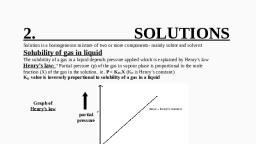
, , Unsaturated solution: A solution in which more amount of solute can be dissolved at, the same temperature is called unsaturated solution., , Factors Affecting Solubility Of a Solid in a Liquid, Effect of temperature: In a nearly saturated solution, the solubility increase with increase in, temperature if dissolution is endothermic. If dissolution is exothermic the solubility of solid, in liquid decrease with increase in temperature, (i), Effect of pressure: pressure has no any significant effect on solubility of solid in, liquid. This is because solids an liquid are highly incompressible., (ii), Nature of the solute and the solvent: A solute dissolves in a solvent if the, intermolecular interactions are similar in the two. This is expressed by saying ‘like dissolve, like’. This statement (The polar) compounds like NaCl dissolve in polar solvents like water, and very little or almost insoluble non-polar solvents like benzene, ether etc, Solubility of A Gas in a Liquid: Almost gases are soluble in water through different extents., The existence of aquatic life in lakes, rivers, sea etc is due to dissolution of oxygen gas of the, air in water. Some gases are also soluble in solvents like ethyl alcohol, benzene etc., FACTORS FFECTING THE SOLUBILITY OF A GAS IN A LIQUID, (I)Nature of the gas and the solvent: Solubility of gas in a solvent is due to the chemically, similarity between the gas and the solvent, Example: Gases like hydrogen, oxygen, nitrogen etc, dissolve in water only to a small extent, whereas gases like CO , HCl, NH etc are highly soluble, (ii)Effect of temperature: The dissolution of a gas in liquid is an exothermic process. It means, that solubility of a gas decreases with increase in temperature, (iii)Effect of pressure: The solubility of gases increase with increase of pressure. Henry gave, quantitative relation between pressure and solubility of a gas in solvent, which is known as, Henry’s (1803) law, Henry’s Law, The law states that at a constant temperature the solubility of a gas in a liquid directly, proportional to the pressure of the gas., OR, The partial pressure of the gas in vapour phase (p) is proportional to the mole fraction, of the gas(x) in the solution and is expressed as:, P=𝑲𝑯 𝑿
Page 4 :
Where 𝐾 is the Henry’s law constant. If we draw a graph between partial pressure of the, gas versus mole fraction of a gas in solution, then we should get a plot of the type., Different gases have different 𝐾 values at the same temperature. This suggests that 𝐾 is a, function of the nature of the gas., Values of Henry’s law Constant for some selected Gases in Water, Gas, He, 𝐻, 𝑁, 𝑁, 𝑂, 𝑂, , Temperature/K, 293, 293, 293, 303, 293, 303, , 𝐾 /𝑘, Bar, 144.97, 69.16, 76.48, 88.84, 34.86, 46.82, , Gas, , Temperature/K, , Argon, 𝐶𝑂, Formaldehyde, Methane, Vinyl chloride, , 298, 298, 298, 298, 298, , 𝐾 /𝑘, bar, 40.3, 1.67, 1.83x, 10, 0.413, 0.611, , From these values following result may be drawn:, (i), Henry’s constant 𝐾 is a function of the nature of the gas, (ii), Greater the value of 𝑲𝑯 𝒍𝒐𝒘𝒆𝒓 𝒊𝒔 𝒕𝒉𝒆 𝒔𝒐𝒍𝒖𝒃𝒊𝒍𝒊𝒕𝒚 𝒐𝒇 𝒕𝒉𝒆 𝒈𝒂𝒔., (iii), Value of 𝐾 increase with increase of temperature implying that the solubility, decrease with increase of temperature. This is because the aquatic species are more, comfortable in cold waters rather than in warm waters., Application Of Henry’s Law, i), , To increase the solubility of 𝐶𝑂 in soft drinks and soda water, the bottle are, sealed under high pressure, (i), Scuba divers must be provided with high concentration of dissolved gases while, breathing air at high pressure under water. When diver come towards surface, the dissolved, gases released and leads to the formation of bubbles of nitrogen in the blood. This blocks, capillaries and causes bends. To avoid bends, the tanks used by scuba divers are filled by air, with He(11.7%), 56.2% nitrogen and 32.1% oxygen., (ii), At high altitudes, partial pressure of oxygen is less than ground level. This leads to, low concentration of oxygen of the blood, so that climbers to become weak and unable think, properly, a disease called anoxia., VAPOUR PRESSURE OF LIQUID SOLUTIONS, Vapour pressure of liquid-liquid solution, When two volatile liquids 1 and 2 are mixed together in a closed vessel, both the components, would evaporate an eventually equilibrium would be established between vapour phase and, the liquid phase. Each component will exert a vapour pressure, called its partial pressure, whose value depends upon the mole fraction of the component in the solution and the fraction, of the component in the solution and the vapour pressure of that component in the pure state., These studies were made by French chemist Raoult in 1886 and he put forward the following, result known after him as Raoult’s Law.
Page 5 :
RAOULT’S LAW, The partial vapour pressure of each components of the solution is proportional to its mole, fraction present in solution., 𝑝 𝛼𝑥, 𝑝 = 𝑝 𝑥, If p is the vapour pressure of the solvent and x is the mole fraction of solvent . Where 𝑝∎ is, the vapour pressure of the pure solvent., A solution that obeys Raoult’s Law is said to be an ideal solution. This law states that for a, solution of volatile liquids the partial vapour pressure of each component of the solution is, directly proportional to its mole fraction present in the solution., , Thus, for component 1, 𝑝 𝛼𝑥, 𝑝 = 𝑝 𝑥, Where 𝑝 represent the vapour pressure of the pure component 1. Similarly for component 2, 𝑝 𝛼𝑥, 𝑝 = 𝑝 𝑥, Where 𝑝 represents the vapour pressure of the pure component 2, According to Dalton’s law of partial pressure, the total pressure (𝑷𝒕𝒐𝒕𝒂𝒍 ) over the, solution phase in the container will be the sum of the partial pressure of the components, of the solution and is given as, 𝑷𝒕𝒐𝒕𝒂𝒍 = 𝒑𝟏 + 𝒑𝟐, Substituting the values of 𝑝 𝑎𝑛𝑑 𝑝, We get, 𝑃, , =𝑥 𝑝 +𝑥 𝑝
Page 6 :
𝑃, , = (1 − 𝑥 )𝑝 + 𝑥 𝑝, , 𝑃, , =𝑝 −𝑥 𝑝 +𝑥 𝑝, , 𝑃, , = 𝑝 + (𝑝 − 𝑝 )𝑥, , Following conclusion can be drawn from the above equation, i), , Total vapour pressure over the solution can be related to the mole fraction of any, one component., ii), Total vapour pressure over the solution varies linearly with the mole fraction of, component, iii), Depending on the vapour pressure of the pure component 1and 2 total vapour, pressure over the solution decreases or increasing with the increase of the mole, fraction of component, If Y1 and Y2 are the mole fraction of the components 1 and 2 respectively in the, vapour phase then, using Dalton’s law of partial pressure., p1 = Y1 𝑃, p2 =Y2 𝑃, In general, 𝒑𝒊 = 𝒀𝒊 𝑷𝒕𝒐𝒕𝒂𝒍, RAOULT’S LAW S A SPECIAL CASE OF HENRY’S LAW, According to Raoult’s law 𝑝 𝑥 𝑝, According to Henry’s law p=𝐾 𝑥, If we compare these two, only the proportionality constant 𝐾 differs from 𝑝, But both states that partial vapour pressure is directly proportional to mole fraction of, component. Thus Raoult’s law becomes a special case of Henry’s law in which 𝐾 = 𝑝, VAPOUR PRESSURE OF SOLUTIONS OF SOLIDS IN LIQUIDS, Another type of solutions consists of solid dissolved in liquid., Example: Sodium chloride, glucose, urea and cane sugar in water and sulphur dissolved in, carbon disulphide., Some physical properties of these solutions are quite different from those f pure solvents for, example, vapour pressure., In a pure liquid the entire surface is occupied by the molecules of the liquid., If a non-volatile solute is added to a solvent to give a solution. The vapour pressure of the, solution decreases at a given temperature. This is explained as follows. When a non-volatile, solute is dissolved in solvent the surface has both solute and solvent a same temperature. In, the solution the surface has both solute and solvent molecules, there by the fraction of the, surface covered by the solvent molecules gets reduced. Thus the vapour pressure is also, reduced., When a solid is dissolved in liquid, the escaping capacity of liquid decreases. Therefore, vapour pressure decreases. When the concentration of solute (solid) in a solution increases,, vapour pressure goes on decreases., For example, decrease in the vapour pressure of water by adding 1.0mol of sucrose to one kg, of water is nearly similar to that produced by adding 1.0mol of urea t the same quantity of, water at the same temperature., Raoult’s law in its general from can be started as, for any solution the partial vapour pressure, of each volatile component in the solution is directly proportional to its mole fraction.
Page 7 :
In a binary solution, let us denote the solvent by and solute by 2, when the solute in nonvolatile only the solvent molecules are present in vapour phase and contribute to vapour, pressure., Let p1 be the vapour pressure of the solvent, x1 be the mole fraction 𝑃° be its vapour pressure, in the pure state. Then according to Raoult’s law, 𝑝 𝛼𝑥, 𝑝 = 𝑥 𝑃°, , The proportionality constant is equal to the vapour pressure of pure solvent 𝑃°, If a solution obeys Raoult’s law for all concentration, its vapour pressure would vary linearly, from zero to the vapour pressure of the pure solvent., A plot between vapour pressure and the mole fraction of the solvent is linear., IDEAL AND NON-IDEAL SOLUTIONS, Ideal solutions: The solutions which obey Raoult’s law over the entire range of concentration, are known as ideal solutions. When the forces of attraction between A-A, B-B is similar to AB, then A and B will form ideal solution., An ideal solution will satisfy the following conditions:, (i)Raoult’s law is obeyed i.e 𝑃, , =𝑝 +𝑝, , (ii)∆𝐻, = 0, There should not be enthalpy change (i.e. not heat is evolved or absorbed), when the two components are mixed., (iii), , ∆𝑉, = 0, there will be no change in volume on mixing the two components (the, volume of solution would be equal to the sum of the volumes of two components), , A perfectly ideal solution is rare but some solutions are nearly ideal in behaviour., Example: Solution of n-hexane and n-heptne, bromoethane and chloroethene benzene and, toluene etc.
Page 8 :
Non-ideal solutions: When a solution does not obey Raoult’s law over the entire range of, concentration, then it is called non-ideal solution. The vapour pressure of such solution is, either higher or lower; it exhibits negative deviation from Raoult’s law. The plots of vapour, pressure as a function of mole fraction for such solutions are shown below., , NON-IDEAL SOLUTION SHOWING POSITIVE DEVIATION, In case of positive deviation from Raoult’s law A-B interactions are weaker than those, between A-A or B-B. So escaping tendency of molecules increases and leads to increase in, vapour pressure and results in positive deviation., Examples: (i) Mixture of ethanol an acetone (ii) Mixture of carbon disulphide and Acetone, NON-IDEAL SOLUTIONS SHOWING NEGATIVE DEVIATION, In case f negative deviation from Raoult’s law, the intermolecular attractions between A-A, and B-B are weaker than those between A-B. S escaping tendency of molecules decreases, and leads to decrease in vapour pressure. This results in negative deviations, Examples: (i) Mixture of phenol and aniline (ii) Mixture of chloroform and acetone, (iii)Chloroform + Benzene, , (iv) Chloroform + diethyl ether, , (v)Acetone + Aniline, , (vi)HCl +water, , (vii)𝐻𝑁𝑂, , + water, , (viii) Acetic acid + Pyridine
Page 9 :
Difference between ideal and non-ideal solutions:, Ideal solutions, 1.Which obeys Raoult’s law, 2. During mixing volume does not, change(∆𝑉=0), 3.During mixing heat does not change(∆𝐻=0), 4.During mixing force of attraction does not, change, 5.Plot between vapour pressure and mole, fraction is linear, 6.𝑝 = 𝑋 × 𝑝° & 𝑝 = 𝑋 × 𝑝°, 7.Compnents A & B can be completely, separated by fractional distillation, , Non-ideal solutions, Which do not obeys Raoult’s law, During mixing volume changes(∆𝑉 ≠0), During mixing heat changes(∆𝐻 ≠0), During mixing force of attraction changes, But the plots are curve having maxima, and minima, 𝑝 ≠ 𝑋 × 𝑝° & 𝑝 ≠ 𝑋 × 𝑝°, Components A & B cannot be completely, separated by fractional distillation because, finally they form azeotropic mixture, , AZEOTROPES: Binary mixtures having same composition in liquid and vapour phase, and boils at constant temperature. Or Liquid mixtures which distil over without changes in, composition are called constant boiling mixtures or Azeotropic mixtures or Azeotropes., Examples: (i) 95.5% 𝑪𝟐 𝑯𝟓 𝑶𝑯 𝒂𝒏𝒅 𝟒. 𝟓% 𝑯𝟐 𝑶(rectified spirit), (ii)98% conc. 𝐻 𝑆𝑂 𝑎𝑛𝑑 2% 𝐻 𝑂, There are two types of azeotropic mixture. They are, (i)Minimum boiling azeotropes: These are solutions which show maximum positive, deviation from Raoult’s law, Example: 95.5% 𝐶 𝐻 𝑂𝐻 𝑎𝑛𝑑 4.5%𝐻 𝑂, (ii) Maximum boiling azeotropes: These are solutions which show maximum negative, deviation from Raoult’s law, Example: 68% 𝐻𝑁𝑂 𝑎𝑛𝑑 32% 𝐻 𝑂(𝐵𝑃 = 393.5𝐾), , COLLIGATIVE PROPERTIES AND DETERMINATION OF MOLAR MASS, [colligative: From latin: Co means together ligare means to bind], Properties that depend on the number of solute particles or concentration of particles, (molecules ion, etc,) present in a solution and not on the nature of the particles., The important colligative properties are, (i)Relative lowering of vapour pressure of the solvent, (ii)Osmotic pressure of the solution, (iii)Elevation of boiling point of the solvent, iv)Depression of freezing point of the solvent
Page 11 :
ELEVATION OF BOILING POINT, The vapour pressure of a liquid increases with increase of temperature., The boiling point of a liquid is the temperature at which the vapour pressure o the liquid, becomes equal to the atmospheric pressure., Example: Vapour pressure of water at 100℃(373𝐾)𝑖𝑠 1.013𝑏𝑎𝑟 = (1𝑎𝑡𝑚) . This is the, reason that water boils at 373K as at this temperature. Its vapour pressure becomes equal to, one atmospheric pressure (i.e. 1.013bars), It is found that the boiling point of the solution is always higher than that of the pure solvent., The increase is called the elevation in boiling pint. The reason for the elevation in boiling pint, may be explained as follows:, The vapour pressure of the solution is lower than that of the pure solvent and vapour pressure, increases with increase in temperature. Hence the solution has to be heated more to make the, vapour pressure equal to the atmospheric pressure. Thus the boiling point of a solution is, always higher than that of the boiling point of the pure solvent., The elevation of boiling pint also depends on the number of solute molecule rather than their, nature, , Let 𝑇 ° be the boiling pint f pure solvent and 𝑇 be the boiling pint of solution. The increase, in the boiling point., ∆𝑇 = 𝑇 − 𝑇 ° is known as elevation of boiling point, For diluted solutions, the elevation of boiling point (∆𝑇 ) is directly proportional to the, molality(m) of the solution., Thus, , ∆𝑇 𝛼𝑚, ∆𝑇 = 𝐾 𝑚, , Here m (molality) is the number of moles of slue dissolved in 1kg of solvent and the constant, of proportionality 𝐾 is called boiling point elevation constant or molal elevation constant., The unit of 𝐾 : K kg 𝑚𝑜𝑙 . If 𝑤 gram of solute of molar mass 𝑀 is dissolved in 𝑤, grams of solvent, then molality ‘m’ of the solution is given by the expression., , m=, , 𝑤2 /𝑀2, =, 𝑤1 /1000, , /, ×
Page 12 :
Substituting the value of molality in equation,, ∆𝑇 = 𝐾 𝑚, ∆𝑇 =, , 𝐾 𝑤 /1000, 𝑤 ×𝑀, , 𝑀 =, , 𝐾 𝑤 /1000, 𝑤 × ∆𝑇, , Thus by knowing the value of 𝐾 , 𝑤 , 𝑤 and ∆𝑇 the molecular mass of the solute can be, calculated., , DEPRESSION OF FFREEZING POINT, The lowering of vapour pressure of a solution causes a lowering of the freezing point, compared to that of the pure solvent., The freezing point of a substance may be defined as the temperature at which the vapour, pressure of the substance in its liquid phase is equal to its vapour pressure in the solid phase., At the freezing pint, the solid phase is in the dynamic equilibrium with the liquid phase., According to Raoult’s law when a non-volatile solid is added to the solvent, its vapour, pressure decrease and the hence the freeing point of the solvent decreases., , Let 𝑇 ° be the freezing point solvent and 𝑇 be its freezing point of the solution. The decrease, in freezing point is known as depression in freezing point., ∆𝑇 =𝑇 ° -𝑇, Depression of freezing point (∆𝑇 ) for dilute solution (ideal solution) is directly proportional, to molality (m) of the solution
Page 14 :
Osmosis: The passage of solvent molecules through a semi permeable membrane separating, two solutions of different concentrations is called osmosis., Semi-permeable membrane: A membrane which allows a selective passage of chemical, species(only solvent) is called semi-permeable membrane., Example: Pig’s bladder or parchment paper or synthetic such as cellophane, Exosmosis: When the membrane allows solvent molecules to come out through the, membrane, it is called exosmosis (exo-osmosis), Endomosis: When the membrane permits the solvent molecules to enter inside, it is called, endosmosis., OSMOTIC PRESSURE: The extra pressure applied on solution that just stops the flow of, solvent(osmosis) is called osmotic pressure of the solution., The osmotic pressure of a solution is the excess pressures that must be applied to a solution t, prevent osmosis. i.e., stop the passage of solvent molecules high a semi permeable membrane, into the solution. The osmotic pressure depends on the concentration of the solution., , For dilute solutions, osmotic pressure is proportional to the molarity, C of the solution at a, given temperature (T). Thus., 𝜋 = 𝐶𝑅𝑇, Hence 𝜋 𝑖𝑠 𝑡ℎ𝑒 𝑜𝑠motic pressure and R is the gas constant., 𝜋=, , 𝑛, 𝑅𝑇, 𝑉, , Hence V is volume of a solution is litres containing 𝑛 moles of solute. If 𝑤 grams of solute, of molar mass, 𝑀 is present in the solution, then, , 𝑛 =, 𝜋𝑉 =, , and we can write, or, , 𝑀 =
Page 15 :
Thus knowing the values of 𝑤 , 𝑇 , 𝜋 𝑎𝑛𝑑 𝑉 𝑤𝑒 𝑐𝑎𝑛 𝑐𝑎𝑙𝑐𝑢𝑙𝑎𝑡𝑒 𝑡ℎ𝑎𝑡 𝑚𝑜𝑙𝑎𝑟 mass of the, solute., Note: This method is widely used to determine molar masses of proteins, polymers and other, macromolecules., *Isotonic solution: Two solutions having same osmotic pressure at a given temperature are, isotonic solutions., *Hypotonic solution: If one solution is with lower osmotic pressure, with respect to more concentrated solution., , is called hypotonic, , *Hypertonic solution: The more concentrated solution is said to be hypertonic with respect, to the dilute solution., Explanation Of Some Phenomena On The Basis Of Osmosis, (i)Raw mangoes shrink into pickle when placed in concentrated common salt solution (brine)., This is due to outflow of water through semi permeable membrane of mangoes due to, osmosis., (ii) Withered flowers revive when placed in fresh water. This is also due to osmosis., (iii)People consuming more salt or salty food develop swelling or puffiness of their tissues a, disease caked ‘edema’ . This is due to retention of water in the tissue cells and intercellular, space on account of osmosis., (iv)Preservation of meat against bacterial action is done by salting and that of fruit by adding, sugar. This is also explained by osmsis., Reverse Osmosis And Water Purification, If a pressure higher than the osmotic pressure is applied on the solution, the solvent will flow, from the solution into the pure solvent, through the semi permeable membrane. This process, is called reverse osmosis., , An important application of reverse osmosis is in the desalination of sea water. That is, removal of salts from sea water. A porous membrane is a film of cellules acetate place over a, suitable support.
Page 16 :
Abnormal Molar Mass, When the molecular mass, calculated with the help of colligative property is, different from theoretical molecular mass, it is called abnormal molecular mass., *Van’t Hoff’s Factor, To calculate the extent of association or dissociation Vant’s Hoff’s in 1880, introduced a factor ‘i’ called van’t hoff’s factor., i=, i=, i=, , Normal molar mass, Abnormal mlar mass, , Observed colligative property, Calculated colligative property, , Total number of moles of particles after association/dissoiation, Number of moles of paticles before association/dissociation, , In the case of association, value of ‘i’ is less than unity while for dissociation it, is greater than unity., For example, the value of ‘i’ for ethanoic acid in benzene is nearly 0.5, Modification of colligative properties:, Relative lowering of vapour pressure of solvent,, , °, °, , =i, , Elevation of boiling point ∆𝑇 =i𝐾 𝑚, Depression of freezing point, ∆𝑇 = i𝐾 𝑚, Osmotic pressure of solution, π = in RT/V, The following table depicts values of the factor i, for several electrolytes. For, KCl, NaCl and 𝑀𝑔𝑆𝑂 i approach 2 as the solution becomes very dilute. S, expected, the value of i gets close to 3 for 𝐾 𝑆𝑂, Salt, NaCl, kCl, MgSO4, , 0.1m, , 0.01m, , 1.87, 1.85, 1.21, , 1.94, 1.94, 1.53, , Value of i, 0.001m, 1.97, 1.98, 1.62, , Vant’t Hoff’s factor i, for, complete, dissociation of solute, 2.00, 2.00, 2.00
Page 17 :
K2 SO4, , 2.32, , 2.70, , 2.84, , 3.00, , ABNORMAL MOLAR MASS WHEN THE SOLUTE UNDERGOES ASSCIATION, IN THE SOLUTION, Molecules of ethanoic acid (acetic acid) dimerise in benzene due to hydrogen bonding. This, normally happens of solvents of low dielectric constant., In this case number of particles is reduced. Association of molecules can be represented as, follows., 2CH3COOH, , ⇌, , (CH3COOH) 2, , Hence the experimentally observed value of the colligative property is lower and the, molecular mass is higher than the expected value., ABNORMAL MASS, DISSOCIATION, , WHEN, , THE, , SOLUTE, , PARTICLE, , UNDERGOES, , In case of KCl in the aqueous solution each molecule dissociates to give two ions, (KCL→ 𝐾 +𝐶𝑙 ). Thus as the number of particles becomes double, the observed value of, colligative is double than expected value and the molecular mass is half of the expected, value.