Page 1 :
SHS, , General Chemistry 1, Quarter 3: Week 1 - Module 1, Kinetic Molecular Model
Page 2 :
General Chemistry 1, Grade 11 Quarter 3: Week 1 - Module 1: Kinetic Molecular Model, First Edition, 2021, , Copyright © 2021, La Union Schools Division, Region I, , All rights reserved. No part of this module may be reproduced in any form, without written permission from the copyright owners., , Development Team of the Module, , Author: Jovy B. Licos MT-II, Editor: SDO La Union, Learning Resource Quality Assurance Team, Illustrator: Ernesto F. Ramos Jr., P II, , Management Team:, Atty. Donato D. Balderas, Jr., Schools Division Superintendent, Vivian Luz S. Pagatpatan, Ph.D, Assistant Schools Division Superintendent, German E. Flora, Ph.D, CID Chief, Virgilio C. Boado, Ph.D, EPS in Charge of LRMS, Rominel S. Sobremonte, Ed.D, EPS in Charge of Science, Michael Jason D. Morales, PDO II, Claire P. Toluyen, Librarian II
Page 3 :
General, Chemistry 2, Quarter 3 – Week 1 - Module 1, Kinetic Molecular Model
Page 4 :
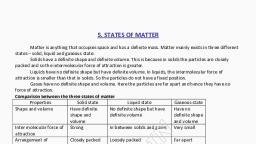
Target, , The lesson explores the kinetic molecular theory and how it pertains, to the properties of solids and liquids. You'll learn the Kinetic Molecular Theory, explains the properties of solids and liquids in terms of intermolecular forces of, attraction and the kinetic energy of the individual particles. After reading this, learning material, you are expected to:, Use the kinetic molecular model to explain properties of liquids and, solid STEM_GC11IMFIIIa-c-99), Describe and differentiate the types of intermolecular forces, (STEM_GC11IMFIIIa-c-100), , Before going on, check how much you know about this topic., Answer the pretest on the next page and write your answer in, ¼ sheet of paper., , JUMPSTART, Direction: Select the letter of the correct answer and write in ¼ sheet of paper., 1. Which of the following is NOT a characteristic of liquids?, A. Liquids have the ability to flow., B. The particles of a liquid are not attracted to each other., C. The particles of liquids are closer together than particles of gases., D. Liquids conform to the shape of their container.
Page 5 :
2. Which of the following explains that liquids cannot be compressed easily?, A. The particles are too far apart., B. The particles are arranged in a fixed position., C. The particles are too close together to be squished any closer., D. The particles are free to move and simply move away from each, other when we try to squish them, 3. When NaCl dissolves in water, aqueous Na+ and Cl ions result. What do you, call the force of attraction that exists between Na+ and H2O?, A. dipole-dipole, , C. hydrogen bonding, , B. ion-ion, , D. ion-dipole, , 4. Which of the following is NOT a characteristic of liquids?, A. Liquids have the ability to flow., B. The particles of a liquid are not attracted to each other., C. The particles of liquids are closer together than particles of gases., D. Liquids conform to the shape of their container., 5. Kinetic-molecular theory makes several assumptions about _______________., A. The size and energy of the molecules., B. The motion and energy of the molecules., C. The motion and size of the molecules, D. The size and weight of the molecules, , Discover, Kinetic Molecular Theory, Take a glass of water. Drop a few drops of red food coloring in it. What happens?, The red food coloring drops should make their way down the glass of water slowly,, spread out and finally tint all of the water a reddish color. Why does this happen?, It happens because both substances are made out of molecules that are constantly, moving. These molecules have energy; one of the fundamental principles of the, kinetic molecular theory.
Page 6 :
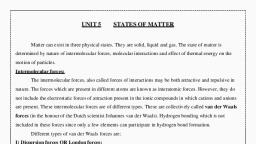
The Kinetic Molecular Theory (KMT) is a model used to explain the, behavior of matter. It is based on a series of postulates., Some of the postulates of KMT are as follows:, •, , Matter is made of particles that are constantly in motion. This energy in, motion is called kinetic energy., , •, , The amount of kinetic energy in a substance is related to its temperature., , •, , There is space between particles. The amount of space in between particles, is related to the substance's state of matter., , •, , Phase changes happen when the temperature of the substance changes, sufficiently., , •, , There are attractive forces in between particles called intermolecular, forces. The strength of these forces increase as particles get closer together., , Now, let us investigate two kinds of forces, or attractions, that operate in a, molecule—intramolecular and intermolecular. Intramolecular forces are the, forces that hold atoms together within a molecule. Intermolecular forces are forces, that exist between molecules., , INTERMOLECULAR FORCES (IMF) are relatively weaker than the, forces within the molecules forming bonds (intramolecular forces) Intramolecular, Forces hold atoms together in a molecule. The intermolecular forces of attraction in, a pure substance are collectively known as van der Waals forces; Dipole-dipole,, Hydrogen bonding, Ion-dipole, London dispersion, 1. Dipole-dipole forces. These forces occur when the partially positively charged part, of a molecule interacts with the partially negatively charged part of the neighboring, molecule. The prerequisite for this type of attraction to exist is partially charged, ions—for example, the case of polar covalent bonds such as hydrogen, chlorideDipole-dipole interactions are the strongest intermolecular force of attraction.
Page 7 :
2. Hydrogen bonding: This is a special kind of dipole-dipole interaction that occurs, specifically between a hydrogen atom bonded to either an oxygen, nitrogen, or, fluorine atom. The partially positive end of hydrogen is attracted to the partially, negative end of the oxygen, nitrogen, or fluorine of another molecule. Hydrogen, bonding is a relatively strong force of attraction between molecules, and, considerable energy is required to break hydrogen bonds. This explains the, exceptionally high boiling points and melting points of compounds like water and, hydrogen fluoride. Hydrogen bonding plays an important role in biology; for, example, hydrogen bonds are responsible for holding nucleotide bases together, in and RNA., , 3. Ion-dipole . The ions and the oppositely charged ends of the polar water, molecules overcome the attraction between ions themselves. Each ion becomes, separated and water molecules cluster around it., 4., , 1. London dispersion forces, under the category of van der Waal forces: These are, the weakest of the intermolecular forces and exist between all types of molecules,, whether ionic or covalent—polar or nonpolar. The more electrons a molecule has,, the stronger the London dispersion forces are. For example, bromine has more
Page 8 :
electrons than chlorine, so bromine will have stronger London dispersion forces, than chlorine, resulting in a higher boiling point for bromine, compared to, chlorine.. Also, the breaking of London dispersion forces doesn’t require that much, energy, which explains why nonpolar covalent compounds like methane oxygen,, and nitrogen—which only have London dispersion forces of attraction between the, molecules—freeze at very low temperatures., , The types of intermolecular forces in a liquid depend on the chemical, make up of the liquid itself. Strength of intermolecular force is related to the type of, intermolecular force, but it is also affected by the amount of kinetic energy in the, substance. The more kinetic energy, the weaker the intermolecular forces. Liquids, have, , more, , kinetic, , energy than solids, so, the, , intermolecular, , forces between liquid, particles tend to be, weaker. Liquids do not have, , a simple or regular structure, but many of their, , properties can be explained qualitatively by viewing them at the particulate level., Below are the properties of liquids and their intermolecular forces., 1. Surface tension allows needles and paper clips to float in water if placed carefully, on the surface. It also explains why drop of water are spherical in shaped. These, intermolecular forces tend to pull the molecules into the liquid and cause the surface, to tighten like an elastic film or “skin”. Molecules within a liquid are pulled in all, directions by intermolecular forces. Molecules at the surface are pulled downward, and sideways by other molecules, not upward away from the surface. The liquids, that have strong Intermolecular forces also have high surface tension, 2. Capillary action is the tendency of a liquid to rise in narrow tubes or be drawn, into small openings such as those between grains of a rock. Capillary action, also, liquid to rise, is a result of intermolecular attraction between the liquid and solid
Page 9 :
materials. Example of capillary actions., There are two types of forces are involved in capillary action:, Cohesion is the intermolecular attraction between like molecules (the, liquid molecules).And Adhesion which is an attraction between unlike molecules, (such as those in water and in the particles that make up the glass tube)., 3.Viscosity. The viscosity of liquid Depends on their intermolecular attraction. The, stronger the intermolecular force, the higher is the liquid’s viscosity. Example is oil, which has long-chained substances that has greater intermolecular forces because, there are more atoms that can attract one another, contributing to the substance’s, total attractive forces. Also with honey, a concentrated solution of sugar, is also highly, viscous because of the hydrogen bonding that forms as a result of the numerousOH groups of sugar molecule., Substances with relatively strong intermolecular forces will have low vapor, pressure because the particles will have difficulty escaping as a gas., Example:, 1.Wate (H O),, 2, , (Hydrogen Bonding) has vapor pressure of 0.03 atm., , 2.Ethyl Ether, , (C H O), dipole-dipole & London Force ) has vapor pressure at 0.68, 4 10, , atm., 4. Boiling point. The boiling point of a liquid is the temperature at which its vapor, pressure is, , equal to the external or atmospheric pressure .Increasing the, , temperature of a liquid raises the kinetic energy of its molecules, until such point, where the energy of the particle movement exceeds the intermolecular forces that, hold them together.The greater intermolecular force, the higher the energy needed to, increase the kinetic energy of the molecules to break these forces., 5. Molar Heat of vaporization ( H, , vap, , ) is the amount of heat required to vaporize one, , mole of substance at its boiling point.T he application of heat disrupts the, intermolecular forces of attraction of the liquid molecules and allows them to, vaporize. Boiling point generally increases as molar heat of vaporization increases., 6. The, molecules., , H, , vap, , is also determined by the strength of intermolecular forces between
Page 10 :
Let us continue on the properties of solids and their intermolecular forces. As, you should remember from the kinetic molecular theory, the molecules in solids are, not moving in the same manner as those in liquids or gases. Solid molecules simply, vibrate and rotate in place rather than move about. Solids are generally held together, by ionic or strong covalent bonding, and the attractive forces between the atoms,, ions, or molecules in solids are very strong. In fact, these forces are so strong that, particles in a solid are held in fixed positions and have very little freedom of, movement. Solids have definite shapes and definite volumes and are not, compressible to any extent., There are two main categories of solids—crystalline solids and amorphous, solids. Crystalline solids are those in which the atoms, ions, or molecules that make, up the solid exist in a regular, well-defined arrangement. The smallest repeating, pattern of crystalline solids is known as the unit cell, and unit cells are like bricks, in a wall—they are all identical and repeating. The other main type of solids are called, the amorphous solids. Amorphous solids do not have much order in their, structures. Though their molecules are close together and have little freedom to, move, they are not arranged in a regular order as are those in crystalline solids., Common examples of this type of solid are glass and plastics., There are four types of crystalline solids:, Ionic solids—Made up of positive and negative ions and held together by electrostatic, attractions. They’re characterized by very high melting points and brittleness and are, poor conductors in the solid state. An example of an ionic solid is table salt, NaCl., Molecular solids—Made up of atoms or molecules held together by London, dispersion forces, dipole-dipole forces, or hydrogen bonds. Characterized by low, melting points and flexibility and are poor conductors. An example of a molecular, solid is sucrose., Covalent-network (also called atomic) solids—Made up of atoms connected by, covalent bonds; the intermolecular forces are covalent bonds as well. Characterized, as being very hard with very high melting points and being poor conductors., Examples of this type of solid are diamond and graphite, and the fullerenes. As you, can see below, graphite has only 2-D hexagonal structure and therefore is not hard, like diamond. The sheets of graphite are held together by only weak London forces!
Page 11 :
EXPLORE, , Here are some enrichment activities for you to strengthen the, basic concepts you have learned from this lesson, Activity 1. Travelling Water Experiment! Property of Liquid and their Intermolecular, Forces.The concept of the following experiment can be used in our day to day, activities., I., , To demonstrate cohesion and adhesion of water., , II., , Materials: Two large plastic cups, Thick cotton string of length 2 ½ feet to, 3 feet., , III., , Procedure:, , 1. Fill one of the beaker with ¾ full of water., 2. Soak the thick cotton string in water until it is completely wet., 3. Put one end of the string into the cup with water and the other end in the, empty cup., 4. Add a little food colour to water in the cup so that we can see water travelling, through the string. Raise the cup with water slightly., Observation:, __________________________________________________________________________, __________________________________________________________________________., , Activity 2. Intermolecular Forces, I., , To demonstrate the types of intermolecular forces., , II., , Materials: Liquids: water, alcohol and honey/shampoo, 3 droppers, 3 pcs coins, 3 paint brush (small), bond paper, 10 g of sodium, chloride (NaCl)/ salt, 3 small glass containers, spatula
Page 12 :
III., , Procedure:, 1. Put several drops of water to cover the whole coin. Continue putting, drops of water until it spills. Do the same with another coin using honey, and on the third coin using alcohol., Observations:, ____________________________________________________________________, ____________________________________________________________________, 2. Brush s strip of water on the clean sheet of bond paper and observe, how long it will evaporate. Do the same procedure using honey and, alcohol., Observations:, ____________________________________________________________________, ____________________________________________________________________, 3. Using the three different liquids, add the sodium chloride separately, and, , observe, , if, , it, , dissolves, , in, , each, , liquid., , Observations:, , ___________________________________________________________________, ___________________________________________________________________, You are really doing great! That’s amazing!, , Deepen, , At this point, continue assessing your learning by accomplishing the activity, below., Enrichment Activity: “The Scientist Got Talent”., Compose a poem or a song (indicate the tune), at least 2 stanzas having four, lines, showing or applying the concepts about Kinetic Molecular Theory or, intermolecular force and bonding.
Page 13 :
POEM/SONG RUBRIC, Beginning, , Developing, , Accomplished, , Exempler, , (7 pts), , (8 points), , (9 pts), , (10 pts), , Organiz, , The sequencing of The sequencing The, , ation, , words, , and of, , phrases, , words, , The, , and sequencing, , of sequencing, , is phrases is very the words and words, , random., , The confusing,, , and phrases, , evidence, , is, , logical, and the, , of need to use his logical, and the reader is able, , thoughtful, , or, , ordering of ideas., , knowledge, , her, , own reader is able to, , determine, , follow, , the, , to to to follow the ordering, the ordering, , ordering, , of ideas, , ideas., poem, , and, , is phrases, , reader can find the reader may somewhat, no, , of, , of, , of ideas easily, with, , minimal efforts, , Word, , The, , Choice, , general, , and, , ordinary terms to ordinary, , Main, , describe, , Idea, , object; the words idea., , develop a main develop a main, , do, , idea, , not, , uses The poem uses The poem uses The poem uses, or general, , or several, terms descriptive, , the to develop main words, develop, , main idea., Spelling, , Numerous, , spelling, , errors spelling, , to words, , impede the reader impede, , or, , message., are There are very, , spelling errors, few, , spelling, , the which may or errors., , from, , reader, , understanding, , understanding, , poem’s the, , to, , or idea, , There, errors, , precise,, , and descriptive, , message, , Numerous, , the, , many, , from may, , not, , be are, , developmentall, , poem’s y, , They, , developmentall, , appropriate. y, , message.Errors, , message., , are, , of the errors are, , do not impede impede, , developmentally, , developmentally, , the, , appropriate, , corrected., , and have, noticed, corrected., , should of the poem, been, and, , do, , not, the, , reader’s reader’s, , and appropriate, but understanding, , should have been others, noticed, , Some However, they and, , appropriate, , understanding, of the poem.
Page 14 :
Gauge, , Direction: Read carefully each question. Use a separate sheet of paper for your, answer. Write the letter of the best answer.(15 pts), 1. Kinetic-molecular theory makes several assumptions about _______________., A. The size and energy of the molecules, B. The motion and energy of the molecules, C. The motion and size of the molecules, D. The size and weight of the molecules, 2. What do you call the force when the partially positive end of one molecule is, attracted weakly to partial negative end?, A. coulomb's force, , B. electrostatic force, , C. dipole-dipole interaction, , D. ionic bond, , 3. Which of the following is NOT a characteristic of liquids?, A. Liquids have the ability to flow., B. The particles of a liquid are not attracted to each other., C. The particles of liquids are closer together than particles of gases., D. Liquids conform to the shape of their container., 4. Which of the following explains that liquids cannot be compressed easily?, A. The particles are too far apart., B. The particles are arranged in a fixed position., C. The particles are too close together to be squished any closer., D. The particles are free to move and simply move away from each, other when we try to squish them., 5. In liquids, the attractive intermolecular forces are __________., A. very weak compared with kinetic energies of the molecules, B. strong enough to hold molecules relatively close together, C. strong enough to keep the molecules confined to vibrating about their, fixed lattice points, D. not strong enough to keep molecules from moving past each other
Page 15 :
6. When NaCl dissolves in water, aqueous Na+ and Cl ions result. What do you, call the force of attraction that exists between Na+ and H2O, A. dipole-dipole, , B. hydrogen bonding, , C. ion-dipole, , D London dispersion force, , 7. Which of the following contribute to the reason behind the origin of surface, tension?, A. only cohesive forces, B. only adhesive forces, C. neither cohesive forces nor adhesive forces, D. both cohesive forces and adhesive forces, 8. What do you call the weakest type of intermolecular forces and solely for, nonpolar molecules and noble gases?, A. Dipole-dipole force, , B. Hydrogen bonding, , C. Ion-dipole force, , D. London dispersion force, , 9. Which statement is true about the viscosity of a liquid?, A. The stronger the intermolecular forces, the more viscous the liquid., B. The smaller the molecules, the more viscous the liquid., C. The higher the temperature, the more viscous the liquid., D. All of the answers are true., 10. What do you call the force that polar molecules containing H chemically, , bonded to a small and highly electronegative nonmetal atom such as N, O,, and F?, A. dipole-dipole, , B. hydrogen bonding, , C. ion-dipole, , D. London dispersion force, , 11.What was the Kinetic Molecular Theory designed to explain?, A. the behavior of matter, , B. what temperature measures, , C. types of intermolecular forces, , D. crystalline structure of solids
Page 16 :
12. What is a dipole-dipole force?, A. The force that occurs between the oppositely charged poles of polar, molecules., B. The force that occurs within a polar molecule because of the oppositely, charged poles., C. The attractive force that occurs between an ion and a dipole., D. The force that occurs between non-polar molecules., 13. By which phenomenon does the water rise from the roots to leaves of plants?, A. heat of vaporization, , B. capillary action, , C. surface tension, , D. viscosity, , 14. Which of the following describes surface tension in water?, A. surface tension occurs due to ionic bonding, B. surface tension is caused by water molecules repelling one another, C. surface tension allows water to support small objects if they are placed, carefully on its surface, E. surface tension of water is weakened by hydrogen bonding, 15. Which of the following scenarios is an example of cohesion?, A. water molecules stick to the surface of a mirror., B. water sticks to the walls of blood vessels., C. water molecule stay on the tip of the needle because the water is attracted, to the surface of the needle., , D. water molecules stick to one another and form a bead.
Page 17 :
Pre-Test, 1.B, , 2.D, , 3. D, , 4. B, , 5. B, , Explore, Activity 1. Observation : Water will cling to the string. We will see water droplets entering, slowly in the empty cup. Water will start collecting in the empty cup drop by drop. The level of, water in the cup with water will decrease and the level of water in the empty cup will increase., , Activity 2., Observation 1: Water – intact and creates a dome forming on top due to hydrogen bonding, Honey -intact due to dipole-dipole force/hydrogen bonding, Alcohol- dispersed or scattered due to London Dispersion Force, Observation 2: Water -second to evaporate, Honey-3rd or last, Alcohol -1st to evaporate, Observation 3: Water – salt dissolves in water – ion-dipole, , - London Dispersion, , Alcohol – insoluble, , - dipole-dipole, , Honey – insoluble, Deepen Answers may vary, Gauge, 12. A 13. B, , 11. A, , 2. C, , 1.B, , 3. B, , 4. D, 14. C, , 5.A, , 6. C, , 7. D, , 8. D, , 9. A, , 10. C, , 15. D, , ANSWER KEY