Page 2 :
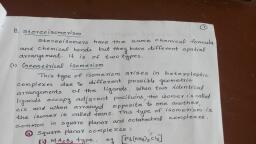
sdination Compounas, , some other pairs showing this type of j i, i) [PtCl2(NH3)4]Brg and (PeoesNHs) ree an, , (i [CoClz (NH3)4]NO. and [CoclNO») (NEI ), , (ii) (POH) (NH)41S0, and IPt(SO,)¢NHH Dal or, , 2. Solvate Isomerism (Hydrate isomerism) ‘ Whe, ia ist nvolved as a solvent, solvate isomerism is called, , ate isomerism. The water molecules can act as li a, , Mell as simple molecules of water of crystallisation, When, wo complexes differ in this aspect, they exhibit hydrate, , wemerist. For example, with the formula CrCl;-6H,0,, 20,, , following three isomers are known to exist,, f UGrHiO)4ICly, exaaquachromium(| 5 ., © [CeO Hee ne ote, pentaaquachloridochromium (IID chloride monohydrate, _— [er(t,0,cl,1cLaH,0 | Meee"), tetraaquadichloridochromium (III) chloride dihydrate, These isomers differ from each other " cy, of water molecules coordinated to central chromium, atom. They possess different colours and may further be, differentiated by conductivity measurements., Some other complexes showing hydrate isomerism are, () [CoC](H20) (NH3)4]Clz and [CoCl,(NH3)4]Cl-H,0, (ii) [CrCl,(H20)2(py) 2]Cl and [CrCl3 (H,0)(py)2]H,0, 3. Linkage or structural salt isomerism : This isomerism, arises when the ligands have two different atoms available, for coordinating with metal ion, i.e., ligands are ambident., Inone isomer one donor atom of the ligand coordinates with, the central metal atom while in the other isomer the second, donor atom coordinates with the metal atom. For example,, inNO) ion, both N and O atoms can coordinate with the, central metal atom. Thus, following pair of compounds, exhibit linkage isomerism., , be 2+, NH; y°, , iN HN ONO, , NN | Noe and Ne, , HyN—~ fw,, , NH3, pentaamminenitritocobalt( II) ion, (red), , ‘Co, HN | na,, NH;, , Pentaamminenitrocobalt(III) ion, (yellow brown), , Although both pentaamminenitrocobalt (I) and, Pentaamminenitritocobalt (III) ions contain NO2 group,, yet they differ in colour and behaviour towards acids. The, former is yellow brown in colour and is stable towards, acids, while the latter is red and is easily decomposed by, acids to give nitrous acid. ct _, , Similarly, coordination compounds containing SCN, Soup as ligand also show linkage isomerism. For example,, , [Cr(SCN)(H,0)s5]°* and [Cr(NCS)(H20) 5], , 4. Coordination isomerism : This type of isomerism, 'S shown by the complexes in which both positive and, Negative parts are complex species. The isomerism arises, Ne to the interchange of ligands between the coordination, , spheres of Positive and i or, I negative parts. S irs showin;, this type of isomerism are given below: eo :, , ca etc areca em, 6. 6] and [Co(CN)¢] [Cr(NI, NH [PtCl4] and [Pt(NH3)4] ‘cacy o, ihe u ese cases, the ligands have been changed, een oan spheres. For example , in the last, ford i le first complex has cation (Cu(NH,)4]2* and anio), a hist Te une isomer has cation [Pt(NH),]2", ad Peavy Henn thong the ligands coordinated to Cu, 5. Ligand isomerism : This is, ; 1 : type of isomeris is, wn ligand present in the complex can exist fi mart Ben ee, we oo ke ae the ligand diaminopropane, é Alara, Siiemiaonea » 2-diaminopropane as well as 1,, , oh - —CH,, NH, NH), , 1, 2-diaminopropane (p,), , (eG — Ci,, |, , NH, NH,, , 1, 3-diaminopropane (1,), , , When these ligands coordinate to a metal atom or ion,, ligand isomers are obtained. For example,, , [Co@,)2Cl]* and —[Co(t,)2Cl,]*., 9.3.2 Stereoisomerism, , ; Coordinate bonds are directional in nature and, give rise to the phenomenon of stereoisomerism in, coordination compounds. In this type of isomerism, different, atoms or groups of atoms occupy different spatial positions, around the central metal atom. The isomers thus obtained, are called stereoisomers., , Stereoisomerism is very common in coordination, compounds and is studied extensively. Stereoisomerism is, of two types — geometrical isomerism and optical isomerism., Both are exhibited by complex compounds. A brief account, of these isomerism is given below., , [A] Geometrical Isomerism, , Geometrical isomerism comes into existence by the, different spatial arrangement of groups around the central, metal atom. Similar groups may either be arranged on the, same side or on opposite sides of the central metal atom., This gives rise to two types of isomers called cis and trans, isomers. When similar groups are arranged on the same side, of the central metal atom, we have cis isomer and when the, similar groups are spatially placed on the opposite sides, we, have trans isomer. a, , Geometrical isomerism is common in coordination, compounds and depends upon the coordination number, of the central metal atom and also upon the geometry of, the complex. Various cases of this type of isomerism are, discussed below. ;, , 1. Four coordination compounds : Complexes with, coordination number four are either tetrahedral or square, planar in shape. Tetrahedral complexes can not show, geometrical isomerism because all the four ligands lie at the, same distance from central metal atom. Therefore, no case is, , Scanned with CamScanner
Page 3 :
oe” Leen, NONT Lear. <, , 488, , observed where a tetrahedral complex is found to show this, type of isomerism., , Geometrical isomerism is very common in square, planar complexes. However, all square planar complexes, can not exhibit geometrical isomerism. Square planar, complexes of the type May, Ma3b, and Mab; are unable, to exist in cis and trans forms (where a and b represent, monodentate ligands). Geometrical isomerism is shown, only by the following types of complexes., , (i) Complexes of the type (Magb2)"* : Complexes, of the type (Magb2)"* can exist in cis and trans forms. Cis, form is obtained when both the groups a and both the, , groups b occupy neighbouring positions, while trans form, is obtained when similar groups occupy trans positions, around the central metal M., , For example, the cis and trans forms of complex, diamminedichloridoplatinum (I), [PtCl,(NH3)2] are, shown in Fig. 9.5., , H3N a, , , , Trans-isomer, , Fig. 9.5 Cis and trans isomers of (PtCl,(NH3)2]Another complex of this type is [Pd(NO.)2(NH3)2]It can also exist in cis and trans forms in the same way as, , above. . ;, shown Complexes of the type (Mazbc)™* : In this case ,, cis isomer is obtained when similar groups a are adjacent, to each other, while the trans form is obtained when they, are opposite to each other., , For example, the cis and trans forms of complex, diamminebromidochloridoplatinum (1D, [PtBrCl(NH3)2], exist as shown in Fig. 9.6., , HN, , Pt, , , , , , , , ea lal, , Trans-form, , HAN, , Cis-form, , Fig. 9.6 Cis and trans forms of [PtBrCl(NH3)9]., , (iii) Complexes of the type [Mabed]"* : When all the, four ligands are different, three geometrical isomers are, possible in square planar complexes. An example of this, type of complex is [PtBrCl(NH3)(py)]. It can exist in the, following three forms (Fig. 9.7)., , 7 BY ee, , , , Fig. 9.7 Three geometrical isomers of [PtBrCl(NH3\(py)]., , co, Nootan, , of the type [M(AB),) "* ae, M is the central metal atom, ip,, , s, , (wv) Complexes, lex (M(AB)2] r, ry an Cente bidentate ligand. An e., mplex is [Pr(gly)a], where gly, gc0O ) ligand. The cis and, , in Fig. 9.8., , “e, this type of co Stands 5, glycino, (NH2CH; TONS form, , this complex are shown, , , , . Fig. 9.8 Cis and trans forms of [Pt(gly),]., , 2. Six coordination compounds : Complexes yi, coordination number six are octahedral in shape. A reniz, octahedron contains eight faces and six equivalent vertcg,, In an octahedral complex the metal is placed at the cen, and six ligands occupy their positions at the verti:, Octahedral complexes of the type Mag, Masb and Mab; ¢>, not show geometrical isomerism because in these complet:, different spatial arrangements of ligands are not possible, Geometrical isomerism in all other types of octahedn|, complexes is very common. Some of the important types of, octahedral complexes showing geometrical isomerism ae, as follows., , (i) Complexes of the type [Mayby]"* : In tee, complexes four monodentate ligands a and nw, monodentate ligands b are octahedrally attached to te, central metal atom M. Cis-isomer is obtained when ligands, b occupy adjacent (1, 2) positions, while trans-isomer s, obtained when ligands b are opposite to each other, it,, they occupy 1, 6 positions., , NH,, , ra, , NH,, Cisisomer, Fig. 9.9 Cis and trans isomers of (CoCly( NH!", An example of this type of complex is [CoCl,(NH)), The cis and trans forms of this complex cation are show, Fig. 9.9. In the cis-isomer, the two Cl are in two adj!, positions (any) and hence it is designated as cis isomet, trans isomer, the two Cl” are in opposite positions (#"?, and therefore it is designated as trans isomer., , , , , , HN, , , , Scanned with CamScanner
Page 4 :
uw the Magb,)"* ., , ii) Complexes of the type [Magb,]"* ;, , ( Je of this type of complexes is (erci aeperient, sample ~ n(NH4)5). Its cis, . rans forms ATC shown in Fig. 9,10, “, ci), , Z1<—=, , ws y ] ci), ed, , HN C1 (3), , Ch(1), HN ZA, , SS NH,, oki isomer St), , is-tsomer Or Trans-isomer or, , Fig. 9-10 Cis and trans isomers of CrClgNEe|, , In the cis- isomer, the three Cl are on one triangular, face and the three NH3 molecules are placed on the, opposite triangular face. This isomer is designated as facial, , ic) isomer. In trans-isomer, Cl are placed on the edges, ofthe octahedron, while NH3 molecules are Present on the, , posite edges. This isomer is termed as meridonal (mer), isomer or peripheral isomer. Other examples of this type, of complexes are [CoCl3(NH3)3] and [Rh(py)3Cls]., , (iii) Complexes of the type [M(AA)2a9]"* ; In, this type of complexes, central metal atom M is attached, to symmetrical bidentate chelating ligands AA and, two monodentate ligands a. The two letters A and A in, AA indicate the two similar coordinating atoms. These, complexes exist in cis and trans forms and exhibit the, phenomenon of geometrical isomerism., , An example of this type of complexes is [CoCl,(en)2]*., The cis and trans forms of this complex are shown in Fig., 9.11., , , , Trans-isomer, , Cis-isomer by, Fig. 9.11 Cis and trans isomers of [CoCla(en)2] ., Other complexes of this type are [Co(en)2 (NO3)a} 2, (¢,0,),c1,]*- and [Ir(Cz0,)2Clz]*. These exist in cs, trans forms in the same way as shown above., , 489, [B] Optical Isomerism, , Ptical isomerism is shown b, ‘ : Yy those compounds, - Possess chirality, ie., which do not aan any, _ _ of symmetry. Presence of an element of symmetry, leet en symmetric and renders it optically, —o en a molecule does not Possess any element of, ley 2 mirror image is not superimposable on the, cant Be ¥ Tee = the molecule optically active, Such, i « Molecule can exhibit the phenomenon of, , optical isomerism. The two forms of the molecule which, cs mirror images of each other, , rm rotates the plane of plane i i, , orm ri I polarised light in cl, direction, while the other in snticteiet deseo, , former i, teh ie called the d- form, while the latter is termed as, , The phenomenon of o, common in coordination, ose molecules are asymmei, The optical isomeris, discussed ahead., , are called enantiomers. One, , ptical isomerism is quite, compounds. The complexes, tric exhibit optical isomerism., m of various types of complexes is, , 1. Four Coordination Com, (i) Square planar comp! ae In square planar, , complexes all the four ligands and central metal atom lie, , in the same plane. Therefore, they possess a plane or axis, of symmetry and are generally not chiral in nature. This, is why optical isomerism is not common in square planar, complexes and is very rarely observed., , (ii) Tetrahedral complexes : Organic compounds, having asymmetric tetrahedral carbon atoms are generally, optically active. Therefore, it is expected that a tetrahedral, complex with four different ligands attached to a central, metal atom or ion, i.e., a complex of the type [Mabcd)"*, should exhibit optical activity. However, it has not been, possible to resolve optically active d- and I-forms of such a, complex due to its labile nature., , Thus, optical isomerism is not very common in both, square planar as well as tetrahedral complexes. Only a very, few four coordination complexes are known which exhibit, optical isomerism., , 2. Six Coordination Compounds _ —, Optical isomerism is more common in six coordination, , complexes, i.e., in octahedral complexes. Optical isomerism, of some important types of octahedral complexes is, discussed below., , 4. Octahedral complexes containing only monodentate, ligands : Octahedral complexes of the type [Maybc9],, [Magbjcd], [Magbcde] and [(Mabcdef] do Rot possess, any element of symmetry and should be optically active., However, none of these complexes could be resolved till, now. Theoretically, octahedral complexes containing only, monodentate ligands are optically active and should exist, in d- and I-forms, but the paucity of adequate experimental, techniques to resolve them makes their optical isomerism, , ittle value., 7 “ Octahedral complexes containing one or more, symmetrical bidentate chelating ligands : Octahedral, , Scanned with CamScanner, , , , eee
Page 5 :
490, , complexes containing all the monodentate ligands could, not be resolved. However, ifan octahedral complex contains, one or more bidentate chelating ligands, it is possible to, Tesolve it into its optically active forms. Some examples of, such complexes are given below., , () Complexes of the type [M(AA)]3]"* : In the, complexes of this type, three symmetrical bidentate, chelating ligands AA are coordinated to the central metal, atom M. Such complexes do not possess any element, of symmetry and are optically active. Moreover, these, complexes can be resolved into optical isomers. 3., , An example of this type of complexes is [Cr(C204)3]” ., It is optically active and has been resolved into d- and, L-froms (Fig. 9.12)., , , , Mirror, Fig. 9.12 Optically active forms of complex, [Cr(C20,4)3I* (ox refers to bidentate oxalato ligand)., , Other examples of this type are {(Co(en)]**,, [Co(p,)3}**, [Pt(en)3]* and [Cd(p,)3]°*. The optical, , isomers of [Co(en)3]** are shown in Fig. 9.13., , , , , , en__y, , Mirror Lorm, , Fig. 9.13 Optically active forms of (Co(en),]**., , (ii) Complexes of the type [M(AA),a2}"* : The, complexes in which two symmetrical bidentate chelating, ligands AA and two monodentate ligands a are coordinated, , to central metal atom M also exhibit the Phenomenon of, , optical isomerism and can be resolved into their optical, isomers., , An example of this type of complexes is [CoCl,(en)>]* ;, It exhibits both geometrical as well as optical isomerism,, Its cis form is unsymmetrical, while the trans form is, symmetrical because it contains a plane of symmetry., Hence, optical isomerism is shown by cis form only. The, cis form has been resolved into d- and Lforms. The d- and, , L- forms along with the optically inactive trans form are, shown in Fig. 9.14., , , , Horm, , cis, , d-form Mirror, cis, Optically active forms (cis), cl, , +, , , , Optically inactive, trans form, , Fig. 9.14 Optically active (cis) and optically inactive, (trans) forms of the complex [CoCl.(en,)}*,, , (iii) Complexes of the type [M(AA)ab]"* : tn tig, case AA are symmetrical bidendate chelating ligands, while, a and b are monodentate ligands. Such complexes exist in, three forms, two are optically active (d- and l-forms) and, the third one is inactive meso form. An example of this type, , of complexes is [CoCl(en)2(NH3)]°*. Its three forms ae, shown in Fig. 9.15., , 2+, , , , , , , , Optically inactive, Meso form, , Fig. 9.15 Optically activ ples, P, (CoCl(en),(NHg)]2*, ‘© and meso forms of co!, , Scanned with CamScanner