Page 1 :
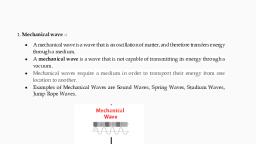
Wave motion and its applications, , Wave motion is one of the most important methods of transferring energy. Various forms of, energy such as light, heat, sound, wireless etc. are transmitted by wave motion. Wave motion is a, form of disturbance produced in the medium by the repeated periodic motion of the particles of, the medium about their mean positions., , A wave results from a disturbance. When a medium is disturbed, energy is imparted to it. This, sets some of the particles in vibration. Because the particles are linked by intermolecular forces., oscillation of each particle affects its neighbours. The added energy/disturbance propagates by, means of interaction between the particles of the medium. Thus a wave is a disturbance which, propagates energy and momentum from one particle to another without the transport of, matter., , The waves are broadly classified into three types. They are:, , 1. Mechanical waves: These types of waves require a medium for their propagation. It’s of, two types depending on the direction of the particle’s oscillation relative to the direction, in which the wave travel., , I. Transverse wave, , Il. Longitudinal wave, I. Transverse Waves:, Here the displacement of the medium is perpendicular to the direction of propagation of the, wave. We can also define transverse wave motion as the wave motion in which the particles of, the medium vibrate about their mean positions at right angles to the direction of the propagation, of the wave. If a string is tied at one end and is moved up and down, a disturbance in the form of a, pulse travels along the length of the string i.e particles of the string vibrates along a direction, perpendicular to the direction along which the disturbance travels. This is an example for, transverse wave. Other examples are vibrations of sitar, violin, guitar, ripples on the surface of, water, etc., , Transverse waves commonly occur in elastic solids due to the shear stress generated; the, oscillations in this case are the displacement of the solid particles away from their relaxed, position, in directions perpendicular to the propagation of the wave. These displacements, correspond to a local shear deformation of the material. Hence a transverse wave of this, nature is called a shear wave. Since fluids cannot resist shear forces while at rest,, propagation of transverse waves inside the bulk of fluids is not possible. Thus a transverse, wave can only be sustained in solids and surface of the liquids ., , viratin “4, particle, iveckirn oy, , Wwone yneien,, , , , tA), , J toe Paty | el om, with the 4 {om, , ‘the ed end in up & dem., direction . @
Page 2 :
These waves consist of elevated and depressed positions. The elevated portion is called crest and, the depressed part is called trough. Thus the transverse wave travels in the form of crest and, , troughs as. showp jn the figure below, , i. pf HS dvedion — voowe. panpagpion, , I. Longitudinal Waves:, A wave motion in which the particles of the medium vibrate in the direction of the, propagation of the wave is called longitudinal wave motion., Sound waves is an example of longitudinal waves. Longitudinal waves can propagate in solids,, liquids and gases. Longitudinal waves are also called compressional or compression waves,, because they produce compression and rarefaction when traveling through a medium,, and pressure waves, because they produce increases and decreases in pressure. A wave, , along the length of a stretched Slinky toy, where the distance between coils increases and, decreases, is a good Ce, , Re recon of vi Ae, wave, ? on = on Leave vo, , Compression is the region in which the particles of the medium are closely packed i.e, density is higher than the normal region creating a high pressure region and Rarefaction is, the region where the particles are loosely packed i.e density is rarer than the normal, regions creating a low pressure region . Thus a longitudinal wave propagates in the form, of compressions and rarefactions., , 2. Non- Mechanical waves / Electromagnetic waves:, These waves do not require a medium for their propagation. They can travel in vacuum, , too. Light is an example of electromagnetic wave. Electromagnetic waves are also, transverse in nature i.e the electric field, , PARAMETERS RELATED TO WAVE MOTION:, , Wave length, , A wavelength is a measure of distance between two identical crests (high points ) or between two, identical troughs ( low points ) or between two consecutive compressions or rarefaction in a, wave. Wavelengths represent a repeating pattern of traveling energy, such as light or sound.
Page 3 :
_ Wave, , ] *—_ Veveliength—_>, , Distance——— +4, Time Period, , A time period is the time needed for, , The time taken by a particle in compl, by T., , one complete cycle of vibration to pass in a given point or, €ting one vibration is defined as its time period. It’s denoted, , Frequency, , It is the number of vibrations made by the particle in one second. As the frequency of a wave, increases, the time period of the wave decreases. The SI unit for frequency is hertz (Hz) (OR), Frequency is the number of occurrences of a repeating event per unit of time or the number, of waves that pass a fixed point ina given amount of time. It’s denoted by n or v., , n=1/T, Amplitude, , Amplitude is the maximum displacement of the particle from its equilibrium position or wave, measured from its equilibrium position. It’s denoted by A., , -— Wavelength A ae cerosts, , , , Relation between wave velocity, wavelength and frequency, , We know that f = 1 / T--------- (i), , The wave speed (v) is defined as the distance traveled by a wave per unit time. If considered that, the wave travels a distance of one wavelength in one period, then v = N/T ----------- (ii), , As we know that T = 1/f ----------- (iii), , hence, we can express the above equation as,, , =f, , , , its fre length., Thus, the wave speed or wave velocity is equal to the product of its frequency and waveleng!, , @