Page 1 :
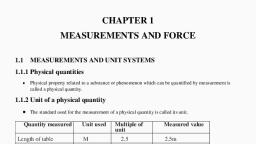
CHAPTER 1, MEASUREMENTS AND FORCE, 1.1, , MEASUREMENTS AND UNIT SYSTEMS, , 1.1.1 Physical quantities, , , Physical property related to a substance or phenomenon which can be quantified by measurement is, called a physical quantity., , 1.1.2 Unit of a physical quantity, , , The standard used for the measurement of a physical quantity is called its unit., , Quantity measured, , Unit used, , Multiple of, unit, , Measured value, , Length of table, , M, , 2.5, , 2.5m, , Speed of a car, , km/hr, , 60, , 60km/hr, , Volume of milk, , Litre, , 2, , 2 litres, , Voltage of a battery, , Volt, , 1.5, , 1.5volt, , Body temperature, , Fahrenheit, , 97. 6, , 97.6 Fahrenheit, , Fundamental quantities and derived quantities, , , , , Physical quantities which are defined by the process of measurement and independent of other quantities, are called fundamental quantities., Quantities derived from fundamental quantities are called derived quantities., The unit of fundamental quantities are called fundamental or base units and those of derived quantities, are called derived units., , Table 1.2 Examples of fundamental and derived quantities along with their units, , Fundamental quantity, , Unit, , Length, , meter (m), , Time, , second (s), , Mass, , kilogram (kg), , Derived quantity, Area, Volume, Velocity, Acceleration, Density, Momentum, , Unit, 2, , m, m3, m/s, m/s2, kg/m3, kg m/s
Page 2 :
1.1.4 Unit systems, , , The complete set of units of all physical quantities forms a unit system. CGS system, MKS system, and, SI system are examples of unit systems., , 1.1.5 CGS system, , , 1.1.6, , , CGS system is a unit system based on three fundamental quantities namely length, mass, and time. In, the CGS system, centimeter (cm), gram (g), and second (s) are the units of length, mass, and time, respectively., , MKS system, MKS unit system has meter (m), kilogram (kg), and second (s) as base units respectively for the three, fundamental quantities - length, mass, and time., , 1.1.7 System International (SI), , , The SI system is based on seven fundamental quantities and its units. Units of all derived quantities can, be obtained by multiplying and dividing seven base units, with no numerical factors involved., , Table 1.3 Fundamental quantities and their units in SI unit system, Fundamental quantity, , Unit, , Symbol, , Length, , meter, , m, , Mass, , kilogram, , kg, , Time, , second, , s, , Electric current, , ampere, , A, , Temperature, , kelvin, , K, , Amount of substance, , mole, , mol, , Luminous intensity, , candela, , cd, , , , SI unit system classified plane angle and solid angle as supplementary quantities. The SI unit of plane, angle is radian (rad) and that of solid angle is steradian (sr)., , , , It is convenient to represent large and small quantities in the SI system in terms of multiple and submultiple of 10.
Page 3 :
Table 1.4 Prefixes used for multiples and submultiples in SI unit system, Prefix, , Multiple, , Symbol, , Prefix, , Sub- multiple, , Symbol, , Deca, , 101, , Da, , deci, , 10-1, , d, , Hector, , 102, , H, , centi, , 10-2, , c, , Kilo, , 103, , K, , milli, , 10-3, , m, , Mega, , 106, , M, , micro, , 10-6, , µ, , Giga, , 109, , G, , nano, , 10-9, , n, , Tera, , 1012, , T, , pico, , 10-12, , p, , Peta, , 1015, , P, , femto, , 10-15, , f, , Exa, , 1018, , E, , atto, , 10-18, , a, , Express the following in given units, 1) 2.43 cm = 2.43 x 10⁻² m, 2) 14.3 cm = …………… m, 3) 7.00 cm = ……………m, 4) 5 mm = ……………m, 5) 24.5 mm2 = ……………m, , 2, , 6) 18.4 cm3= …………….m, , 3, , 7) 22 mm3 = ……………m, , 3, , 8) 12 cm2= ……………m, , 2, , 9) 50g = ……………kg, 10) 150 g/cm3= ……………kg/m, , 3, , 11) 36 km/hr =………………m/s, 12) 8 litres =………………m, , 3, , 13) 2.48cm2= ………………m, , 2
Page 4 :
1.2 ERRORS IN MEASUREMENTS, , , , The value of every measurement contains some uncertainty. This uncertainty is called error., The difference between the true value and the measured value of a quantity is known as the error of, measurement., , True value – measured value = error, , , Errors in measurements can be classified into two categories. They are systematic errors and random, errors., , 1.2.1 Systematic Errors, , , Systematic errors in measurements can be due to instrumental errors, incorrect experimental techniques,, and personal errors., , a) Instrumental errors:, , , These errors arise from the imperfect design or calibration of instruments, zero error of instruments, etc., Zero error in vernier calipers or screw gauge and error due to measurement of length using a scale, broken at one end are examples of instrumental errors., , b) Error due to incorrect experimental technique:, , , These kinds of errors occur due to inaccurate experimental procedures as well as external factors like, pressure, temperature, humidity, wind, etc. For example, measurement of body temperature by placing a, thermometer under the armpit results in a lower temperature value than the actual value., , c) Personal errors:, , , Such errors arise due to personal bias, lack of proper setting of the apparatus, or individual’s, carelessness in taking observations. These types of errors are also known as observational errors. For, example, when an observer holds his head towards the right (by habit) while reading the position of a, needle on the scale, he introduces an error due to parallax., , , , The systematic errors tend to be in one direction, either positive direction or negative direction with, respect to the true value., , , , This type of error can be minimized by using better instruments, improving experimental techniques,, and avoiding personal bias., , 1.2.2 Random Errors, , , , , , , Random errors come from unpredictable changes in experimental conditions., The magnitude and direction of these errors vary randomly with each measurement., Random errors are present in all experiments and are unpredictable., The random errors can be reduced by taking a greater number of measurements., These errors are also called statistical errors and can be removed by statistical methods like averaging.
Page 5 :
For example, unpredictable temperature changes can affect the electrical properties of instruments in an, experiment involving electrical instruments., , 1.2.3 Least Count Error, , , , , , , , The least count error is the error associated with the resolution of the instrument., The smallest value that can be measured by a measuring instrument is called its least count., All readings or values are good only up to this value., For example, a vernier caliper has the least count of 0.01 cm and a screw gauge has a least count of, 0.001 cm., Using instruments of higher precision, improving experimental techniques, etc., we can reduce the least, count error., Repeating the observations several times and taking the arithmetic mean of all the observations, the, mean value would be very close to the true value of the measured quantity., , 1.2.4 Absolute error, Let𝑎1, 𝑎2, 𝑎3, . . . . . . . . . , 𝑎n be the values obtained for a physical quantity ‘a’ in an experiment repeated, ‘n’ times. The arithmetic mean of the values is taken as the true value. The arithmetic mean is, , 𝑎mean, , , a1+ a2+………+an, 𝑛, , =, , The absolute error of a measurement is the difference between the individual measurement and the true, value of that quantity. It is denoted as|∆𝑎|.Then errors in individual measurements are, , ∆𝑎1 = 𝑎mean − 𝑎1, ∆𝑎2 = 𝑎mean − 𝑎2, ……, , ……, , ….., , ……, , ……, , ….., , ∆𝑎n, , , , =, , 𝑎mean − 𝑎n, , ∆𝑎 calculated may be positive or negative, but absolute error |∆𝑎| is always positive., The arithmetic mean of all absolute errors of all the measurements is taken as the mean absolute error of, the physical quantity ‘a’. It is denoted as ∆𝑎mean., , ∆𝑎mean = (|∆𝑎1| + |∆𝑎2| + |∆𝑎3|, The value of the physical quantity ‘a’ can be written as, , 𝑎 = 𝑎mean ± ∆𝑎mean, , + |∆𝑎n|)/𝑛
Page 6 :
1.2.5 Relative error, The ratio of mean absolute error,∆𝑎mean to the mean value, 𝑎meanof the physical quantity, measured is called the relative error., , 1.2.6 Percentage error, , , The relative error of a physical quantity expressed in percentage is called percentage error., , %, Example 1.1, The measurement of length gives values of 2.54cm, 2.51cm, 2.48cm, 2.55cm, and 2.52cm. Find the absolute, error, relative error, and percentage error., Solution:
Page 7 :
Example 1.2, The mean absolute error of a set of measurements is 0.85 and the mean value is 12.6. Find the relative error and, percentage error., Solution:
Page 8 :
1.3 BASIC INTRODUCTION TO VECTORS, , , , , Physical quantities can be classified into two categories., Quantities having only magnitude are called scalar quantities. Mass, time, temperature, and potential, energy are examples of scalar quantities., Quantities having both magnitude and direction are called vector quantities.. Force is an example., , 1.3.1 Graphical representation of a vector, , , , , , , A vector quantity is represented graphically by a straight line with an arrowhead., The length of the straight line represents the magnitude of the vector and the arrowhead gives the, direction of the vector., The end having the arrow mark is called the head and the other end is called the tail of the vector., , A vector can be displaced parallel to itself. Moving a vector parallel to itself does not change the, magnitude and direction of the vector., , 1.3.2 Collinear vectors, , , Two or more vectors lying on the same line are called collinear vectors. They can have the same or, different magnitude and the direction can be either the same or opposite., , 1.3.3 Equal vectors, , , Two vectors of the same magnitude and direction are called equal vectors., , 1.3.4 Negative of a vector, , , The negative of a vector is defined as another vector having the same magnitude but opposite in, direction to the given vector., , 1.3.5 Unit vector, , , , , , A unit vector is a vector of unit magnitude and points in a particular direction., It is used just to specify a direction and hence it is also called a direction vector., A unit vector is denoted by a cap or hat symbol above a letter., A vector divided by its magnitude gives the unit vector in the direction of the given vector.
Page 9 :
Unit vector, 𝑎^ in the direction vector, 𝐴⃗ is given by, , , , The commonly used unit vectors are 𝚤^, 𝚥̂ and 𝑘^which indicates X, Y, and Z directions respectively., , 1.3.6 Addition of vectors, The result of the addition of two or more vector quantities is called vector sum or resultant. The addition, , , of two vectors can be done mathematically by using graphical methods or analytical methods., The result of the addition of two or more vector quantities is called vector sum or resultant, , ?, , Force is a vector quantity. Add following pairs of forces which are either parallel or antiparallel., , i, , 16 N, , ii., , 5N, , iii., , 5N, , iv., , 4N, , +, , +, , 6N, , =, , 5N, , =, , +, , 3N, , =, , +, , 2N, , =
Page 10 :
1.3.7 Graphical methods for vector addition, In the graphical method, we use the graphical representation of vectors to find the resultant of two vectors. The, resultant of two non-parallel vectors can be obtained graphically by two methods; triangle method and, parallelogram method., (a)Triangle method of vector addiction, The triangle method is based on the triangular law of vector addition. The triangular law of vector addition, states that if two vectors are represented by the adjacent sides of a triangle taken in order, then the resultant, vector is represented both in magnitude and direction by the third side of the triangle taken in the reverse, order., , Let 𝐴⃗ and 𝐵¯ are two non-parallel vectors. To find the vector sum using the triangle method, place, the vectors such that the tail of one vector coincides with the head of the other vector. Complete the triangle by, drawing the third side. The third side gives the resultant vector𝑅¯ ., (b)Parallelogram method of vector addition, This method is based on the parallelogram law of vector addition. The parallelogram law of vector addition, states that if two vectors are represented both in magnitude and direction by the two sides of a parallelogram, drawn from a point, then the resultant vector is represented both in magnitude and direction by the diagonal, of the parallelogram passing through the point., , In this method, the two vectors are placed such that their tails coincide. A parallelogram is formed by, drawing two lines parallel to the given vectors. The diagonal of the parallelogram passing through the common, point of the two vectors is the resultant vector.
Page 11 :
1.3.8 Analytical method for vector addition, The graphical method provides a good visual understanding of the process of vector addition. But it is, time-consuming and has less accuracy. Alternately the resultant vector can be found using the analytical, method., , Consider two vectors 𝐴⃗ and 𝐵¯ . Let θ be the angle between the two vectors. The resultant, 𝑅¯ , of, the two vectors can be obtained by the parallelogram method., The magnitude of the resultant vector R is given by the expression, , R = √A2 + B2 + 2ABcosθ, The direction of the resultant vector is specified by the angle ‘α’ with respect to the vector 𝐴⃗ ., The angle ‘α’ is given by the expression, 𝛼 = 𝑡𝑎𝑛–1 (, , 𝐵 𝑠𝑖𝑛𝜃, , ), , 𝐴⃗ + 𝐵 𝑐𝑜𝑠𝜃, Special cases:, , a) If two vectors are in the same direction, then θ = 0 and hence, 𝑐𝑜𝑠𝜃 = 1, The magnitude of the resultant,R = √A2 + B2 + 2ABcosθ, R= √A2 + B2 + 2AB, , R= √(A + B)2, R = 𝐴⃗ + 𝐵, , , The magnitude of the resultant is the sum of the magnitudes of the two vectors.
Page 12 :
b) If two vectors are in opposite direction, then θ = 180o and hence, 𝑐𝑜𝑠𝜃 = −1, The magnitude of the resultant, R = √A2 + B2 + 2ABcosθ, , R= √A2 + B2 − 2AB, , R= √(A − B)2, R = 𝐴⃗ − 𝐵, , , The magnitude of the resultant is the difference of the magnitudes of the two vectors., , ? Consider two vectors, 𝐴⃗ and 𝐵, , of magnitudes 4 units and 2 units. The angle between the vectors is 600 Find, out the magnitude and direction of the resultant of the two vectors by, i) Triangular method, ii) Parallelogram method, iii) Analytical method, , 1.3.9 Subtraction of vectors, Subtraction of two vectors also involves addition. To subtract𝐵Z from 𝐴⃗ first, take the negative of 𝐵¯ and, then add it to𝐴⃗ . Hence, subtraction of two vectors is the same as the addition of a vector with the negative of, the second vector., 𝐴⃗ − 𝐵 = 𝐴⃗ + (−𝐵 ), , 1.3.10 Resolution of a vector, , , , The process of splitting a given vector into two or more vectors along different directions is called the, resolution of a vector., The vectors obtained by the resolution of the given vector are called component vectors., , Consider a vector lying in the northwest direction. It can be considered to have two components – a, northward component and a westward component. Similarly, an upward and rightward vector has an upward, component and a rightward component.
Page 13 :
Rectangular resolution of a vector, , , , A vector lying in a plane is usually resolved along two mutually perpendicular directions. The resolution, of a vector along mutually perpendicular directions is called rectangular resolution., The two perpendicular components are called rectangular components. The rectangular components are, taken along the X-axis and Y-axis.
Page 14 :
Consider a vector 𝐴⃗ making an angle θ with the X-axis. Draw perpendiculars from the head of the, vector 𝐴⃗ to X-axis and Y- axis to meet at the points P and Q respectively. Then, if OP and OQ are taken as, two vectors parallelogram law of vector addition, 𝐴⃗ is the resultant vector., , 𝐴⃗ = 𝐴⃗x + 𝐴⃗y, , Thus and 𝐴⃗x and 𝐴⃗y are vector components of𝐴⃗ .Magnitudes of 𝐴⃗x and 𝐴⃗y are /called scalar components. 𝐴⃗x, and 𝐴⃗y are called x-component and y-component respectively., Using simple trigonometric relations, x-component and y-component of vector 𝐴⃗ is given by, 𝐴⃗x = 𝐴⃗ 𝑐𝑜𝑠𝜃, 𝐴⃗y = 𝐴⃗ 𝑠𝑖𝑛𝜃, Now let us examine two real-life examples of the resolution of vectors., , , Walking: While walking, a person applies a force on the ground and the reaction force by the ground on, the man enables him to move forward. The force applied by the man is directed at an angle with the, horizontal. The reaction force by the ground is opposite in direction to the applied force. The reaction, force R can be resolved along horizontal and vertical components. The horizontal component pushes, him forward., , , , Pulling a cart: Consider a man pulling a cart. The force is directed at an angle with the horizontal. Here, the force can be resolved into two components – vertical and horizontal components. The horizontal, component is responsible for the motion of the cart.
Page 15 :
? Resolve the given forces along x-direction and y-direction., 1., , 12 N, 30o, , 2., , 20 N, 60o, , 3., , 8N, , x- component = -------- N, y-component = --------- N, , x- component = -------- N, y-component = --------- N, , x- component = -------- N, 45o, , y-component = --------- N
Page 16 :
1.4 KINEMATICS, An object is at rest if its position does not change with time. An object is said to be in motion if its, position changes with time. The concept of rest and motion are relative to the observer. There is no absolute, motion or absolute rest., , , , Mechanics is a branch of physics that deals with the study of the motion of bodies, its causes, and, effects., Kinematics is a branch of mechanics that describes the motion of objects without considering the causes, of motion., , In kinematics, motion is mathematically described in terms of distance, displacement, speed, velocity,, acceleration, and time., , 1.4.1 Distance travelled and Displacement, Consider a particle initially at position A, it travels and reaches point B through the path ACB. Distance is, defined as the total length of the path travelled by a particle. Here the length ACB gives the distance travelled., Distance is a scalar quantity and its unit is meter., , , , Displacement is defined as the shortest path length between the final position and the initial position, of the particle., , The straight-line path from A to B gives the displacement. Displacement is a vector quantity having both, magnitude and direction. The length of the straight line gives the magnitude of the displacement and the, direction is from the initial position to final position., , , The SI unit of displacement is also meter., , 1.4.2 Speed, , , The speed of a particle is related to the distance travelled. Speed is the distance travelled by a body in, unit time., , Speed =, , , 𝒅𝒊𝒔𝒕𝒂𝒏𝒄𝒆, 𝒕𝒊𝒎𝒆, , Speed is a scalar quantity and its unit is m/s
Page 17 :
1.4.3 Velocity (v), , , The velocity of a particle denotes how fast it is changing its position. The displacement of a body in, unit time is called velocity., , 𝑣𝑒𝑙𝑜𝑐𝑖𝑡𝑦 =, , 𝑣=, , , 𝒅𝒊𝒔𝒑𝒍𝒂𝒄𝒆𝒎𝒆𝒏𝒕, 𝒕𝒊𝒎𝒆, , 𝒔, 𝒕, , Velocity is a vector quantity and its unit is m/s., , 1.4.4 Acceleration (a), , , The rate of change of velocity of a body is called acceleration. Since velocity is a vector quantity, a, change in its magnitude or direction or both gives accelerated motion., , 𝑎𝑐𝑐𝑒𝑙𝑒𝑟𝑎𝑡𝑖𝑜𝑛 =, , 𝑎=, , 𝒄𝒉𝒂𝒏𝒈𝒆 𝒊𝒏 𝒗𝒆𝒍𝒐𝒄𝒊𝒕𝒚, 𝒕𝒊𝒎𝒆, , 𝒗−𝒖, 𝒕, , where u is the initial velocity and v is the final velocity of the body., , , Acceleration is a vector quantity and its unit is m/s2., , 1.4.5 Motion in one dimension, The motion of an object along a straight-line path is called motion in one dimension. A particle in onedimensional motion has only two directions of motion (either left or right, upward or downward, east or west,, etc.). To specify the directions of the vector quantities displacement, velocity, and acceleration we use the signs, + and - to denote the two directions., , , , , , , If the velocity of the body remains a constant in one-dimensional motion, then it is called uniform, motion., In uniform motion, the magnitude and direction of velocity remain constant and hence its acceleration is, zero., The motion of a car along a straight road, a ball thrown vertically upwards, a freely falling body are, some of the examples of motion in one dimension., A uniformly accelerated motion is one in which the acceleration of the particle remains constant.
Page 18 :
1.4.6 Equations of motion, Consider the motion of a particle with initial velocity ‘u’ and uniform acceleration ‘a’. Let the, displacement and velocity of the particle after a time ‘t’second is ‘s’ and ‘v’ respectively. The motion of the, particle along a straight-line path with uniform acceleration can be analyzed using the three equations of, motion., , v = u + at, 𝟏, , s = ut + at2, 𝟐, , v2 = u2 + 2as, , 1.5 DYNAMICS, Dynamics is a branch of mechanics that deals with the study of forces and its effect on the motion of, bodies. In dynamics, Newton's laws of motion are three laws that describe the relationship between the motion, of an object and the forces acting on it., , 1.5.1 Newton’s first law of motion, Newton’s first law of motion states that everybody continues in its state of rest or of uniform motion along a, straight line unless compelled by some external force to change that state., , ? Consider a cricket ball placed at one end of a very long horizontal straight-line track. A force is applied just, to start the motion of the ball along the track. Now answer the following questions based on your experience, and check whether our common experience contradicts Newton’s first law of motion., 1., , Do we need to apply force all the time to keep the ball in motion?, , 2., , Will the ball stop after some time? Does this observation contradict Newton’s first law of motion?, , 3., , Is there any external force acting on the body to stop it?, , ? Imagine that you are going to drive a car which is at rest. From Newton’s first law, we know that an external, force is required to change the state of the rest of a body. The rotating force acting on the wheels of the car is, provided by the engine and it is an internal force. Does the motion of the car contradict Newton’s first law of, motion? Explain your answer., , , , , , Newton’s first law only provides a mere definition of the force, but it doesn’t provide any means to, measure the force acting on a body., Force can be defined as any agency which can change the state of rest or uniform motion of a body., If the net force is zero, the body should be either in rest or in uniform motion.
Page 19 :
1.5.2 Inertia, , , , , , , Inertia is the resistance of a body to any change in its state of rest or uniform motion along a straight, line., Newton’s first law of motion is also known as the law of inertia, The inertia of an object is measured by its mass., The tendency of a body to remain in its existing state of rest is called inertia of rest., The tendency of a body to remain in its existing state of motion with constant velocity is called inertia of, motion., , Example,, 1. A person standing in a stationary bus falls backward when the bus starts suddenly. This is because the lower, part of his body moves forward with the bus, but the upper part of his body remains at rest due to inertia of rest,, which results in the backward fall., 2. A person trying to get down from a moving bus falls forward. The lower part suddenly comes to rest on, touching the ground, but the upper part of his body remains in motion due to inertia of motion and the person, falls forward., 3. Fruits from a tree fall due to inertia of rest when the tree is shaken. Both the fruits and branches are at rest,, but when shaken branches start moving whereas fruits remain in its state of rest and are separated from the, branches., , 1.5.3 Momentum (p), , , , , Momentum is the quantity of motion of a body., The momentum of a body is defined as the product of mass and velocity., It is a vector quantity and its unit is kg m/s., If a body of mass ‘m’ moving with a velocity ‘v’, then its momentum is given by, , 𝑝 = 𝑚𝑣, , , The momentum of a body at rest is zero., , 1.5.4 Newton’s second law of motion, Newton’s second law of motion states that the rate of change of momentum of a body is directly proportional, to the applied force and takes place in the direction of the force., , force ∝ 𝑟𝑎𝑡𝑒 𝑜𝑓 𝑐ℎ𝑎𝑛𝑔𝑒 𝑜𝑓 𝑚𝑜𝑚𝑒𝑛𝑡𝑢𝑚, It can be easily proved that the rate of change of momentum of a moving body is equal to the product of, mass and acceleration of the body. Thus, force is proportional to the product of mass and acceleration., 𝐹 ∝ 𝑚𝑎, 𝐹 = 𝑘 𝑚𝑎
Page 20 :
where k is the constant of proportionality. By suitably defining the SI unit of force, we can take k as 1. Thus,, 𝐹 = 𝑚𝑎, , , One unit of force is defined as that which causes an acceleration of 1m/s2 in a body of mass 1kg. This, unit is known as newton (N)., 1 𝑁 = 1 𝑘𝑔 𝑚⁄𝑠2, , If ‘p’ is the momentum of the body, then Newton’s second law can be expressed in differential form as, , F=, , , , 𝒅𝒑, 𝒅𝒕, , The second law implies that if Force F = 0, then acceleration, a = 0, which means the body is either at, rest or in uniform motion. Thus, Newton’s first law can be derived from the second law., Newton’s first law gives a qualitative idea of force and the second law gives a mathematical expression, for force., , 1.5.5 Newton’s third law of motion, Newton’s third law of motion states that to every action, there is always an equal and opposite reaction., If a body B exerts a force, 𝐹AB on a body A, then the body A exerts an equal and opposite force,𝐹BA on, body B., 𝐹AB = − 𝐹BA, , , Newton's third law of motion describes the nature of forces created as a result of mutual and, simultaneous interaction between two objects:, , The correct meaning of the third law can be understood if the terms action and reaction are replaced by the, term force. It becomes – to every force, there is always an equal and opposite force. The main properties of, action and reaction forces are:, a) Action and reaction are the simultaneously occurring pair of forces acting between two objects., b) Forces always occur in pairs and a single force doesn’t exist in the universe. This is an important property of, forces., c) Action and reaction are always equal in magnitude and opposite in direction. If one force is 10N in the east, direction, the other force will be 10N in the west direction., d) There is no cause-effect relation implied in the third law. Both action and reaction occur at the same time. So,, any of the two forces can be called action and the other reaction., e) The action and reaction forces, though equal and opposite, never adds up to get zero. Action and reaction do, not cancel each other since they act on different objects.
Page 21 :
Examples of Newton's third law of motion are,, a) When a man jumps off a boat to the shore, he exerts a force on the boat. The boat exerts an equal and, opposite force on the man which makes the jump possible. The boat moves backward due to the force, exerted by the man, , b) A runner exerts a force on the ground and the reaction force of the ground on the runner pushes him, forward., , ? Identify action-reactio pairs in the following cases:, 1. A man jumping, 2. A man swimming, 3. A bird flying, 4. Striking a ball with a bat, 5. A book placed on a table
Page 22 :
1.5.6 Law of conservation of momentum, From Newton’s second law of motion, the net force acting a system of particles is given by,, , 𝑓𝑜𝑟𝑐𝑒 =, , , 𝒄𝒉𝒂𝒏𝒈𝒆 𝒊𝒏 𝒎𝒐𝒎𝒆𝒏𝒕𝒖𝒎, 𝒕𝒊𝒎𝒆, , If the net force acting on the system is zero, then the change in momentum also becomes zero., Therefore,, 𝑓𝑖𝑛𝑎𝑙 𝑚𝑜𝑚𝑒𝑛𝑡𝑢𝑚 = 𝑖𝑛𝑖𝑡𝑖𝑎𝑙 𝑚𝑜𝑚𝑒𝑛𝑡𝑢𝑚, , Thus, the law of conservation of momentum states that if the net external force acting on a system is, zero, its linear momentum remains constant., , As an example, we are going to prove the law of conservation of linear momentum in the case of collision of, two masses using Newton’s second law and third law., Consider two bodies of masses 𝑚1 and 𝑚2 moving along a straight line with velocities 𝑢1 and 𝑢2, respectively. Let the bodies collide for a time ‘t’ seconds. After the collision, the velocities become 𝑣1 and 𝑣2, respectively for masses 𝑚1 and 𝑚2 along the same direction., , Since there is no external force acting on the system of two colliding bodies, the bodies apply internal, forces on each other during the collision. Let the force acting on the mass 𝑚1 (applied by𝑚2) be 𝐹12 and the, force acting on the mass 𝑚2 (applied by𝑚1) be 𝐹21. From Newton’s second law of motion,, 𝑐ℎ𝑎𝑛𝑔𝑒 𝑖𝑛 𝑚𝑜𝑚𝑒𝑛𝑡𝑢𝑚, , 𝑓𝑜𝑟𝑐𝑒 =, ∴ 𝐹12 =, , F12 =, , 𝑡𝑖𝑚𝑒, 𝑐ℎ𝑎𝑛𝑔𝑒 𝑖𝑛 𝑚𝑜𝑚𝑒𝑛𝑡𝑢𝑚 𝑜𝑓 𝑚1, 𝑡𝑖𝑚𝑒, 𝑚1𝑣1−𝑚1𝑢1, 𝑡, , Similarly,, 𝑚2𝑣2−𝑚2𝑢2, , 𝐹12 =, , 𝑡, , Since 𝐹12 and 𝐹21 are action-reaction pairs produced during the collision, applying Newton’s third law of, motion, we have
Page 23 :
𝐹12 = − 𝐹21, 𝑚1𝑣1−𝑚1𝑢1, 𝑡, , =-, , (𝑚2𝑣2−𝑚2𝑢2), 𝑡, , 𝑚1 𝑣1 − 𝑚1 𝑢1 = − 𝑚2 𝑣2 + 𝑚2 𝑢2, 𝑚1 𝑢1 + 𝑚2 𝑢2 = 𝑚1 𝑣1 + 𝑚2 𝑣2, , , 𝑡𝑜𝑡𝑎𝑙 𝑚𝑜𝑚𝑒𝑛𝑡𝑎 𝑏𝑒𝑓𝑜𝑟𝑒 𝑐𝑜𝑙𝑙𝑖𝑠𝑖𝑜𝑛 = 𝑡𝑜𝑡𝑎𝑙 𝑚𝑜𝑚𝑒𝑛𝑡𝑎 𝑎𝑓𝑡𝑒𝑟 𝑐𝑜𝑙𝑙𝑖𝑠𝑖𝑜𝑛, , In the case of collision of two masses, the momentum of the system is conserved, if the external force acting on, the system is zero., , ? Consider an explosive lying on a surface. It explodes into (a) two pieces and (b), many pieces. Discuss the nature of the motion of the pieces in both cases., , 1.5.7 Recoil of gun, The gun carried by a soldier normally has a mass of 10 kg. On firing, the gun moves backward such that if not, handled carefully, it can hurt the person using it. The backward motion of a gun when a bullet is fired from it, is called the recoil of the gun. It can be explained using the principle of conservation of linear momentum., The total momentum of the gun and bullet before firing is zero. Since no external force acts on the gun, and the bullet, its momentum should be conserved. After firing the bullet moves with a velocity producing, momentum in the forward direction. To balance the momentum change, the gun moves backward with a, velocity, such that the total momentum is zero., , Let 𝑀g and 𝑚b are masses of the gun and bullet respectively. Suppose, a bullet is fired from the gun, with a velocity 𝑣b and the gun recoils with a velocity 𝑉g., 𝑇𝑜𝑡𝑎𝑙 𝑚𝑜𝑚𝑒𝑛𝑡𝑎 𝑏𝑒𝑓𝑜𝑟𝑒 𝑓𝑖𝑟𝑖𝑛𝑔 = 0, 𝑇𝑜𝑡𝑎𝑙 𝑚𝑜𝑚𝑒𝑛𝑡𝑎 𝑎𝑓𝑡𝑒𝑟 𝑓𝑖𝑟𝑖𝑛𝑔 = 𝑀g 𝑉g + 𝑚b 𝑣b
Page 24 :
By the law of conservation of momentum, the total momenta after firing must be equal to the total momenta, before firing., 𝑀g 𝑉g + 𝑚b 𝑣b = 0, 𝑀g 𝑉g = − 𝑚b 𝑣b, , 𝑉g = −, , , 𝒎𝒃 𝒗𝒃, 𝑴𝒈, , The negative sign shows that the direction recoil velocity of the gun is opposite to the direction of the, velocity of the bullet., , 1.5.8 Rocket propulsion, Rockets are used to launch artificial satellites and space shuttles, deliver explosive warheads to their, targets, and also for human space flight and scientific exploration of outer space., The principle behind rocket propulsion is the law of conservation of momentum (external force on, rocket is zero and effect of gravity is neglected). The linear momentum of the rocket including its fuel is, conserved throughout the motion. The initial total momentum of the rocket on its launching pad is zero. After, the rocket is launched, the fuel is continuously burned and hot gases are ejected out in the downward direction, with high velocity. This creates a momentum change in the downward direction. To balance it, the remaining, mass of the rocket moves in the upward direction., , , , , , Newton’s third law of motion can also be used to explain the principle of rocket propulsion., Rocket is a variable mass system because its mass decreases over time, as a result of its fuel (propellant), burning off. As the rocket moves up, its mass decreases, and hence its velocity increases., The velocity of the rockets can be further increased by using multistage rockets instead of single-stage, rockets. A multistage rocket has two or more rocket stages, each has its engine and propellant. If one, stage burns completely, it will fall off from the rocket. Hence, the mass of the rocket decreases, and its, velocity increases considerably., , 1.5.9 Impulse, Consider a boy striking a ball with a bat. He hits the ball with the bat such that the force exerted by the, bat is only for a very smalltime interval. In such cases, it is difficult to measure the force and time separately. A, large force acting for a short interval of time is called an impulsive force. We use the term impulse to measure, the effect of an impulsive force on a body. Impulse (I) is defined as the product of force and time for which the, force acts., 𝑖𝑚𝑝𝑢𝑙𝑠𝑒 = 𝑓𝑜𝑟𝑐𝑒 × 𝑡𝑖𝑚𝑒
Page 27 :
Since the two forces acting on the body are in opposite directions, the net force on the body is given by, 𝐹 = 𝐹1 − 𝐹2 = 10 − 6 = 4 𝑁, 𝐹 = 𝑚𝑎, 𝐹, , 𝑎=𝑚, 4, , = 2 = 2 𝑚/𝑠2, Example 1.9, A bullet of mass 40g is fired from a 5kg gun with a velocity of 250m/s. Find the recoil velocity of the gun., Solution:, Given 𝑚b = 40 𝑔 = 40 × 10–3 𝑘𝑔 ;𝑣b = 250 𝑚/𝑠 ; 𝑀g = 5 𝑘𝑔 ;, Recoil velocity of the gun is given by, , 𝑉g = −, , 𝑚𝑏 𝑣𝑏, 𝑀𝑔, , =-, , 0.04×250, 5, , = −2 𝑚/𝑠, , PRACTICE PROBLEMS, 1. The readings of an experiment involving measurement of time give 2.78s, 2.90s, 2.92s, and 2.85s. Find, the absolute error, relative error, and percentage error., 2. Find the percentage error for the following measured values – 23.5,24.4, 23.9,23.0, and 24.3., 3. A force of 20N acts on a body of mass 4kg. Find the acceleration produced., 4. A body at rest is acted upon by a force so that it reaches a velocity of 20m/s in 4s.If the mass of the body, is 3kg, find the force., 5. A car of mass 1000kg moving at 20m/s is brought to rest over a distance of 40m.Find the braking force., 6. An object is moving at 40m/s. A force of 10N is applied opposite to its direction of motion. Find the, time taken by the object to come to rest., 7. The momentum of a body changes from 40kgm/s to 10kgm/s in 5s in the same direction by the, application of a force. Find the force applied., 8. A body of mass 1kg is acted upon by two perpendicular forces 3N and 4N.Find the magnitude of the, acceleration of the body., 9. A gun of mass 8kg fires a bullet of mass 80g with a velocity of 300m/s. Find the recoil velocity of the, gun., 10. A shell of mass 0.02kg is fired from a gun of mass 200kg with a velocity of 100m/s. Find the recoil, velocity of the gun., QUESTIONS, 1., , Define the unit of a physical quantity., , 2., , Differentiate between fundamental quantity and derived quantity., , 3., , What are the seven fundamental quantities and their units in the SI system?, , 4., , Explain different types of errors in measurements., , 5., , Distinguish between absolute error, relative error, and percentage error., , 6., , State and explain the triangular law of vector addition.
Page 28 :
7., , State and explain the parallelogram law of vector addition., , 8., , Explain the term resolution of a vector., , 9., , State Newton’s first law of motion and explain inertia, , 10., , Define force from the first law of motion., , 11., , State and explain Newton’s second law of motion., , 12., , With the help of an example explain Newton’s third law of motion., , 13., , Explain the recoil of a gun. Derive an expression for the recoil velocity of the gun., , 14., , Explain the propulsion of a rocket using the law of conservation of momentum., , 15., , What is impulse? Show that change impulse is equal to change in momentum.