Notes of 2nd Year ME, Opencast Mining Methods MiningMethods-PartI-Surfacemining.pdf - Study Material
Page 1 :
Part I-Surface mining
Page 2 :
About This Topic, In this Topic, you will learn the various surface mining methods used, to extract ore from near surface deposits., , After completing this unit, you should be able to:, , , Understand the geological factors for surface mining, , , , Understand the engineering factors for surface mining, , , , Explain what a placer deposit is, , Understand the surface mining methods:, , , , , , , , , Open-pit mining., Terrace mining., Strip mining., Contour strip mining., Auger Mining, Glory Holing, Quarrying, , , , , , , , , Panning, Sluicing, Dredging, Hydraulic Mining, Heap Leaching, In-situ leaching (ISL), , We will explore all of the above in Topic 5.
Page 4 :
Choice of mining and processing methods:, “The simple aim in selecting and implementing a, particular mine plan is always to mine a mineral, deposit so that profit is maximized given the unique, characteristics of the deposit and its location, current, market prices for the mined mineral, and the limits, imposed by safety, economy, environment” (Text book, definition: Spitz and Trudinger, 2009, my italics) (Social, “limits” are not mentioned specifically!), , 4
Page 5 :
What is Surface Mining?, Surface mine A mine in which the ore lies near the surface, and can be extracted by removing the covering, layers of rock and soil., Almost all surface mining operations are, exposed to the elements and require no roof, support., , 5
Page 6 :
Evaluation of Surface Deposits, The following outline lists the basic factors which must be taken into account for evaluation of a prospective surface mine :, Geography, Legal status of land and mining rights, Historical, political, and socialogical factors, Geology, Mining conditions, Ore treatment requirements, Economic analysis, Geography:, Topography, a function of location, affects cost of development and operation of a surface mine. Geographic location establishes, climate., Location establishes the condition of remoteness from or proximity to civilization and its developed facilities such as transportation, systems, power supply, labour pool, manufacturing and supply services, and specialty repair shops., Legal status of land and mining rights, Land and other necessary rights should be checked, such as water use rights and the ability to acquire auxiliary land for plant site, roads,, tailings disposal ground etc., Historical, political, and socialogical factors, It is important to determine the extent and nature of national and local laws and regulations in regard to conservation, water use, water, and air pollution, tailings disposal, reclaimation, handling of explosives, taxes, royalities, import duties, mining safety and health codes,, wage and labour conditions, pension requirements, and unions.
Page 7 :
Evaluation of Surface Deposits (cont.), Geology, Geological evaluation may include wide-spaced drilling, drill-sample logging, testing and processing, plotting of the data on, maps and cross-sections, preparation of specialized interpretive maps, calculation of reserves by grades, calculation of, stripping requirements, groundwater studies, and economic analysis., Mining conditions, , The geometry of an ore body and the topography of the land surface beneath which the ore body exists will affect the kind, and cost of a surface mine. The depth and character of overlying rock and the physical characteristics of the wall rock also, affect the configuration and cost of a surface mine., Ore treatment requirements, Almost every potential surface mine must consider some phase of product upgrading (benefication)., This may vary from a simple crushing and sizing operation to a complex operation including multiple stages of size, reduction, concentration and agglomeration. In many cases, pilot-scale testing is deemed advisable., Economic analysis, In the broadest sense, economic analysis for a surface mine involves the determination of market value of the product and, all the elements of cost of production., By subtraction, a margin of profit (or loss) can be calculated., Many new surface mines require very high capital investments. There are 3 commonly used yardsticks to value investment, worth :, i) Degree of necessity,, ii) Payback period, and, iii) Rate of return (IRR) .
Page 8 :
History, The history of surface mining is, essentially that of mining coal, copper, and, iron ores, and the nonmetallic minerals clays, gypsum, phosphate rock, sand,, gravel, and stone., Changing public policy is exerting strong, pressure favouring a reduction or, elimination of surface mining; and, since, the economic differences between surface, and underground mining for the remaining, mineral resources is narrowing, this, increasing force may become the deciding, factor in determining the future trend in, surface vs, underground mining., , 6
Page 9 :
Surface mining:, Mineral deposits are on or near the surface of the Earth and are removed., This is the traditional cone-shaped excavation (although it can be any shape, depending on the, size and shape of the orebody) that is used when the ore body is typically pipe-shaped, vein-type,, steeply dipping stratified or irregular., Although it is most often associated with metallic orebodies, (e.g., Palabora copper, Mamatwan, and Sishen iron-ore), it can be used for any deposit that suits the geometry – most typically, diamond pipes – (e.g., Venetia, Koffiefontein and Finsch)., , Surface mining is the predominant exploitation method worldwide., In the USA, surface mining contributes about 85% of all minerals, exploitation (excluding petroleum and natural gas). Almost all metallic, ore (98%) and non-metallic ore (97%), and 61% of the coal is mined using, surface methods in the USA (Hartman and Mutmansky, 2002)., Surface mining requires large capital investment, (primarily expensive transportation equipment), but generally results in:, High productivity (i.e., high output rate of ore)., Low operating costs., Safer working conditions and a better safety record than, underground mining., 7
Page 11 :
Steps of Surface Mining Operation:, , Strip out overburden (becomes spoils), Traditional surface mining methods fall into, two broad categories based on locale:, i) Mechanical excavation methods, {such as: Open-pit (or Open-cut or Open-cast);, Terrace; and Strip mining}., , ii) Aqueous methods {such as: Placer and, In-situ leaching (ISL)/ Solution mining}., , Clean up (reclamation), , 11
Page 12 :
Table : Subdivided surface mining methods (Bohnit, 1992), Method, , Subclass, , Method, , , , , , , , , Open-pit (or Open-cut or Open-cast) mining., Terrace mining., Strip (flat terrain) mining., Contour strip (hilly terrain) mining., Auger Mining, Glory Holing, Quarrying, , Placer, , , , , , , Panning, Sluicing, Dredging, Hydraulic Mining, , Solution, , Heap Leaching, In-situ leaching (ISL), , Mechanical, excavation, , Aqueous, , 10
Page 13 :
Figure shows major surface mining methods
Page 14 :
Mineral Extraction, • Surface Mining: overburden (soil and rock on top of, ore) is removed and becomes spoil., • 1. open pit mining – digging holes, • 2. Dredging – scraping up underwater mineral, deposits, • 3. Area Strip Mining – on a flat area an earthmover, strips overburden, • 4. Contour Strip Mining – scraping ore from hilly, areas
Page 15 :
1) Mechanical Extraction Method, a thick deposit is generally mined in benches or steps,, although thin deposits may require only a single bench or, face., Of all the variations of mechanical surface excavation, mining methods available, the three most common methods, only will be described here, namely:, 1.1. Open-pit (or Open-cut or Open-cast or quarry) mining., 1.2. Terrace mining., 1.3. Strip (flat terrain) mining., 1.4. Contour strip (hilly terrain) mining.
Page 16 :
Figure refers to Classification of Surface mining methods (Bullivant, 1987)
Page 17 :
OPEN PIT MINING
Page 18 :
Open pit, • Used when ore bodies lie near, the surface, • Large hole exposes the ore, body, • Waste rock (overburden) is, removed, • 2nd cheapest method, but has, the largest environmental, impact. Why?
Page 19 :
Basic Concept, Although the basic concept of an open pit is quite simple, the planning required to develop a, large deposit for surface mining is a very complex and costly undertaking., At one mine, it may be desirable to plan for blending variations in the ore so as to maintain, as, nearly as possible, a uniform feed to the mill., At another operation it may be desirable to completely separate two kinds of ore, as for example,, a low- grade deposit where one kind of "oxide" ore must be treated by acid leach, but a second, kind of "sulfide" ore must be treated by different methods., The grade and tonnage of material available will determine how much waste rock can be, stripped, and there is often an ultimate limit to the pit that is determined more by the economics, of removing overburden than a sudden change in the ore deposit from mineral to non-mineral, bearing material. The ultimate pit limit and the slope of the pit walls are therefore determined as, much by economics and engineering as by geological structure. Material that is relatively high, grade may be left unmined in some awkward spot extending back too deeply beneath waste, , The typical large open pit mining operation that has been in production for 10 years and more is, operating under conditions that could not possibly have been foreseen by the original planners of, the mine., Metal prices, machinery, and milling methods are constantly changing so that the larger, operations must be periodically reevaluated, and several have been completely redeveloped, from time to time as entirely different kinds of mining and milling operations., Sometimes the preliminary stripping of the waste overburden is contracted to firms specializing in, earthmoving. Mining is usually done by track-mounted electric shovels in the large operations,, and by rubber-tired diesel front-end loaders in the smaller operations. Scrapers are sometimes, used in special situations., Large bucket-wheel excavators of the kind used in European coal mines have not been applied, to metal mining, because this equipment is best adapted to softer bedded, relatively flat-lying, strata.
Page 20 :
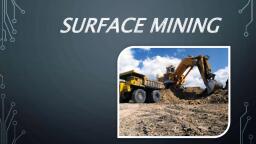
1.1) Open pit Mining method, • Mine working open to the surface., • Funnel shaped hole in ground, with ramp spiraling down, along sides, allows moderately deep ore to be reached., • Operation designed to extract minerals that lie close to the, surface, • It is used when the orebody is near the surface and little, overburden (waste rock) needs to be removed., • It is usually employed to exploit a near-surface deposit or, one that has a low stripping ratio., • Waste is first removed, then the ore is broken and loaded., • Generally low grade, shallow ore bodies., • Non-selective all high and low grade zones mined, • Mining rate > 20,000 tons mined per day (tpd)., • It often necessitates a large capital investment but generally, results in high productivity, low operating cost, and good, safety conditions., • Design issues:, , Stripping overburden, Location of haul roads, Equipment size of trucks and fleet, Pit slope angle and stability, , Surface Mining methods (Open pit Mining method)
Page 21 :
Outside Dump, , Typical Non-haul, Road bench, , Typical, Bench Wall, , Catch, Berm, , Typical, Haul Road, , Top of Main Ramp, Out of Open Pit, , Drill rig Drilling Out, a New Pattern, , Loaded Haul Truck Going to, Run of Mine Stockpile, , Shovels loading, haul trucks, , 2 February 2016, , Drilled out pattern about to, be charged with explosivesProf. Dr. H.Z. Harraz Presentation, , Typical Open Pit Mine, , Mining Methods, Surface mining, , Empty haul truck, returning to shovel, 21
Page 22 :
open pit mining: funnel shaped hole in, ground, with ramp spiraling down along, sides, allows moderately deep ore to be, reached., Initial mining for zinc at Franklin, and Ogdensburg, New Jersey-USA., , Photo I took at Bingham. 4 km in diameter 1 km in depth, at, its zenith 400000 tons of rock per day
Page 23 :
Open-pit mine: Chuquicamata copper mine, Región de Antofagasta, Chile, Benches, , http://upload.wikimedia.org/wikipedia/commons/2/2a/Chuquicamata_panorama.jpg, , Access ramps, , Dust, , Locality: Región de Antofagasta, Chile., Slope failure, Pit dimensions: 4.3 km long x 3 km wide x 850 m deep., Mining dates: 1915 -present, Total production: 29 million tons of copper to the end of 2007 (excluding Radomiro Tomić production). For many, years it was the mine with the largest annual production in the world, but was recently overtaken by Minera, Escondida (Chile). It remains the mine with the largest total cumulative production., Production 2007: 896,308 fine metric tons of copper (Codelco, 2007)., Mining cost in 2007: 48.5 US¢ per kg (2006), 73.0 US¢ per kg (2007) (Codelco, 2007)., Employees: 8,420 as of 31st 2007 (Codelco, 2007)., Pre-tax profits: US$ 9.215 billion (2006), US$ 8,451 billion (2007) (Codelco, 2007)., , 23
Page 24 :
Overburden Removal
Page 25 :
Removing Overburden
Page 27 :
Some photos and machinery used in open-pit mining, , A Dragline Shovel, , Loading ore in pit
Page 28 :
Haulage is usually by truck, although railroads,, inclined rails, and conveyor belts have been, used., The conveyance unloads directly into a primary, crusher and crushed material is stored in coarse, ore bins prior to shipment to the mill., , Blastholes are usually drilled vertically by selfpropelled, track-mounted pneumatic or rotary, drills. Bulk explosives are loaded in the holes and, large volumes of ore are broken in a single blast., Sometimes the drill holes are routinely sampled, and assayed to help plan the position of the, shovels in advance of mining., Blasthole assay control is especially desirable, when exploration data are incomplete or lacking, as in the case in the older pits which have long, been mined past the limits of "ore" used in original, planning.
Page 29 :
Mining Trucks, , Crushing in pit, , Drilling in pit, , *To the left is a photograph of a Liebherr, 360 ton (327 metric ton) haul truck. This, unit is powered by a 2750 horse power, engine and weighs 443,000 pounds (177, tons) empty...
Page 31 :
Benching, , Figure shows Open pit Mining method, , Bench level intervals are to a large measure, determined by the type of shovel or loader used, and, these are selected on the basis of the character of the, ore and the manner in which it breaks upon blasting and, supports itself on the working face.
Page 32 :
Figure 2.8 Open-pit mining sequence (for pipe-like orebody)
Page 33 :
Various open-pit and orebody configurations, Flat lying seam or bed, flat terrain, (Example platinum reefs, coal)., , Massive deposit, flat terrain (Example, iron-ore or sulphide deposits)., , Dipping seam or bed, flat terrain, (Example anthracite)., , Massive deposit, high relief, (Example copper sulphide)., , Thick bedded deposits, little overburden, flat, terrain (Example iron ore, coal)., Figure from Hartman and Mutmansky, 2002., , 33
Page 34 :
1.2) Terrace Mining, • Where the overburden is too thick {or the floor of the pit (i.e., The ore, inclination) is too steeply dipping} to allow waste dumping directly over, the pit (as is the case with a dragline and strip mining), it is necessary to, use intermediate cyclic or continuous transport (e.g., trucks or conveyors), to transport the overburden to where it can be tipped back into the, previously mined void., • It is a multi-benched sideways-moving method, the whole mine moves, over the ore reserve from one end to the other, but not necessarily in a, single bench. The number of benches used is usually a function of the, excavation depth and type of machinery used (typically between 10-15m, bench height and 1-32 benches in the terrace)., • Where steeply dipping orebodies are encountered, the modified method, is most often applied, a more typical 3 waste bench terrace operation with, steeply dipping orebody. In this case, the pit dimensions are limited by, seam exposure (pit length) and available working area (for mining and, dumping faces) (pit width).
Page 35 :
1.3) Strip Mining, Used for near-surface, laterally continuous, bedded deposits such as coal, stratified ores such, , as iron ore, and surficial deposits (nickel laterite or bauxite)., When orebodies are flat-lying and close to surface, it is sometimes economical to remove the overlying rock to, expose the orebody., Strip mining is ideally applied where the surface of the ground and the ore body itself are relatively, horizontal and not too deep under the surface, and a wide area is available to be mined in a series of strips., The surface soil is stripped off and stockpiled for later land reclaimation., A stripping dragline with a long-boom or long reach shovels are common., The pits are shallower that open-pit mines, and the overburden is “hind-cast” directly into adjacent, mined out panels., It is a very low-cost, high-productivity method of mining., , Typical examples of this type of mining are the larger tonnage coal mining operations in Mpumulanga., Favourable conditions are:, Relatively thin overburden (0-50 m maximum otherwise stripping ration and cost of stripping becomes too, high)., Regular and constant surface topography and coal layers (not more than 20º variation from horizontal on the, coal seam –topography can vary more since pre-stripping can be used to level it – but this is expensive to, apply)., Extensive area of reserves (to give adequate life of mine (LOM) and to cover all capital loan repayments –, typically more than 20 years life at 4-14mt per annum production).
Page 36 :
Production, 1), , Electric drills prepare the, overlying strata for blasting., , 2), , Removal of broken ore., , 3), , Removal of broken rock., , 4), , Extraction of upper ore seam., , 5), , Removal of upper ore.
Page 37 :
Strip Mining:, , Strip Mining:, The cheapest and safest method,, but can have a significant impact, environmentally on the surface., , 1), , Electric drills prepare the, overlying strata for blasting., , 2), , Removal of broken ore., , 3), , Removal of broken rock., , 4), , Extraction of upper ore seam., , 5), , Removal of upper ore., , Why……………..?, The ore is close to the surface of the land (30m) but has one or more layers of rock, and dirt on top of it. To mine the ore, these layers have to be taken off., This mining is done in long, narrow strips. When the ore is done in one strip, the, miners begin to create another strip next to it. The waste, dirt, and rock that they, take off of the top of the next strip is put on top of the last one.
Page 38 :
Strip Mining, , Large-scale continuous bucket excavators are gaining popularity., These large scale machines are designed for high capacity output, and are tremendous in size, highly productive, and very expensive.
Page 39 :
Strip mining., , Example: Alcoa’s, Sierra de Bahoruco, Aluminum mining, in D.R. Southern, Peninsula until 1985, , Strip-mining: Blast, scoop off rock, overburden, and then scoop out ore material., Fairly shallow., Economics of strip mining depend on stripping, ratio, Large land area can be involved, especially for, coal and bauxite.
Page 40 :
"Strip mining" is the practice of mining a seam of mineral by first removing a, long strip of overlying soil and rock (the overburden). It is most commonly used to mine, coal or tar sand. Strip mining is only practical when the ore body to be excavated is, relatively near the surface. This type of mining uses some of the largest machines on, earth, including bucket-wheel excavators which can move as much as 12,000 cubic, meters of earth per hour., , There are two forms of strip mining. The more common method is:i) "Area stripping", which is used on fairly flat terrain, to extract deposits over a, large area. As each long strip is excavated, the overburden is placed in the, excavation produced by the previous strip., ii) "Contour stripping" involves removing the overburden above the mineral, seam near the outcrop in hilly terrain, where the mineral outcrop usually follows, the contour of the land. Contour stripping is often followed by auger mining into, the hillside, to remove more of the mineral. This method commonly leaves, behind terraces in mountain sides., Among others, strip mining is used to extract the oil-impregnated sand in the, Athabasca Tar Sands in Alberta. It is also common in coal mining. Bucket-wheel, excavators are widely used for this purpose, however, they are prone to damage and, require many millions of dollars to repair.
Page 41 :
Schematic of strip coal mine, , http://en.wikipedia.org/wiki/File:Coal_mine_Wyoming.jpg, , Coal strip mine in Wyoming, , Figure from Hartman and Mutmansky, 2002., , • Significant “permanent” waste dumps are not needed., • Mine rehabilitation can be carried out, progressively at the same rate as mining., , Area Strip Mine (Coal)
Page 42 :
Strip Mining, Coal Mine Shovel-Truck Operation, , 2 February 2016, , Prof. Dr. H.Z. Harraz Presentation, Mining Geology, Introduction, , 200 T Haulage Truck, , 42
Page 43 :
Strip Mining, , Example: coal, placer, , Kansas Geological Survey
Page 45 :
Large bucket wheel extractor being moved through Germany. Moves 10, meters per minute. Takes 5 people to operate. Used in strip mining
Page 46 :
1.4. Contour strip (hilly terrain) mining or Contour (Bench) Strip Mining, , “Highwalls”, , Contour Mining in KY
Page 47 :
Mining Process, , Drilling, |, Blasting, |, Loading, |, Hauling, |, Transporting, |, Processing/Washing, , SURFACE MINER, , DRAG LINE, , 2 February 2016, , OPEN CAST, , Drill machines (rotary/percussive), |, SMS, emulsion, Primer, Nonel, etc, |, Shovels, Draglines, etc, |, Front-end loader, etc, IN-PIT CRUSHING &, |, CONVEYING, Dumpers, Conveyors, etc, |, Coal washeries…, , Prof. Dr. H.Z. Harraz Presentation, Mining Methods, Surface mining
Page 48 :
Selection of, Mining, Equipment, , •, •, •, •, •, , Stripping Ratio – in case of Opencast., Life of the mine., Infrastructure available., Proposed annual output., Technology available., , Different OC Machinery, , 1. Shovel + Dumper, 2. Dragline, 3. Surface Miner, 4. Bucket Wheel Excavator, 5. In-pit crushing + Spreader
Page 49 :
1.4) Glory Holing, This kind of operation is uncommon, as it involves a mine opening at the surface,, from which ore is removed by gravity through raises connected to adit haulage, ways beneath, and by tramming the ore to the surface on the haulage level., The glory hole method is best suited to mining on a hillside, and irregular deposits, can be cleanly mined without dilution by waste wall rock. Narrow veins have been, mined by glory hole; in these cases the “hole” becomes narrow and long. The, benches are mined away as work descends to the bottom of the deposit or to the, haulage way, so that spectacular steep side walls may result if the walls do not, slough in., Mining can be quite selective, and little waste rock is thrown on the surface dumps., The principal environmental objection to the method is difficulty in reclamation of, the surface of the mine area.
Page 50 :
1.5) Auger Mining, AUGER MINING refers to a method of, removing coal, clay, phosphate, oil-shale,, etc. from thin seams exposed in deep, trenches or high-walls in strip mines., The auger consists of two principal pieces., The first is a cutting head, generally from, 1.5 to 8 feet in diameter. It may be single or, multiple. The second is a prime mover,, usually a skid mounted carriage, providing, a mounting for the engine, drive head, and, controls. As coal arrives at the surface it is, transported via a conveyor belt or a frontend loader to a waiting truck., , Operations are usually lowcost and highly productive, but, recovery ranges from 40 to, 60%. It can be implemented, with relatively low capital, costs.
Page 51 :
1.6) Quarrying, QUARRYING or Quarry Mining is usually, restricted to mining dimension stone - prismatic, blocks of marble, granite, limestone, sandstone,, slate, etc. that are used for primary construction, of buildings or decorative facing materials for, exterior and interior portions of buildings., Quarries generally have benches with vertical, faces from a few feet to 200 feet in height., Blocks are drilled and wedged free in a highly, selective manner using time consuming and, expensive methods., Planning of the excavation is based primarily on, geological factors such as the direction and, attitude of bedding and joint systems.
Page 52 :
2) Aqueous Extraction Methods, Depend on water or another liquid (e.g., dilute sulfuric acid, weak, cyanide solution, or ammonium carbonate) to extract the mineral., 2.1) Placer mining:, 2.1.1) Hydraulic mining, 2.1.2) Dredging mining, , 2.2) In-situ leaching (ISL)/ Solution mining, 2.3) Undersea Mining, Placer and solution mining are among the most economical of all mining, methods but can only be applied to limited categories of mineral deposits.
Page 53 :
2.1) PLACER MINING
Page 54 :
2.1) Placer mining, Placer deposits are concentrations of heavy minerals, usually within loose alluvium that can easily be, excavated and washed., Placer minerals such as gold, tin, and tungsten minerals, are of relatively high value, but the value of the, placer gravel itself may be very low, often less than a dollar per cubic yard., For deposits of such low grade to be worked they must be near water, on or near the surface of the, ground, and should be only loosely consolidated so that drilling and blasting are not necessary., Placer mining affects large surface areas for the volume of material mined, is highly visible and has, serious environmental problems with surface disturbance and stream pollution., , Placer mining is used to exploit loosely consolidated deposits like common sand and gravel or gravels containing, gold, tin, diamonds, platinum, titanium, or gems., There are two types of placer mining:2.1.1) Hydraulic mining: Generally used for weakly cemented near-surface ore deposits. Hydraulic mining, of a placer gold deposit. Hydraulic king utilizes a high-pressure stream of water that is directed, against the mineral deposit (normally but not always a placer), under-cutting it, and causing its, removal by the erosive actions of the water., 2.1.2) Dredging mining: Generally used most often for mineral-sands and some near-shore alluvial, diamond mining operations. Dredging performed from floating vessels, accomplishes the, extraction of the minerals mechanically or hydraulically., "Dredging" is a method often used to bring up underwater mineral deposits. Although dredging is, usually employed to clear or enlarge waterways for boats, it can also recover significant amounts, of underwater minerals relatively efficiently and cheaply.
Page 55 :
Figure shows Hydraulic mining of a placer gold deposit, , The “Stang Intelligiant” monitor, (operator controlled high pressure, water discharge point) mounted, on a skid, Figures from Hartman and Mutmansky, 2002.
Page 56 :
i) Hydraulic Mining (or Hydraulic king), , , Hydraulic Mining involves directing a highpressure stream of water, via a MONITOR or, nozzle, against the base of the placer bank., , , , The water caves the bank, disintegrates the, ground and washes the material to and through, sluice boxes, and / or jigs, and / or tables, situated down-slope., , , , Hydraulic mining totally disturbs large areas, and puts much debris into the drainage system., Presently, hydraulicking is used primarily in, Third World countries. It is closely controlled or, prohibited in the U.S.
Page 57 :
Dredging mining, , "Dredging" is a method often used to bring up, underwater mineral deposits. Although, dredging is usually employed to clear or, enlarge waterways for boats, it can also, recover significant amounts of underwater, minerals relatively efficiently and cheaply.
Page 58 :
ii) Dredging, Large alluvial deposits are mined by floating washing plants, capable of excavating the gravel, processing it in the washing plant,, and stacking the tailings away from the dredge pond., A Dredge floats in water and digs the gravel by an endless string of, buckets. Coarse material is screened out and dumped out the back., The fine material passes into a series of sluices where the gold in, recovered., Several types of excavation methods are in use: DRAGLINE and, BACKHOE PLANTS., , , , Dragline use in placer mining with washing plants is limited to, shallow digging depths. Its bucket is less controllable on the bottom, than the backhoe, and it is less able to dig into the bottom to clean, up all the ore that may be there. However, it has the advantage of a, longer reach., , The digging reach of the backhoe extends to as much as 70 feet, below the surface. It has the advantage of relatively low first cost,, excellent mobility, and an ability to excavate hard material.
Page 59 :
Types of Excavation Methods Using Dredging:, i) Bucket Wheel Hydraulic Dredges are becoming, more popular for underwater excavation, except, where a high content of soft clay exists or where, excessive oversize material occurs. It is dependent, upon flooded pump openings that convey the, material mined to the washing plant, and therefore, it cannot work above water level. Placement of the, pump suction is critical., ii) Bucketline Dredges are capable of continuous, excavation and are very efficient. They mine,, process, and discard tailings to waste in one, continuous stream. However, no storage, opportunities exist, and the stream moves through, the system by the force of gravity. Buckets,, supported by a LADDER, dig the mine face., Material moves up the ladder and dumps into a, hopper that feeds the washing plant. They are, capable of high excavation rates., , iii) Suction Cutter Dredges are similar to the, Bucket Wheet Dredge except the digging device, consists of a series of cutting arms rotating in a, basket about a suction intake. The rotating arms, break up the bank material, slurrying it so it can, be drawn into the dredge suction. It has proven, to be successful in mining unconsolidated beach, sands and offshore placers., , Various methods are used to position the dredge --anchored by wire, ropes or piling (SPUDS) at the rear of the dredge. Boulders can cause, serious problems.
Page 60 :
Placer Mining Costs, Capital Cost of Bucketline Dredge (1990):, , Operating Costs (1990):, , Because large placer deposits can be thoroughly explored before floating, a dredge, such operations can lend themselves to thorough planning, and, it is possible to carry out reclamation as mining progresses at only a slight, increase in operating costs.
Page 61 :
SOLUTION MINING
Page 62 :
Solution Mining, Basic concept, , , The theory and practice of leaching are well-developed because for many years leaching has been, used to separate metals from their ores and to extract sugar from sugar beets. Environmental, engineers have become concerned with leaching more recently because of the multitude of dumps, and landfills that contain hazardous and toxic wastes. Sometimes the natural breakdown of a toxic, chemical results in another chemical that is even more toxic. Rain that passes through these, materials enters ground water, lakes, streams, wells, ponds, and the like., , , , Although many toxic materials have low solubility in water, the concentrations that are deemed, hazardous are also very low. Furthermore, many toxic compounds are accumulated by living cells, and can be more concentrated inside than outside a cell. This is why long-term exposure is a serious, problem; encountering a low concentration of a toxic material a few times may not be dangerous, but, having it in your drinking water day after day and year after year can be deadly., , , , The main theory of leaching neglects mechanisms for holding the material on the solid. Although, adsorption and ion exchange can bind materials tightly to solids, we will simplify the analysis and, consider only dissolving a soluble constituent away from an insoluble solid. An example is removing, salt from sand by extraction with water., , , , Countercurrent stage wise processes are frequently used in industrial leaching because they can, deliver the highest possible concentration in the extract and can minimize the amount of solvent, needed. The solvent phase becomes concentrated as it contacts in a stage wise fashion the, increasing solute-rich solid. The raffinate becomes less concentrated in soluble material as it moves, toward the fresh solvent stage.
Page 63 :
In-situ leaching (ISL)/ Solution mining, Solution mining (in-situ recovery) = resources in a, deep deposit are dissolved in a liquid and, siphoned out., Salts, lithium, boron, bromine, potash, copper,, uranium., Less environmental impact than other methods:, Less surface area is disturbed., Acids, heavy metals, uranium can accidentally leak., , 63
Page 64 :
2.2. In-situ leaching (ISL)/ Solution Mining, Used most commonly on evaporite (e.g. salt and potash) and sediment-hosted uranium deposits,, and also to a far lesser extent to recover copper from low-grade oxidized ore., The dissolving solution is pumped into the orebody from a series of injection wells, and is then, pumped out, together with salts dissolved from the orebody from a series of extraction, (production) wells., , Metals and minerals commonly mined by solution mining methods., Dissolving agent specified in each case. (From Hartman and Mutmansky,, 2002, and references therein)., Metal or Mineral, Gold, Silver, Copper, , Approximate, Primary production, 35%, 25%, 30%, , Uranium, , 75%, , Common Salt, Potash, Trona, Boron, Magnesium, Sulfur, Lithium, , 50%, 20%, 20%, 20%, 85%, 35%, 100%, , Dissolution Agent/ Method, Sodium cyanide (NaCN), Sodium cyanide (NaCN), Sulphuric acid (H2SO4); Ammonium carbonate (alkali), {(NH4)2CO3}, Sulphuric acid (H2SO4); Ammonium carbonate (alkali), {(NH4)2CO3}, Water, , Water, , Aside: The same, reagents are often, used for processing, mined ores in, hydrometallurgical, plants, , Water, Hydrochloric acid (HCl), Seawater, lake brine processing, Hot water (melting), Lake brine processing, , 64
Page 65 :
In-situ leaching (ISL)/ Solution Mining, Hot water, Brine out, , ISL salt mine, , Compressed air, Sulfur, Water & air, , ISL sulfur mine, , Solution mining includes both borehole mining, such as the methods used to extract sodium, chloride or sulfur, and leaching, either through drillholes or in dumps or heaps on the surface., , 65
Page 66 :
In-situ leaching (ISL)/ solution mining:, Advantages:, No solid wastes., Liquid wastes (low concentration brines with no market value) can be re-injected, into the stratum being leached. Also reported that wastes are sometimes injected, into a separate acquifer (not good practice)., Problems:, , Little control of the solution underground and difficulty in ensuring the process, solutions do not migrate away from the immediate area of leaching., , Main impact of evaporite ISL is derived from surface or shallow groundwater, contamination in the vicinity of evaporation ponds. Pregnant solutions can be, highly corrosive and pyhto-toxic, and can react with the soil materials used in, pond construction, and may migrate to surrounding areas through seepage,, overflow (both bad practice),and windblown spray., , Surface subsidence and the development of sink-holes may also occur after, prolonged solution mining if inadequate un-mined material is left to support, the overburden (bad practice)., , 66
Page 67 :
Example, Evaporite deposits, Has been used for many decades to extract soluble evaporite salts such as halite (NaCl),, trona (3Na2O · 4CO2), nahcolite (NaHCO3), epsomite (MgSO4 · 7H2O), carnallite, (KMgCl3 · 6H2O), borax (Na2B4O7 · 10H2O) from buried evaporite deposits in UK,, Russia, Germany, Turkey, Thailand and USA)., A low salinity fluid, either heated or not, is injected underground directly into the, evaporite layer; the “pregnant” solutions (brines) are withdrawn from recovery, boreholes and are pumped into evaporation ponds, to allow the salts to crystallize, out as the water evaporates., , Old underground mines, consisting typically of roomand-pillar workings, are often further mined using, solutions to recover what remains of the deposit,, i.e., the pillars (with associated surface subsidence, risk)., , Evaporation ponds, Arizona, Figure from Spitz and Trudinger, 2009.
Page 68 :
Heap Leaching, Heap leaching is also used in recovering metals from their, ores., Bacterial leaching is first used to oxidize sulphide minerals., Cyanide solution is then used to leach the metals from the, mineral heap., 'Heap leaching' is a countercurrent process where the, solid is in a stationary heap and the solvent percolates, through the solid. An example is a dump or landfill. This, leaching is essentially countercurrent. In industrial, leaching, solvent and solid are mixed, allowed to approach, equilibrium, and the two phases are separated. Liquid and, solids move counter currently to the adjacent stages. The, solvent phase, called the extract, becomes more, concentrated as it contacts in stagewise fashion the, increasingly solute-rich solid. The raffinate becomes less, concentrated in soluble material as it moves toward the, fresh solvent phase.
Page 69 :
Uranium heap leaching, Occurs in tetravalent and hexavalent forms, Tetravalent uranium requires oxidation during, leaching, Leaching in acid or carbonate medium,, depending on gangue acid consumption. Lower, recoveries in carbonate medium., Addition of suitable oxidising agent such as,, H2O2, MnO2, NaClO3 for regeneration of Fe3+,, or by bacterial oxidation. Typically 0.5g/L Fe,, ORP 475-425 mV, which may be produced from, gangue dissolution., Bacterial leaching offers advantage of reduced, oxidising agent cost and generation of acid, from sulphide minerals such as pyrite, as well, as liberation of mineral from sulphide host., “Readily leachable” minerals are acid leached, at pH 1.5-2.0 and 35-60oC, which are suitable, conditions for bioleaching. “Refractory”, minerals require higher temperature (60-80oC), and stronger acid (up to 50g/L).
Page 71 :
Uranium deposits, Uranium minerals are soluble in acidic or alkaline solutions., The production (“pregnant”) fluid consisting of the water soluble uranyl, oxyanion (UO22+) is subject to further processing on surface to precipitate, the concentrated mineral product U3O8 or UO3(yellowcake)., Acid leaching fluid, sulphuric acid + oxidant (nitric acid,, hydrogen peroxide or dissolved oxygen), or, Alkali leaching fluid, ammonia, ammonium, carbonate/bicarbonate,, or sodium carbonate/bicarbonate, The hydrology of the acquifer is irreversibly, changed: its porosity, permeability and, water quality. It is regarded as being easier, to “restore” an acquifer after alkali, leaching., , Figure from Hartman and Mutmansky, 2002., , 71
Page 72 :
Heap Leach Operation, Installing a Plastic Membrane Liner
Page 73 :
Layout of copper bio-heap pilot plant, SX-EW, photo), , (off, , Auxiliary, Ponds, , Drum agglomeration, , PLS,, Raffinate, Ponds, , Heaps, , Crushing,, Agglomeration, , Humidification layer with drainage pipes
Page 74 :
Advantages/disadvantages, of, heap, leaching, Advantages/disadvantages of heap, •Advantages, , •, •, •, •, •, , leaching, , Low capital and operating costs, Absence of milling step, may require crushing and agglomeration, Simplicity of atmospheric leach processes, Can be used to treat low-grade ores, wastes and small deposits, Absence of liquid-solid separation step allows counter-current, operation, • Metal tenor may be built up by recycling solution over heaps, •Disadvantages, , •Lower recoveries than mill/float or mill/leach, •Long leach cycles and hold-up, •Lengthy experimental programmes, •Large footprint, •Acid-mine drainage of wastes
Page 75 :
Undersea (or Oceans) Mining, •, •, , We extract minerals (e.g., magnesium) from seawater, Minerals are dredged from the ocean floor, Sulfur, phosphate, calcium carbonate (for cement), silica (insulation and glass), copper, zinc, silver, gold, , •, , Manganese nodules = small, ball-shaped ores scattered across the ocean floor, Mining them is currently uneconomical, Manganese Nodules (pacific ocean)– ore nodules crystallized from hot solutions arising from volcanic, activity. Contain manganese, iron copper and nickel., , •, •, , Hydrothermal vents may have gold, silver, zinc, Mining would destroy habitats and organisms and release toxic metals that could enter the food, chain, 1) Minerals are found in seawater, but occur in too low of a concentration, 2) Continental shelf can be mined, 3) Deep Ocean are extremely expensive to extract (not currently viable), , View publication stats



 Learn better on this topic