Notes of II PUC, English notes - when you are old.pdf - Study Material
Page 1 :
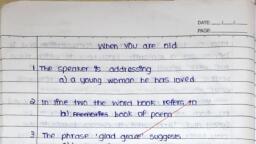
6. When you are old -, , William Butler Yeats, , Comprehension I, 1. The speaker is addressing, a. A young woman he has loved, 2. Inline two, the word ‘book’ refers to, b. book of poems, 3. The words ‘glad grace’ suggests, a. Her physical beauty, 4. ‘pilgrim soul’ means the soul, a. Which is in quest of true love, 5. What does the phrase ‘your changing face’ suggest?, It suggests the changes in the face of the woman as she grows old. Her, face has lost its beauty and grace., 6. ‘Love fled’ connotes, b. The loss endured by her., Comprehension II, Question 1., How is the ‘one-man’ different from the many others who loved the lady?, William Butler Yeats is an Irish Poet and one of the foremost figures of 20th, century literature. The speaker addresses the beautiful lady of his time who, does not reciprocate his love. The narrator/speaker asks his lady love to, presume that she has grown old and grey and is sitting by the fire nodding. The, poet visualises her old age and thinks that, by then, the lady will be left with, none but only his book of poems that expresses his true love for her. Then he, asks her to read the book and reminisce her past when she was in her prime, youth. While she is thus engaged in recalling her past, the poet reminds her, that though she undoubtedly had a great many suitors who admired her beauty, and elegance and professed ‘love’ which may be true or false, he alone loved, her unconditionally. He feels that all the other young lovers were merely drawn, to the physical beauty of her., While admitting that many suitors were attracted by her youthful beauty and, elegance, the speaker tries to tell her that he was the only lover who loved the
Page 2 :
pilgrim soul in her. He wants her to know that he was attracted by the beauty, of her inner self and his love would remain constant even after she grows old., Thus the poet says that he is the one man different from others as he loved her, inner beauty as well as the sorrows of her changing face., 2. Does the poem brings out the transient nature of beauty as against the, permanence of love?, The poem ‘when you are old’ written by W.B.Yeats mainly speaks about two, important combinations beauty and love and time and regret. Shakespeare, in, one of his poems said “love is not time’s fool”, that means time cannot control, love. True love does not change. However, beauty is subjected to change and, lose its grace as time passes. In the poem, the poet makes an attempt to, persuade the young lady not to ignore him or his love, also incidentally, highlights the transient / temporary nature of beauty as against the, permanence of love. The speaker argues that, all her suitors are merely, attracted by her youthful beauty and elegance, he is attracted by her pilgrim, soul. He states that she does not understand his true love, but he loves her, spiritual soul rather than her physical self. Furthermore, he claims that the love, exhibited by her many suitors may not last long and might change as she grows, old., On the contrary, his love will remain constant and unconditional. He would love, her ‘pilgrim soul’ as well as the changes in her face which appear as one grows, old. The poet thus says that the lady who now enjoys the attention of her lovers, hardly understands that in future she will regret for not realizing his true love., Thus, the poet, using the phrase ‘your moments of glad grace’ in the first line of, the second stanza in contrast with the phrase ‘sorrows of your changing face’ in, the fourth line suggests that ‘beauty’ is transient in nature whereas ‘love’ is, permanent., Comprehension III, 1. Comment on the usage of the time frame by the poet in ‘When You Are, Old’., ‘When You Are Old’ is short love poem written by one of the best known Irish, Poets W.B.Yeats. In the poem the poet uses a time frame in which the speaker, addresses his most beautiful lady love in the present, takes her to an unreal
Page 3 :
condition in the future, and asks her to recall her past memories. The poet feels, that his pure love for her is not reciprocated by her. The poem has a time frame, of present and future. He does so, in order to persuade her or warn her not to, ignore him and make a wrong decision., The poem sets up a time frame of present and future in comparison with youth, and old age. The lady is enjoying her stardom and understandably there are, many who just adore her glamour and beauty. The poet has found the pilgrim, soul in her which appeals to his heart. The poet’s point of view is the most, compelling point of the poem. The narrator is calling upon a woman that is not, yet through with youth to, once past her prime, recall the days he was in her life, and very much in love with her. Obviously, he wants her to remember him for, his unique and unconditional love for her, and how she is choosing to ignore it, in the present. By writing this poem in this fashion, the woman, when the poet, hopes that she grows old, will remember the days when she was young with, happiness but will grow regretful that she did not take advantage of his love., The opening stanza presents the future years when the lady will be left with, none and will only regret the loss of her spiritual love and youth., The poem shifts to the present in second stanza where the poet brings us the, picture of the lady surrounded by love aspirant youth. He regrets that she does, not perceive his real spiritual love. The poem concludes with a shift to the future, years where she will have lost her beauty and love. The poet sadly concludes, that her love has fled beyond her reach over the mountains. He hopes that, if, once in her old age, she will grow sorrowful that she did not foresee how, steadfast his love was but how foolish she was for taking no notice of it. He is, already fearful that she will grow old without him, and this can be seen as he, requests that she remember him a ‘little sadly’ and as a missed chance to have, a happy future., Thus the time frame of present and future that the poet has used in this poem, facilitates the poet to write this sad and reminiscent poem. The poem is not, designed primarily to make an old woman regretful, but to keep a young woman, from ignoring the narrator and making the wrong decision.
Page 4 :
2. ‘When You Are Old’ is a poem of contrasts. What purpose do they serve?, ‘When You Are Old’ was written to show the true and unforgettable love from, the writer. The theme is a painful one of unrequited love, which the poet, manipulates in an interesting manner. Instead of focusing upon the present or, the past, Yeats looks to the future, a future in which the two people in the poem, are destined to be forever apart. The poet visualizes an unreal condition that, the woman he loved became old and felt regret for refusing his true love., To depict such a theme, the poet deploys elegant and quiet words and builds, pictures of contrasts:, In the first stanza, there is a contrast between her elegant youth and her, depressing old age. In the second stanza, there is a contrast between her many, suitors who professed superficial love and the speaker or the lover who, promises true love for her. In the third stanza, there is a contrast between the, transient love represented by her many suitors and the personified love of the, poet., There is a contrast between ‘the sorrows of your changing face’ in the second, stanza and ‘murmur a little sadly’ of the third stanza. ‘The sorrows’ indicate, passion or strong emotion is seen in young people and ‘little sadly’ reflects the, listlessness of old people. There is a contrast between the ‘beauty and elegance’, because her physical beauty and elegance was sought after by the suitors but, the speaker cherished the ‘pilgrim soul’ in the same lady. The many suitors who, wanted to court her were attracted by her superficial beauty whereas this, lover/speaker was attracted by her pilgrim soul, which symbolizes her inner self., These contrasts serve to build a strong argument to persuade the young lady, not to ignore him now and regret later., xxxxxxxxxxxxxxx



 Learn better on this topic