Page 1 :
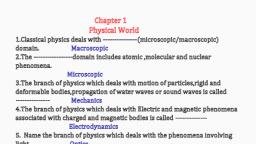
Chapter 1, Physical World, 1.Classical physics deals with ---------------(microscopic/macroscopic), domain., Macroscopic, 2.The -----------------domain includes atomic ,molecular and nuclear, phenomena., Microscopic, 3.The branch of physics which deals with motion of particles,rigid and, deformable bodies,propagation of water waves or sound waves is called, --------------Mechanics, 4.The branch of physics which deals with Electric and magnetic phenomena, associated with charged and magnetic bodies is called -------------Electrodynamics, 5. Name the branch of physics which deals with the phenomena involving, light ., Optics, 6. Name the branch of physics which deals with changes in internal, energy,temperatur,etc.,of the system through external work and transfer of, heat., Thermodynamics, , Chapter 2, Units and Measurement, 1.Name the fundamental(base) quantities and units according to SI system., , Seema Elizabeth, MARM Govt HSS Santhipuram, Thrissur, 1
Page 2 :
2.Name and state the principle used to check the correctness of an equation., , 3. Using the method of dimension check whether the equation is, dimensionally correct or not, , 4. Using the method of dimension check whether the equation is, dimensionally correct or not, , 2
Page 3 :
5. Using the method of dimension check whether the equation is, dimensionally correct or not, , 6.Check the dimensional correctness of the equation E=m𝐜 𝟐, , 7.In the given equation v = x + at , find the dimensions of x., (where v= velocity , a=acceleration , t=time), , 8. In the given equatio x= a + bt + c𝐭 𝟐 , find the dimensions of a,b and c., (where x is in meters and t in seconds), , 3
Page 4 :
9.Derive the equation for kinetic energy E of a body of mass m moving, with velocity v, , 10.Write any two limitations of dimensional analysis., , 4
Page 5 :
Chapter 3, Motion in a Straight Line, 1. Write the differences betwee path length(distance ) and displacement, , 2. A body completes one full rotation in a circular path of radius R., Write the values of its, (a) Distance travelled, (b) Displacement, (a)2𝛑𝐑, (b) Zero, 3. Define average velocity, , 5. Define average speed, , 6.Write the difference between Average Speed and Velocity, , 5
Page 7 :
9. The area under velocity -time graph gives --------------Displacement, 10. The slope of velocity-time graph gives --------------Acceleration, 11. Define average accelaration, The average acceleration over a time interval is defined as the ratio of, change in velocity to the time interval., , 𝐚⃗ =, , 𝐯𝟐 −𝐯𝟏, 𝐭 𝟐 −𝐭 𝟏, , 𝚫𝐯, , = 𝚫𝐭, , 12.Draw the position- time graph of an object moving with, , 13. Draw the velocity- time graph of an object moving with, (a) uniform positive acceleration, (b) uniform negative acceleration, , 14. Draw the velocity- time graph of a stone thown vertiaccly upwrds and, comes back., , 7
Page 8 :
14. Draw the speed- time graph of a stone thown vertiaccly upwrds and, comes back., , 15. Draw the velocity-time graph of a freely falling body.( A stone vertically, falling downwards), , 16. Is it possible for a body to have zero velocity with a nonzero, acceleration. Give an example., Yes. When a body is thrown upwards ,at the highest point of projection,, its velocity is zero , but it has an acceleration., 17. (a)Draw the velocity-time graph of a body with uniform aceeleration ., (b) Using the graph obtain, (i) Velocity - time relation, (ii) Displacement -tme relation, (iii) Displacement velocity relation, , 8
Page 9 :
9
Page 10 :
16 .An object is under freefall. Draw its (a) Acceleration -time graph, (b) Velocity- time graph, (c) Displacement-time graph, , Chapter 4, Motion in a Plane, 1. Differentiate scalar and vector quantities, A scalar quantity has only magnitude and no direction., Eg. distance , speed, mass , temperature, time ,work ,power, energy,, pressure, frequency, angular frequency etc., A vector quantity has both magnitude and direction and obeys the triangle, law of addition or the parallelogram law of addition., Eg. displacement, velocity, acceleration , momentum, force,, angular velocity, torque, angular momentum etc., 10
Page 11 :
2.What is the trajectory(path) followed by a projectile? Ans: Parabola, 3. Draw the trajectory of a projectile, , 4. A stone is thrown up with a velocity u , which makes an angle 𝛉 with, the horizontal., a) What are the magnitudes of horizontal and vertical components of, velocity?, b) How do these components vary with time?, a) Horizontal component- u cos θ and vertical component - u sin θ, b) Horizontal component- u cos θ remains constant with time., vertical component first deceases, becomes zero at the highest point of, projection and then increases in reverse direction., 5.What are the values of these components at the highest point, of projection?, At the highest point,, Horizontal component, u cos θ remains the same., Vertical component = zero, 6. A projectile has an acceleration of 9.8m 𝒔−𝟐 in vertical direction and no, acceleration in horizontal direction, 7) Show that the path of the projectile is a parabola ., Displacement of the projectile after a time t, x= ucosθ t, t=, , x, ucosθ, 1, , y= u sinθ t − g t 2, 2, , x, , 1, , x, , 2, , y= u sinθ (, ) − 2 g (ucosθ), ucosθ, y= tanθ x −, , g, 2 u2 cos2 θ, , x2, , 11
Page 13 :
8.What is the angle of projection for maximum horizontal range, 𝟒𝟓𝟎, 9. What is the maximum value of horizontal range, Range is maximum when θ=𝟒𝟓𝟎, R=, , 𝐮𝟐 𝐬𝐢𝐧 𝟗𝟎, , Rmax =, , 𝐠, 𝐮𝟐, 𝐠, , 10. Find the angle of projection for which the range will be same, as that in case of θ=𝟑𝟎𝟎 for a given velocity of projection., For a given velocity of projection range will be same for angles, 𝜽 and ( 90-𝜽 ), , Here θ=300, 90-𝜽 =90-30 =600, The range will be same for 300 and 600 ,for a given velocity of projection., 11.A cricket ball is thrown at a speed of 28 m s –1 in a direction 30° above the, horizontal. Calculate (a) the maximum height, (b) the time taken by the ball, to return to the same level, and (c) the distance from the thrower to the, point where the ball returns to the same level., (a) H = u2 sin 2θ, 2g, H = 282 sin2 30, 2 x 9.8, H = 10 m, (b) T = 2 u sin θ, g, T = 2x 28 sin30, 9.8, T = 2.9 s, (c) R = u2 sin 2θ, g, R = 282 sin60, 9.8, R = 69 m, 13
Page 14 :
Chapter 5, Laws of Motion, 1.Define momentum, Momentum, P of a body is defined to be the product of its mass m and, velocity v, and is denoted by p., p=mv, 2.State Newton’s Second Law f Motion. Write its mathematical expression., , or F=, , 𝐝𝐩, 𝐝𝐭, , 3.Why a seasoned cricketer draws his hands backwards during a catch?, By Newton's second law of motion ,, 𝐝𝐩, , F= 𝐝𝐭, , When he draws his hands backwards, the time interval (dt) to stop the ball, increases . Then force decreases and it does not hurt his hands., 4. Derive of Equation of force from Newton's second law of motion, By Newton's second law of motion ,, , 5.Define Newton, , 14
Page 15 :
6. A bullet of mass 0.04 kg moving with a speed of 90 m/s enters a heavy, wooden block and is stopped after a distance of 60 cm. What is the average, resistive force exerted by the block on the bullet?, , 7.Define Impulse, Impulse is the the product of force and time duration, which is the change in, momentum of the body., Impulse = Force × time duration, I=Fxt, Unit = kg m s−1, 8. Define Impulsive force., A large force acting for a short time to produce a finite change in, momentum is called an impulsive force., Eg: A cricket ball hitting a bat, 9. Using Newtons second law of motion arrive at Impulse momentum, Principle, Impulse is equal to the change in momentum of the body., By Newton's second law of motion,, F=, , dp, dt, , F x dt = dp, I = dp, Impulse = change in momentum, 15
Page 16 :
10.A batsman hits back a ball straight in the direction of the bowler without, changing its initial speed of 12 m 𝐬−𝟏 . If the mass of the ball is 0.15 kg,, determine the impulse imparted to the ball., Impulse = change of momentum, Change in momentum = final momentum – initial momentum, Change in momentum = 0.15 × 12–(–0.15×12), Impulse = 3.6 N s, 11.State the Law of Conservation of Momentum, The total momentum of an isolated system of interacting particles is, conserved., Or, When there is no external force acting on a system of particles ,their total, momentum remains constant., 12.Proof of law of conservation of momentum Using Newton’s second law of, motion, By Newton's second law of motion , F=, , dp, dt, , When F = 0, dp, dt, , =0, , dp = 0 ,, p=constant, Thus when there is no external force acting on a system of particles, their, total momentum remains constant., 13.Explain the recoil of gun using law of conservation of linear momentum, , 16
Page 17 :
If pb and pg are the momenta of the bullet and gun after firing, pb + pg = 0, pb = - pg, The negative sign shows that gun recoils to conserve momentum., 14.Obtain the expression for Recoil velocity and muzzle velocity, Momentum of bullet after firing , pb = mv, Recoil momentum of the gun after firing , pg = MV, pb = - pg, mv = −MV, −mv, Recoil velocity of gun , V=, Muzzle velocity of bullet , v=, , M, −MV, m, , M= mass of gun, V= recoil velocity of bullet, m= mass of bullet, v=muzzle velocity of bullet, 15. . Explain the collision of two bodies using law of conservation of, momentum, , 17
Page 18 :
Total Final momentum = Total initial momentum, i.e. , the total final momentum of the isolated system equals its total initial, momentum., 16.State the law of static friction, The law of static friction may thus be written as , fs ≤ 𝛍𝐬 𝐍, 0r, ( 𝐟𝐬 )𝐦𝐚𝐱 = 𝛍𝐬 𝐍, where μs the coefficient of static friction,, 17.State the Law of Kinetic Friction, 𝐟𝐤 = 𝛍𝐤 𝐍, where μk the coefficient of kinetic friction,, 18.Show that 𝛍𝐬 = 𝐭𝐚𝐧 𝛉 (the coefficient of static friction is eual to the, tangent of angle of friction) when a body just begins to slide on an, inclined surface, , The forces acting on a block of mass m When it just begins to slide are, (i) the weight, mg, (ii) the normal force, N, (iii) the maximum static frictional force ( 𝐟𝐬 )𝐦𝐚𝐱, In equilibrium, the resultant of these forces must be zero., m g sin θ = ( fs )max ------------(1), m g cos θ = N-------------(2), But ( fs )max = μs N, Eqn (1) becomes, mg sin θ= μs N------------(3), (3), , Eqn(2) --------, , mg sin θ, m g cos θ, , =, , μs N, N, , 𝛍𝐬 = 𝐭𝐚𝐧 𝛉, , 18
Page 19 :
19.Disadvantages of friction, In a machine with different moving parts, friction opposes relative motion, and thereby dissipates power in the form of heat, etc., 20.Advantages of friction, Kinetic friction is made use of by brakes in machines and automobiles., We are able to walk because of static friction., The friction between the tyres and the road provides the necessary external, force to accelerate the car., 21.Methods to reduce friction, (1)Lubricants are a way of reducing kinetic friction in a machine., (2)Another way is to use ball bearings between two moving parts of a, machine., (3) A thin cushion of air maintained between solid surfaces in relative, motion is another effective way of reducing friction., 22.Derive the expression for maximum safe speed on a curved level road, , Three forces act on the car., (i), The weight of the car, mg, (ii), Normal reaction, N, (iii), Frictional force, fs, As there is no acceleration in the vertical direction, N= mg, The static friction provides the centripetal acceleration, fs =, , mv2, R, , But , fs ≤ μs N, mv2, , 𝐯, , R, 𝟐, , ≤ μs mg, , (N=mg), , ≤ 𝛍𝐬 𝐑𝐠, 𝐯𝐦𝐚𝐱 = √𝛍𝐬 𝐑𝐠, 19
Page 21 :
25.Obtain the expression for optimum speed (without considering frictional, force) of a vehicle on a banked road, , The maximum permissible speed,, 𝐯𝐦𝐚𝐱 = √, , 𝐑𝐠(𝛍𝐬 +𝐭𝐚𝐧 𝛉 ), 𝟏 −𝛍𝐬 𝐭𝐚𝐧 𝛉, , If friction is absent, μs = 0, Then Optimum speed, 𝐯𝐨𝐩𝐭𝐢𝐦𝐮𝐦 = √𝐑𝐠 𝐭𝐚𝐧 𝛉, 26.A circular racetrack of ra dius 300 m is banked at an angle of 15°. If the, coefficient of friction between the wheels of a race-car and the road is 0.2,, what is the, (a) optimum speed of the race car to avoid wear and tear on its tyres, and, (b) maximum permissible speed to avoid slipping ?, (a), , (b), , 21
Page 22 :
Chapter 6, Work ,Energy and Power, 1.Define work., The work done by the force is defined to be the product of component of the, force in the direction of the displacement and the magnitude of this displacement., W=𝐅⋅𝐝, 2.Write the situations in which work done by a body is zero, (i) when the displacement is zero ., (ii )when the force is zero., (iii) the force and displacement are mutually perpendicular, W=Fd cos 90 = 0., 3.Give an example for Positive Work, Workdone by Gravitational force on a freely falling body is positive, 4.Give an example of Negative work, The frictional force opposes displacement and θ = 180 o ., Then the work done by friction is negative (cos 180 o = –1)., 5. What is the work done by centripetal force on a body moving in circular, path, Zero., Here θ = 90 o , W =Fd cos 90 = 0., 6. 1 horse power,1HP= -----------Watt., 7. 1 kilowatt-hour,, , 746W, , 1kWh = ------------------ J, , 3.6 × 𝟏𝟎𝟔 J, , 8. Kilowatt-hour is the unit of ------------Energy, 9. The energy possessed by a body by virtue of its motion is called----------Kinetic energy, 10. The energy stored by virtue of the position or configuration of a, body(state of strain) is called------------Potential Energy., 11. Calculate the work done in lifting a body of mass 10kg to a height of 10m, above the ground, W= F x d, = mg x h =10 x 9.8 x10 =980J, 22
Page 23 :
12. Two bodies of masses 𝐦𝟏 𝐚𝐧𝐝 𝐦𝟐 have same momenta. What is the ratio, of their kinetic energies?, 1, , p2, , 2, p2, , 2m, , KE, K = mv 2 =, K1 =, , K2 =, , 2 m1, , p2, 2 m2, , K1 / K 2 = m2 /m2, K 1 : K 2 = m2 : m2, 13. A light body and heavy body have same momenta, Which one has greater, kinetic energy?, KE =, , p2, 2m, 1, , KE∝, m, Lighter body will have more Kinetic energy., 14.Power is the scalar product of force and -------------Velocity, , ( P= F .v), , 15.Show that the gravitational potential energy of the object at height h, is, completely converted to kinetic energy on reaching the ground., PE at a height h,, , V = mgh, , When the object is released from a height it gains KE, K = ½ mv 2, v 2 = u2, , + 2as, u=0, a=g , s=h, v 2 = 2gh, K = ½ m x 2gh, K= mgh, 16. State and prove the law of conservation of mechanical energy for a freely, falling body., The principle of conservation of total mechanical energy can be stated as,, The total mechanical energy of a system is conserved if the forces, doing, work on it, are conservative., 23
Page 26 :
9.The time rate of change of the angular momentum of a particle is equal to, the --------------- acting on it., Torque, 10.State and prove the law of conservation of angular momentum, If the total external torque on a system of particles is zero, then the total, angular momentum of the system is conserved i.e, remains constant., τ⃗ext =, , ⃗, dL, dt, , If external torque, τ⃗ext = 0 ,, ⃗, dL, dt, , =0, , ⃗L = constant, 11.Write an example of a motion in which angular momentum remains, constant, Motion of planets around sun., 12. Moment of Inertia is the rotational analogue of -----------Mass., 13.The rotational analogue of mass is called--------------------Moment of Inertia, 14. Mass is a measure of ------------------ and moment of inertia is a measure, of ------------------------Inertia , Rotational inertia, 15. Writ the expression for moment of inertia of a particle of mass m, rotating about an axis, I =m𝐫 𝟐, 16. Write the equation for rotational kinetic energy, 𝟏, , Rotational 𝐤𝐄 = 𝐈𝛚𝟐, 𝟐, , 17. What do you mean by radius of gyration, The radius of gyration can be defined as the distance of a mass point from, the axis of roatation whose mass is equal to the whole mass of the body and, whose moment of inertia is equal to moment of inertia of the whole body, about the axis., I =Mk 2, 𝐤=√, , 𝐈, 𝐌, 26
Page 27 :
18.What is a flywheel, A disc with a large moment of inertia is called a flywheel. It is used in, machines, that produce rotational motion., 19.State perpendicular axes theorem, The moment of inertia of a plane lamina about z axis is equal to the sum of, its moments of inertia about x-axis and y-axis, if the lamina lies in xy plane., , 𝐈𝐳 = 𝐈𝐱 + 𝐈𝐲, , 20. State Parallel Axes Theorem, The moment of inertia of a body about any axis is equal to the sum of the, moment of inertia of the body about a parallel axis passing through its, centre of mass and the product of its mass and the square of the distance, between the two parallel axes., , 𝐈𝐳′ = 𝐈𝐳 + 𝐌𝐚𝟐, , 21. The moment of inertia of a ring about an axis passing through its centre, and perpendicular to its plane is 𝐌𝐑𝟐 .Determine its moment of inertia, about a diameter., By perpedicular axes theorem Iz = Ix + Iy, But Ix = Iy, Iz = 2Ix, Ix =, , Iz, 2, , But Iz = MR2, 𝐈𝐱 =, , 𝐌𝐑𝟐, 𝟐, 27
Page 29 :
25.The moment of inertia of a rod of mass M, length l about an axis passing, through its centre and perpendicular to it is, , Ml2, 12, , . Find its moment of inertia, , about an axis perpendicular to it through one end., Iz′ = Iz + Ma2, , 𝑙, , Iend = Imid point + M( )2, But Imid point =, Iend =, 𝐈𝐞𝐧𝐝 =, , 𝑀𝑙 2, , +, , 12, 𝑴𝒍𝟐, , 𝑀𝑙 2, , 2, 𝑀𝑙 2, 12, , 4, , 𝟑, , Chapter 8, Gravitation, 1.State Universal Law of Gravitation, Every body in the universe attracts every other body with a force which is, directly proportional to the product of their masses and inversely, proportional to the square of the distance between them, ., 𝐦𝟏 𝐦𝟐, 𝐅=𝐆 𝟐, 𝐫, , 2. The value of Gravitational Constant., G = 6.67×1𝟎−𝟏𝟏 N 𝐦𝟐 /𝐤𝐠 𝟐, 3.Define acceleration due to gravity of the Earth, The acceleration gained by a body due to the gravitational force of earth, is called acceleration due to gravity., 4. Obtain the expression for acceleration due to gravity on the surface of the, earth (or) Obtain the relation connecting g and G., Consider a body of mass m on the surface of earth of mass M and radius R., The gravitational force between body and earth is given by, F=, , GMm, R2, , -----------(1), , By Newton’s second law, F=mg, where g is acceleration due to gravity, g=, From Eq (1), 29, , g=, , F, , m, 𝐆𝐌, 𝐑𝟐
Page 30 :
5.The average value of g on the surface of earth is -------., 9.8m𝐬 −𝟐 ., 6. Acceleration due to gravity is independent of------------( mass of the, body/mass of earth)., mass of the body, 7.A man can lift a mass of 15kg on earth.What will be the maximum mass, that can be lifted by him by applying the same force on moon., 6x15 =90kg, 𝟏, , (Acceleration due to gravity on the surface of moon is times that on earth., 𝟔, , So he can lift 6 times massive objects on the surface of moon), 8.A mass of 30kg is taken from earth to moon. What will be its mass and, weight on the surface of moon, Mass on the moon=30kg (mass remains the same), 𝟑𝟎, , Weight on the moon =, , 𝟔, , =5kg, , 9.Obtain the expression for Acceleration due to gravity at a height h above, the surface of the earth., Acceleration due to gravity on the surface, of earth, GM, , g=, , R2, , ------------(1), , Acceleration due to gravity at a height, above the surface of earth, gh =, , GM, (R+h)2, , ----------(2), , For , h << R, gh =, gh =, , GM, h, , R2 (1+R)2, GM, R2, , h, , (1 + )−2, R, , Substituting from eq(1), h, , g h = g(1 + )−2, R, , Using binomial expression and neglecting higher order terms., 𝐠 𝐡 ≅ 𝐠 (𝟏 −, 30, , 𝟐𝐡, 𝐑, , )
Page 31 :
10.Derive the expression for acceleration due to gravity at a depth d below, the surface of the earth, We assume that the entire earth is of uniform density. Then mass, of earth, Mass =volume x density, 4, , M= πR3 ρ ------------(1), 3, , Acceleration due to gravity on the surface of, earth, g=, , GM, R2, , -------------(2), , Substituting the value of M in eq(2), g=, , G, R2, , 4, , ( πR3 ρ), 3, , 4, , g = πRρG ---------------(3), 3, , Acceleration due to gravity at a depth d below the surface of earth, 4, , g d = π(R − d)ρG ---------(4), 3, , eq(4), eq(3), , ------, , gd, g, , =, , gd, g, , 4, π(R−d)ρG, 3, 4, πRρG, 3, , =, , (R−d), R, , 𝐠 𝐝 = 𝐠(𝟏 −, , 𝐝, 𝐑, , ), , 11.The acceleration due gravity ---------------(decreases/increases) , as we go, above earth’s surface and ---------------(decreases/increases) ,as we go down, below earth’s surface., Decreases ,Decreases., 12.The acceleration due gravity is ---------------------at the centre of earth., Zero, , 31
Page 32 :
Chapter 9, Mechanical Properties of Solids, 1.Define Stress, The restoring force per unit area is known as stress., If F is the force applied and A is the area of cross section of the body,, Stress =, , 𝐹, 𝐴, , The SI unit of stress is N 𝑚−2 or pascal (Pa), 2.Define Strain, Strain is defined as the fractional change in dimension., Strain =, , 𝐶ℎ𝑎𝑛𝑔𝑒 𝑖𝑛 𝑑𝑖𝑚𝑒𝑛𝑠𝑖𝑜𝑛, 𝑂𝑟𝑖𝑔𝑖𝑛𝑎𝑙 𝑑𝑖𝑚𝑒𝑛𝑠𝑖𝑜𝑛, , Strain has no unit and dimension., 3.Wrte three types of stress and strain., 1. Longitudinal Stress, 2. Shearing Stress, 3. Hydraulic Stress, , and, and, and, , Longitudinal Strain, Shearing Strain, Hydraulic Strain (Volume Strain), , 4. Define Longitudinal strain, Longitudinal strain is defined as the ratio of change in length(ΔL) to original, length(L) of the body ., Longitudinal strain =, Longitudinal strain =, , Change in length, Original length, ΔL, 𝐿, , 5.Define Shearing strain, , Shearing strain is defined as the ratio of relative displacement of the faces, Δx to the length of the cylinder L, Shearing strain =, , Δx, 𝐿, , 32, , =tanθ = θ
Page 33 :
6.Volume strain (hydraulic strain), Volume strain(hydraulic strain) is defined as the ratio of change in volume, (ΔV) to the original volume (V)., Volume strain=, Volume strain=, , Change in volume, Original volume, ΔV, V, , 7.State Hooke’s Law, For small deformations the stress is directly proportional to strain. This is, known as Hooke’s law., Stress ∝ Strain, 𝐒𝐭𝐫𝐞𝐬𝐬, 𝐬𝐭𝐫𝐚𝐢𝐧, , =𝒌, , The constant k is called Modulus of Elasticity., The SI unit of modulus of elasticity is N 𝑚−2 or pascal (Pa), 8.The stress-strain curve for a metal is given in figure. Mark, 1)Elastic limt (or) yield point 2) Fracture point 3) Proportional limit, 4)Elastic region 5) Plastic region 6)permanent set, 7) yield strength (𝑺𝒚 ) 8) ultimate tensile strength (𝑺𝒖 ), , 33
Page 34 :
9.The stress-strain graph for three materials A B and C are shown below, , Which is more elastic A ,B or C. Justify, your answer., , Material A is more elastic, stress, Modulus of elasticity =, = slpoe of the graph, strain, , Slope of graph for material A is greater than that of B and C, So material A is more elstic., 10.The stress-strain graphs for materials A and B are shown in Figure., , The graphs are drawn to the same scale., (a) Which of the materials is more elastic?, (b) Which of the two is the stronger material?, (c) Which of the two materials is more ductile?, (a), Slope of graph for material A is greater than that of B., So material A is more elstic than B, (b) Strength of a material is determined by the amount of stress, required to cause fracture., The fracture point is greater for material A., So material A is stronger than B, (c) The fracture point is far apart for material A than B., So material A is more ductile than B., , 34
Page 35 :
Chapter 10, Mechanical Properties Of Fluids, 1.State Pascal’s law for transmission of fluid pressure., Whenever external pressure is applied on any part of a fluid contained in a, vessel, it is transmitted undiminished and equally in all directions., 2.Briefly explain the working of hydraulic lift., , The pressure on smaller piston, P=, , F1, A1, , --------------(1), , This pressure is transmitted to the larger cylinder with a larger piston of, area A2 ., Upward force on A2 ,, F2 = P A2, Substituting from eq(1),, , F2 =, , F1, A1, , 𝐅𝟐 = 𝐅𝟏, , A2, 𝐀𝟐, 𝐀𝟏, , 4. State and prove Bernoulli’s Principle, Bernoulli’s principle states that as we move along a streamline, the sum of, the pressure , the kinetic energy per unit volume and the potential energy, per unit volume remains a constant., 𝟏, , 𝐏 + 𝛒𝐯 𝟐 + 𝛒𝐠𝐡= constant, 𝟐, , 35
Page 39 :
9.The change of state from solid to liquid is called --------------melting ,, 10. The change of state from liquid to solid is called ------------------., Fusion, 11.The temperature at which the solid and the liquid states of the substance, coexist in thermal equilibrium with each other is called its ------------melting point., 12.Melting point ------------ with increase in pressure ., decreases, 13. The change of state from liquid to vapour (or gas) is called -----------------vaporisation, 14.The temperature at which the liquid and the vapour states of the, substance coexist in thermal equilibrium is called its--------------boiling point., 15. The boiling point increases with increase in pressure and decreases with, decreases in pressure., 16 .Cooking is difficult on hills. Give reason, The boiling point decreases with decreases in pressure. At high altitudes,, atmospheric pressure is lower, boiling point of water decreases as, compared to that at sea level. So cooking is difficult., 17.Cooking is faster using a pressure cooker. Give reason, The boiling point increases with increase in pressure., Boiling point is increased inside a pressure cooker by increasing the, pressure. Hence cooking is faster., 18.Define Sublimation. Give an example of a substance that sublime., The change from solid state to vapour state without passing through the, liquid state is called sublimation., Eg: Dry ice (solid CO2) , Iodine., 19.Define Latent Heat, The amount of heat per unit mass transferred during change of state of the, substance is called latent heat of the substance for the process., L=, , 𝐐, 𝐦, , SI unit of Latent Heat is J k𝑔−1, 39
Page 40 :
20.Why burns from steam are usually more serious than those from boiling, water?, For water, the latent heat of vaporisation is 𝐋𝐯 = 22.6 × 10⁵ J k𝑔−1 ., That is 22.6 × 10⁵ J of heat is needed to convert 1 kg of water to steam at, 100 °C. So, steam at 100 °C carries 22.6 × 10⁵ J k𝑔−1 more heat than water, at 100 °C. This is why burns from steam are usually more serious than those, from boiling water., 21.The graph given below represents the temperature versus heat for water, at 1 atm pressure. Answer the following questions., , Fill up the table, Graph, Process, BC, ------------ Ans:Melting, DE, ------------ Ans: Vaporisation, , Phase(state), ------------- Ans: solid + liquid, -------------Ans: liquid + gas, , Graph, Phase, AB, ---------- Ans: Solid (ice), CD, ---------- Ans: Liquid(water), EF, ---------- Ans: Gas(steam), The heat energy corresponding to BC is called -----------Latent heat of fusion, The heat energy corresponding to DE is called -----------Latent heat of Vaporisation, The slope of AB and CD are different.Why?, Different slopes indicates that specific heat capacity of ice and water are, different., When slope of graph is less, it indicates a high specific heat capacity ., Slope of CD is less than that of AB ,i.e., specific heat capacity of water is, greater than that of ice., 40
Page 41 :
Chapter 12, Thermodynamics, 1.State first law of Thermodynamics, The heat supplied to the system is partly used to increase the internal, energy of the system and the rest is used to do work on the environment ., ΔQ = ΔU + ΔW, 2.Different thermodynamic processes, , 3.Write the equation of state for an isothermal process, PV = constant, 4.Write the equation of state for an adiabatic process, P𝐕 𝛄 = constant, , 41
Page 44 :
12.Is it possible for an engine to have 100% efficiency., Q, No,., Efficiency, η = 1 − 2, Q1, , For η = 1 or 100% , Q2 should be zero , which is not possible., 13.Give an example for an external ombustion engine, Eg: steam engine, 14.Give an example of an internal combustion engines, Eg: Petrol engine ,Diesel engine., , Chapter 13, Kinetic Theory, 1.Write any four postulates of kinetic theory of an Ideal Gas, • A given amount of gas is a collection of a large number of molecules, that are in random motion., • At ordinary pressure and temperature, the average distance between, molecules is very large compared to the size of a molecule (2 Å)., • The interaction between the molecules is negligible., • The molecules make elastic collisions with each other and also with, the walls of the container ., • As the collisions are elastic , total kinetic energy and total momentum, are conserved ., • The average kinetic energy of a molecule is proportional to the, absolute temperature of the gas., 2.Derive the expression for pressure of an ideal gas, , A gas is enclosed in a cube of side 𝑙, Consider a molecule moving in positive x direction makes an elastic collision, with the wall of thecontainer., Momentum before collision = mvx, Momentum after collision = −mvx, The change in momentum of the molecule = −mvx −mvx, = −2 mvx, 44
Page 46 :
3.Show that the average kinetic energy of a molecule is proportional to the, absolute temperature of the gas;, 1, P= nmv̅̅̅2, 3, 1, , PV= nVmv̅̅̅2, 3, , N, , n= , N=nV, V, , 1, , PV= Nmv̅̅̅2, 3, , where N is the number of molecules in the sample., 2, 1, PV= (N mv̅̅̅2 ), 3, , 2, , The quantity in bracket is the average translational kinetic energy of the, molecules in the gas., 1, N mv̅̅̅2 =E, PV=, , 2, 3, , 2, , E---------------------(1), , Ideal gas equation, PV =Nk B T -------------------(2), 2, , From eq(1)and (2), , 3, , E = Nk B T, 3, , E = Nk B T, 2, , 𝟑, , E/N = 𝟐 𝐤 𝐁 T, The average kinetic energy of a molecule is proportional to the absolute, temperature, , 4.Obtain the expression for Root Mean Square (rms) Speed of a molecule of, an ideal gas, 𝟑, , E/N = 𝐤 𝐁 T, 𝟐, , 1, , 3, mv̅̅̅2 = k B T, , 2, , 2, , 3k T, v̅̅̅2 = B, m, , 𝐯𝐫𝐦𝐬 = √, , 𝟑𝐤 𝐁 𝐓, 𝐦, 46
Page 47 :
Chapter 14, Oscillations, 1.Define Simple Harmonic Motion(SHM), Simple harmonic motion is the motion executed by a particle subject to a, force, which is proportional to the displacement of the particle and is, directed towards the mean position., 2.Write a mathematical expression for an SHM, x (t) = A cos (ωt + 𝛟), x (t) =displacement, A=amplitude , ω =angular frequency,, (ωt + ϕ) = phase ,ϕ=phase constant or initial phase angle, 3.Write the expression for angular frequency, ω=, , 2𝜋, 𝑇, , or ω =2𝜋𝜈, where T=period, 𝜈= frequency, Unit of ω is rad/s, Angular frequency is a scalar quantity, 𝝅, , 4.An SHM is given by x = 8 sin(10𝝅𝒕 + ) m, 𝟒, , Find the (i) amplitude (ii)Angular frequency (iii)period, (iv)frequency(v) initial phase angle or phase constant, 𝜋, x = 8 sin(10𝜋𝑡 + ), 4, , Comparing with general expression for SHM, x (t) = A cos (ωt + ϕ), (i)Amplitude , A=8 m, (ii)Angular frequency , ω = 10𝜋 rad/s, (iii)ω =, , 2𝜋, 𝑇, , Period , T =, , 2𝜋, ω, , =, , 2𝜋, 10𝜋, , 1, , 5, , T, , 1, , =1/5 s, , (iv)Frequency , 𝜈 = = =5Hz, 𝜋, , (v)Initial phase angle, ϕ = rad, 4, , 47
Page 49 :
6.What is the length of a simple pendulum, which ticks seconds? Or, What is the length of a seconds pendulum ?, T = 2π√, T 2 = 4π2, L=, , L, g, , l, g, , T2 g, 4π2, , For seconds pendulum ,T = 2s, L=, , 22 x 9.8, 4 x 3.142, , L=0.994≈ 1m, , Chapter 15, Waves, 1.Write the displacement relation for a progressive wave travelling along, the positive direction of the x-axis ., y (x, t ) = a sin (kx – ωt + ϕ), , 2.Write the displacement relation for a progressive wave travelling along, the negative direction of the x-axis., y (x, t ) = a sin (kx +ωt + ϕ), 3.The magnitude of the maximum displacement of the elements from their, equilibrium positions as the wave passes through them is called ----------Amplitude, 4.Define propagation constant or angular wave number, Propagation constant or Angular Wave Number is defined as, , k=, , 𝟐𝝅, 𝝀, , Its SI unit is radian per metre or rad 𝑚−1, 49
Page 50 :
5.A wave travelling along a string is described by,, y(x, t) = 0.005 sin (80.0 x – 3.0 t), in which the numerical constants are in, SI units (0.005 m, 80.0 rad 𝒎−𝟏 , and 3.0 rad 𝒔−𝟏 ). Calculate, (a) the amplitude,, (b) the wavelength,, (c) the period and frequency of the wave., (d) Calculate the displacement y of the wave at a distance, x = 30.0 cm and time t = 20 s ?, Answer, y(x, t) = 0.005 sin (80.0 x – 3.0 t), Comparing with the general expression for a travelling wave, y (x,t ) = a sin (kx – ωt + ϕ), (a) Amplitude , a=0.005m, (b) k=80 rad 𝑚−1, but , k=, 2𝜋, 𝜆, , 2𝜋, 𝜆, , = 80, , 𝜆=, , 2𝜋, 80, , =0.0785 m, , 𝝀 = 𝟕. 𝟖𝟓 𝒄𝒎, (c), , ω=3, but, ω =, 2𝜋, 𝑇, , 2𝜋, 𝑇, , =3, , Period , 𝑇 =, , 2𝜋, 3, , = 𝟐. 𝟎𝟗 𝐬, , Frequency, 𝜈 = 1/T =1/2.09 = 0.48 Hz, (d), , y(x, t) = 0.005 sin (80.0 x – 3.0 t), x = 30.0 cm =0.3m, t = 20 s, 50
Page 52 :
9.Write the expression for speed of a longitudinal wave in a solid bar, 𝒀, , v=√𝛒, , Y =Young’s modulus, ρ=density of the medium,, 10.Write Newtons Formula for speed of a longitudinal wave in an ideal gas, 𝑷, , v=√ 𝛒, , P= Pressure of gas, ρ = density of gas, 11. Write Laplace correction to Newton’s formula for speed of a longitudinal, wave in an ideal gas, , v=√, , 𝜸𝐏, 𝛒, , P= Pressure of gas, ρ = density of gas, γ=, , 𝐶𝑃, 𝐶𝑉, , 12.Obtain Newtons Formula for speed of a longitudinal wave in an ideal gas, v=√, , 𝑩, 𝛒, , Newton assumed that, the pressure variations in a medium during, propagation of sound are isothermal., For isothermal process, PV = constant, VΔP + PΔV = 0, −VΔP, ΔV, , =P, , B =P, 𝑷, , v=√ 𝛒, , 52