Page 1 :
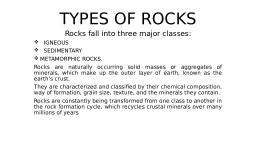
1st Semester, Paper I- PHYSICAL GEOGRAPHY, UNIT 2, Classification of Rocks:, Igneous Rocks, , Solidified from magma and lava, , Sedimentary Rocks, , The result of the deposition of fragments of, rocks by exogenous processes, , Metamorphic Rocks, , Formed out of existing rocks undergoing, recrystallization, , The solid masses occurring naturally can be described as Rocks. The rocks contain properties of, mineral traces. The rocks usually contain a unique combination of chemicals, minerals, textures,, size, shape, grains etc. These distinguishing characteristics play a very important role in further, categorizing rocks. Following are the different types of Rocks:, 1. Igneous Rock, 2. Sedimentary Rock, 3. Metamorphic Rock, 1. Igneous Rock:, Rocks that are formed by the solidification and cooling of magma or lava are called Igneous Rock., This rock can be formed with or without the crystallization. They can be found on the surface that, is extrusive rocks or below the surface as intrusive or plutonic Rocks. The magma melts due, to increase in temperature, change in composition or decrease in pressure. Magma is also a form, of molten rock made by the partial melting of rocks under high temperature or high-pressure, conditions. Lava is the form of magma that reaches the surface of the earth. Igneous rocks are, smooth and shiny as well. An example of Igneous Rock includes Basalt, Granite etc., The igneous rock gets cooled over the period of this is formed out of magma and lava from the, interior of the earth. They are also known as primary rocks. When magma in its upward movement, cools and turns into a solid form it is called igneous rock. The process of cooling and solidification, can happen in the crust of the earth or on the surface of the earth., Igneous rocks are classified based on texture. If the molten material is Cooled slowly at great, depths, mineral grains may be very large. Sudden cooling at the surface results in small and smooth, grains. Intermediate conditions of cooling would result in intermediate sizes of grains making up, igneous rocks., They are also known as primary rocks. They are the ‘new’ rocks on earth. Formed through the, cooling and solidification of magma or lava, igneous rocks are the hardest and heaviest. The term, ‘Igneous’ is in fact derived from the Latin word ‘igneus’, meaning ‘fire’. It is formed out of magma, and lava from the interior of the earth. Lava is the form of magma that reaches the surface of the
Page 2 :
earth When magma in its upward movement cools and turns into a solid form it is called igneous, rock. The process of cooling and solidification can happen in the crust of the earth or on the surface, of the earth. The igneous rock gets cooled over the period of time and has large structures like, crystals. They can found on the surface that is extrusive rocks or below the surface as intrusive or, plutonic Rocks., 1. Intrusive/Plutonic Igneous Rock: Magma slowly cools below the earth’s surface and forms, large rock crystals Examples: Granite, gabbro, diorite., 2. Extrusive/Volcanic Igneous Rock:, Magma comes out through a volcano as lava, cools rapidly and forms small rock crystals., Examples: Basalt, andesite, obsidian, pumice, rhyolite, 2, , Sedimentary Rocks, , The sedimentary rocks are not primary rocks they are secondary rocks they are formed by the, deposition of sediments or debris on the pre-existing rock. The rocks formed by the sediment or, debris of the liquid care called Sedimentary Rocks. The particles that form sedimentary rocks are, termed as sediments. Formed by the accumulation of sediments, like fragments of older rocks,, organic remains (shell, bones), and minerals that eventually compact and harden to rocks over a, long period. The sediments are transported with the water, ice or wind. They cement together to, form a rock like structure. These deposits through compaction turn into rocks. This process is, called lithification. These sediments are broken down by erosion and transported by rivers and, streams to accumulate in layers on earth’s surface or at the bottom of lakes, and oceans. These, layers can be identified in the rocks by differences in colors, particle size, and distribution of, sediments. They are the ‘recycler’ rocks.It takes many years for a sedimentary rock to form. The, porosity of the rock rescues due to the compaction and piling of layers on the rock., Properties & Characteristics: Crumbles easily, can be scratched by fingernails; grainy texture due, to layers of sand, silt or gravel; varying sizes of crystals, Examples: Sandstone, conglomerate, chalk, claystone, breccias, shale, calcite, siltstone, Uses: As a construction material (sandstone); production of chalk, lime, industrial carbon, dioxide, cement, and in glassmaking (limestone); brick making and as base material under roads, (shale), TYPES OF SEDIMENTARY ROCKSCLASTIC SEDIMENTARY ROCK: The rock formed from classics or small pieces of, fragmented rock due to mechanical weathering is called Clastic Sedimentary Rock. These rocks, are formed due to the compaction and cementation effect. Examples of Clastic Sedimentary, Rock are Sandstone, Siltstone etc., CHEMICAL SEDIMENTARY ROCK: The rock formed due to the deposition of chemicals on, the parent rock is called Chemical Sedimentary Rock. These rocks are formed due to the mineral
Page 3 :
elements in the water and the evaporation, which leaves the minerals on the rock. One finds, chemical sedimentary rock often in the areas with arid lands having good deposits of gypsum, and salts. The example of Chemical Sedimentary Rock includes Rock Salt, some Lime Stones,, Iron ore, Flint etc., ORGANIC SEDIMENTARY ROCK: The rock that is formed due to the deposition of plant, and animal debris such as corals, shells or bone are called Organic Sedimentary Rock. This rock, is made up of sand, pebbles, shells and various other materials. The plant and animal debris have, a high content of calcium minerals and they get to pile up over the time to form the Organic, Sedimentary Rock. One can also find fossils in this type of rocks. The example of Organic, Sedimentary rock is the Dolomites and Lime Stones., 3. Metamorphic rocks, Metamorphic means “changed form,” and That is exactly what these rocks are. They start out as, either igneous or sedimentary, but over time extreme heat or pressure causes them to change into, a different kind of rock. For example, limestone eventually can turn into marble., The Metamorphic Rocks are also formed beneath the earth's surface due to high temperature and, a good amount of pressure. The temperature, pressure and various other conditions can physically, or chemically change the properties of Metamorphic Rock. This process is called Metamorphism., The exposure to extreme conditions can also change or alter the mineralogy, texture and chemical, composition of these rocks, These rocks form under the action of volume, pressure, and temperature (PVT) changes., Metamorphism happens when rocks are forced down to lower levels by tectonic processes or when, molten magma rising through the crust comes in contact with the crustal rocks or the underlying, rocks are exposed to great amounts of pressure by overlying rocks.The exposure to extreme, conditions can also change or alter the mineralogy, texture and chemical composition of these, rocks, Properties & Characteristics: Lightweight, glassy appearance; relatively hard, but still easy enough, to break; layered or foliated structure made up of crystals of the same sizeExamples: Gneiss (from, granite), Amphibolite (from basalt), Quartzite (from quartz)Uses: Writing board (slate); flooring, and sculpture material (marble); ballast in railroad construction., TYPES OF METAMORPHIC ROCKS ARE1. Foliated Metamorphic Rock, 2. Non- Foliated Metamorphic Rock., 1. Foliated Metamorphic Rock: This kind of rock is formed in the earth’s interior when the, pressure is high in one particular direction. The minerals in the original rock reorient with, flat and long minerals. The Foliated Metamorphic rock is formed where the pressure is, discreet. The foliation leads to the development of new minerals. The foliated metamorphic, rocks are classified on the basis of their texture. Slate is formed at low temperatures and, pressures. This kind of rock breaks in the perfect parallel line. Phylite is the crystalized, rocks having a shiny appearance. Schist is larger crystals with larger grains. They have
Page 4 :
parallel and sub parallel lines. Genesis is formed by high pressures and temperatures and, have a coarse-grained texture., 2. Non-Foliated Metamorphic Rock: This kind of metamorphic rock is found due to, ingenious intrusions where the pressure is relatively low but the temperature is high. The, minerals in the rock crystalize and are packed tightly together. The Non foliated, metamorphic rock is distinguished based on their composition., The major difference between Foliated metamorphic Rock and Non-Metamorphic rock is, their texture and appearance as well. They are also different as the pressure of, recrystallization varies. The pressure applied during the recrystallization process decides, the appearance of the rock. The geological changes have a great impact on the metamorphic, rock and decide the appearance of the rock as well as minerals. The moment of the tectonic, plates under the earth's surface can cause friction and distortion. It can also lead to the, formation of magma., The type of pressure on the rock plays a prominent role in the formation of a rock. If the, pressure is unequal then the rock formed during the process will be foliated and if the, pressure is equal then the rock formed will be non-foliated. The content of minerals also, varies for foliated and non-foliated rocks. The type of pressure on the rock plays a, prominent role in the formation of a rock. If the pressure is unequal then the rock formed, during the process will be foliated. The minerals appear randomly in case of Non-Foliated, Rock. The appearance of this rock is granular as there are no layers. The type of pressure, on the rock plays a prominent role in the formation of a rock. If the pressure is unequal, then the rock formed during the process will be foliated. The rocks consist of several, minerals and are formed in specific conditions. The characteristic of each rock is different., Based on their appearance, texture, and minerals the use of rock is determined. The rocks, are used by different purpose in our day-to-day life such as for household tiles, Coal, sand, making for construction, Tool Making, Infrastructures, Decorations etc. The study of type, of rock helps one to understand the appearance, texture, minerals and different, characteristics of rocks.