Page 1 :
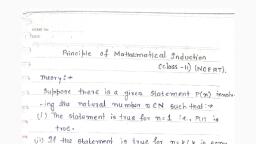
Chapter, , 4, , Principle of, Mathematical Induction, k +1D[(k +1)+1], Syllabus:, Process of the proof by induction,, , application, , of the method, , motivating the, by looking at natural, , the least inductive subset of real, numbers. The principle of mathematical induction, numbers, , as, , (4 hours), , and simple applications., Exam corner:, , Marks, , Total 5 marks, , No.of qns, , 1question, , 2, , which is P(k+1), , Thus, P(k)P(k +1), Hence, by, , mathematical induction, , neN., , Ans: Let, , +(2n-1) =n*, , P(n):1+3+5+7+, , 1, LHS, , =, , 1, RHS, , =, , 1'=1, , LHS = RHS, , Let Pn) be a statement involving the natural, , P(1) is true., , P(k) is true for some ke, , number n such that, , Let upwards assume, , i) P(1) is true and, , i.e., 1+3 +5+.... +(2K-1) =*, , Then P(n)is truefor allneN, , Adding (k +1)", , term, , all n eN., , nn+1), , Ans: Let P(n):1+2+3++n=*, , 2, , =1, , 2, , +, , 1,, , on, , both sides,, , =k*+2k +1, , which is P(k +1), , Thus, P(k)P(k +1)., Hence, by mathematical induction Pn) is, , assume P(K) is true for some, , all ne N, , keN., , P(n): +2 +3+., , ie, 1+2+3++k=*), 2, , Forn=1,, , Adding (k +1) term= k+ 1, on both sides we get, , =nn+1(2 +1), 6, , +(k+1), , n?=nn+1)X2n+1), 6, , LHS =1?=1, RHS= +D(2+),, 6, , LHS= RHS, P (1) is true., Let us assume P(k) is true for some keN., , 2, , Student's uminator, , true, , Ans: Let, , 1+2+3.+k+(k+1), , we, , = (k +1)2, , 31+2+33+.... +n', , P(1) istrue, us, , 2K, , 1+3+5+...+(2k-1)(2k +1), , LHS RHS, , Let, , =, , N., , get,, , 1. Using the principle of mathematical induction,, n(n+1), 1 + 2 + 3 + . . + n = " u , for, prove that (1), 2, , For n=1, LHS =1, RHS=, , for, , 2 1+3+5+7+..+(Zn -1) =n,for all, , Principle of Mathematical induction:, , is true., , true, , all neN., , Forn=, , (ii) P(k+1) is true, whenever P(k), , P(n) is, , for
Page 2 :
54, ie., , '+2+3, , k(k+IN2k +1), , ++2+2, , 6, , Adding (k+1, , term, , =, , get,, , (k, , 1)., , +, , on, , both sides,, , we, , k1D&1)+1, , +2 +3+++(k+1), k(k, , 2, , +102k +1)k+ D, , which is P(k+1), , Thus, P(k), , (k+1)., , -[2+1)+6tk+1)], , Hence, by, , 6, , all ne N., , 2+k+6k+6, , S., , k+(2 +7k+6), For, , 6, , which is P(k +1), , Hence, by mathematical induction, P(m), all ne N, , |,, , neN., , is true for, , 1= 1; RHS, , 1.2 =2,, , RHS=tDd+2)_, 3, , is true for some, ke N., , =, , Adding (k + 1)" term= (k+1)(k, +2), , 3, on, , we get,, , both sides,, , 1.2+2.3+3.4+....+k(k+ 1) +(k +1)%k+ 2), , Ck+1Xk +2,k+1Xk +2), , |11+)., , (k +1IMk+22k +3], 3, , _k+D[k+1)+1]|(k+1)+2], , is true., , Let us assume P(k), ie. '+2+3+, , 3, , is true for some ke N., , which is P(k +1)., , Thus, P(k) P(k+1)., , +), , Hence, by mathematical induction, P(n) is true for, , 21, term, , =(k +1)', , get,, , +2, , =, , Let us assume P(k), , for all, , P(n):P+2' +3* +..n=n*), , Adding (k +1", , n=1, LHS, , P(1) is true., , LHS =RHS, , P(1), , , for, , 3, , 1e.,1-2+2.3+3.4+..+K(k +1n-*+D(k+2), , A+2+3+.n, , ., , 1.2+2.3++n(n+1)=Zn+)(n +2), , LHS =RHS, , Thus, P(k), P(k +1), , =, , is truef, for, , Pn):1-2+2:3+3.4+.+n(n+1)=n+D(a+2), , k +1[k+1D+1/2k+1)+1], , n=1, LHS, , P(n), , Ans: Let, , 6, , For, , mathematical induction,, , all neN., , a+2)02k+3), , Ans: Let, , P(k+1), , on, , both sides,, , we, , all ne N., , 6., , +3* +, 2, , k+1, 4, , Student's illuminator, , +k+(k +1, , 1-2.3+2.3.4+.+n(n +1)(n +2), n(n +1)(n +2(n +3), for all neN., , Ans: Let P(n):1.2.3+2.3.4+... +n(n +10n+2), n(n+Mn +2(n +3)
Page 3 :
Jeevith publications, For, , 1, LHS, , n=, , =1.2.3, , =, , 55, , =2304), , 6, RHS, , k, , 4, , k+1, , LHS =RHS, , k(k+2)+1, , P(1) is true., Let, , us assume, , i.e., 1-2, , P(k), , (k +1Xk +2), , is true for some ke, N., , k +2k+1, , 3+2:3.4+..+k(k +1)Xk +2), , (k+1)(k+2), , k(k +1Xk +2Xk+3), , (k+1 k+1, , 4, , Adding (k, , +, , (k+1)(k +2), , 1)", , term, , sides, we get,, , =(k+1%k+2(k+3), , (k +1k+2), on, , both, , +(k+1(k +2)(k+3), (k, , k+1, , (k+1)+1, , 1-2-3+2:3.4++k(k +1)%k +2)), , k(k+1Mk+ 2)(k+3), , k+2, , +, , 1(k +2k +3), , k +10k +2(k +3)(k + 4, , which is P(k +1)., , Thus, P(k)>P(k+1), Hence, by mathematical, all ne N, , induction, P(n), , is true for, , 4, , 1, , 12:323.4 3.45*nin, n(n i, +1(n +2), , (k +1D[(k+1)+1](k+2)+1][(k +1)+3]], , n(n +3), , 4, , which is P(k +1)., , n, , +1(n +2), , all neN., , Ans: Let, , Thus, P(k)P(k +1)., Hence, by mathematical induction, P(n) is, , 2323.4, , true for, , all neN, , For n=1, LHS, , 7122.33.4, L,!, , 10r, , n+, n(n +1) n+1', , for, , RHS, , all ne N., , Ans: Let, , n(n +1(n +2), , =1.2.3, , n(n +3), , 4(n+1Mn +2), , 6, , (1+3)1, , 41+1(1+2) 6, , LHS =RHS, , POn), , 3'34*a+, , ., , P(1) is true., , Let us assume P(k) is true for some ke N, For, , =1,, , LHS= = ;RHS=L, , LHS, , 1, , ie, i.e1.2-3 2.3.4, , RHS, , =kk+3), , P(1) is true., Let, , us, , assume, , i, , P(k), , k(k +1k +2), , is true for, , some, , 34* k(k+1), Adding (k +1 term, , 4(k +1k +2), , ke N, , 2, (k +1k +2), , Adding (k +1" term, (k +1Xk, , k+1, on, , we get,, , sides, we get,, both sides,, , +2) k+3), , on both, , 12.3 2-34, 1, , 1-2 2-3, , k(k +1) (k+1)(k +2), , Student's illuminator, , 1k+2) (k+1k +2)k+3)
Page 4 :
60, , PU Matrer, , Let us assume, , P(k), , is, , true, , for, , some, , Hence, by, , ke N, , duction, Pn), , mathematical, , n, , true, , for, , all ne N., , n(2n -12n+1, , 21. 1+3 +5'+.+(2n-1, , Multiplying (k+1)" term, , Ans: Let, , SIdes, we get, , P(n):1+3 +5, , 3, , Ln-1} 2n+1, *), , +(2-1, , 3, , For n=1, LHS =1' =1, , = (k +1»1 =, , RHS=1(2-1X2+).1|, , =(k+1)+, , 3, , t+1., LHS = RHS, , which is P(k +1), , . P(1) is true., , Thus, P(k)=P(k +1), Hence, by mathematical induction, P(n) is, , true for, , all ne N, , Let us, , assume, , P(k) is true for some, , i.e., I + 3 + 5 + + 2 k -1?, , ke N., , =*(2k-)(2k +1), , Adding (k +1)" term = (2k +1) on both sides, we, get, , Ans: Let P(n):, , +3 +5+.(2k-1)*+(2k+1), , (2k +(p(2-1)+3(2k+1)], , 2-k+6k+3], , For n=1, LHS14, , (2k+1(2k +5k +3)(2k +10k +1)X2k +, , RHS (1+1 =4, , k+112k+)-J[2(k +1)+1], , LHS =RHS, , 3, , P(1) istrue., Let, , us assume, , 3, , 3, , P(k) is true for some ke N., , which is P(k +1), , Thus, P(k)=» P(k+1), , ie.1, , Hence, by mathematical induction, P(n) is, , Multiplying both sides by (k+1)°, , all ne N., , term, , 2a. Prove that 2" >n for all positives integers, , 12+0, we get,, , Ans: Let P(n):2">n, , (k+1), , 2k+3, , k+1F, =&+|1e(+1+2k+3, , (k+1J, , =k+4k+4=[k+ 2' =[k +1)+1?, , For n= 1, 2'>1. Hence, P(1) is true., Assume that P(k) is true for some ke N, , ie, 2>k, Multiply both sides by 2, we get, , 2-2'2k, , which is P(k +1), , ie., 2>2k =k+k>k+1, , Thus, P(k)>P(k+1)., , 2>kt+1, which is P(k +1), , Student's illuminator, , fu, , true, , .
Page 5 :
61, , Jeevith publications, , Thus, P(k)P(k +1), , k +3k+6k +3, , Hence, by mathematical induction, P(n) is true for, , 3, , all ne N, , [3+34 +1)+3k +2], , 23. 1+2+3.+H<(2n+1*, , Ans: Let P(n):1+2+3+...+n<(2n+1)*, , which is P(k +1), , 8, , For n=1. I2+1=, , 9, , 8, , Thus, P(k)>P(k +1), , which is true., , Hence, by, , mathematical induction,, , .. P() is true., , all ne N., , Let us assume P(k) is true for some ke N., , 25. (2n+7)<(n +3)*, , i.e., 1+2+3++k<(2k +1)?, , Ans: Let P(n):(2n + 7)< (n +3)*, , Adding (k+1)" term =k+1 on both sides, we get, , 1+2+3++tk + (k+1) <(2k+1, , +(k+1), , For n=1,, , (2+7)<(1+3) »9<16, , P(n) is, , is, , true, , for, , true, , for, , true., , P() is true., , Let us assume P(k), , is true for, , some, , ke N., , ie., (2k +7) < (k +3)*., , = 4k*+4k +1+8(k+1)], , Consider 2(k+1)+7=2k+2+7, , 8, , = (2k+7)+2, , -14k+12+9, , <(k+3)+2=k +6k +9+2, , k +3-20+1)+1f, , <(k +4), P(k+1) is true., , which is P(k +1), , Hence, by mathematical induction. P(n) is, , Thus, P(k)>P(k +1), Hence, by mathematical induction, P(n) is, all ne N, , true, , for, , 24. 1+2+3++n'>neN., , 3, , all ne, , 26.7-3 is divisible by 4., Ans: Let P(n): 7" -3" is divisible by 4., , Forn= 1, P(1):7-3, ., , Ans: Let P(n):13 +2 +3++n*>, , =4 which is divisible, , by 4., , P(1) is true., , Let us assume P(k) is true for some ke N-, , ie, 7-3* is divisible by 4., , For n= 1, 1>:, , Let 7-3 =4d, where deN, P() is true., , Consider 7*" -3, , =7*l-7(3* ) +7(3*)-3*-, , Let us assume P(k) is true for some ke N, , = 7(7" -3) +3(7-3), =7(4d)+3*(4) = 4(7d +3), , ie., +2++k>, Adding (k+1)" term = (k+1)* on both sides, we get, , 7, , 3, , is divisible by 4., , Thus, P(k) >P(k+1), , P+2+k +(k +12> +(k+1), k+3(k+2k+1), 3, , Student's illuminator, , Hence, by mathematical, , all ne N, , induction,, , P{n) is, , true, , for
Page 6 :
63, , 33. (ab, , =a'b, , Ans: Let, , P(n): (ab)", , For n=1, LHS, , =, , a'b", , =(ab) =ab, , RHS = a'b = ab, , LHS =RHS, ., , P(1), , Let, , is true., , us assume, , P(k), , is true for, , some, , ke N., , i.e., (ab)' =a'b, , Consider, , (ab)*, , =, , (ab, , (ab), , = (a*b*\ab), , = (a a'6.b), which is, , =a'b, P(k +1)., , Thus, P(k)P(k+1)., , Hence, by mathematical induction, P(n) is true for, all neN., , 34. (1+r)" 2 (1+nr), for all natural number, , n,, , where x >-1., Ans: Let, , P(n):(1+x), , 2(1+nx), for x>-1, For n=1;Pa):(1+x)' 21+x) which is true., Let us assume P(k) is true for some ke N, , i.e., (1+21+kx), Consider (1+x* = (1+ x'(1+x), , 2(1+kx)1+x), = (1+kr+x+kx*), , 2(1+(k+1)x), , kr 20., , which is P(k +1), , Thus, P(k) =» P(k +1), Hence,, , by, , mathematical induction, P(n) is, , true, , for, , all ne N, , ++++++