Notes of MATUGBS01 (SI), Mathematics Mean Value Theorem.pdf - Study Material
Page 1 :
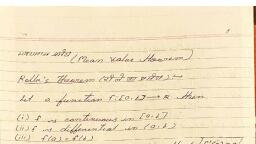
LAWS OF MEAN, 9.1. Introduction., Some interesting and very useful properties are possessed by real, alue functions which are continuous in a finite and closed interval [a,, 11 and are also derivable on the open interval (a, b). These properties are, formulated in the form of theorems known as Mean value theorems. In, this chapter we shall deal with Rolle's theorem, Lagrange's mean value, theorem, Cauchy's mean value theorem, Taylor's theorem and their, geometrical interpretations and applications., 9.2. Rolle's Theorem., Let f be a function defined on a finite closed interval [a, b] such that, [W.B.U. T 2011], (i) f(x) is continuous for all x in asxsb., (ii) f'(x) exists for all x in a<x<b, and (iii) f(a) = f(b)., Then there exist at least one value c, a<c<b, such that f'(c) 0., Proof. Beyond the scope of the book., Geometrical Interpretation of Rolle's Theorem., A function f which is continuous on the closed interval [a, b], can be, represented graphically by a curve without break (see the following fig. )., Since f is derivable on (a, b), the curve has a tangent at each point on the, arc AB where A= (a, f(a)) and B= (b, f(b))., %3D, Also, since f(a) = f(b), so the ordinates of the two points A and B, are same., y = f(x), fla), f(b), x= b, Now f'(c) = 0 means the tangent at the point C to the curve is parallel, to the x-axis where C= (c, f(c)).
Page 2 :
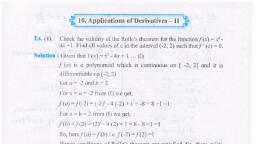
202, ENGINEERING MATHEMATICS., Hence the geometrical interpretation of Rolle's theorem is "If the gran, of y f(x) is represented by the arc AB without any break on [a h, having a tangent at every point and ordinate of A and B points are sam, then there exist at least one point C, on the arc AB, where the tangent i, parallel to the x-axis.", 9.3. Illustrative Examples., Example. 1. Verify Rolle's theorem in each of the following cases:, (i) f(x)= cosx in, (ii) f(x) = 2x' + x² - 4x- 2, -2 sxs 2, (iii) f(x)=2+(x – 1)73, 0sxs2, (iv) fx)-지,-1SxsI., Solution : (i) We know the function cosx is continuous and derivable, for all real values of x., [W.B.U.T. 2012,2003], * f(x) is continuous on, and derivable on, 2 2, Now f'(x)=-sin.x,-, TC, <x<, 2, Also, Thus f(x) satisfies all the conditions of Rolle's theorem., By Rolle's theorem, we should have, S(c) =0 where-<e., 2., Here f'(c) 0=- sinc = 0 = sin e = 0 whose one solution is c= 0, %3D, %3D, and, Hence, Rolle's theorem is verified for the given function., (ii) Since every polynomial in x is continuous and derivable for every, real values of x, so f(x)= 2x' +x -4x-2 is continuous on, and derivable on (-2, 2)., Also, f'(x) = 6x + 2x – 4, – /2 <x < /2., 11
Page 3 :
Thus f(x) satisfies all the conditions of Rolle's theorem., A-2) = 2(-/2)' +(2)-4(-/2)-2=D0 and f(/2)= 0., 203, LAWS OF MEAN, Moreover,, By Rolle's theorem, we should have, L'(c) = 0, where - V2<c< JZ., Here f'(c)= 0= 6c² + 2c- 4 = 0, ie. 2(c+1)(3c-2)3D0 whose two solutions are c=-1,, and, 2<-1<v2 as well as -2 <<2., Hence, Rolle's theorem is verified for the given function., (iD Here f(x)=2+(x-1) is continuous on 0sxS2 but, does not exist at x 1., Hence f(x) is not derivable on 0 <x<2., Thus the conditions of Rolle's theorem do not hold. So Rolle's theorem, is not applicable to the given function., (iv) The given function can be written as, (x) = -x, when -1sxs0, = x, when 0<x s., Obviously f(x) is continuous on [-1, 1]., f(0+h)- f(0), Now Lf'(0) = lim, h-0-, = lim, h0-, -h-0, = -1, f(0+h)-f(0), h-0, Rf (0) = lim, = lim, = 1., %3D, h-0+, h0+ h, * Lf(0) R f'(0)., So f'(x) does not exist at x 0 which lies between -1 and 1., Hence f(x) is not derivable on-1<x<1., %23, Thus the conditions of Rolle's theorem do not hold. So Rolle's theorem, 15 not applicable to the given function., 213
Page 4 :
ENGINEERING MATHEMATICS-1, 204, Example 2. Verify Rolle's theorem for the functions:, (i) f(x)=x'(x-1) in the interval 0SISI, (ii) f(x)=x-5x +6 in the interval lsr54, (i) /(x)= x(x-1(x-2) in the interval [0,2], Solution: (1) Here, f(x) x'(x-1), which is a polynomial of degree 5, and so continuous at every point., So f(x) is continuous in [0.1), r-3r-1+xr' 2(x-1), -'(x-1)(3x -3+2x), -x(x-D(5x-3)., which exists in (0,1)-, Also f (0) = 0 and f(1) 0., Thus f(x) satisfies all the conditions of Rolle's Theorem., Then there exists at least one point x-c in (0, 1) such that f'(c) = 0, or, c(c-1XSc-3) = 0, Since 0<c<1,c 0, c 1 ie. c-1#0, Therefore, Sc-3=0. ie. c= which lies in (0,1), 5, (ii) f(x)=x-5x +6, Since f(x) is a polymonial function, it is continuous at every point So, it is continuous in the interval [1,4]., f'(x) = 2x-5 which exists in (1,4)., Also, f(1) 1-5+6%=2 and f(4) = 16-20+6= 2, i.e., f(1) = f(4), Thus the given function satisfies all the conditions of Rolle's theorem., So, there is at least one point x=c in 1<x<4. such that f'(c) =0, 2c-5 0, i.c., c =-, which lies in (1,4)., 2, (ii) S(x) = x(x - 1)(x-2), =x'-3x +2x
Page 5 :
LAWS OF MEAN, 205, This is a polynomial function and so is continuous at every point. So, f(x) is continuous in [0, 2]., f'(x) = 3x - 6x + 2, which is also a polynomial, and so it exits in (0,2)., Again f(0) = 0 = f(2), Thus f(x) satisfies all the conditions of Rolle's theorem. Then there, exists at least one point x= c on 0<x<2, such that f'(c) = 0 or,, 3c-6c +2 0, 6 36-24, =11, V3, V3, 6., 3, 1.732, = 1t, = 1577, 1.423, %3D, Both these values of c lie in (0,2)., Example 3. (i) Is Rolle's theorem applicable to the function f(x) = 1-x, in -1, 1]? Justify your answer., (ii) Is Rolle's theorem applicable to f(x) =, 2- r2, in [-1, 1] ? Justify, your answer., 2., Solution :(i) Here, f(x)= 1-x3., If x # 0, f'(x) =, 3x3, So, f'(0) does not exist, and, -1<0<1, ie. f(x) is not derivable in, (1, 1), Hence Rolle's theorem is not applicable to the function f(x)=1-x3, on the interval [-1, 1]., (ii) f(x) =, 1, is continuous in [-1, 1]., 2-x2, 2x, S'(x) = (-1)(2 – x²)*² × (-2.1) =, (2-x2)*, which exists in (-1, 1)., Also, f(1)=, %3D1, 2-1, = 1 and f(-1) =,=, %3D, %3D, So, f(1)= f(-1)



 Learn better on this topic