Page 3 :
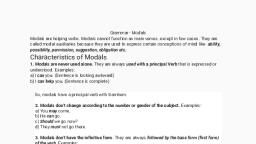
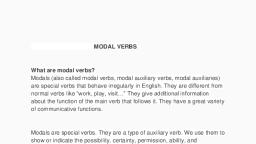
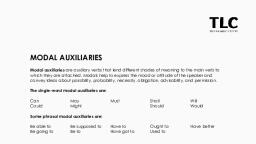
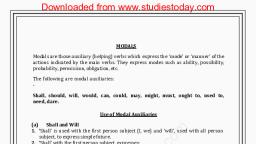
WHAT ARE MODAL VERBS?, , • special verbs which behave very, irregularly and that are used to indicate, modality – ability, possibility, likelihood,, probability, permission, and obligation.
Page 4 :
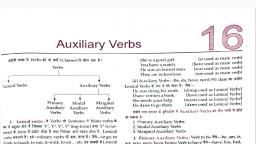
LIST OF MODAL VERBS, •, •, •, •, •, •, •, •, •, •, , Can, Could, May, Might, Must, Shall, Should, Will, Would, Ought to, , They are Auxiliary verbs that, provide additional and specific, meaning to the main verb of the, sentence, Modal verbs are sometimes, referred to as, Modal Auxiliary verbs because, they help other verbs
Page 5 :
Structure of Modal Verbs, I, You, , He, She, It, , We, They, , Modal Verb, (can /should, etc.), , Infinitive, (without TO)
Page 6 :
How do we use modals?, , S, Subje, ct, , M, , V, Verb, , Example: Mary can play the piano, -they are not conjugated, - they don’t need other auxiliary verbs
Page 7 :
Form, There is no “s” in singular, There is no “do / does” in the question, There is no “don’t / doesn’t” in the negative, , He can ski not He cans ski or He can skis., Would you like to come with me?, Do you would like to come with me?, They can’t be serious., They don’t can be serious.
Page 8 :
Form, Modal verbs do not have infinitives or –ing forms, , to can / caning, , to must /musting, , Modal verbs are followed by an infinitive without to, She must study., He could play football in his youth. (general ability), We should have gone the other way.
Page 9 :
Form, Modal verbs do not have all the tenses, , Many modals cannot be used with the past or the, future tenses, Can - be able to, Must - have to, I can solve the problem. – I was able to solve the problem., You must come early. – You had to come early yesterday.
Page 10 :
Modals in the Past, - refer to actions that happened in the past, MODAL + HAVE + verb in past participle, , It must have been a difficult decision, They should have invited her to their wedding
Page 11 :
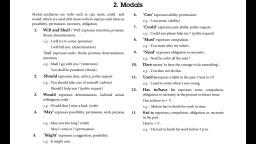
CAN, 1) to express ability:, Ryan can speak French but he cannot speak German., Superman can do things that ordinary people can’t., 2) to express request:, Can you help Sue?, Can I offer you something to drink?, 3) to express permission:, Can I use your cell phone?, You can’t go out with Victor., 4) to express possibility:, If the weather is perfect tomorrow, we can go on a picnic., I can be ready by five., I will be ready five.
Page 12 :
COULD, 1), , 2), , 3), , 4), , to express abilities in the past:, Jason could talk when he was four., to express permission:, Could I leave the classroom?, to express future possibility:, I could get a bad final mark. It depends on the next exam., could with present perfect tense is used to express something, in the past may be real., You could have been killed in that accident., I could have won that game.
Page 13 :
SHALL, 1) to express the simple future for the first, person., • Shall we meet at the bus stop?, • I shall never forget your help.
Page 14 :
WILL, 1) present to future tense:, , Sean will leave tomorrow. She will be, back in a few days., If it rains, the soccer game will be put, off., 2) express willing,, If you won’t go and help him, I will., I will wash the dishes if you cook.
Page 15 :
WOULD, 1) as the past tense of will:, She said she would buy dinner on her way home., I believed it would rain so I brought my raincoat., 2) to express polite request:, Would you please take off your coat?, Would you mind turning the radio off?
Page 16 :
SHOULD, 1) to give advice and opinions, You are driving too fast; you should slow down a little bit., You have gained a lot of weight. You should go on a diet., 2) to express expectations:, Are you ready? The taxi should be here soon., Twenty dollars is enough. It shouldn’t cost more than that., 3) to suggest a less strong possibility, If you should pass the bakery, can you buy some bread?, Should with present perfect tense means something in the, past should not be done., The baby is crying. You shouldn’t have talked so loudly., She is angry. You shouldn’t have come back so late.
Page 17 :
MUST and HAVE TO, 1) express something is necessary and essential, You must pay by cash., You have to drive on the right in France., 2) Students have to wear uniform., must not is used to express something is not permitted or, allowed., You mustn’t smoke, eat and drink in the museum., You must not drink and drive., 3) not have to is used to express something that is not to be done, necessarily., We don’t have to get up early on Saturday., She doesn’t have to live in the hotel. She can live with us.
Page 18 :
MAY, 1) express possibility in the present or in the future., It may rain., Elizabeth may know his telephone number., 2) for permission:, May I come in?, You may come if you want., 3) to express wish or hope., May you a long life!
Page 19 :
MIGHT, 1) to express possibility in the present or in the future., Ashley might be in the library. I am not sure., George might come as well., He may come., He might come. (the chance that he comes is less likely than, may), 2) might with present perfect tense means speculation about the, past., Edward is late. He might have missed his bus or he might, have overslept.
Page 20 :
Exercise: Use an appropriate modal verb in each sentence., 1., , 2., 3., 4., 5., 6., 7., 8., , 9., 10., , 11., 12., 13., 14., , Owen _______( not) do his homework because tomorrow is Saturday., Drivers ________ stop at a stop sign., ________ you make a copy for me?, We _______ leave now or we will be late., A: _______ I use your laptop computer? B: Of course you _______., I _______ rather cook tonight., _____ I go to the restroom, Miss Chang?, ______ you prefer chicken or steak for dinner?, I __________ catch the bus this morning. My father drove me to, school., _________ you answer the phone?, When I was young, I ________ speak better English than now., You look pale. You ______ go to a doctor., You have been driving for ten hours. You _________ be exhausted., We __________ rent a car. My father will lend us his.
Page 21 :
Practise, 1. My son ___ be home by now. Where can he be?, a. Have to, 2., , b. could, , c. ought to, , d. can, , b. mustn’t, , c. don’t have to, , d. had to, , Johnnie’s fallen down the stairs! I ________ call an ambulance!, a. Will, , 5., , d. Could, , If you are interested in losing weight, you ______ try this new diet., a. Could, , 4., , c. Should, , I think your thumb is broken. You ___ go to the emergency room., a. Might, , 3., , b. Would, , b. might, , c. may, , d. ought to, , You _______ come too early. We won’t leave until 9 o’clock., a. Has to, , b. must, , c. needn’t, , d. can’t
Page 22 :
Practise, 6., , Children ________ be accompanied by an adult at the zoo., a. Ought to, , 7., , d. mustn’t, , b. mustn’t, , c. couldn’t, , d. ought to, , I can feel the heat. We _________ be near the fire., a. Can, , 9., , c. would, , You _________ talk during tests. It’s forbidden!, a. don’t have to, , 8., , b. must, , b. would, , c. must, , d. have to, , They ________ hear him because he was whispering., a. Wouldn’t, , b. mustn’t, , c. shouldn’t, , d. couldn’t, , 10. You’ve never heard of Britney Spears! You ________ be serious!, a. Must, , b. had to, , c. can’t, , d. shouldn’t
Page 23 :
Practise, 11. __________ you like to have dinner with me tonight?, a. Could, , b. may, , c. should, , d. would, , 12. You _________ let him hear about the party tomorrow. It’s a, surprise!, a. mustn’t, , b. wouldn’t, , c. couldn’t, , d. can, , 13. __________ I speak to the Chief of Police, please?, a. Must, , b. May, , c. Would, , d. Need, , 14. He has arrived late. He _______ missed the bus, a. Must have, , b. Should have, , c. Could have, , d. must
Page 24 :
More practise, Re-write the following sentences using modals so that they have the, same meaning., 1. I suggest that you get a good lawyer!, should get a lawyer, You ___________________________________________, 2., , A university degree isn’t necessary for that job., , needn’t have a university degree for that job, You ___________________________________________, don’t have to have a university…, 3., , 4., , Perhaps my father will pick you up., may / might pick you up, My father _______________________________________, 4. Eating is forbidden in class!, mustn’t eat in class, You ___________________________________________
Page 25 :
Use your imagination, Think about these situations and create a sentence using modals., 1., , We are going to Paris for a weekend. (Make suggestions about, things to do), , 2., , We start school in September. (Talk about necessity), , 3., , Margaret is a very talented sportswoman. (Talk about ability), , 4., , You have just won the lottery! (Talk about possibility), , 5., , Peter has got a headache and a congested nose. (Give him some, advice), , 6., , You want to borrow your uncle’s Mercedes Benz. (Ask for, permission politely)
Page 26 :
Possible answers, 1. We could visit the Louvre / We should go up the Eiffel Tower, 2. We have to buy a new notebook, , 3. She can speak 3 languages! / She is able to play the piano and the violin, 4. I might stop working / I may buy a new car / I can travel to New York, 5. You should see a doctor / You ought to drink hot tea, 6. Can I borrow your car, please? or May I borrow your car, please?
Page 31 :
ONLINE EXERCISE ON MODALS