Page 2 :
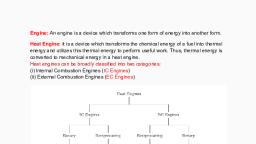
What is I C ENGINE ?, An internal combustion engine is a, heat engine which converts the heat, energy released by combustion of, fuel taking place inside the engine, into mechanical work., Heat energy, , Mechanical work, Four Stroke Petrol Engine, , 2
Page 3 :
CLASSIFICATION OF IC ENGINE, , • According to type of fuel used., Petrol engine, Diesel engine, Gas engine, Bio-fuel., • According to number of strokes per cycle., 4 stroke engines, 2 stroke engines., • According to method of ignition., Spark ignition(SI), Compression ignition(CI)., , • According to the cycle of combustion., Otto cycle, Diesel cycle, Duel combustion cycle., , • According to the number of cylinders., Single cylinder, Multi cylinder, , • According to position of cylinder, i) Horizontal engine ii) Vertical engine (car, bus, truck engines), iii) V-engine, iv) Radial Engine, v) Opposed cylinder engine, , • According to Method of cooling, i) Air cooling, ii) Water cooling ,iii) Liquid cooling, , • According to speed of engine, i) Slow speed , ii) Medium speed, iii) High speed engine, , 3
Page 5 :
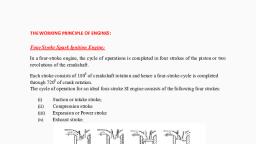
Four stroke Petrol Engine(Otto Cycle), 1., 2., 3., 4., , Suction stroke, Compression stroke, Power stroke, Exhaust stroke, , SUCTION STROKE, , • Inlet is open exhaust is closed., • Piston moves from TDC to BDC., • Petrol air mixture drawn into, cylinder due to pressure difference, • Cranking, • Crankshaft revolves 1/2 the rotation., • It is represented by the line AB, , 5
Page 6 :
Compression stroke, •Both inlet and exhaust are closed., •Piston moves from BDC to TDC., •Crankshaft revolves half the rotation., •Cranking, •Petrol air mixture is compressed to a, ratio of 1:11., •This mixture is ignited by spark plug., •Reversible adiabatic Represented by, curve BC,, Constant volume combustion process, represented by vertical line CD., , 6
Page 7 :
Power stroke, , •Piston moves from TDC to BDC., •Crankshaft revolves half the rotation., •Burnt gases generate heat energy and, force the piston to move down., •Process is represented by the line DE, (Reversible adiabatic process), •Exhaust opens & drop in pressure is represented, by line EB., , 7
Page 8 :
Exhaust stroke, • Exhaust is open and inlet is closed., • Piston moves from BDC to TDC., • crankshaft revolves half the rotation., • energy for this stroke is supplied by, flywheel., • Burnt gases are expelled out, through outlet port., , 8
Page 9 :
Four stroke Petrol Engine, , Theoretical Otto Cycle (P-V Diagram), , 9
Page 10 :
FOUR STROKE DIESEL ENGINE, , Theoretical Diesel Cycle (P V diagram), , 10
Page 11 :
Suction stroke, • Inlet is open exhaust is closed., • Piston moves from TDC to BDC and, crankshaft revolves half the, revolution., • Cranking during first cycle., • Due to the pressure difference fresh, air only enters the cylinder through, air filter., • This process is, represented by the, horizontal line AB., , 11
Page 12 :
Compression stroke, •, •, •, •, •, , Inlet and exhaust are closed., Piston moves from BDC to TDC., Cranking required in first cycle., Air will be compressed to a ratio of 1:20., Diesel oil is sprayed into cylinder by fuel, injector and auto-ignition takes place., • Adiabatic process represented, by the line BC., , 12
Page 13 :
Power stroke, • Piston moves from TDC to BDC., • Inlet and exhaust valves are closed., • burnt gases generate heat energy and force the, piston to move down till injection of fuel is complete., • Constant pressure expansion due to combustion of, fuel is represented by line CD., • Expansion of burnt gases represented by the curve, DE., , 13
Page 14 :
Exhaust stroke, •, •, •, •, •, , Exhaust is open and inlet is closed., Piston moves from BDC to TDC., Crankshaft revolves half the rotation., Energy for this stroke is supplied by flywheel., Burnt gases are expelled out through outlet, port, , 14
Page 15 :
2 Stroke Petrol Engine, Valves are replaced by Ports in 2 stroke., 1. Inlet Port: Through this inlet port only,, Fresh charge from the carburetor is, taken into the cylinder., 2. Transfer port: Through this Transfer, port only, fresh charge from the bottom, of the piston is supplied to the cylinder., 3. Exhaust port: The Hot exhaust gases, are pushed out from the combustion, chamber. The cycle beginning at the, point when the piston reaches TDC at, the end of the compression stroke., , 15
Page 16 :
Intake. The fuel/air mixture is first drawn into the crankcase, by the vacuum created during the upward stroke of the piston, During the downward stroke the fuel mixture is compressed in the crankcase, , Compression. The piston then rises, driven by flywheel momentum,, and compresses the fuel mixture. (At the same time, another intake, stroke is happening beneath the piston, Power. At the top of the stroke the spark plug ignites the fuel mixture., The burning fuel expands, driving the piston downward, to complete, the cycle. Burnt gases escape through the exhaust port, , 16
Page 17 :
Comparison of 4 stroke & 2 stroke engine, 4 –Stroke engine, , 2-Stroke engine, , Requires 4 separate strokes to complete, one cycle of operation., , Requires 2 separate strokes to complete, one cycle of operation., , Power is developed for every revolutions, of the crankshaft., , Power is developed in every revolution of, the crankshaft., , The inlet and exhaust are opened and, closed by the valves., , The inlet and exhaust are opened and, closed by the valves., , Turing moment is uniform and hence, requires lighter flywheel., , Turing moment is uniform and hence, requires lighter flywheel., , The charge is directly admitted into the, engine cylinder during the suction stroke., , The charge is first admitted into the, crankcase and then transferred to the, engine cylinder., , For the same power developed the, engine is light and compact., , For the same power developed the, engine is heavy and bulky., , Thermal efficiency is high., , Thermal efficiency is low., , Requires lesser lubricant and coolant., , Requires grater lubricant and coolant., , Fuel consumption is less., , Fuel consumption is more., , Initial cost is more., , Initial cost is less., , 17
Page 18 :
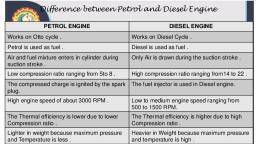
Difference b/w Petrol & Diesel Engine, Petrol Engine (SI, Engine), , Diesel Engine (CI, Engine), , Draws a mixture of petrol & air during Draws only air during suction stroke., suction stroke., The carburettor is employed to mix air The fuel injector is employ to inject, &petrol to supply it to the engine, the fuel at the end of compression, during suction stroke., stroke., Compression ratio ranges from 7:1 to, 12:1., , Compression ratio ranges from 18:1 to, 22:1., , The petrol & air mixture is ignited, with the help of spark plug, hence, called as SI., , The diesel is ignite with high, temperature compressed air, hence, called as C. Ignition, , The combustion of fuel takes place, approximately at constant volume., , The combustion of fuel takes place, approximately at constant pressure., , Works on the theoretical otto cycle., , Works on theoretical Diesel cycle., 18
Page 19 :
Difference b/w Petrol & Diesel Engine, Petrol Engine (SI Engine), , Diesel Engine (CI Engine), , Power developed is less., , Power developed is more., , Thermal efficiency is low. It is, up to about 26%., These are high speed engine., , Thermal efficiency is high i.e., about 40%., These are low speed engines., , The maintenance cost is less., , The maintenance cost is more., , The running cost is high, because of cost of petrol., Lighter and cheaper because of, low compression ratio., , The running cost is low because, cost of diesel., Heavier & costlier because of, high compression ratio., , 19