Page 1 :
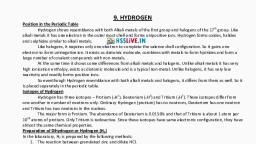
HYDROGEN, , , Hydrogen has resemblance with halogens as well as alkali metals, , Hydrogen resemblance with alkali metals, 1., One electron in valance shell, 1s1 like alkali, metals ns1, 1., Forms monopositive ions- +1, , Hydrogen resemblance with halogens, 1., Requires one electron to fulfill inert gas, configuration, 2., Similar ionization energy, , H H++e-, , 3., , H2 gas like halogens(Cl2), , Na Na++e-, , 4., , Non metal like halogens, , 2., , +1 oxidation state., , H+e- H-, , 3., , Shows similar activity in electrolysis, , Cl+e- Cl-, , 4., , Reducing agents, , 5., , Forms covalent bond, , 6., , High ionization energy, , 5., Affinity for electronegative atoms(Na2O,, NaCl, H2O, HCl.), , , 3 Isotopes of Hydrogen-, , neutrons, 0, 1, 2, , Preparation of Dihydrogen, H2, Laboratory Preparation of Dihydrogen, (i) It is prepared by the reaction of granulated zinc with dil HCl., Zn + 2HCl ZnCl2 + H2, (ii) It is prepared by the action of zinc with aqueous alkali., Zn+2NaOH→Na2ZnO2+H2, Commercial preparation of dihydrogen, 1. By the electrolysis of acidified water, A small quantity of acid or alkali is added to water to make it a good conductor and electrolysed in a, cell. In this cell,iron sheet is used as a cathode while nickel plated iron sheet act as anode., , 2. From water gas/syngas (Bosch process), When super heated steam is passed over red hot coke or coal at 1270K in the presence of nickel catalyst,, a mixture of carbon monoxide and dihydrogen is produced., C(s) + H2O (g) ———-> CO + H2 -121.3 KJ, 1
Page 2 :
A mixture 1:1 of CO and H2 was called water gas. All mixtures of CO and H2 irrespective of their, composition are called synthetic gas or syngas., This process of producing syngas from coke or coal is coal gasification., Syngas is produced from sewage ,sawdust, scrap wood ,newspaper., It is difficult to obtain pure hydrogen from water gas or Syngas, since CO is difficult to remove. To, remove CO and increase the production of dihydrogen from syngas, CO of the syngas is oxidised to CO 2, by mixing it with more steam at 673 K in presence of iron chromate as catalyst., CO ( g) + H2O ( g ) + H2O (g) ————-> CO2 (g) + 2H2(g), syn gas ., , 673K, FeCrO4, , steam, , Chemical reaction in which carbon monoxide of the syngas reacts with steam to form carbon dioxide and, more dihydrogen is called water gas shift reaction., CO2 thus produced is removed either by scrubbing the mixture with sodium arsenide solution or, bypassing the mixture through water under 30 atm pressure when carbon dioxide dissolves leaving, behind dihydrogen which is collected., , 3. From steam (Lane’s process) Dihyrogen can also be manufactured by passing alternate currents of, steam and water gas over red hot iron.It consists of two stages:, (1) Oxidation Stage: Super heated steam is passed over iron filling heated to about 1023 – 1073 K when, hydrogen is formed and magnetic oxide of iron is left behind., 3Fe + 4H2O ————> Fe3O4 + 4H2 + 160.7 KJ, (2) Reduction stage: When the whole of iron has being oxidised, the steam supply is cut off and a steam, of water gas is passed to reduce Fe3O4 back to iron., Fe3O4+ 4 H2 ———–> 3Fe + 4H2O, Fe3O4+ 4CO———> 3Fe + 4CO2, By passing steam and water gas alternatively over heated iron, dihydrogen gas can be manufactured, from a small quantity of iron., Highly pure (> 99.95%)dihydrogen is obtained by electrolysing warm aqueous barium hydroxide, solution between nickel electrodes., 4. From hydrocarbons by partial oxidation, A mixture of hydrocarbons is mixed with steam and passed over heated Nickel catalyst at 1270 K., CnH2n+2 + nH2O ————-> nCO + (2n+1) H2, Natural gas may also be used., CH4 (g) + H2 (g) ——-> CO(g) + 3H2(g), Whole process of obtaining dihydrogen from natural gas is called steam reforming process., (2) Thermal cracking of natural gas, 2
Page 3 :
Dihydrogen may also be obtained by thermal cracking of natural gas at 1270 K in the presence of a, catalyst., CH4 ——> C + 2H2, • Properties of Dihydrogen, Physical properties, (i) Dihydrogen is a colourless, odourless and tasteless gas., (ii) It is a combustible gas., (iii) It is insoluble in water., (iv) It is lighter than air., Chemical properties, (1) The H-H bond dissociation enthalpy is the highest for a single bond between two atoms of any element., H2 ( g) ———–> 2H(g), Dihydrogen is quite stable and relatively inert at room temperature due to its high H-H .bond dissociation, enthalpy. Therefore most of the reactions of dihydrogen occur at high temperature., (2) It is neutral to Litmus., (3) Combustibility : It is highly combustible gas and burns in air or dioxygen with a pale blue flame to form, water. It is not a supporter of combustion., 2H2 ( g ) + O2 (g) ———> 2H2O(l), (4) Reaction with metals, Dihydrogen reacts with strongly electropositive metals like Sodium ,Potassium ,calcium at high, temperature to form salt like metal hydrides, in which the oxidation state of hydrogen is -1., 2Na + H2 ————-> 2NaH, Ca + H2 ————-> CaH2, (5) Reaction with non metals, Dihydrogen combines with many non metals at high temperature in presence of a catalyst to form covalent, or molecular hydrides., (a)With dioxygen ,dihydrogen forms water.The reaction is highly exothermic., 2H2 (g)+ O2 (g) ——–> 2H2O (l) ΔH = – 285.9 Kj mol-1, (b) Reaction with halogens, Dihydrogen combines with halogens to form hydrogen halides., H2 (g) + X2 (g) ———–> 2HX (g) where X= F, Cl, Br, I, The reactivity of halogens towards dihydrogen decreases in the order:, F2 > Cl2 > Br2 > I2, Fluorine reacts in dark, chlorine in the presence of diffused sunlight, while the reaction with bromine and, Iodine occurs on heating in the presence of a catalyst., H2 (g) + F2 ( g ) ———–> 2HF (g) . dark, H2 (g) + Cl2 ( g ) ———–> 2HCl (g) . 673 K , sunlight, H2 (g) + Br2 ( g ) ———–> 2HBr (g) 673 K , catalyst, H2 (g) + I2 ( g ) ———–> 2HI (g), 673 K , Pt catalyst, (c) With dinitrogen it forms ammonia, , N2 (g) + 3 H2 (g) ———-> 2NH3 ( g), , 673 K , 200 atm, Fe, Mo , ΔH = -92.6 KJ/ mol, , 3
Page 4 :
Fe act as a catalyst while Mo act as a promoter. This reaction is used for the manufacture of ammonia by, the Haber’s process., (d) With Sulphur ,it forms hydrogen sulphide., H2 (g) + S (l) ———-> H2S (g) . 700K, e) With carbon, Depending upon condition it forms Methane or acetylene., C(s) + 2H2 (g) ———-> CH4 (g) 1375 K, 2C (s) + H2 (g) ———–> C≡C, electric arc, 3300 K, Reduction of metal oxides and ions, Dihydrogen acts as a reducing agent and hence reduces oxides of certain metals less electropositive than, zinc such as those of Cu, Pb, Fe etc to corresponding metals., CuO + H2 ——-> Cu + H2O, ZnO + H2 ————–> Zn + H2O, PbO + H2 ———> Pb + H2O, Dihydrogen also reduces some metal ions in aqueous solution., Pd2+ (aq) + H2 (g) ———> Pd (s) + 2 H+ (aq), Cu 2+ (aq) + H2 (g)———> Cu (s) + 2H+ (aq), (7) Hydrogenation of unsaturated hydrocarbons, Unsaturated hydrocarbons such as alkenes and alkynes add dihydrogen in presence of a catalyst to form, saturated hydrocarbon., Hydrogenation of unsaturated organic compounds in presence of heterogeneous and homgeneous catalyst, is used in many industrial processes., (8) Hydroformylation of Olefins, Olefins reacts with carbon monoxide and dihydrogen in presence of octacarbonyl dicobalt as catalyst under, high temperature and pressure to form aldehydes., This reaction is called hydroformylation or the oxo- process. The aldehydes thus obtained on subsequent, catalytic reduction gives alcohols., RCH2CH2CHO + H2 ———-> RCH2CH2CH2OH Ni , heat, (9) Hydrogenation of Oils, The vegeatable oil such as soyabean oil, cotton seed oil ,groundnut oil are called polyunsaturated oils since, they contain many carbon carbon double bonds.When these oils are exposed to air for prolonged period, ,the double bond present in them undergo oxidation and the oils become rancid i.e. develop unpleasant, odour and taste due to formation of lower aldehydes and carboxylic acid., Dihydrogen is bubbled through edible oils in presence of finely divided nickel at 473 K when the oils are, converted into solid fats., Vegetable oil + H2 ——–> Vegeatble fat 473 K , Ni catalyst, This process is called hydrogenation or hardening of oil and is used in the manufacture of vegetable ghee., Uses of Dihydrogen, 1. It is used in the manufacture of CH3OH., 2. It produces temperature of 2850°C and oxy-atomic hydrogen flame produces a temperature of, 4000°C, so it is used in oxy-hydrogen flame., 3. The largest single use of H2 is in the synthesis of NH3 which is used in the manufacture ofHNO3 and, fertilizers., 4
Page 5 :
4., 5., 6., 7., , Liquid hydrogen (LH2) is used as rocket fuel., H2 is used as a reducing agent in extraction of metals., H2 is used in fuel cell for generating electrical energy., Hydrogen is used in the manufacture of synthetic petrol., , , Hydrides- 3 types, (i) Ionic or saline or salt like hydridesHydrides formed between hydrogen and electropositive element of group I and II belonging to s-block., These are stoichiometric compounds. They are crystalline, non-volatile and non-conducting in solid state., They show salt like properties. They conduct electricity in molten state and liberate hydrogen at anode., Example: NaH, LiH., (ii) Covalent or molecular hydridesThese, are, compounds, of, hydrogen, with, non-metals, belonging, to, p-block., Example: NH3, CH4, H2O, HF. They are mostly volatile compounds with low boiling points., 3 types(i) Electron-Deficient Molecular Hydride: Molecular hydrides in which central atom does not have octet, are called electron deficient hydrides e.g., B2H6, BH3, MgH2, BeH2., (ii) Electron precise hydrides: Those hydrides in which the central atom has its octet complete e.g., group, 14 hydrides. They are tetrahedral in geometry. CH4, (iii) Electron rich hydrides: Those metal hydrides which contain lone pair of electrons are called electron, rich, hydrides,, e.g.,, NH3,, PH3,, H 20, and, H2S., NH3 and PH3 has 1 lone pair and H20 and H2S have 2 lone pairs of electrons., (iii) Metallic or non-stoichiometric hydridesThese hydrides are also known as interstitial hydrides. Transition metals group 3, 4 and 5 form metallic, hydrides. The hydrides are generally non-stoichiometric and their composition varies with temperature, and pressure, for example, Ti H1.73, CeH2.7′ , LaH2.8 etc. They are strong reducing agents. They are used, for Hydrogen storage and transport., Hydride gap- In group 6, chromium alone has a tendency to form CrH. Metals of 7, 8 and 9 do not form, hydrides., Water:, Structure:, In gas phase, it is a bent molecule with HOH bond angle 104.5° and O—H bond length of 95.7 pm. It is, highly polar in nature. Ice is the crystalline form of water. At atmospheric pressure ice crystallise in the, hexagonal form. At low temperature it condenses to cubic form. Density of ice is less than that of, water. Therefore, ice cubes can float on water., Chemical Properties of Water, 1. Water is amphoteric in nature., , 5
Page 6 :
Autoprotolysis of water also accounts for its amphoteric nature according to Bronsted-Lowry concept, 2., , 3. In hydrated salts, water may remain in five types such as coordinated water, hydrogen bonded, water, lattice water, clathrate water and zeolite water., 4. A number of compounds such as calcium hydride, calcium phosphide. etc ., undergo hydrolysis with, water., Hydrates Formation- From aqueous solutions many salts can be crystallised as hydrated salts. 3 types:, (i) Coordinated water, For example: [Ni(H20)6]2+ (N03–)2 and [Cr(H20)6]3+3Cl-, , (ii) Interstitial water, For example: BaCl2. 2H20, (iii) Hydrogen bonded water, For example: [Cu(H20)4]2+ S042- H20 in CuS04.5H20, •, •, , Hard and soft water- Depending upon its behaviour towards soap solution w.r.t. lather formation,, water may be classified as : soft water and hard water., Soft water: Water that produces lather with soap readily is called soft water., 6
Page 7 :
For ex: Rain water ,distilled water ,demineralised water., • Hard water: Water which does not produce lather with soap readily is called hard water. Presence, of calcium and magnesium salts in the form of hydrogen carbonate, chloride and sulphate in water, makes the water hard., For ex: sea water ,river water, spring water ,lake water and well water., Hard water: Soap is sodium or potassium salt of certain higher fatty acids such as steric acid, palmitic, acid ,oleic acid. When hard water is treated with soap solution, Ca2+ and Mg2+ ions present in hard, water react with the anions of fatty acids present in soap to form scum or curdy white precipitate. As a, result, hard water does not produce lather with soap immediately., Methods of removing hardness of water:, The process of removing hardness i.e. soluble bicarbonate, chloride and sulphate of calcium and, magnesium from hard water is called softening of water., For temporary hard water :, The temporary hardness of water is due to the presence of bicarbonates of calcium and magnesium. It, can be removed by:, a) By boiling: When temporary hard water is boiled, bicarbonates of calcium and magnesium, decompose to form insoluble calcium and magnesium carbonate., Ca(HCO3)2 ———-> CaCO3 ↓ + CO2 + H2O, Mg(HCO3)2———–> MgCO3 ↓ + CO2 + H2O, These insoluble carbonates are removed by filtration and the water is rendered soft., b) By clark’s process: In this process, calculated quantity of quicklime is added. The bicarbonates, present in the temporary hard water react with lime to form insoluble calcium and magnesium, carbonate which can be easily filtered off., CaO(s) + H2O ——-> Ca(OH)2, Ca(HCO3)2 + Ca(OH)2 ———> 2 CaCO3 ↓ + 2H2O, Mg(HCO3)2 + Ca(OH)2 ———> 2 MgCO3 ↓ + 2H2O, If excess of lime is added water will again become hard due to absorption of carbon dioxide from the, atmosphere by unused slaked lime to form soluble calcium bicarbonate., Ca(OH)2 + 2 CO2 —–>Ca(HCO3)2, For permanent hardness:, Washing soda process:, Hard water is treated with a calculated amount of washing soda .When Chloride and sulphate of, calcium and magnesium present in hard water get precipitated as insoluble calcium and magnesium, carbonate which can be easily filtered off. The water thus becomes soft., CaCl2 + Na2CO3 —–> CaCO3 ↓ + 2 NaCl, MgSO4 + Na2CO3 —–> MgCO3 ↓ + 2 NaCl, Calgon process:, Sodium hexametaphosphate Na6P6O18 is also called as calgon., When calgon is added to hard water the Ca2+ and Mg2+ ions present in it combine with sodium, hexametaphosphate to form soluble complex of calcium and magnesium salts., Na6P6O18, Na++Na4P6O182CaCl2 + Na4P6O182- ——-> [Na2Ca (P6O18]2- + NaCl, 7
Page 8 :
MgSO4 + Na4P6O182- ——-> [Na2Mg (P6O18]2- + Na2SO4, The complex calcium and magnesium ions do not form any precipitate with soap and hence readily, produce lather with soap solution. The water softened by the above process can be used for laundry, and household washing purposes and also for raising steam in boilers. Calgon is also in synthetic, detergents to check the wastage of soap during washing of clothes and also for removing boiler scales., Ion-exchange method: The Ca2+ and Mg2+ ions present in hard water are exchanged by those present in, complex inorganic and organic compounds called ion exchangers., Permutit process/ zeolite process, Complex inorganic salts like hydrated sodium aluminium silicate(NaAlSiO4), exchange Ca2+ and, Mg2+ ions present in hard water with sodium present in complex salts. The naturally occurring complex, salts are called zeolite. These may also be prepared artificially and is called permutit., Both permutit and zeolite can be represented by the general formula NaZ where Z= AlSiO4., NaZ + CaCl2 ———-> CaZ + 2NaCl, NaZ + MgCl2 ———-> MgZ + 2NaCl, Ca2+ and Mg2+ ions get attached to the zeolite and the water which rises above the permutit layer is, reasonably soft. The softened water still contains sodium salts. But these sodium salt do not precipitate, soap and hence do not prevent the lather formation., After sometime, the whole of permutit get exhausted due to the conversion of sodium zeolite into, calcium and magnesium zeolite. It can however be, regenerated by passing a 10% solution of NaCl, through it., CaZ2 + 2 NaCl —–> 2NaZ + CaCl2, MgZ2 + 2 NaCl —–> 2NaZ +MgCl2, The soluble calcium and magnesium salt thus formed are washed away by water and the regenerated, permutit can be used again., Ion exchange resins:, The hard water passes through the tube and sodium ions from the resin come off and go into the, water n exchange with the calcium ions, thus removing hardness. Ion exchange resins are giant organic, molecules of high molecular masses., They are of 2 types:, a) Cation exchange resins:, These resins consists of giant hydrocarbons framework attached to acidic groups such as -COOH or –, SO3H groups. They may be represented by general formula R–COOH and R–SO3H where R represents, the giant hydrocarbons framework. Since these raisins can exchange H+ ions with cations such as Ca2+, and Mg2+ ions present in hard water, they are called cation exchange resins or simply cation, exchanges., Hard water is passed through first tank(cation exchange resin). Thus the water that comes out from the, tank is richer in hydrogen ions., , This water is then passed through second tank(anion exchange resin),here the anions are exchanges, with hydroxide ion to form distilled water., 8
Page 9 :
b) Anion exchange resins: These resins consist of giant hydrocarbon framework attached to basic, groups such as OH‾ ions usually in form of substituted ammonium hydroxide., The general formula R-NH3OH where R denotes the giant hydrocarbon framework., Since these resins can exchange OH‾ ions with anions such as Cl‾ and SO 42‾ ions present in hard water,, they are called an anion exchange resins or or anion exchanger., , Hydrogen Peroxide [H2O2], H2O2 was discovered by J.L. Thenard in 1818. It is an important compound used in pollution control, treatment of domestic and industrial effluents., Methods of Preparation, , Acidifying barium peroxide and evaporation under reduced pressure removes water and gives, hydrogen peroxide, , Acidified Sulphate solution on electrolysis at high current density gives peroxodisulphate which on, hydrolysis yields hydrogen peroxide., , 2-alkylanthraquinol undergoes auto oxidation to produce hydrogen peroxide., In this case1% hydrogen peroxide is formedwhich is extracted with water and concentrated to, 30% by distillation under reduced pressure, 85% by careful distillation under low pressure., The remaining can be frozen to get pure H2O2, Storage of Hydrogen Peroxide (H2O2), It is stored in the presence of traces of alcohol, acetanilide or sodium pyrophosphate which slow down, the rate of decomposition of hydrogen peroxide., Physical Properties of H2O2, Colourless(Very pale blue)liquid. MP- 272.4K, BP-423K, It is miscible in all proportions and forms H2O2. H2O, 30% H2O2 is 100 Volume hydrogen peroxide; 1ml of 30% H2O2 will give100ml of O2 at STP., Chemical Properties of H2O2, 1. Acidic nature It is weakly acidic in nature and pure hydrogen peroxide turns blue litmus red., 2. Oxidising agent It acts as a strong oxidising agent in acidic as well as in basic medium., , 9
Page 10 :
In acidic medium, , In basic medium, , 3. Reducing agent, (a) In acidic medium, , (b) In basic medium, , 4. Bleaching properties Its bleaching action is due to oxidation by atomic oxygen and permanent., H2O2 H2O + [O], dye + [O] → dye is oxidised and bleached, Structure:, It has non planar structure., , , , Heavy Water (D20), Heavy water is a compound that is made up of oxygen and deuterium, a heavier isotope of, hydrogen which is denoted by ‘2H’ or ‘D’. Heavy water is also called deuterium oxide and is, denoted by the chemical formula D2O. It has a greater molar mass than regular water since the, atomic mass of deuterium is greater than that of protium., Properties: Heavy water is a colourless and odourless Density, 1.107 g/mL, liquid. The density of D2O is approximately 11% greater, o, than that of H2O, an ice cube made of deuterium oxide Melting Point, 3.82 C, will sink in normal water., Boiling Point, , o, , 101.4 C, , 10
Page 11 :
Uses of D2O: It is used as moderator in nuclear reactors., (ii) It is used in the exchange reaction study of reaction mechanisms., (iii)It is used in the preparation of other deuterium compounds., , • Dihydrogen as a Fuel:, • Hydrogen economy:, The new energy source is to burn hydrogen as a fuel in industry and power plants and possibly, also in homes and motor. This proposal is referred to hydrogen economy., The basic principle of hydrogen economy is the transportation and storage of energy in the form, of liquid or gaseous dihydrogen. Advantage is that energy is transmitted in the form of, dihydrogen and not as electric power., •Advantages to use hydrogen as fuel:, • It is used as fuel cells for the generation of electric power., • It is abundantly available., • One major advantage of combustion of hydrogen is that it produces very little pollution, as its combustion product being water, it is pollution free, there is not any emission of, unburnt carbon particles in the form of smoke or harmful carbon dioxide, sulphur, dioxide, hydrocarbons and other oxides of nitrogen.., • It is evident from the study that dihydrogen in the gaseous state as well as in liquefied, form releases more energy on combustion as compared to the other fuel commonly, used. It yields almost double the energy provided by jet fuels. For example, liquid, hydrogen is used as a rocket fuel., H2(g) + ½O2(g) → H2O(I) + 286 KJ, • 5% of dihydrogen is mixed in CNG for use in four wheeler vehicles., Limitations to use Hydrogen as Fuel:, • Pure hydrogen gas is not readily available., • Hydrogen gas is highly flammable and explosive to handle., • Storage and transport of hydrogen gas is very expensive., • The cost of production of hydrogen is very high at this point of time., , ***********-------------**********, , 11