Page 2 :
CHEMICAL BOND, The attractive force, which holds various, constituents together, in different chemical, species, , is, , called, , chemical bond., , a
Page 3 :
KOSSEL-LEWIS APPROACH, Kossel and Lewis explained the formation of chemical bonds in, terms of electrons., Atom is a positively charged ‘Kernel’ (Nucleus + Inner, electrons)., The outer shell could accommodate a maximum of eight, electrons., These eight electrons occupy the corners of a cube which, surround the kernel., Eg: The single outer electron of sodium would occupy one, corner of the cube., In noble gases, all the eight corners would be occupied.
Page 4 :
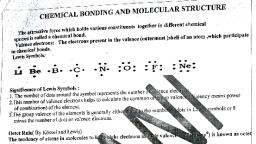
LEWIS SYMBOLS, G.N Lewis introduced simple notations to, represent valence electrons in an atom., These notations are called Lewis symbols or, Lewis notations., According to Lewis symbols, the symbol of the, element represents the nucleus.
Page 5 :
The valence electrons are represented as dots (.) or, crosses (x) around the Symbol., , The valency of Li, Be, B and C are 1, 2, 3, and 4, respectively., The valencies of N, O, and F are 3, 2, and 1 respectively.
Page 6 :
SIGNIFICANCE OF LEWIS SYMBOLS, The number of dots around the symbol represents the, number of valence electrons., The number of valence electrons helps to calculate, the common or group valency of the element., The group valency of the elements is either equal to, the number of dots in Lewis symbols or 8 minus the, number of dots or valence electrons.
Page 7 :
OCTET RULE, Atoms can combine either by, transfer of valence electrons, from one atom to another or, by sharing of valence electrons, in order to have an octet in, their valence shells., This is known as Octet Rule.
Page 8 :
IONIC BOND OR ELECTROVALENT BOND, When an electronegative element combines with an, electropositive element, one or more electrons are, transferred from the valence shell of an atom to the, valence shell of the atom of the electronegative, element., As a result, the electropositive atom becomes a +ve, ion and the electronegative ion becomes a ―ve ion.
Page 9 :
The electrostatic force of attraction between positive and, negative ions is called electrovalent bond or ionic bond., Ionic bond may also defined as the electrostatic force of, attraction holding the oppositely charged ions., Eg: Formation of NaCl, , Eg: Formation of CaCl2
Page 11 :
ELECTROVALENCY, The number of electrons gained or lost by an, atom during the formation of an Ionic bond is, called electrovalency of the atom., Electrovalency is equal to the charge on the, atom.
Page 12 :
ENERGY CHANGES DURING THE FORMATION, OF AN IONIC BOND, , Formation of gaseous cation:, The energy required for this step is called, Ionisation energy., Formation of gaseous anion:
Page 13 :
The energy released during this step is called, Electron affinity., The packing of positive and negative ions to, form the solids., The energy released in this step is called Lattice, Energy.
Page 14 :
FACTORS FAVOURING IONIC BOND FORMATION, Low Ionisation Energy of the electropositive, atom., High Electron Affinity of the electronegative, atom., High Lattice Energy of the compound formed.
Page 15 :
LATTICE ENERGY, The amount of energy released when one gram, mole of an ionic solid is formed from gaseous, ions.
Page 16 :
LATTICE ENTHALPY, It is defined as the energy required to, completely separate one mole of a solid ionic, compound into gaseous constituent ions., The lattice enthalpy is equal to lattice energy, with reverse sign.
Page 17 :
CONSEQUENCE OF LATTICE ENERGY, The greater the lattice energy, the more stable, is the ionic compound., Ions having higher charge and smaller radii will, have greater lattice energy., The value of lattice energy affects the, solubilities of ionic compounds.
Page 18 :
COVALENT BOND, A covalent bond is formed by the mutual sharing of, electrons between atoms., The atoms involved in the covalent bond formation, contribute equal number of electrons for sharing., The shared electrons become common to both the, atoms., This shared pair of electrons is called bond pair.
Page 19 :
If the atoms shared one pair of electrons, the bond, formed is called a single covalent bond., If the atoms shared two pairs of electrons, the, covalent bond is called a double bond., If the atoms shared three pairs of electrons, the, bond is called a triple bond.
Page 21 :
COVALENCY, The number of electron pairs shared by an atom or, the number of electrons contributed by an atom, for the formation of covalent bonds is called, covalency., Eg:- Covalency of chlorine is one, oxygen is two,, and that of nitrogen is three.
Page 23 :
FORMAL CHARGE, In the case of polyatomic ions, the net charge is, possessed by the ion as a whole and not by a, particular atom., The formal charge is defined as the difference, between the number of valence electrons of that, atom in the free State and the number of electrons, assigned to that atom in the Lewis Structure.
Page 26 :
LIMITATIONS OF, OCTET RULE
Page 27 :
1. THE INCOMPLETE OCTET OF THE CENTRAL ATOM, In some compounds, the number of electrons, surrounding the central atom is less than eight., i.e., elements having less than four valence, electrons., Eg:- LiCl, BeH2 and BeCl3
Page 28 :
2. ODD ELECTRON MOLECULES, In molecules with an odd number of electrons like, nitric oxide (NO) and nitrogen dioxide (NO2), the, octet rule is not satisfied for all the atoms.
Page 29 :
3. THE EXPANDED OCTET, Elements in and beyond the third period of the, periodic table have apart from 3s and 3p orbitals,, 3d orbitals also available for bonding., Here there are more than eight valence electrons, around the central atom., This is termed as the expanded octet., Eg:- PF5 , SF6 , H2SO4
Page 31 :
COORDINATE OR DATIVE BOND, A covalent bond in which both the electrons in, the shared pair is contributed by only one of the, two atoms is called a coordinate covalent bond., The atom which contributes the electron pair is, called the donor., The atom which shares the electron pair is, called an acceptor.
Page 32 :
This bond is also called a donor acceptor bond., This bond is usually represented by an arrow, pointing from donor to the acceptor atom., During the formation of coordinate bond, slight, polarity develops in the molecule., Eg:- Formation of NH4+
Page 34 :
CHARACTERISTICS OF, COORDINATE COVALENT COMPOUNDS, The electrons in coordinate covalent compounds are, held firmly by the nuclei and therefore they do not form, ions in water., The coordinate compounds are sparingly soluble in, water., A coordinate covalent bond resides a semi polarity in, the molecule., Because the shared electron pairs is contributed by one, of the atoms only.
Page 35 :
BOND PARAMETERS
Page 36 :
BOND LENGTH, The equilibrium distance between the nuclei of, two bonded atoms in a molecule., Bond lengths are measured by spectroscopic, xray diffraction and electron diffraction techniques.
Page 37 :
BOND ANGLE, The angle between the orbitals containing, bonding electron pairs around the central atom in, a molecule/complex ion., Bond angle is expressed in degrees., It, , can, , be, , experimentally, , spectroscopic methods., Eg:- H2O, , determined, , by
Page 38 :
BOND ENTHALPY, The amount of energy required to break one, mole of bonds of a particular type between two, atoms in gaseous state., The unit of bond enthalpy is kJ/mol., Eg:- The H―H bond enthalpy in hydrogen, molecule is 435.8 kJ/mol
Page 39 :
AVERAGE BOND ENTHALPY, Average bond enthalpy is used in the case of, polyatomic molecules., It is obtained by dividing total bond dissociation, enthalpy by the number of bonds broken., Eg: H2O
Page 40 :
BOND ORDER, Bond order is the number of bonds between the, two atoms in a molecule., Eg:- H2 , O2 and N2 have bond order 1, 2 and 3, respectively.
Page 41 :
RESONANCE STRUCTURES, When a molecule cannot be represented by a, single structure but its characteristic properties, can be described by two or more structures with, similar energy, positions of nuclei, bonding and, non-bonding pairs of electrons, then the actual, structure is said to be a resonance hybrid of these, structures.
Page 42 :
This phenomenon is called resonance., The different possible structures are called, contributing or canonical structures., Resonance is represented by double headed, arrows., Eg:- O3
Page 43 :
RESONANCE IN OZONE, , RESONANCE IN CO2
Page 44 :
RESONANCE IN CO, , 23
Page 45 :
POLARITY OF BONDS, When a covalent bond is formed between two similar atoms, the shared, pair of electrons is equally attracted by the atoms., As a result, electron pair is situated exactly between the two identical, nuclei., The bond so formed is called non polar covalent bond., In the case of heteronuclear molecule, the shared electron pair between, the atoms gets displaced more towards the more electronegative atom., The bond thus formed is called a polar covalent bond., As a result of polarization, the molecule possesses the dipole moment.
Page 46 :
DIPOLE MOMENT
Page 49 :
FAJAN’S RULES, The smaller the size of the cation and the larger the size of, the anion, the greater the covalent character of an ionic bond., The greater the charge on the cation, the greater the, covalent character of the ionic bond., For cations of same size and charge, the one, with electronic, configuration (n―1)dn ns0 , typical of transition metals, is more, polarizing than the one with a noble gas configuration, ns2 np6 ,, typical of alkali and alkaline earth metal cations.
Page 50 :
VSEPR THEORY, Sidgwick and Powell in 1940, proposed a simple, theory based on the repulsive interactions of the, electron pairs in the valence shell of the atoms.
Page 51 :
POSTULATES OF VSEPR THEORY, The shape of a molecule depends upon the number of, valence shell electron pairs around the central atom., The valence shell electron pairs repel each other., In order to reduce the repulsion, the electron pairs stay, at a maximum distance., Presence of lone pairs of electron causes distortion in, the expected geometry of the molecule.
Page 52 :
SHAPES OF MOLECULES, The definite relative arrangement of the bonded atoms in a, molecule is known as geometry or shape of the molecule., For the prediction of geometrical shapes of molecules, with, the help of VSEPR theory, it is convenient to divide molecules, into two categories., Molecules in which the central atom has no lone pair., Molecules in which the central atom has one or more lone, pairs.
Page 53 :
GEOMETRY OF MOLECULES IN WHICH THE CENTRAL ATOM, HAS NO LONE PAIR OF ELECTRONS
Page 54 :
SHAPE OF SOME SIMPLE MOLECULES/IONS WITH CENTRAL IONS, HAVING ONE OR MORE LONE PAIR OF ELECTRONS
Page 55 :
SHAPES OF MOLECULES CONTAINING, BOND PAIR AND LONE PAIR
Page 56 :
1. MOLECULAR TYPE AB2E, No. of bonding pairs : 2, No. of lone pairs : 1, Shape : Bent
Page 57 :
REASON FOR THE SHAPE ACQUIRED, Theoretically the shape should have been triangular, planar., Actually it is found to be bent or V shaped., The reason is that the lone pair―bond pair repulsion is, much more as compared to the bond pair― bond pair, repulsion., So the bond angle is reduced to 119.50 from 1200., Eg: SO2
Page 58 :
2. MOLECULAR TYPE AB3E, , No. of bonding pairs : 3, No. of lone pairs : 1, Shape : Trigonal Pyramidal
Page 59 :
REASON FOR THE SHAPE ACQUIRED, Here one lone pair of electron is present., Lone pair―Bond pair repulsion is greater than, bond pair―bond pair repulsion., The angle between the bond pairs is reduced to, 1070 from 109.50., Eg: NH3
Page 60 :
3. MOLECULAR TYPE AB2E2, , No. of bonding pairs : 2, No. of lone pairs : 2, Shape : Bent
Page 61 :
REASON FOR THE SHAPE ACQUIRED, The shape should have been tetrahedral if there were all bond, pairs., Here two lone pairs are present., So the shape is distorted tetrahedral or angular., The reason is lone pair―lone pair repulsion is more than lone, pair―bond pair repulsion which is more than bond pair―bond, pair repulsion., Thus the angle is reduced to 104.50 from 109.50 ., Eg: H2O
Page 62 :
4. MOLECULAR TYPE AB4E, , No. of bonding pairs : 4, No. of lone pairs : 1, Shape : See Saw
Page 63 :
REASON FOR THE SHAPE ACQUIRED, Here the lone pairs are in an equatorial, position., There are two Lone Pair―Bond Pair repulsions., Hence this arrangement is more stable., Shape is distorted tetrahedron or see saw., Eg: SF4
Page 64 :
5. MOLECULAR TYPE AB3E2, , No. of bonding pairs : 3, No. of lone pairs : 2, Shape : T Shape
Page 65 :
REASON FOR THE SHAPE ACQUIRED, Here the lone pairs are present at equatorial, position., So there are less lone pair―bond pair repulsions, as compared to others in which the lone pair are, at axial position., So this structure is the most stable., Eg: ClF3
Page 66 :
VALENCE BOND THEORY (VBT), Valence Bond Theory was developed by Heitler and, London in 1927., Developed further by Pauling and others., A covalent bond is formed by the overlapping of halffilled orbitals present in the valence shell of the, combining atoms., The overlapping orbitals must contain electrons with, opposite spins.
Page 67 :
As a result of overlapping, energy is released and hence, stability is increased., The strength of the bond depends on the extent of, overlapping., The greater the overlap, the stronger is the bond., The number of covalent bonds formed by an atom is equal to, the number of half-filled orbitals in it., The direction of the bond is the same as the direction of the, overlap of half-filled orbitals.
Page 68 :
FORMATION OF HYDROGEN MOLECULE, Consider two hydrogen atoms A and B having the nuclei, HA and HB and the corresponding electrons eA and eB, respectively., When the two atoms are at large distance from each other,, there is no interaction between them., The potential energy of the system at this stage is taken as, Zero., As the two atoms come closer and closer, they will begin to, interact with each other.
Page 69 :
As a result new attractive and repulsive forces begin to, operate., The new forces are attractive forces between the nucleus of, one atom and the electron of the other atom, i.e., (i) the attraction between H A and e B (ii) the attraction, between HB and e A ., Repulsive forces between their electrons and their nuclei i.e.,, (i) repulsion between eA and eB, (ii) repulsion between HA and HB .
Page 70 :
ORBITAL OVERLAP CONCEPT FOR COVALENT BOND, The main ideas of orbital overlap concept of forming covalent bonds are:, Covalent bonds are formed by the overlapping of half-filled atomic, orbitals present in their valence shell., The orbital undergoing overlapping must have electrons with opposite, spins., The overlapping results in pairing of the electrons., Overlapping of atomic orbitals results in the decrease of energy and, formation of covalent bond., The strength of a covalent bond depends on the extent of overlapping., The greater the overlapping, the stronger is the bond formed between, the atoms.
Page 72 :
Why He2 Molecule is not formed?, He atom has two electrons in its 1s orbital., The 1s orbital of one He atom cannot overlap with the, 1s orbital of another He atom, because it violates the, Pauli’s Exclusion Principle., Hence, He atoms do not form bonds between them., Therefore, He2 molecule is not formed.
Page 73 :
TYPES OF ORBITAL’S OVERLAPPING, Depending upon the extent and type of, overlapping, the covalent bonds may beof two, types., They are sigma bonds(σ) and Pi (π) bonds.
Page 74 :
SIGMA BOND, The covalent bond formed by axial overlapping or end to end, overlapping of half filled atomic orbitals along the internuclear, axis is known as sigma bond., The electrons involved in sigma bond formation are called, sigma electrons., Single bonds present in all molecules are always of sigma, type., The sigma bond is formed by any one of the following types of, combination of atomic orbitals.
Page 75 :
s-s OVERLAPPING, In this type, two half-filled s orbitals overlap, along the inter-nuclear axis.
Page 76 :
s-p OVERLAPPING, This type of overlapping occurs between the halffilled s orbital of one atom and half-filled p orbital, of the other atom.
Page 77 :
p-p OVERLAPPING, This type of overlapping occurs between the halffilled p orbital of one atom and half-filled p, orbital of the other atom.
Page 78 :
Pi BOND, The covalent bond formed by the side wise or lateral overlap of the, half-filled atomic orbitals is known as pi bond., The electrons involved in pi bond formation are called pi electrons., The π bond is always present in molecules having multiple bonds,, i.e., double or triple bonds.
Page 79 :
STRENGTH OF SIGMA BONDS AND PI BONDS, The strength of a covalent bond depends on the extent of, overlapping of atomic orbitals forming the bond., During the formation of a sigma bond, the overlapping of, orbitals takes place to a large extent., On the other hand, during the formation of a π bond, the, overlapping occurs to a smaller extent., Therefore, a sigma bond is stronger than a pi bond.
Page 80 :
HYBRIDISATION, The phenomenon of intermixing of atomic, orbitals of slightly different energies so as to, redistribute their energies, resulting in the, formation of new sets of orbitals of equivalent, energies and shape., The new orbitals formed as a result of, hybridization are called hybrid orbitals.
Page 81 :
SALIENT FEATURES OF HYBRIDISATION, The number of hybrid orbitals formed is equal to, the number of atomic orbitals that get hybridized., The hybrid orbitals are always equivalent in, energy and shape., The hybrid orbitals are more effective in forming, stable bonds than the pure atomic orbitals.
Page 82 :
These hybrid orbitals are directed in space in, some preferred directions to have minimum, repulsion between the electron pairs and thus a, stable arrangement is obtained., Therefore, the type of hybridization indicates, the geometry of the molecule.
Page 83 :
CONDITIONS FOR HYBRIDISATION, The orbitals present in the valence shell of the, atom are hybridized., The orbitals undergoing hybridization should, have almost equal energy.
Page 84 :
Promotion of electron is not essential condition, prior to hybridization., It is not necessary that only half filled orbitals, participate in hybridization., In some cases, even filled orbitals of valence, shell take part in hybridization
Page 86 :
sp HYBRIDISATION, The intermixing of one ‘s’ orbital and one ‘p’, orbital of an atom to form two equivalent orbitals, is known as sp hybridization., The resulting orbitals are known as sp hybrid, orbitals., These orbitals are directed along a line.
Page 87 :
So it is also called linear hybridization., The suitable orbitals for sp hybridization are s, and Pz , if the hybrid orbitals are to lie along the, z-axis., Each sp hybrid orbitals has 50% s-character, and 50% p-character.
Page 88 :
sp HYBRIDISATION, 2, , The intermixing of one s and two p orbitals of an, atom to form three equivalent orbitals is known as sp2, hybridization., The resulting orbitals are called sp2 hybrid orbitals., These sp2 hybrid orbitals lie in a plane and are, directed towards the three corners of an equilateral, triangle., So it is called trigonal hybridization.
Page 89 :
sp3 HYBRIDISATION, The intermixing of one s and three p orbitals of, an atom to form four orbitals., The four orbitals have equivalent energy., These orbitals are directed to the four corners of, a regular tetrahedron., It is called sp3 hybridization.
Page 90 :
The resulting orbitals are called sp 3 hybrid, orbitals., The angle between sp 3 hybrid orbitals is 109 0, 28Ꞌ., There is 25% s-character and 75% p-character in, each sp3 hybrid orbital.
Page 91 :
EXAMPLES
Page 93 :
BERYLLIUM FLUORIDE (BeF2), The ground state electronic configuration of, Be is 1s2 2s2 ., To account for the divalency of Be, one of the, 2s electron is promoted to a vacant 2p orbital., Now the two half-filled orbitals (2s and 2p), hybridize to form two sp hybrid orbitals.
Page 94 :
These hybrid orbitals overlap with half-filled p, orbitals of two fluorine atoms to form two Be―F, sigma bonds., Thus BeF2 is linear in shape and the bond angle, is 1800 .
Page 95 :
ACETYLENE (CH≡CH), In the formation of acetylene, both the carbon, atoms undergo sp hybridization leaving two 2p, orbitals (2P y and 2P x ) in the unhybridized state., One sp hybrid orbital of one carbon atom overlaps, axially with sp hybrid orbital of the other carbon, atom to form C―C sigma bond.
Page 96 :
The other unhybridized orbital of each carbon, atom overlaps axially with the half filled s orbital of, hydrogen atoms forming σ bonds., Each of the two unhybridized p orbitals of both the, carbon atoms overlaps sidewise to form two π bonds, between the carbon atoms., So the triple bond between the two carbon atoms is, made up of one sigma and two π bonds.
Page 99 :
BORON TRICHLORIDE (BCl3), The ground state electronic configuration of, boron atom is 1s2 2s2 2p1 ., In the excited state, one of the 2s electrons is, promoted to vacant 2p orbital., As a result, boron has three unpaired electrons., These three orbitals (one 2s and two 2p), hybridize to form three sp2 hybrid orbitals.
Page 100 :
The three hybrid orbitals so formed are oriented in a, trigonal planar arrangement and overlap with 2p, orbitals of chlorine to form three B―Cl bonds., Therefore, in BCl3 , the geometry is trigonal planar, with bond angle 1200 .
Page 101 :
ETHYLENE (CH2=CH2), In the excited state, carbon atom has four unpaired, electrons in the valence shell., In the formation of ethylene, each carbon atoms, undergo sp2 hybridization leaving one of the 2p orbitals, in the unhybridized state., Two hybrid orbitals of each carbon atom overlap with, 1s orbitals of two hydrogenatoms to form C―H sigma, bonds.
Page 102 :
The third hybrid orbital of one carbon atom overlaps, with the sp2 hybrid orbital of other carbon atom to, form C―C sigma bond., The unhybridized 2p orbital of one carbon atom, overlap sidewise with the similar orbital of the other, carbon to form a C―C Pi bond., Thus in ethylene, the C―C bond consists of one σ and, one π bond., Ethylene is a planar molecule with bond angle 120 0 .
Page 105 :
METHANE (CH4), In the formation of methane, carbon undergoes, sp3 hybridization., All the four sp3 hybrid orbitals overlap with the, 1s orbitals of four hydrogen atoms., It gives rise to four σ bonds., Thus, CH4 is tetrahedral in shape and the bond, angle is 1090 28Ꞌ.
Page 107 :
AMMONIA (NH3), The ground state electronic configuration of, nitrogen atom is 1s2 2s2 2px1 2py12pz1 ., Nitrogen has three unpaired electrons in the sp 3, hybrid orbitals and a lone pair of electron is present, in the fourth one., These hybrid orbitals overlap with 1s orbitals of, hydrogen atoms to form three N―H sigma bonds.
Page 108 :
Here lone pair bond pair repulsion is greater, than the two bond pairs of electrons., The molecule thus gets distorted and the bond, angle is reduced to 1070 from 109.50 ., The geometry of the molecule is pyramidal.
Page 109 :
WATER (H2O), In the case of water molecule, the four, orbitals of oxygen (one 2s and three 2p), undergo sp3 hybridization., It forms four sp3 hybrid orbitals out of which, two contain one electron each and the other, two contain a pair of electrons.
Page 110 :
These four Sp3 hybrid orbitals acquire a, tetrahedral geometry, with two corners, occupied by the lone pair., , The bond angle in this case is reduced to 104.5 0, from 109.50, The molecule acquires a V-shape or angular, geometry.
Page 111 :
ETHANE (CH3-CH3), In the formation of ethane, both the carbon atoms, undergo sp3 hybridization., One of the sp3 hybrid orbitals of one carbon atom, overlaps with one of the sp3 hybrid orbitals of the, other to establish a C―C sigma bond., The remaining sp3 hybrid orbitals of each carbon, atom overlap axially with the 1s orbital of hydrogen, atoms to form C―H sigma bonds.
Page 113 :
HYBRIDISATION OF ELEMENTS, INVOLVING d-ORBITALS, The elements present in the third period contain, d orbitals in addition to s and p orbitals., The energy of the 3d orbitals are comparable to, the energy of the 3s and 3p orbitals., The energy of 3d orbitals are also comparable to, those of 4s and 4p orbitals.
Page 114 :
The important hybridization schemes involving s, p, and d orbitals are summarized below.
Page 115 :
PHOPHOROUS PENTACHLORIDE (PCl5), The ground state and the excited state outer, electronic configuration of phosphorous (z = 15) is, represented below.
Page 116 :
In PCl5 , the five sp3d orbitals of phosphorous, overlap with singly occupied p, orbitals of chlorine atoms to form five P―Cl, sigma bonds., The three P―Cl bonds lie in one plane and make, an angle of 1200 with each other., These bonds are called equatorial bonds.
Page 117 :
The remaining two P―Cl bonds, one lying, above and one lying below the equatorial, plane make an angle of 900 with the plane., These bonds are called axial bonds., In order to keep the five electron pairs as far, apart, , as, , possible,, , bipyramidal shape., , PCl5, , adopts, , trigonal
Page 118 :
PCl5 is more reactive. Why?, In PCl5 , the axial bond pairs suffer more repulsive, interaction from the equatorial, bond pairs., Therefore, axial bonds have been found to be, slightly longer and hence slightly weaker than the, equatorial bonds., Hence PCl 5 molecule is more reactive.
Page 119 :
SULPHUR HEXA FLUORIDE (SF6), In SF6 , the central atom sulphur has six pairs of, electrons in the valence shell., The ground state and the excited state electronic, configurations of sulphur are, represented below., In the excited state, the available six orbitals (one, 2, three p and two d) are singly occupied by, electrons.
Page 120 :
These orbitals hybridize to form six new sp3d2 hybrid, orbitals., These orbitals are projected towards the six corners, of a regular octahedron., The six sp3d2 hybrid orbitals overlap with singly, occupied orbitals of fluorine, atom to form six S―F sigma bonds., Thus SF, geometry., , 6, , molecule has a regular octahedral
Page 122 :
MOLECULAR ORBITAL THEORY (MOT), Molecular Orbital Theory was developed by F. Hund, and R.S. Mulliken in 1932., The salient features of this theory are, The electrons in a molecule are present in the, various molecular Orbitals., The atomic orbitals of comparable energies and, proper symmetry combine to form molecular, orbitals.
Page 123 :
A molecular orbital, is influenced by two or, more nuclei depending up on the number of, atoms in the molecule., An atomic orbital is monocentric while a, molecular orbital is polycentric., The number of molecular orbital formed is, equal to the number of atomic orbitals combined.
Page 124 :
When two atomic orbitals combine, two, molecular orbitals are formed., One is known as bonding molecular orbital, while the other is called Antibonding molecular, orbital., The bonding molecular orbital has lower energy, and, , hence, , greater, , stability, , than, , corresponding Antibonding molecular orbital., , the
Page 125 :
The electron probability distribution around, a group of nuclei in a molecule is given by a, molecular orbital., The, , molecular, , orbitals, , are, , filled, , in, , accordance with the Aufbau Principle obeying, the Pauli’s Exclusion Principle and the Hund’s, Rule.
Page 126 :
DIFFERENCES BETWEEN, ATOMIC ORBITALS AND MOLECULAR ORBITALS, An atomic orbital is monocentric., i.e., an electron in an atomic orbital is, influenced by only one nucleus., A molecular orbital is polycentric., i.e., an electron in a molecular orbital is, influenced by two or more nuclei.
Page 127 :
FORMATION OF, MOLECULAR ORBITALS
Page 128 :
LINEAR COMBINATION OF ATOMIC ORBITALS, , Molecular orbitals are formed by the, combination of atomic orbitals., The atomic orbitals can combine by addition, and subtraction of their wave, functions., This is called Linear Combination of atomic, orbitals, LCAO.
Page 129 :
If ψ A and ψ B are the orbital wave functions of two, atoms A and B, they can combine by addition or, subtraction to form a molecular orbital., Therefore the two molecular orbitals σ and σ* are, formed as, The molecular orbital σ formed by the addition of, atomic orbitals is called the bonding molecular orbital., The molecular orbital σ* formed by the subtraction of, atomic orbital is called Antibonding molecular orbital.
Page 130 :
DIFFERENCE BETWEEN BONDING, AND ANTIBONDING MOLECULAR ORBITALS
Page 131 :
CONDITIONS FOR THE COMBINATION OF ATOMIC ORBITALS, , The combining atomic orbitals must have, the same or nearly the same energy., The combining atomic orbitals must have, the same., The combining atomic orbitals must overlap, to the maximum extent.
Page 132 :
TYPES OF MOLECULAR ORBITALS, Molecular orbitals of diatomic molecules are, designated as sigma (σ) and Pi ( π )., A σ MO is formed by the axial overlap of, atomic orbitals., A π MO is formed by the lateral overlap.
Page 133 :
COMPARISON OF SIGMA AND PI MOLECULAR ORBITALS
Page 134 :
ELECTRONIC CONFIGURATION, The distribution of electrons among various, molecular orbitals is called the electronic, configuration of the molecule.
Page 135 :
STABILITY OF MOLECULES, Nb is the number of electrons present in, bonding molecular orbitals., Na is the number of electrons present in, antibonding molecular orbitals., If Nb > Na, the molecule is stable., If Nb < Na, the molecule is unstable.
Page 136 :
BOND ORDER, Bond Order is defined as one half of the, difference between the number of electrons, present in the bonding and antibonding, molecular orbitals., , Bond Order gives the following information.
Page 137 :
If the value of bond order is +ve, the, molecule is stable., If the bond order is ─ve or zero, the molecule, is unstable., Greater the bond order, greater is the, dissociation energy., Greater the bond order, shorter is the bond, length., The bond order of a diatomic molecule is, equal to the number of covalent bonds in the, molecule.
Page 138 :
MAGNETIC BEHAVIOUR, A molecule will be paramagnetic if it has, unpaired electrons in its Molecular Orbital., A molecule will be diamagnetic if it has no, unpaired electrons in its Molecular Orbital.
Page 139 :
HYDROGEN MOLECULE (H2), , H2 molecule is stable., It is diamagnetic., The two hydrogen atoms are bonded by a, single covalent bond.
Page 140 :
HELIUM MOLECULE (He2), , He2 molecule is unstable and does not exist.
Page 141 :
LITHIUM MOLECULE (Li2), , Li2 molecule is stable., It is diamagnetic., The two Li atoms are joined by single covalent, bonds.
Page 142 :
CARBON MOLECULE (C2), , C2 molecule is stable., It is diamagnetic., The two carbon atoms are joined by means of a, double bond.
Page 143 :
NITROGEN MOLECULE (N2), , N2 molecule is stable., It is diamagnetic., The two nitrogen atoms are joined by triple, bonds.
Page 144 :
OXYGEN MOLECULE (O2), , ✔O2 molecule is stable., ✔It is paramagnetic., ✔The two oxygen atoms are joined by double, bonds.
Page 145 :
FLUORINE MOLECULE (F2), , ✔F2 molecule is stable., ✔It is diamagnetic., ✔The two fluorine atoms are joined by single, covalent bond.
Page 146 :
NEON MOLECULE (Ne2), , Ne2 molecule is unstable and does not exist.
Page 147 :
MOLECULAR ORBITAL DIAGRAM OF, HOMONUCLEAR DIATOMIC MOLECULES
Page 152 :
HYDROGEN BOND, The, , attractive, , force, , that, , binds, , the, , electronegative atom in one molecule with the, hydrogen atom of the neighbouring molecule, of the same or different substance is called, Hydrogen bond., Eg: H2O, HF, NH3 etc
Page 153 :
INTERMOLECULAR HYDROGEN BOND, If the hydrogen bond is, operating between the, molecules of same or, different substance, it is, called, Intermolecular, Hydrogen Bond., Eg:- H2O, HF, NH3 etc.