Page 1 :
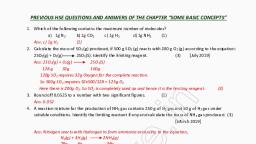
PREVIOUS HSE QUESTIONS AND ANSWERS OF THE CHAPTER “SOME BASIC CONCEPTS”, 1. (a) Who proposed the law of conservation of mass?, (1), (b) Illustrate the above law by using a chemical reaction. (1), Ans: (a) Antoin Lavoisier, (b) Consider the reaction C(s) + O2(g), CO2(g), 12g 32g, 44g, Total mass of reactants = 12+32 = 44g, Total mass of products = 44 g, i.e. Total mass of reactants = Total mass of products. This is law of conservation of mass., 2. Determine the empirical formula of an oxide of iron which has 69.9% iron (Fe) and 30.1% oxygen (O) by, mass. [Hint: Atomic mass of Fe = 55.85]., (3), [December 2020], Ans:, Element Percentage Atomic mass Percentage/Atom, Simple ratio, Simplest whole, ic mass, no. ratio, Fe, 69.9, 55.85, 69.9/55.85 = 1.25 1.25/1.25 = 1, 1x2=2, O, 30.1, 16, 30.1/16 = 1.88, 1.88/1.25 = 1.5, 1.5 x 2 = 3, Empirical formula = Fe2O3, 3. (a) Classify the following matter as homogeneous mixture, heterogeneous mixture, element and, compounds. gold, air, muddy water, water, (1), (b) Define limiting reagent of a reaction. (1), Ans: (a) Homogeneous mixture: air, Heterogeneous mixture: muddy water, Element: gold, Compound: water, (b) It is the reagent that limits a reaction or completely used up in a reaction., 4. (a) Hydrogen and oxygen combines to form H2O and H2O2. Which law of chemical combination is, illustrated here?, (1), (b) The balanced chemical equation for combustion of CH4 is CH4(g) + 2O2(g), CO2(g) + 2H2O(l)., Calculate the amount of water formed by the combustion of 32g of CH4. (2), [March 2020], Ans: (a) Law of multiple proportion, (b) CH4(g) + 2O2(g), CO2(g) + 2H2O(l)., 16g, 64g, 44g, 36g, 16g CH4 produces 36g water., So the amount of water formed by the combustion of 32g CH4 = 36 x 32/16 = 72 g., 5. Which of the following contains the maximum number of molecules?, a) 1g N2, b) 1g CO2, c) 1g H2, d) 1g NH3, (1), Ans: c) 1g H2, (1), 6. Calculate the mass of SO3 (g) produced, if 500 g SO2 (g) reacts with 200 g O2 (g) according to the equation:, 2SO2(g) + O2(g), 2SO3(S). Identify the limiting reagent., (3), [July 2019], Ans: 2SO2(g) + O2(g), 2SO3(S), 128 g, 32g, 160g, 128g SO2 requires 32g Oxygen for the complete reaction., So 500g SO2 requires 32x500/128 = 125g O2, Some Basic concepts - Prepared by ANIL KUMAR K L, GHSS ASHTAMUDI, KOLLAM, Join Telegram Channel, https://t.me/hsslive, , Prepared by Anil Kumar K L, , Downloaded from www.Hsslive.in ®, , Page 1
Page 2 :
Here there is 200g O2. So SO2 is completely used up and hence it is the limiting reagent., (3), 7. Round off 0.0525 to a number with two significant figures., (1), Ans: 0.052, 8. A reaction mixture for the production of NH3 gas contains 250 g of N2 gas and 50 g of H2 gas under, suitable conditions. Identify the limiting reactant if any and calculate the mass of NH 3 gas produced. (3), [March 2019], Ans: Nitrogen reacts with Hydrogen to form ammonia according to the equation,, N2(g) + 3H2(g), 2NH3(g), 28g, 6g, 34g, i.e. 28g N2 requires 6g H2 for the complete reaction., So 250g N2 requires, 6x 250/28 = 53.57g H2., But here there is only 50g H2., So we have to consider the reverse case., i.e. 6g H2 requires 28g N2., So 50g H2 requires 28 x 50/6 = 233.33g N2, Here H2 is completely consumed. So it is the limiting reagent., Amount of ammonia formed = 50+ 233.33 = 283.33 g, 9. Which among the following measurements contains the highest number of significant figures?, a) 1.123 x 10⁻³ kg, b) 1.2 x 10⁻³ kg c) 0.123 x 10³ kg d) 2 x 10⁵ kg, (1), -3, Ans: a) 1.123 x 10 kg, 10. State and illustrate the law of multiple proportions. (2), Ans: It states that if two elements combine to form more than one compound, the different masses of one of the, elements that combine with a fixed mass of the other element, are in small whole number ratio., Illustration: Hydrogen combines with oxygen to form two compounds – water and hydrogen peroxide., Hydrogen + Oxygen → Water, 2g, 16g, 18g, Hydrogen + Oxygen → Hydrogen Peroxide, 2g, 32g, 34g, Here, the masses of oxygen (i.e. 16 g and 32 g) which combine with a fixed mass of hydrogen (2g) bear a simple, ratio, i.e. 16:32 or 1: 2., , 11. Calculate the amount of CO2(g) produced by the reaction of 32g of CH4 (g) and 32g of O2 (g). (3), [August 2018], Ans: CH4 (g) + 2O2 (g), CO2 (g) + 2 H2O (g), 16g, 64g, 44g, 36g, 64g O2 requires 16g CH4 for the complete reaction., So, 32g O2 requires 8g CH4., 16g CH4 combines with 64g O2 to form 44g CO2., Therefore, 8g CH4 combines with 32g Oxygen to form 22g CO2., 12. The number of oxygen atoms present in 5 moles of glucose (C6H12O6) is .............. (1), Ans: 30 x 6.022 x 1023 atoms, 13. Find the molecular formula of the compound with molar mass 78 g mol-1 and empirical formula CH. (2), Ans: Molar mass = 78 g/mol, Empirical Formula mass = 12+1 = 13, Molecular formula = Empirical formula x n, , Some Basic concepts - Prepared by ANIL KUMAR K L, GHSS ASHTAMUDI, KOLLAM, Join Telegram Channel, https://t.me/hsslive, , Prepared by Anil Kumar K L, , Downloaded from www.Hsslive.in ®, , Page 2
Page 3 :
n=, , Molar mass, = 78/13 = 6, Empirical formula mass, So, Molecular formula = (CH) x 6 = C6H6, 14. Calculate the mass of oxalic acid dihydrate (H2C2O4.2H2O) required to prepare 0.1M, 250 ml of its aqueous, solution., (3), [March 2018], Ans: Molarmass of Oxalic acid dihydrate = 126, Molarity = 0.1M, Volume of the solution = 250 mL, Molarity =, Mass of the solute x 1000, Molar mass of the solute x volume of solution in mL, So Mass of the solute = (Molarity x Molar mass of the solute x volume of solution in mL)/1000, = (0.1 x 126 x 250/1000 = 3.15 g, 15. a) NO and NO2 are two oxides of nitrogen., i), Which law of chemical combination is illustrated by these compounds? (1), ii), State the law. (1), b) Calculate the mass of a magnesium atom in grams., (1), c) What is molality? (1), [July 2017], Ans: a) i) Law of multiple proportions, ii) It states that if two elements combine to form more than one compound, the different masses of one of, the elements that combine with a fixed mass of the other element, are in small whole number ratio., , b) Atomic mass of magnesium = 24g, i.e. Mass of 6.022 x 10²³ atoms of Magnesium = 24g, So, Mass of one magnesium atom = 24/(6.022x1023) = 3.98x10⁻²³ g, c) Molarity is the no. of moles of solute present per litre of the solution., 16. a) Determine the number of moles present in 0.55 mg of electrons., i) 1 mole, ii) 2 moles, iii) 1.5 moles iv) 0.5 mole, (1), b) Give the empirical formula of the following., C6H12O6, C6H6, CH3COOH, C6H6Cl6, (2), c) Two elements, carbon and hydrogen combine to form C2H6, C2H4 and C2H2. Identify the law illustrated, here. (1), [March 2017], Ans: (a) (i) 1 mol, (Score 1), [Explanation: Mass of one electron = 9.1 x 10⁻²⁸ g = 9.1 x 10⁻²⁵ mg., Mass of 1 mol of electron = 9.1 x 10-25 x 6.022 x 1023 mg = 0.55 mg., So, 0.55 mg of electron ≡ 1 mol of electron.], (b) Empirical formulae are: CH2O, CH, CH2O, CHCl., (Score 2), (c) Law of multiple proportions, (Score 1), 17. Empirical formula represents the simplest whole number ratio of various atoms present in a compound., a) Give the relation between empirical formula and molecular formula. (1), b) An organic compound has the following percentage composition C = 12.36%, H = 2.13%, Br = 85%. Its, vapour density is 94. Find its molecular formula., (2), c) What is mole fraction? (1), [September 2016], Ans: a) Molecular formula = Empirical formula x n, (1), b), Some Basic concepts - Prepared by ANIL KUMAR K L, GHSS ASHTAMUDI, KOLLAM, Join Telegram Channel, https://t.me/hsslive, , Prepared by Anil Kumar K L, , Downloaded from www.Hsslive.in ®, , Page 3
Page 4 :
Element, , Percentage, , Atomic mass, , C, H, Br, , 12.36, 2.13, 85, , 12, 1, 80, , Percentage/Atom, ic mass, 12.36/12 = 1.03, 2.13/1 = 2.13, 85/80 = 1.06, , Simple ratio, 1.03/1.03 = 1, 2.13/1.03 = 2, 1.06/1.03 = 1, , Simplest whole, no. ratio, 1, 2, 1, , Empirical Formula = CH2Br, Empirical Formula Mass (EFM) = 12+2+80 = 94, Molar mass (MM) = 2 x vapour density = 2 x 94 = 188, n = MM/EFM = 188/94 = 2, Molecular formula = Empirical formula x n, = (CH2Br) x 2 = C2H4Br2, (2), c) Mole fraction is the ratio of the number of moles of a particular component to the total number of moles, of solution. (1), , 18. a) When nitrogen and hydrogen combines to form ammonia, the ratio between the volumes of gaseous, reactants and products is 1: 3: 2. Name the law of chemical combination illustrated here., (1), b) A compound is made up of two elements A and B, has A = 70% and B = 30%. The relative number of, moles of A and B in the compound are 1.25 and 1.88 respectively. If the molar mass of the compound is, 160, find the molecular formula of the compound. (3), [March 2016], Ans: a) Gay – Lussac’s law of Gaseous volumes, (1), b) The relative number of moles means %/atomic mass., Elements, %, Relative no. of, Simple ratio, Simplest whole no., moles, ratio, A, 70, 1.25, 1.25/1.25 = 1, 2, B, 30, 1.88, 1.88/1.25 =, 3, 1.5, Empirical formula is A2B3, (Here at. Mass is not given. But it can be find out from % composition and the no. of moles as follows), Atomic mass of A = %/no. of moles = 70/1.25 = 56, Atomic mass of B = %/no. of moles = 30/1.88 = 15.96, So, emp. Formula mass = 56 x 2 + 15.96 x 3 = 159.88 = 160, n = Mol.mass/Emp. Formula Mass = 160/160 = 1, Molecular formula = (emp. Formula) x n = (A2B3)x 1 = A2B3, (3), 19. 12 g of 12C contains Avogadro’s number of carbon atoms., a) Give the Avogadro’s number., (1), b) The mass of 2 moles of ammonia gas is ........., (i), 2g, (ii) 1.2 x 10²²g, (iii) 17 g, (iv) 34g, (1), c) Calculate the volume of ammonia gas produced at STP when 140 g of nitrogen gas reacts with 30 g of, hydrogen gas. (Atomic mass: N = 14u, H = 1 u) (2), [October 2015], 23, Ans: a) 6022 x 10, (1), b) (iv) 34g, (1), c) No. of moles of N2 = Mass in gram/ molar mass = 140/28 = 5 mol, No. of moles of H2 = Mass in gram/ molar mass = 30/2 = 15 mol, N2 combines with H2 to form NH3 according to the equation: N2(g) + 3H2(g), 2NH3(g), From the equation, it is clear that 1 mol nitrogen reacts with 3 mol H2 to form 20mol NH3., Some Basic concepts - Prepared by ANIL KUMAR K L, GHSS ASHTAMUDI, KOLLAM, Join Telegram Channel, https://t.me/hsslive, , Prepared by Anil Kumar K L, , Downloaded from www.Hsslive.in ®, , Page 4
Page 5 :
So, 5 mol N2 reacts with 15 mol H2 to form 10 mol NH3., Volume of 1 mol of ammonia at STP = 22.4 L, So volume of 10 mol of ammonia at STP = 224 L, (2), 20. ‘A given compound always contains exactly the same proportion of elements by weight.’, a) (i), Name the above law., (1), (ii), Write the name of the Scientist who proposed this law. (1), b) Calculate the number of molecules in each of the following:, i) 1 g N2 ii) 1 g CO2 (Given that NA is 6.022 x 10²³, molecular mass of N2 = 28 and CO2 = 44) (2), [March 2015], Ans: a) (i) Law of definite (constant) proportions, (1), (ii) Joseph Proust, (1), b) No of molecules = Given mass in gram x NA, Molar mass, 23, (i), (1 x 6.022 x 10 )/28, = 0.0357 x 10²³ molecules, (1), 23, 23, (ii), (1 x 6.022x10 )/44, = 0.0227 x 10 molecules, (1), 21. a) How many moles of dioxygen are present in 64g of dioxygen? (Molar mass of dioxygen is 32). (1), b) The following data were obtained when dinitrogen (N 2) and dioxygen (O2) react together to form, different compounds., Mass of, Mass of O2, N2, 14 g, 16 g, 14 g, 32 g, 28 g, 32 g, 28 g, 80 g, Name the law of chemical combination obeyed by the above experimental data. (1), c) Define empirical formula. How is it related to the molecular formula of a compound? (2), [March 2014], Ans: a) No. of moles = Mass in gram / Molar mass = 64/32 = 2 moles, (1), b) Law of multiple proportion (1), c) Empirical formula is the simplest formula which gives only the ratio of different elements present in the, compound. It is related to molecular formula as Molecular formula = Empirical formula x n, (2), 22. Hydrogen combines with oxygen to form two different compounds, namely water (H 2O) and hydrogen, peroxide (H2O2)., a) Which law is obeyed by this combination?, (1), b) State the law., (2), c) How many significant figures are present in the following?, i), 0.0025, ii) 285 (1), [August 2014], Ans: a) Law of Multiple proportions (1), , b) It states that if two elements combine to form more than one compound, the different masses of, one of the elements that combine with a fixed mass of the other element, are in small whole number ratio., c) i) 2, ii) 3, (1), 23. a) Atoms have very small mass and so usually the mass of atoms are given relative to a standard called, atomic mass unit. What is atomic mass unit (amu)? (1), , Some Basic concepts - Prepared by ANIL KUMAR K L, GHSS ASHTAMUDI, KOLLAM, Join Telegram Channel, https://t.me/hsslive, , Prepared by Anil Kumar K L, , Downloaded from www.Hsslive.in ®, , Page 5
Page 6 :
b) In a reaction A + B2 → AB2, identify the limiting reagent in the reaction mixture containing 5mol A and, 2.5 mol B., (1), c) Calculate the mass of NaOH required to make 500 ml of 0.5M aqueous solution. (Molar mass of NaOH =, 40), (2), [October 2013], th, 12, Ans: a) 1/12 the mass of a C atom is called atomic mass unit. (1), b) B, (1), c) Molarity =, Mass of the solute x 1000, Molar mass of the solute x volume of solution in mL, So, Mass of the solute = (Molarity x Molar mass of the solute x volume of solution in mL)/1000, = (0.5 x 40 x 500)/1000 = 10 g, (2), 24. The mole concept helps in handling a large number of atoms and molecules in stoichiometric calculations., a) Define 1 mol., (1), b) What is the number of hydrogen atoms in 1 mole of methane (CH4)?, (1), c) Calculate the amount of carbon dioxide formed by the complete combustion of 80g of methane as per, the reaction:, CH4 (g) + 2O2 (g), CO2 (g) + 2 H2O (g), (Atomic mass of C = 12.01u, H = 1.008u, O = 16u) (2), [March 2013], Ans: a) 1 mol is the amount of substance that contains as many particles as there are atoms in exactly 12g, C12 isotope. (1), b) 1 mol CH4 contains 4 mol hydrogen = 4 x 6.022 x 1023 H atoms., (1), c) CH4 (g) + 2O2 (g), CO2 (g) + 2 H2O (g), According to the equation, 16 g CH4 gives 44 g CO2, So 80 g CH4 gives 44 x 80/16 = 220 g CO2, (2), 25. a) Mole is a very large number to indicate the number of atoms, molecules etc. Write another name for, one mole., (1), b) i) How the molecular formula is different from that of empirical formula?, (1), ii) An organic compound on analysis gave the following composition. Carbon = 40%, Hydrogen = 6.66%, and oxygen = 53.34%. Calculate its molecular formula if its molecular mass is 90. (2) [September 2012], Ans: a) Avogadro’s Number or Avogadro’s constant (1), b) (i) Empirical formula is the simplest formula which gives only the ratio of different elements present, in the compound. But molecular formula is the actual formula that gives the exact number of different, elements present in the compound., (1), (ii), Element Percentage Atomic mass Percentage/Atom Simple ratio Simplest whole, ic mass, no. ratio, C, 40, 12, 40/12 = 3.33, 3.33/3.33 = 1, 1, H, 6.66, 1, 6.66/1 = 6.66, 6.66/3.33 = 2, 2, O, 53.34, 16, 53.34/16 = 3.33, 3.33/3.33 = 1, 1, Empirical Formula = CH2O, Empirical Formula Mass (EFM) = 12+2+16 = 30, Molar mass (MM) = 90, n = MM/EFM = 90/30 = 3, Molecular formula = Empirical formula x n, = (CH2O) x 3 = C3H6O3, (2), 26. The combination of elements to form compounds is governed by the laws of chemical combination., a. Hydrogen combines with oxygen to form compounds, namely water and hydrogen peroxide. State, and illustrate the related law of chemical combination., (2), Some Basic concepts - Prepared by ANIL KUMAR K L, GHSS ASHTAMUDI, KOLLAM, Join Telegram Channel, https://t.me/hsslive, , Prepared by Anil Kumar K L, , Downloaded from www.Hsslive.in ®, , Page 6
Page 7 :
b. What is mean by limiting reagent in a chemical reaction? (1), c. 28 g of nitrogen is mixed with 12 g of hydrogen to form ammonia as per the reaction,, N2 + 3 H2, 2NH3. Which is the limiting reagent in this reaction?, (1), [March 2012], Ans: a) Law of multiple proportions (Answer of Qn. No. 6), (2), b) A reagent that is completely consumed in a reaction. (1), c) No. of mol of N2 = 28/28 = 1 mol, No. of mol of H2 = 12/2 = 6 mol., Here N2 is completely used up. So it is the limiting reagent., (1), 27. The laws of chemical combination govern the formation of compounds from elements., a) State the law of conservation of mass. Who put forward this law?, (1½), b) The following data are obtained when dinitrogen and dioxygen react together to form different, compounds., Sl. No. Mass of dinitrogen (in Mass of dioxygen (in, g), g), 1, 14, 16, 2, 14, 32, 3, 28, 48, 4, 28, 80, Which law of chemical combination is illustrated by the above experimental data? Explain? (2½), [October 2011], Ans: a) It states that matter can neither be created nor destroyed. Or, in a chemical reaction, the total, mass of reactants = the total mass of products. This law was put forward by Antoine Lavoisier., b) Law of Multiple proportion (See the answer of Qn. No. 6), 28. The laws of chemical combination are the basis of the atomic theory., a) Name the law of chemical combination illustrated by the pair of compounds, CO and CO2. (1), b) State and explain the law of conservation of mass., (1½), c) Calculate the molarity of a solution containing 8 g of NaOH in 500 mL of water. (1½) [March 2011], Ans: a) Law of multiple proportions, b) It states that matter can neither be created nor destroyed. Or, in a chemical reaction, the total mass, of reactants = the total mass of products., Consider the reaction 2H2 + O2 → 2H2O, Here 4 g of H2 combines with 32 g of O2 to form 36 g of water., Total mass of reactants = 4 + 32 = 36g, Total mass of products = 36 g, c) Molarity =, Mass of the solute x 1000, Molar mass of the solute x volume of solution in mL, = (8 x 1000)/40x500 = 0.4 M, 29. One mole is the amount of substance that contains as many particles as 12 g of C 12 isotope of carbon., a) What do you mean by molar mass of a compound?, (1), b) Calculate the number of moles in 1 L of water (Density of water 1 g/mL). Also calculate the number of, water molecules in 1 L water. (3), [September 2010], Ans: a) It is the mass of 1 mol of any substance. (1), b) Since density of water = 1 g/mL, 1 L H2O = 1 kg H2O = 1000g H2O (mass = density x volume), No. of moles = Mass in gram / Molar mass = 1000/18 = 55.55 mol, No of molecules = no. of moles x NA = 55.55 x 6.022 x 1023molecules. (3), 30. If the mass percent of various elements of a compound is known, its empirical formula can be calculated., a) What is mass percent? (1), Some Basic concepts - Prepared by ANIL KUMAR K L, GHSS ASHTAMUDI, KOLLAM, Join Telegram Channel, https://t.me/hsslive, , Prepared by Anil Kumar K L, , Downloaded from www.Hsslive.in ®, , Page 7
Page 8 :
b) A compound contains 4.07% hydrogen, 24.27% carbon and 71.65% chlorine. Its molecular mass is, 98.96. What are the empirical and molecular formulae?, (3), [March 2010], Ans: a) Mass % = Mass of solute × 100, Mass of solution, OR, Mass percent = Mass of that element in the compound x 100, Molar mass of the compound, (1), b), Element Percentage Atomic mass Percentage/Atom Simple ratio Simplest whole, ic mass, no. ratio, C, 24.27, 12, 24.27/12 = 2.02, 2.02/2.02 = 1, 1, H, 4.07, 1, 4.07/1 = 4.07, 4.07/2.02 = 2, 2, Cl, 71.65, 35.5, 71.65/35.5 = 2.02 2.02/2.02 = 1, 1, Empirical Formula = CH2Cl, Empirical Formula Mass (EFM) = 12+2+35.5 = 49.5, Molar mass (MM) = 98.96, n = MM/EFM = 98.96/49.5 = 2, Molecular formula = Empirical formula x n, = (CH2Cl) x 2 = C2H4Cl2, (3), 31. Calculate the number of moles of oxygen required to produce 240 g of MgO by burning Mg metal., (Atomic mass Mg = 24, O = 16), (4), [March 2009], Ans: Here mass of MgO = 240 g, Molecular mass of MgO = 24 + 16 = 40 g/mol, No. of moles of MgO = Mass of MgO/Molar mass of MgO = 240/40 = 6 mol, The chemical equation for the burning of Mg metal can be represented as:, 2 Mg + O2, 2 MgO, i.e. 2 mol MgO require 1 mol O2, So, 6 mol MgO require ½ x 6 = 3 mol O2., (4), 23, 32. One gram atom of an element contains 6.02 x 10 atoms., a) Find the number of oxygen atoms in 4 g of O2. (1), b) Which is heavier, one oxygen atom or 10 hydrogen atoms?, (1), [February 2008], Ans: a) No. of moles of O2 = 4/32 = 0.125 mol, 1 mol O2 contains 2 x 6.022 x 1023 Oxygen atoms., So, 0.125 mol O2 contains 0.125 x 2 x 6.022 x 1023 Oxygen atoms, (1), b) Mass of one oxygen atom = 16u, Mass of 10 hydrogen atoms = 10u, So one oxygen atom is heavier., (1), ##################################################################################, , Some Basic concepts - Prepared by ANIL KUMAR K L, GHSS ASHTAMUDI, KOLLAM, Join Telegram Channel, https://t.me/hsslive, , Prepared by Anil Kumar K L, , Downloaded from www.Hsslive.in ®, , Page 8