Page 3 :
FIRST P.U.C ACCOUNTANCY - QUESTION BANK, , , , , , , , , , , , , , , , , , , , , , , , , , , , , , , , , , , , , , , , , , , , , , , , INDEX, S1.No Particulars Page No., , 1 Instructions for setting the Question Paper 4, Course Structure 10, Chapter wise weight age of marks & allotment of Ti, hours and list of POQs., Suggested Question Paper Design 12, Programme of Work 13, , 6 QUESTION BANK:, Ch-01:Introduction to Accounting 19-24, Ch-02: Theory Base of Accounting 25-30, Ch-03: Recording of Transactions-I 31-42, Ch-04: Recording of Transactions-II 43-67, Ch-05: Bank Reconciliation Statement 68-75, Ch-06: Trial Balance and Rectification of Errors 76-85, Ch-07: Depreciation, Provisions and Reserves 86-88, Ch-08: Bills of Exchange 89-95, Ch-0O9: Financial Statements — I 96-98, Ch-10: Financial Statements - II 99-112, Ch-11: Accounts from Incomplete Records 113-122, Ch-12: Application of Computers in Accounting 123-124, Ch-13: Computerised Accounting System 125-126, , if Model Question Paper - 1(Revised] 127-133, , 8 Model Question Paper -2 134-140
Page 4 :
Question Bank, First PUC Accountancy (Code 30), , Introduction:, , Karnataka is one of the first states to the country to introduce two, year PUC as a separate course in the year 1971-72. The syllabi have, undergone changes. The latest restructuring of the course which has come, into force from the academic year 2017-18 has taken a major departure, from the previous attempts of revisions both in terms of content and, orientation by adopting NCERT Text Books for 1 PUC., , Commerce education is a branch of education which aims at, injecting the business skills and talents and thereby prepares its learners, to enter into the business field in different capacities, who in-turn, contribute to the overall well-being of the society. Over these years,, commerce education in Karnataka has grown in leaps and bounds., , For the first time department of PU Education is releasing the, Question Bank for I PUC Accountancy subject based on NCERT XI, Standard Text Book. It has two volumes. I volume Financial Accounting, Part-I consists of 8 chapters and II volume Financial Accounting Part-II, consists of 7 chapters of which only 5 chapters are retained by, department. All the chapters of first book and only 5 chapters in second, book are retained. Chapter 14 and 15 of II volume are excluded., , General Guidelines/Instructions:1, Availability of teaching hours in a year will be 140 only., , 2. Split-up of available teaching hours:, , O05 Hours” -Forbridge course, , 120 Hours - For completion of course content(excluding POQ}, , 15 Hours” - For the completion of 15 POQs, 3. Duration of Annual Examination will be 3 Hours and 15 Minutes only., 4, Maximum marks of a question paper will be 167., , 5. While framing the questions, weightage should be given, to instructional objectives as follows:, , Knowledge - 15%, Understanding - 25%, Application - 40%, Skill - 20%, Total -100%, , 6. While preparing the question paper due weightage should be given, to the difficulty level as follows:, , Easy - 50%, Average - 40%, Difficult -10%, , Total -100%
Page 5 :
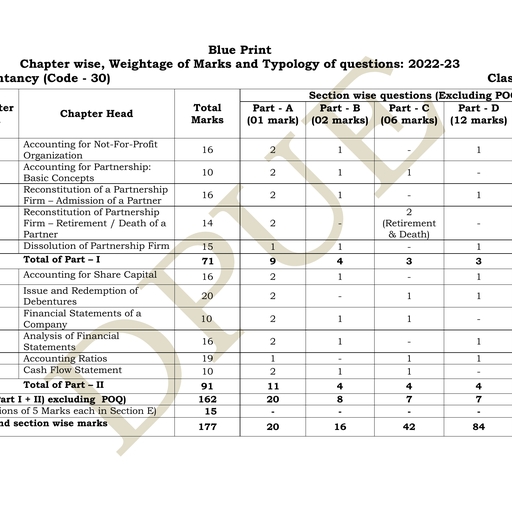
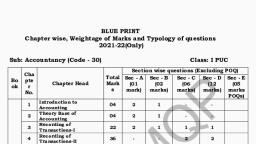
. Detailed Course structure, Question Paper Design, Blue Print,, , Program of work and Chapter-wise Questions are given for the use of, lecturers and students., , . Tests, Mid-term and Annual Examination question paper should be, , strictly as per the stip ulated Question Paper Pattern only., , . Coverage of syllabus should be as per the given Program of work only., . Rules of Debit and Credit should be taught by using, , Accounting Equation Method only (Assets, Liabilities, Capital,, Incomes and Expenses Accounts]., , Special Note:, , For the purpose of knowledge and understanding, more number, of items/transactions are given in the problems. However,, Question Paper setter should adhere strictly to the specific, instructions given pertaining to each topic. Q.P.setter has a, freedom to select appropriate items/transactions or modify the, questions, if necessary, to suit the scheme of evaluation., , Specific Instructions (Section-wise):, , Section-A: One Mark Questions:, , 1. No question should be based on a trivial information or contents., , . Note that, before selecting a very short answer type questions, think, , of the intended answer first to which that answer is the only, appropriate response., , . Question should be frame in a clear, precise and unambiguous, , language, well within the comprehension of the students., , . Question should be straight, simple, understandable, free, , from grammatical and spelling errors., , . Questions should be selected from stipulated chapters, , only(see chap ter-wise distrib ution of marks], , . Generally, questions of knowledge and understanding are best, , suited to this section., , . Each and every question should test a definite objective, . Typ ology of questions are as follows:, , Fill in the blanks 02 questions, MCQ 02 questions, True/ False 01 question, Expand 01 question, Example O1 question, , Very short answertype 03 questions, , Total 10 questions