Page 1 :
PUC 1ST YEAR, BUSINESS STUDIES NOTES, CHAPTER 1 – BUSINESS TRADE AND COMMERCE, Introduction:, ➢ All human beings have different types of needs. To fulfil these needs, they, perform certain activities., ➢ Business is a major economic activity concerned with the production and, sale of goods and services required by people. The purpose behind most, business activities is to earn money by meeting people’s demand for goods, and services. Business has the major influence on our daily lives., ➢ The chapter is divided into two sections:, • Section I deals with the history of trade and commerce in ancient, India., • Section II deals with the concept, nature and purpose of business., SECTION I: HISTORY OF TRADE AND COMMERCE IN ANCIENT INDIA, , History of Trade and Commerce:, ➢ Indian subcontinent has Himalayas in the North and bordered by water in, the South., ➢ Silk Routes, a network of roads helped in establishing commercial and, political contacts with adjoining foreign kingdom and empires of Asia and, the world., ➢ With the help of wealth earned through trade, the chief kingdoms, important, trade centres and the industrial belt flourished that helped ancient India in, progress of domestic and international trade., ➢ Trade and commerce has played an important role in growth of an economy, from time immemorial. Example Harappa and Mohenjodaro were, commercial cities in 3rd millennium BC in Indian Sub contingent., Indigenous Banking System:, ▪ Metal came to be used as money as the economic life of the people, progressed as they are durable and divisible. This accelerated economic, activities., , Page, , 1, , ▪ Documents such as Hundi and Chitti were in use for carrying our, transactions in which money passed from hand to hand.
Page 2 :
▪ Hundi involved a contract which – i) warrant the payment of money, the, promise or order which is unconditional. (ii) capable of change through, transfer by valid negotiation., ▪ With the development of banking people began to deposit precious metals, with landing individuals functioning as banker or Seth’s., ▪ Money became an instrument for supplying the manufacturers with a means, of producing more goods., ▪ Agriculture and the domestication of animals were main part of the, economic life of ancient people., ▪ Also weaving cotton, dyeing fabrics, making clay pots, utensils, and, handicrafts, sculpting, cottage industries, masonry, manufacturing,, transports (i.e., carts, boats and ships) etc. helped in generating surplus and, savings for further investment., Hundi as practised by Indian Merchant Communities, Name of Hundi Broader classification, , Functions of Hundi, , Darshani, , Payable to any person- no liability over, who received payment., , Sah-jog, , Darshani, , Payable to a specific person, someone, ‘respectable’. Liability over who received, payment., , Firman-jog, , Darshani, , Hundi made payable to order., , Dekhan-har, , Darshani, , Payable to the presenter or bearer., , Dhani-jog, , Muddati, , Payable to any person- no liability over, who received payment, but payment over, a fixed term., , Firman-jog, , Muddati, , Jokhmi, , Muddati, , Dhani-jog, , Hundi made payable to order following a, fixed term., Drawn against dispatched goods. If goods, lost in transit, the drawer or holder bears, the coasts, and the Drawee carries no, liability., , Page, , 2, , Rise of Intermediaries, • Intermediaries provided considerable financial security to the, manufacturers by assuming responsibility for the risks involved, especially, in foreign trade.
Page 3 :
• During the Mughal period and the days of the East India Company, the, institution of Jagat Seths also developed and exercised great influence., • Later with emergence of credit transaction, exports exceeded import and, benefited indigenous banking system., • Commercial and industrial banks later evolved to finance trade and, commerce and agricultural banks to provide both short and long term loans, to finance agriculturists., Transport, ✓ Transport by land and water was popular in the ancient times that helped, in maintaining trade., ✓ Trade routes were structurally wide and suitable for speed and safety., ✓ Trade maintained by means of sea is referred to as maritime trade., ✓ Maritime trade was another important branch of global trade network., ✓ Malabar Coast, on which Muziris is situated. Pepper was particularly, valued in the Roman Empire and was known as ‘Black Gold’., ✓ It was in the search for an alternate route to India for spices that led to the, discovery of America by Columbus in the closing years of 15th century and, also brought Vasco da Gama to the shores of Malabar in 1498., ✓ Calicut was such a bustling emporium that it was even visited by Chinese, ships to acquire items, like frankincense (essential oil) and myrrh (fragrant, resin used in perfumed, medicines) from the middle east, as well as, pepper,, diamonds, pearls and cotton from India., ✓ On the Coromandel Coast, Pulicat was a major port in the 17th century., Textiles were the principal export from Pulicat to Southeast Asia., Trading Communities Strengthened, ❖ In different parts of the country, different communities dominated trade., Punjabi and Multani merchants handled business in the northern region., The Bhats managed the trade in the states of Gujarat and Rajasthan., ❖ In western India, these groups were called Mahajan., ❖ In urban centres, such a Ahmedabad the Mahajan community collectively, represented by their chief called nagarseth., , Page, , 3, , ❖ Other urban groups included professional classes, such as hakim and vaid, (Physician), wakil (Lawyer), pundit or mulla (teacher’s), painters,, musicians, calligraphers etc.
Page 4 :
Merchant Corporations, ➢ Guilds were autonomous corporations formed to protect the interest of the, traders through which merchant community also derived power and, prestige., ➢ These corporations, framed their own rules of membership and code of, conduct which kings also accepted., ➢ Trade and industrial taxes were major source of revenue., ➢ Traders had to pay Octroi duties that were levied on most of the imported, articles at varying rates., ➢ Customs duties varied according to the commodities and varied from, province to province., ➢ The ferry tax was another source of income generation which has to be paid, for passengers, goods, cattle and carts., ➢ The guild chief dealt directly with the king or tax collectors and settled the, market toll on behalf of its follow merchants at a fixed sum of money., , Major Trade Centres, In ancient India, the leading trade centres in ancient India were:, 1. Pataliputra: known as Patna today, was a commercial town and also a, major centre for export of stones., 2. Peshawar: It was an important exporting centre for wool and for the, import of horses., 3. Taxila: It served as a major centre on the important land route between, India and Central Asia. It was also a city of financial and commercial, banks. The famous Taxila University flourished here., 4. Indraprastha: It was the commercial junction on the royal road where, most routes leading to the east, west, south and north converged., 5. Mathura: Many routes from South India touched Mathura and Broach., 6. Varanasi: It grew as a major centre of textile industry and became famous, for beautiful gold silk cloth and sandalwood workmanship., , Page, , 4, , 7. Mithila: It established trading colonies in South China, expecially in, Yunnan., 8. Ujjain: Agate, carnelian, muslin and mallow cloth were exported from, Ujjain to different centres.
Page 5 :
9. Surat: Textiles of Surat were famous for their gold borders (zari)., 10. Kanchi: Today known as kanchipuram, where Chinese used to come in, foreign ships to purchase pearls, glass and rare stones and in return they, sold gold and silk., 11. Madura: It attracted foreign merchants, particularly Romans, for carrying, out overseas trade., 12. Broach: It was situated on the banks of river Narmada and was linked, with all important marts by roadways., 13. Kaveripatta: It was a convenient place for trade with Malaysia,, Indonesia, China and the Far East. It was the centre of trade for perfumes,, cosmetics, scents, silk, wool, cotton, corals, pearls, gold and precious, stones, and also for ship building., 14. Tamralipti: It was one of the greatest ports connected both by sea and, land with West and the Far East. It was linked by road to Banaras and, Taxila., Major Exports and Imports:, ➢ Exports: consists of spices, wheat, sugar, indigo, opium, sesame oil,, cotton, parrot, live animals and animal products – hides, skin, furs, horns,, tortoise shells, pearls, sapphires, quartz, crystal, lapis, lazuli, granites,, turquoise and copper etc., ➢ Imports: included horses, animal products, Chinese silk flax and linen,, wine, gold, silver, tin, copper, lead, rubies, coral, glass, amber etc., Position of Indian Subcontinent in World Economy (1 AD up to 1991), • Between the 1st and the 7th centuries CE, India is estimated to have the, largest economy of the ancient and medieval world, controlling about onefourth of the world’s wealth., , Page, , 5, , • The 18th century India was far behind Europe in technology, innovation, and ideas., • In the mid-18th century, the British Empire began to take roots in India and, used revenues generated by the provinces under its rule for purchasing, Indian raw materials, spices and goods. Hence, the continuous inflow of, bullion that used to come on account of foreign trade stopped.
Page 6 :
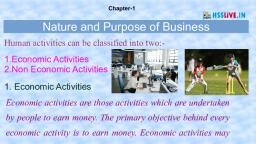
India begins to Reindustrialise, • After Independence, India went for centralised planning., • In 1952, the First Five Year Plan was implemented and importance was, given to the establishment of modern industries, modern technological and, scientific institutes, space and nuclear programmes., • However, the Indian economy could not develop at a rapid pace due to lack, of capital formation rise in population, huge expenditure on defence and, inadequate infrastructure., • Thus, India relied heavily on borrowings from foreign sources and finally, agreed to economic liberalisation in 1991., • Today, Indian economy is one of the fastest growing economies in the, world today and a preferred FDI destination., • The recent initiatives of the Government of India such as, ‘Make in India’,, ‘Skill India’, ‘Digital India’ and roll out of the foreign trade policy (FTP, 2015-20) is expected to help the economy in terms of exports and imports, and trade balance., SECTION II – NATURE AND CONCEPT OF BUSINESS, Concept of Business: The term business is derived from the word ‘busy’. Thus,, business means being busy. However, in a specific sense, business refers to an, occupation in which people regularly engage in activities related to purchase,, production and or sale of goods and services with a view to earning profits., In every society, people undertake various activites to satisfy their needs., These activities may be broadly classified into two groups –, 1. Economic activity, 2. Non-economic activity, 1. Economic activities are those by which we can earn our livelihood., For example: a worker working in a factory, a doctor operating in his clinic, a, manager working in an office and a teacher teaching in a school., , Page, , 6, , 2. Non-economic activities are performed out of love, sympathy, sentiment,, patriotism, etc., For example: a housewife cooking food for her family, or a boy helping an old, man cross the road.
Page 7 :
Economic activities may be further divided into three categories:, 1. Business, 2. Profession, 3. Employment, Business may be defined as an economic activity involving the production, and sale of goods and services undertaken with a motive of earning profit by, satisfying human needs in society., Characteristics of business activities:, 1. An economic activity: Business is considered to be an economic activity, because it is undertaken with the object of earning money or source of, livelihood., 2. Production or procurement of goods and services: Every business, enterprise either manufactures the goods or purchases the goods to be sold, to consumers or users. Goods may be either consumer goods like sugar,, biscuits, note book etc. or capital goods like machinery, furniture etc., Services include services like transportation, electricity, insurance etc., 3. Sale or exchange of goods and services: Business involves sale, transfer, or exchange of goods and services for value., For example: preparing food and selling in to customers in a restaurant is, business., 4. Dealings in goods and services on a regular basis: Business involves, dealings in goods or services on a regular basis., For example: if a person keeps stock of TV sets and sells them regularly,, it becomes a business., 5. Profit earning: One of the main purpose of business is to earn income by, way of profit. That is why businessman make all possible efforts to, maximize profits, by increasing the volume of sales or by reducing cost., , Page, , 7, , 6. Uncertainty of return: Every business invests money (capital) to run its, activities with the objective of earning profit. But it is not certain as to what, amount of profit will be earned. Also there is always a, possibility of losses, being incurred in spite of the best efforts put into the business., 7. Element of risk: Business involves an element of risk. The risks are related, with certain factors like changes in consumer tastes and fashions, changes, in methods of production, strike or lockout in the workplace, fire, theft,, accident etc.
Page 8 :
Comparison of Business, Profession and Employment:, Basic, , Business, , Profession, , Employment, , Mode of, establishment, , Entrepreneur’s, decision and, other legal, formalities, if, necessary, , Membership of a, professional body, and certificate of, practice, , Appointment letter, and service, agreement, , Nature of work, , Production and, distribution of, goods and, services to the, public, , Rendering of, personalised,, expert services, , Performing work as, per service contract, or agreement, , Qualification, , No minimum, qualification is, necessary, , Prescribed, qualifications in a, specified field is, a must., , Qualification is, required as, prescribed by the, employer, , Reward or return, , Profit earned, , Professional fee, , Salary or wages, , Capital, investment, , Capital, investment, required as per, size and nature of, business, , Limited capital, needed for, establishment, , No capital required, , Risk, , Profits are, uncertain and, irregular; risk is, present, , Fee is generally, regular and, certain; some risk, , Fixed and regular, pay; no or little risk, , Transfer of, interest, , Transfer possible, with some, formalities, , Not possible, , Not possible, , Code of conduct, , No code of, conduct is, prescribed, , Professional code, of conduct is to, be followed, , Norms of behaviour, laid down by the, employer are to be, followed, , Shop, factory, , Legal, medical,, profession,, chartered, accountancy, , Jobs in banks,, insurance, companies,, government, departments, , Page, , 8, , Example
Page 9 :
Classification of Business Activities:, Business activities may be classified into two broad categories:, 1. Industry, 2. Commerce, Industry: Industry refers to economic activities which are concerned with, conversion of resources into useful goods., Or, Industry is a part of business activity which is concerned with the raising,, production or procession of goods and materials., Example: Sugar industry, cement industry., Industries may be divided into three broad categories:, 1. Primary Industries: These include all those activities which are, concerned with the extraction and production of natural resources and, reproduction and development of living organisms, plants, etc., These industries may be further subdivided as follows:, a) Extractive Industries: These industries extract products from, natural resources like soil, water etc., Example: farming, mining, hunting and fishing operations., b) Genetic Industries: These industries remain engaged in breeding, plants and animals for their use in further reproduction. Seeds and, nursery companies, cattle breeding, farms, poultry farms, and fish, hatchery come under the class of genetic industries., 2. Secondary Industries: These are concerned with using the materials, which have already been extracted at the primary stage., Secondary industries may be further divided as follows:, a) Manufacturing Industries: These industries are engaged in, producing goods through processing (i.e., conversion) of raw, materials., Manufacturing industries may be further divided into four, categories:, , Page, , 9, , ➢ Analytical Industries: which analyses and separates, different elements from the same materials, as in the case of, oil refinery., ➢ Synthetical Industries: which combines various ingredients, into a new product, as in the case of cement.
Page 10 :
➢ Processing Industry: which involves successive stages for, manufacturing finished products as in the case of sugar and, paper., ➢ Assembling Industry: which assembles different component, parts to make a new product, as in the case of television, car,, computer etc., b) Construction Industries: These industries are involved in the, construction of buildings, dams, bridges, roads as well as tunnels and, canals, etc., 3. Tertiary industries: These are concerned with providing support services, to primary and secondary industries as well as activities relating to trade., Example: transport, banking, insurance, warehousing, communication,, packaging and advertising., COMMERCE:, Commerce includes two types of activities, viz,, Trade: Buying and, selling of gods is termed as trade. Auxiliaries to trade: There are a lot of, activities that are required to facilitate the purchase and sale of goods. These are, called services or auxiliaries to trade and include Transport, banking, insurance,, communication, advertisement, packaging and warehousing., , Page, , 10, , • Trade: Trade is an essential part of commerce. It refers to sale, transfer or, exchange of goods. It helps in making the goods produced available to the, consumers or users., Trade may be classified into two broad categories – internal and, external., Internal domestic or home trade is concerned with the buying and, selling of goods and services within the geographical boundaries of a, country. This may further be divided into wholesale and retail trade., When goods are purchased and sold in bulk it is known as wholesale, trade. When goods are purchased and sole in comparatively smaller, quantities for final consumption it is referred to as retail trade., External or foreign trade: consists of the exchange of goods and, services between persons or organisations operating in two or more, countries. If goods are purchased from another country it is called, import trade. If they are sold to other countries it is known as export, trade. When goods are imported for export to other countries it is, known as entrepot trade.
Page 11 :
• Auxiliaries to trade: Activities which are meant for assisting trade are, known as auxiliaries to trade. These activities are generally referred to, as services because these are in the nature of facilitating the activities, relating to industry and trade. Transport, banking, insurance,, warehousing, and advertising are regarded as auxiliaries to trade., Auxiliaries are an integral part of commerce in particular and business, activity in general. These activities help in removing various, hindrances which arise in connection with production and distribution, of goods. Transport facilitates movement of goods from one place to, another. Banking provides financial assistance to the manufacturer, and trade. Insurance covers various kinds of business risks., Warehousing creates time utility by way of strange facilities., Advertising provides information to the consumers. In other words,, these activities facilitate movement, storage, financing risk, coverage, and sales promotion of goods., Auxiliaries to trade are briefly discussed below:, i., , Transport and communication: Different means of transport like road,, railways, ships etc. facilitate the movement of raw materials to the place of, production and the finished goods from the factories to the place of, consumption. Communication facilities such as postal services and, telecom services are helpful to the producer, traders and consumers to, exchange information with one another., , ii., , Banking and Finance: Banks and other financial institutions help the, businessmen to purchase assets, raw materials to meet other expenses by, providing funds. Commercial banks generally lend money by providing, overdraft and cash credit facilities, loans and advances., Insurance: Business involves various types of risks. Factory, building,, machinery, furniture etc. must be protected against fire theft and other, risks. Materials and goods held in stock or in transit are subject to the risk, of loss or damage. Employees are also required to be protected against the, risks of accident and occupational hazards. Insurance provides protection, in all such cases., , Page, , 11, , iii., , iv., , Warehousing: Different types of warehouses help the businessmen to, store their goods in a safe place till they are demanded., , v., , Advertising: Advertising gives information about the price, quality, uses, and other details of the product or services offered for sale and thus attracts, customers.
Page 12 :
Objectives of Business:, Business enterprises are part of society and need to have several objectives, including social responsibility to survive and prosper in the long run. Since a, business has to balance a number of needs and goals it requires multiple, objectives., , Page, , 12, , The following are the important objectives of the business:, i., , Market standing: Market standing refers to the position of an enterprise, in relation to its competitors. A business enterprise must aim at standing, on stronger footing in terms of offering competitive products to its, customers and serving them to their satisfaction., , ii., , Innovation: One of the objectives of modern business is innovation. It is, necessity in the competitive world. There are two kinds of innovation in, every business:, • Innovation in product or service., • Innovation in various skills and methods of production and supply of, products and services, No business enterprise can flourish in a competitive world without, innovation. Therefore innovation becomes an important objective., , iii., , Productivity: Productivity is ascertained by comparing the value of output, with the value of inputs. It is used as measure of efficiency. In order to, ensure continuous survival and progress every enterprise must aim to, greater productivity through the best use of available resources., , iv., , Physical and financial resources: Every business aims at acquisition of, physical resources like plants, machines, offices etc., and financial, resources, i.e., funds to be able to produce and supply goods and services, to its customers., , v., , Earning profits: One of the important objectives of business is to earn, profits. Every business must earn adequate and reasonable profit which is, so important for its survival and growth. Further, profit is a return on capital, employed and also a reward for the work and the risk., , vi., , Manager performance and development: Every business aims at, implementing various programmes for motivating managers. This enables, managers to conduct and co-ordinate business activities in an efficient, manner., , vii., , Worker performance and attitude: Every enterprise aims at improving, its workers’ performance by payment of fair wages and by providing other, benefits. Such as housing, education, medical facilities etc.
Page 13 :
viii., , Social responsibility: Social responsibility refers to the obligation of, business firms to contribute resources for solving social problems and work, in a socially desirable manner, thus a business enterprise must have, multiple objectives to satisfy different individuals and groups. This is, essential for its own survival and prosperity., , Business Risks:, Business risk refers to the possibility of inadequate profits or even losses, due to uncertainties or unexpected events., Or, Business risk is the possibility of loss arising from uncertainty., Example: Decline in demand for a particular product due to changes in tastes and, preferences of consumers., Business enterprises constantly face two types of risk:, 1. Speculative Risk: Speculative Risks involve both the possibility of gain,, as well as, the possibility of loss. Speculative risks arise due to changes in, market conditions, including fluctuations in demand and supply, changes, in prices or changes in fashion and tastes of customers. Favourable market, conditions are likely to result in gains, whereas, unfavourable ones may, result in losses., 2. Pure Risks: Pure Risks involve only possibility of loss or no loss. The, chance of fire, theft or strike are example of pure risks. Their occurrence, may result in loss, whereas, non-occurrence may explain absence of loss,, instead of gain., Nature of Business Risks:, 1. Business risks arise due to uncertainties: Natural calamities, change in, demand and prices, changes in government policy, improvement in, technology, etc., are some of the examples of uncertainty which create risks, for business because the outcome of these future events is not known in, advance., , Page, , 13, , 2. Risk is an essential part of every business: Every business has some risk., No business can avoid risk although the amount of risk may vary from, business to business. Risk can be minimised but cannot be eliminated., 3. Degree of risk depends mainly upon the nature and size of business:, Nature of business and size of business are the main factors which, determine the amount of risk in a business. For example a business dealing, in fashionable items has a high degree of risk. Similarly a large-scale, business generally has a higher risk than what a small scale has.
Page 14 :
4. Profit is the reward for risk taking: ‘No risk no gain’ is an age-old, principle which applies to all types of business. Greater the risk involved, in a business higher is the chance of profit. An entrepreneur undertakes, risks under the expectation of higher profit. Profit is thus the reward for, risk taking., Cause of Business Risks:, 1. Natural causes: Human beings have little control over natural calamities, like flood, earthquake, lightning, heavy rains, etc., these result in heavy, loss of life property and income in business., 2. Human causes: Human causes include such unexpected events like, dishonest carelessness or negligence of employees stoppage of work due, to power failure, strikes, riots, management inefficiency etc., are, responsible for business risks., 3. Economic causes: Economic causes such as change in government, policies, change in technology, change in demand and supply of goods due, to change in fashion and consumer tastes, increase in tax rates, increase in, interest rate on borrowings etc., which lead to the possibility of business, risks., 4. Other causes: These are unforeseen events like political disturbances,, mechanical failures, and fluctuations in exchange rate etc., which lead to, the possibility of business risks., Starting a business – Basic Factors:, 1. Selection of line business: Deciding the nature and type of business to be, undertaken is the first thing to be considered by any entrepreneur of a new, business. The decision will be influenced by the expected profit, customer, requirements etc., , Page, , 14, , 2. Size of the firm: Size of the firm or scale of its operation is another, important decision to be considered while starting a business. Some factors, such as confidence of the entrepreneur to create demand and to raise capital, favour a large size. While uncertain market conditions and high risks will, compel an entrepreneur to start a small sized business., 3. Choice of form of ownership: Depending upon certain factors such as the, line of business, capital requirements, liability of owners, and division of, profit, legal formalities etc., and the choice of suitable form of ownership, is made. It may be sole proprietorship, partnership or a joint stock, company.
Page 15 :
4. Location of business enterprise: An important factor to be considered to, start the business is the place where the enterprise will be located., Availability of raw materials and labour, power supply, services like, banking, transportation, communication, warehousing etc., are the, important factors while making a choice of location., 5. Financing the proposition: Selection of source of fund and decision about, the amount of funds required to be invested on fixed assets, current assets, and to meet the day to day expenses, is another important factor to be, considered while starting a new business., 6. Physical facilities: Availability of physical facilities including machines, and equipment, building and supportive services is a very important factor, to be considered while starting a business., 7. Plant layout: The entrepreneur should draw a proper layout plan showing, the arrangement of physical facilities., 8. Competent and committed worked force: Deciding the number of, skilled and unskilled workers and managerial staff required is another, factor to be considered., 9. Tax planning: The founder of the business has to consider in advance the, tax liability under various tax laws and its impact on business decisions., 10. Launching the enterprise: Finally, the entrepreneur can go ahead with, actual launching of the enterprise., , Page, , 15, , ***********




 Learn better on this topic