Notes of 1 PUC, BUSINESS STUDIES Business Studies Question Bank with Answers.pdf - Study Material
Page 1 :
Business, Studies, , 2018-19, , Question Bank For Second P.U.C, (AS PER N.C.E.R.T, , SYLLABUS), , Highlights:, ►Chapter wise Solved Question Bank, ►Practical Oriented Questions with Answer, ► Blue Print, ►Model Question Paper by PU Board, The Fear of the Lord is the Beginning Wisdom.,, -Holy Bible, , Prepared by : JOY K.V, M.Com., Accountancy Teacher, Chanakya Education Trust Virajpet-571218, Contact: 9482616309, Mail:
[email protected]
Page 2 :
CHAPTER 1, NATURE AND SIGNIFICANCE OF MANGEMENT, SECTION A, (Each Question Carries One Mark), 1. What is Efficiency?, Efficiency means doing the task correctly and with minimum cost., 2. What is Effectiveness concerned with?, Effectiveness in management is concerned with doing the right task,, completing with activities and achieving goals. OR In other words, it, concerned with the end result., 3. Give an example for top level/middle level/supervisory level, management., For Top level management: Chief executive officer (CEO), For Middle level management: Production managers, For Supervisory or Operational level Management:, Supervisors, foremen, section officers, Superintendents etc., 4. Which of the following is not a function of Management, (a) Planning, (b) Staffing, (c) Cooperating (d) Controlling, ►(c) Cooperating, 5. Management is, (a) An art, (b) a science, (c) both art and science (d) neither, ►(c) both art and science, 6. The following is not an objective of management, (a) earning of profits, (b) growth of the organization, 2
Page 3 :
(c) providing employment, (d) policy making, ►(d) policy making, 7. Policy formulation is the function of, (a) Top level management, (b) Middle level management, (c) Operational management, (d) All of the above, ►(a) Top level management, 8. Coordination is, (a) Function of management, (b) The essence of management, (c) An objective of management, (d) None of the above, ► (b) The essence of management, SECTION B, (Each questions carries Two marks), 9. Define Management., Ans: “Management is the process of working with and through, others to effectively achieve the organizational objectives by, efficiently using limited resources in the changing environment.”, by Kreitner, 10. State any two Organizational Objectives of Management., (a) Survival: Earning enough revenues to cover cost. Management, by taking positive decisions with regard to different business, activities ensures survival of business for long term., (b) Profitability: Earning adequate profit in order to survive and, grow., , 3
Page 4 :
11. Define Coordination, Ans: Coordination is the process whereby an executive develops an, orderly pattern of group efforts among his subordinates and secures, unity of action in the pursuit of common purpose. –McFarland, (N.C.E.R.T), OR, Ans: Definition: According to Mooney and Reelay , “ Co-ordination, is orderly arrangement of group efforts to provide unity of action in, pursuit of common goals”.(State syllabus), 12. Justify the importance of coordination by any two factors., I. Growth in the Size: An organisations growth results in the increase, in the number of people employed with varied individual aspirations, and culture., II. Functional Differentiation: All the departments and divisions may, have their own, objective, policies and their own style of working., III. Specialization: Coordination seeks to sequence and integrate all, the specialists’ activities into a wholesome effort., PART– C, (Each questions carries Four marks), 13. Explain the Objectives of Management., 1. Organisational Objectives: Organizational Objectives can be, divided into Survival (Earning enough revenues to cover cost); Profit, (To cover cost and risk); and Growth (To improve its future, prospects)., (a) Survival: Earning enough revenues to cover cost. Management by, taking positive decisions with regard to different business activities, ensures survival of business for long term., (b) Profitability: Earning adequate profit in order to survive and, grow., (c) Growth: Growth indicates how well it exploits the potential, opportunities. Growth of a business can be measured in terms of, sales volume increase, number of employees, products etc., 4
Page 5 :
2. Social Objectives:, Is to provide quality products at reasonable rates and generating, employment opportunities for disadvantaged sections of society. To, provide basic amenities like schools and crèches to employees and, by using environmental friendly methods of production., 3. Personal Objectives:, Includes meeting the financial needs like competitive salaries and, perks and Social and safety needs of the employee like basic, amenities, peer recognition etc., 14. Give any four grounds to say Management is important., ( Importance of Management), Meaning: Management is the process of getting things done with the, aim of achieving goals effectively and efficiently., Definition: Management is the process of working with and through, others to effectively achieve the organizational objectives by, efficiently using limited resources in the changing environment.”, By Kreitner, Importance :, 1. Management helps in achieving group goals, 2. Increases efficiency, 3. Creates dynamic organization, 4. Achieving personal objectives, 5. Development of society, Explanation:, 1. Management helps in achieving group goals: Management, creates teams and coordinates with individuals to achieve individual, goals along with organizational goals., 2. Increases efficiency: Management increases efficiency by using, resources in the best possible manner to reduce cost and increase, productivity., 3. Creates dynamic organization: Management helps the employees, overcome their resistance to change and adapt as per changing, situation to ensure its survival, growth and its competitive edge., 5
Page 6 :
4. Achieving personal objectives: Through motivation and leadership, management helps the individuals in achieving personal goals while, working towards organizational objective., 5. Development of society: Management helps in the development, of society by producing good quality products, creating employment, opportunities and adopting new technologies., Part – D, (Each questions carries Eight marks), 15. Explain the characteristics of Management, Meaning: Management is the process of getting things done with the, aim of achieving goals effectively and efficiently., Definition: Management is the process of working with and through, others to effectively achieve the organizational objectives by, efficiently using limited resources in the changing environment.”, By Kreitner, Characteristics of Management:, I. Management is a goal-oriented process:, II. Management is all pervasive:, III. Management is multidimensional:, (a) Management of work, (b) Management by people, (c) Management by operation, IV. Management is a continuous process:, V. Management is a group activity:, VI. Management is a dynamic function:, VII. Management is an intangible force:, Explanation:, I. Management is a goal-oriented process: An organisation has a set, of simple and clearly stated goals, which are the basic reason for its, existence. Management unites the efforts of the individuals in the, organisation towards achieving these goals., It is a tool which helps use of human & physical resources, to full fill the pre-determined goals., 6
Page 7 :
II. Management is all pervasive: Management is common to all, organisations whether economic, social or political. For e.g., management is applicable for a government company, school,, private company or a NGO., III. Management is multidimensional: Management is a complex, activity that has three main dimensions:, a) Management of work: Each and every organisation exists for, performing some work. Management translates this work in terms of, goals to be achieved and assigns the means to achieve it., (b) Management by people: “getting work done through people “ is, still a major task for the manager. Managing people has two, dimensions., i. It implies dealing with employees as individuals with, diverse needs and behaviour, ii. it also means dealing with individuals as a group of, people., (c) Management by operation: Through management, the, operational inputs (material and technology) are transformed into, desired output (goods and services) for customers., IV. Management is a continuous process: It consisting of series o, functions like, planning, organising, staffing and controlling. All the, managers perform these functions regularly. It is concerned with, identifying the problem and taking appropriate steps to solve it., V. Management is a group activity: Every member of the group has, different purpose to join the organisation. As members of the, organisation, they have to initiate, communicate, coordinate and join, their hands for attaining the common organisational goals., VI. Management is a dynamic function: It has to adapt itself to its, changing external environment, which consists of various social,, economic and political factors., VII. Management is an intangible force: It cannot be seen but its, presence can be felt from the way organization functions., Conclusion: Management is the process of getting things done with, the aim of achieving goals effectively and efficiently it involves, 7
Page 8 :
various characteristics like, goal-oriented process, pervasive,, multidimensional, various operational and group activities and also a, regular process., 16. Management as an art and a science are not mutually exclusive,, but complement to each other”-Elucidate., Meaning: Management is the process of getting things done with the, aim of achieving goals effectively and efficiently., Definition: Management is the process of working with and through, others to effectively achieve the organizational objectives by, efficiently using limited resources in the changing environment.” By, Kreitner, Management full fills the criteria of both an art as well as a science:, 1. Management as an Art : Art refers to skill full and personal, application of existing knowledge acquired through study,, observation and experience. The features of art are as follows:, a. Existence of theoretical knowledge: In every art, Systematic and, organized study material is available to acquire theoretical, knowledge and experts in the respective fields apply these principles, to their respective art forms., b. Personalized application: The use of basic knowledge differs from, person to person and thus, art is a very personalized concept., c. Based on practice and creativity: Art involves creativity and, practice of the experts. Every manager has his own unique style of, managing things and people. He/she uses his creativity in applying, management techniques and his skills improve with regular, application. Since all the features of art are present in management., So it can called an art., 2. Management as a Science, Science is a systematized body of knowledge that is based on general, truths, which can be tested anywhere, anytime. The features of, Science are as follows:, a. Systematized body of knowledge: Science has a systematized, body of knowledge based on cause and effect relationship., 8
Page 9 :
b. Principles based on experiments and observation: Scientific, principles are developed through experiments and observation., c. Universal validity: Scientific principles have universal validity and, application. Management has systematic body of knowledge and its, principles are developed over a period of time based on repeated, experiments & observations which are universally applicable but, they have to be modified according to given situation., Management as both Science and Art:, Management is both an art and a science. The above mentioned, points clearly reveal that management combines features of both, science as well as art. It is considered as a science because it has an, organized body of knowledge which contains certain universal truth., It is called an art because managing requires certain skills. Which are, personal possessions of managers. Science provides the knowledge, & art deals with the application of knowledge and skills., A manager to be successful in his profession must acquire the, knowledge of science & the art of applying it. Therefore, management is a judicious blend of science as well as an art because, it proves the principles and the way these principles are applied is a, matter of art. Science teaches to ‘know‘ and art teaches to ‘do‘., Conclusion: Both management as an art and science, make managers, to use their personalised knowledge in different situations skilfully., For example, a person cannot be a good Accountant unless he has, the knowledge of all accounting principles and the practical skill of, applying those principles in preparing the accounts. To conclude, we, can say that management is both a science and an art., 17. Define Coordination., Coordination., , Explain, , the, , characteristics, , of, , Meaning: The process by which a manager integrates and unites the, activities of different departments is known as co-ordination., 9
Page 10 :
Definition: According to Mooney and Reelay ,“ Co-ordination is, orderly arrangement of group efforts to provide unity of action in, pursuit of common goals”., Characteristics of Coordination., 1. Coordination Integrates Group Effort, 2. Coordination ensures unity of action, 3. Coordination is a continuous process, 4. Coordination is an all pervasive function, 5. Coordination is the responsibility of all managers, 6. Coordination is a deliberate function, Explanation:, 1. Coordination Integrates Group Effort: It is an orderly arrangement, of group effort to ensure that performance is at par with the plans, and schedules., 2. Coordination ensures unity of action: It is a binding force between, various departments and ensures that all efforts are focused towards, achieving the organizational goal. For example, in a manufacturing, organisation, production, sales, purchase, and finance departments, are all reciprocally interdependent. If all the departments work in, coordination, the common goal of the organisations can be achieved., 3. Coordination is a continuous process: It is a never-ending process, as its needs are felt at all levels and in all activities in the, organisations. It begins at the planning stage and continues until, controlling., 4. Coordination is an all pervasive function: It is needed in all, departments and at all levels. Lack of coordination can lead to, overlapping of activities. The purchase, production and sales, departments ‘efforts have to be coordinated to attain the, organisational objectives., 5. Coordination is the responsibility of all managers: Coordination is, equally important at all levels of management. It is the responsibility, of all the individuals in an organisation to carry out their work in a, responsible manner and coordinate with each other to achieve, organizational goals., 10
Page 11 :
6. Coordination is a deliberate function: A manager has to, coordinate the efforts of different people in a conscious and, deliberate manner. In other words, coordination is never established, by itself rather it is a conscious effort on the part of every manager., Conclusion :, Co-ordination is not a separate function of, management. It is an integral part of management. Therefore coordination is necessary for the smooth functioning of all other, functions of management in achieving organisational objectives., 18. Management is a series of continuous interrelated functions’Comment., Meaning: Management is the process of getting things done with the, aim of achieving goals effectively and efficiently., Definition: Management is the process of working with and through, others to effectively achieve the organizational objectives by, efficiently using limited resources in the changing environment.”, By Kreitner, Functions of Management, 1. Planning, 2. Organising:, 3. Staffing, 4. Directing, 5. Controlling, Explanation:, 1.Planning : Setting objectives and targets and formulating an, action plan. It bridges the gap between where we are and where we, want to reach., It is the functions of determining in advance what is to be done, and who is to do it. This implies setting goals in advance and, developing a way of achieving them efficiently and effectively., 2. Organising: Involves assigning duties, grouping tasks, establishing, authority and responsibility relationships and allocating the, resources required to perform a specific plan. It involves:, 11
Page 12 :
(a) Identification and division of work, (b) Departmentalisation, (c) Assigning of duties, (d) Establishing reporting relationships, 3. Staffing : Finding and placing the right person for the right job at, the right time. It involves recruitment, selection, placement,, induction and development of employees. It make sure that the right, people with the right qualifications are available at the right places, and times to accomplish the goals of the organisation., 4. Directing : Refers to leading, influencing, motivating the staff, chosen to perform the assigned task efficiently and effectively., This requires establishing an atmosphere that encourages, employees to do their best. Motivations and leadership are two key, components of direction. Directing also involves communicating, effectively as well as supervising employees at work., 5. Controlling : Refers to monitoring organizational activities, towards the attainment of organizational goals. The task of, controlling involves:, (a) Establishing standards of performance, (b) Measuring current performance’, (c) Comparing this with established standards, (d) Taking corrective action, Conclusion : Management is a series of continuous inter-related, functions. Each one of them performed to guide and direct the, efforts of others., Chapter -2 Principles of Management, Part – A, (Each questions carries One marks), 1. Who is known as the Father of General Management?, ►Henry Fayol., , 12
Page 13 :
2. Name any one new technique of Management developed on the, basis of Principles of Management., ►Method Study, Motion Study , Functional foremanship, ., 3. Who is called the Father of Scientific Management?, ►F.W Taylor., 4. Who advocated separation of planning and execution functions, in any organization?, ►F.W Taylor., 5. What is Standardization according to Taylor?, ► Standardisation refers to the process of setting standards for, every business activity., 6. What is the aim of simplification according to Taylor?, ►Simplification aims at eliminating unnecessary diversity of, products., 7. How Simplification differs from Standardization according to, Taylor?, ►Simplification aims at eliminating superfluous varieties, sizes and, dimensions while standardisation implies devising new varieties, instead of the existing once., 8. Who strongly advocated Piece Wage System?, ►F.W Taylor., 9. What is the objective of Method Study according to Taylor?, ►The objective to method study is to find out one best way of doing, the job., 10. State the number of principles of management propounded by, Henri Fayol., ► 14., 13
Page 14 :
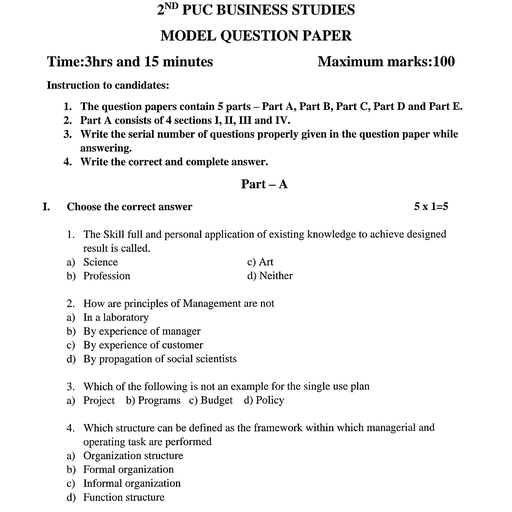
11. Which management principle of Fayol advocates that there, should be only one boss for every individual employee?, ►Unity of command., 12. Principles of management are Not, (a) Universal, (b) Flexible, (c) Absolute, (d) Behavioural, ► (c) Absolute, 13. How are principles of management formed?, (a) In a laboratory, (b) By experiences of managers, (c) By experiences of customers, (d) By propagation of social scientists, ► (b) By experiences of managers, 14. Which of the following statement best describes the principle of, 'Division of Work', (a) Work should be divided into small tasks, (b) Labour should be divided, (c) Resources should be divided among jobs, (d) It leads to specialisation, ► (a) Work should be divided into small tasks, 15. ‘She/he keeps machines, materials, tools etc., ready for, operations by concerned workers’. Whose work is described by this, sentence under functional foremanship, (a) Instruction Card Clerk, (b) Repair Boss, (c) Gang Boss, (d) Route Clerk, ► (c) Gang Boss, , 14
Page 15 :
Part – B, (Each questions carries Two marks), 16. Give the meaning of Mental Revolution as propounded by, Taylor., Taylor called for complete mental revolution on the part of both, management and workers. It means that management and workers, should transform their thinking., 17. What is Discipline according to Fayol?, Discipline Is the obedience to organizational rules and employment, agreement, which are necessary for the working of the organisation., According to Fayol Discipline requires good supervisors at all levels,, clear and fair agreements and judicious application of penalties., 18. State any two differences between Unity of Command and, Unity of Direction., Basis, , Unity of Command, A subordinate should, 1.Meaning receive orders from, only one superior., Prevent dual, 2.Aim, subordination, It affects an individual, 3.Affect, employee, , Unity of Direction, Each group activities having same, objective must have one head and, one plan., Prevent overlapping of activities, It affects the entire organisations., , 19. What is Scalar Chain?, The formal lines of authority and communication between superiors, and subordinates from the highest to the lowest ranks is known as, scalar chain., , 15
Page 16 :
20. What is Gang Plank?, Scalar chain is essential to ensure unity of command and effective, communication., But it has the following limitations:, 1. It is time consuming., 2. There is a possibility of distortion of messages in the, course of its transmission., In order to avoid time limitation, Henry Fayol suggested, shortcutting the chain of command where emergency decisions are, to be taken. This process is called gang plank., Part – C, ( Each Questions Carries Four Marks), 21. Discuss the significance of Principles of Management by, explaining any four points., Principle, A principle is a fundamental truth or proposition that serves as the, foundation for a system of belief or behaviour or for a chain of, reasoning, Principles of Management, Principles of management are broad and general guidelines for, managerial decision-making and behaviour. Management principles, are not as rigid as principles of science as deals with human, behaviour and thus are to be applied creatively given the demands of, the situation., Significance of Principles of Management, 1. Providing Managers with Useful Insights into Reality, 2. Scientific decisions, 3. Optimum utilization of resources and effective administration, 4. Management Training, Education and Research, Explanation, 1. Providing Managers with Useful Insights into Reality: When, managers follow principles it adds to their knowledge, ability and, understanding of managerial situations and circumstances. This, 16
Page 17 :
improves managerial efficiency e.g., when managers use principle of, delegation then they get more time to concentrate on critical areas, of working., 2. Scientific decisions: Decisions must be based on facts, thoughtful, and justifiable in terms of intended purpose. Management principles, must be timely, realistic and subject to measurement and evaluation., Principles are free from bias and prejudice., 3. Optimum utilization of resources and effective administration:, The resources with the company are limited. Management principles, equip the managers to see the cause and effect of their decisions, and actions and thus reduce wastage. Optimum utilization of, resources means maximum benefit with minimum cost., 4. Management Training, Education and Research Principles of, management are the base for management theory. As such they are, used as a basis for management training, education and research., These principles provide basic groundwork for the development of, management as a subject. Professional courses like BBA, MBA also, teaches these principles as part of their, curriculum., 21. Explain the Principles of Management contributed by F.W., Taylor., SCIENTIFIC MANAGEMENT, Scientific management implies the application of scientific method of, study and analysis to the problems of management., F.W.Taylor was the first person who recognized and emphasized the, need for adopting a scientific approach in management. So Taylor is, considered as the father of scientific management., Fredrick Winslow Taylor: 1856-1915… US nationality…Mechanical, engineer…Writing- “The Principles of Scientific management”, Principles scientific of Management, 1. Science, not rule of Thumb: There should be scientific study and, analysis of each element of a job in order to replace the old rule of, 17
Page 18 :
thumb approach or hit and miss method. We should be constantly, experimenting to develop new techniques, which make the work, much simpler, easier and quicker. Scientific method involved, investigation of traditional methods through work-study, 2. Harmony, Not discord: There should be complete harmony, between management and workers I achieving organizational goals., It implies that there should be mental revolution on part of, managers and workers in order to respect each other’s role and, eliminate any class conflict to realize organizational objectives., 3. Co-operation, Not Individualism There should be complete cooperation between the labour and the management instead of, individualism Management should consider all good suggestions, made by the employees which can help in cost reduction. At the, same time workers should never think of going on strikes in order to, get their unreasonable demands fulfilled., 4. Development of Each and Every Person to His or Her Greatest, Efficiency and Prosperity: To maximize production all possible, efforts are made to increase the efficiency of workers. Each person, should be scientifically selected. Then work assigned should suit her, or his physical, mental and intellectual capabilities. To increase, efficiency, they should be given the required training. Efficient, employees would produce more and earn more. This will ensure, their greatest efficiency and prosperity for both company and, workers., 23. What are the four aspects of work study developed by Taylor?, Explain., Four aspects of Work Study is, (a) Time Study, (b) Motion Study, (c) Fatigue Study, (d) Method Study, , 18
Page 19 :
a) Time Study It determines the standard time taken to perform a, well-defined job. The standard time is fixed for the whole of the task, by taking several readings. The method of time study will depend, upon volume and frequency of the task, the cycle time of the, operation and time measurement costs., There are three objectives achieved through time study., (i) Determine the number of workers., (ii) Frame suitable incentive schemes., (iii) Determines labour costs., For example: if standard time taken to do a piece of work in 20, minutes then one work can be done 3 times in an hour and total 21, times (3×7 hours per day) the work can be done on a single day., (b) Motion Study Motion study refers to the study of movements, like lifting, putting objects, sitting and changing positions. On close, examination of body motions, e.g., it is possible to find out three, types motions, (i) Motions which are productive., (ii) Motions which are incidental., (iii) Motions which are unproductive., Out of the above, three workers were motivated to eliminate the, third type completely and reduce the second one to the minimum., This help in increasing productivity., (c) Fatigue Study Fatigue study seeks to determine the amount and, frequency of rest intervals in completing a task. A person is bound to, feel tired physically and mentally if he does not take rest while, working. The next intervals will help one to regain stamina and work, again with the same efficiency., For example: in an organisation working hours are 9 to 5. There is a, lunch break of an hour for the workers to take rest similarly in a, school there is a break for the students and, teachers after 4 periods of continuous learning., (d) Method Study The objective of method study is to find out one, best way of doing the job. Different managers would use their own, 19
Page 20 :
different methods of getting the work done. But there is always one, best method. Right from procurement of raw materials till the final, product is delivered to the customer every activity is the part of, method study. The objective of whole exercise is to minimise the, cost of production and maximise the satisfaction of the customer, Part – D, (Each questions carries Eight marks), 24. Explain the Functional Foremanship of Taylor., , Functional foremanship:, Taylor advocated that specialization must be introduced in an, organization. He suggested functional foremanship for this purpose., It is a form of organization which involves supervision of a worker by, several specialist foremen. Taylor advocated separation of planning, and execution functions. This concept was extended for the lowest, level of the shop floor. It was known as functional foremanship., • Supervision is divided into several specialized functions and each, functions is to be entrusted to a foreman., • There are eight foreman in the related process or function of, production., • Four each under planning and execution who keep a watch on all, workers performance. Under the factory manager, there is a, planning in charge and a production in charge., Under the planning in charge, the work goes as follows:, (i) Instruction Card Clerk Draft instructions for the workers., (ii) Route Clerk Specify the route of production., 20
Page 21 :
(iii) Time and Cost Clerk Prepare time and cost sheet., (iv) Disciplinarian Ensure discipline., Under the production in charge, the work goes as follows, (i) Speed Boss Timely and accurate completion of work., (ii) Gang Boss Keeping tools and machines ready for operation by, workers., (iii) Repairs Boss Ensure proper working conditions of machines., (iv) Inspector Check the quality of work., 25. Explain the nature of Principles of Management., (7 points with introduction, explanation and conclusion), Principle, A principle is a fundamental truth or proposition that serves as the, foundation for a system of belief or behaviour or for a chain of, reasoning, Principles of Management, Principles of management are broad and general guidelines for, managerial decision-making and behaviour. Management principles, are not as rigid as principles of science as deals with human, behaviour and thus are to be applied creatively given the demands of, the situation., Nature of Principles of Management, 1. Universal applicability, 2. Formed by practice and experimentation, 3. General guidelines, 4. Flexible, 5. Mainly behavioural, 6. Cause and effect relationship, 7. Contingent, Explanation, 1. Universal applicability : The principles of management are, intended to apply to all types of organizations, business as well as, non-business, small as well as large, public sector as well as private, 21
Page 22 :
sector, manufacturing as well as the service sectors. However, the, extent of their applicability would vary with the nature of the, organization, business activity, scale of operation and the like., 2. Formed by practice and experimentation: The principles of, management are formed by experience and collective wisdom of, managers as well as experimentation. They are formed from the, knowledge, experiences and experiments of the managers., 3. General guidelines They are general guidelines to action but do, not provide straight solution to all managerial problems, as the, business situations are complex and dynamic., 4. Flexible These principles are not rigid and can be adapted and, modified by the practicing managers depending upon the situation, 5. Mainly behavioural Management principles aim at influencing, behaviour of human beings. Therefore, principles of management, are mainly behavioural in nature, 6. Cause and effect relationship The principles of management are, intended to establish relationship between cause and effect so that, they can be used in similar situations in a large number of cases., 7. Contingent Their applicability depends upon the prevailing, situation at a particular point of time. The application has to be, changed as per the situation., Conclusion:, Management principles are statements of fundamental truth. These, principles serve as guidelines for decisions and actions of managers., Management principles are derived through observation,, experimentation as well as personal experience of managers., , 22
Page 23 :
Chapter 3 Business Environment, Part – A, (Each Questions carries One mark), 1. What is Business Environment?, The term business environment means the totality of all individuals,, institutions, and other forces that are outside a business but that, potentially affect its performance., 2. Which of the following does not characterize the business, environment?, (a) Uncertainty, (b) Employees, (c) Relativity, (d) Complexity, ► (b) Employees, 3. Which of the following is an example for social environment?, (a) Money supply in the economy, (b) Consumer Protection Act, (c) The Constitution of the country, (d) Composition of family, ► (d) Composition of family, 4. Liberalization means, (a) Integration among economies, (b) Reduced government controls and restrictions, (c) Policy of planned disinvestments, (d) None of the above, ►b) Reduced government controls and restrictions, 5. Which of the following does not explain the impact of, Government policy changes on business and industry?, (a) More demanding customers (b) Increasing competition, (c) Change in agricultural prices (d) Market orientation., ► (c) Change in agricultural prices, , 23
Page 24 :
Part – B, (Each questions carries Two mark), 6. Give the meaning of Globalization., Ans: Globalisation means integrating the economy of a country with, the world economy. OR It means integrating various economies of, the world into global economy., 7. What is Privatization?, Ans: providing greater role to the private sector in the nation, building process and reducing the role of public sector known as, Privatization. OR Ans: Privatisation refers to reducing the role of, public sector by involving the private sectors in most activities., Part – C, (Each questions carries Four mark), 8. Explain any four features of Business Environment., Meaning of Business Environment:, The term business environment means the sum total of all individual, other forces that are outside the control of a business enterprise. But, they may affect its performance., Features of Business Environment, 1.Totality of external forces: Business environment is the sum total, of all the forces and factors external to a business firm., 2. Dynamic: Business environment is dynamic in which it keeps on, changing with the change in technology, shift in consumer, preferences etc., 3. Uncertainty: Business environment is largely uncertain, as it is, difficult to predict the future happenings. Such as, frequent, environmental changes in the field of technology and fashion, industry., 4. Relativity: Business environment is a relative concept whose, impact differs from country to country, region to region and firm to, firm., 24
Page 25 :
9. Explain any four points to explain how important the, understanding of Business Environment for managers is., A good understanding of environment by business managers enables, them not only to identify and evaluate, but also only to react to the, forces external to the firms., Importance of Business Environment (any four):, 1.It enables the firm to identify opportunities and getting the first, mover advantage. Environmental understanding enables an, enterprise to identify business opportunities. Early to identification, of opportunities helps the enterprise to be the first to exploit them., Eg. Wonderla, Amazon, Maruthi, 2. It helps the firm to identify threats and early warning signals., Environmental awareness can help managers to identify various, threats and to take steps in time to face them., Eg.: Chinese product , Entry of, 3.I t helps in tapping useful resources, Environment scanning helps the producers to collect in advance the, required raw materials to meet the changes in demand., 4. It helps in coping with rapid changes., All types of enterprises are facing rapid changes in their environment, effectively cope with these changes; suitable courses of action., Eg BSNL – JIO, 5.It helps in assisting in planning and policy formulation, Understanding and analysis of environment serves as the basis for, deciding the future course of action (planning) and in framing, guidelines for decision, 6.It helps in improving performance, The business enterprise that continuously monitor their environment, and adopt suitable business practices can improve their present and, future performance., , 25
Page 26 :
10. Explain any four challenges that were to be faced by business, and industry due to changes in Government Policy., The Indian corporate sector has come face-to- face with several, challenges due to government policy changes. They are:, 1. Increasing Competition: Changes in the rules of industrial licensing, and entry of foreign firm’s Indian market has increased market, competition in India., 2. More Demanding Customers: Well-informed customers are more, demanding. Increased competition in the market gives customer, wider choice of quality products at reasonable price., 3. Rapidly Changing Technological Environment: Increased, competition forces the firms to develop new ways to survive and, grow in the market., 4. Necessity for Change: After 1991, the market forces have become, turbulent, as a result of which the enterprises have to continuously, modify their operations., 5. Need for Developing Human Resources: The changing market, conditions of today requires people with higher competence and, greater commitment, hence there is a need for developing human, resources., Part – D, (Each questions carries Eight marks), 11. Explain the features of business environment., Meaning of Business Environment: The term business environment, means the sum total of all individuals, institutions and other forces, that are outside the control of a business enterprise but may affect, its performance., • The economic, social, political, technological and other forces,, which operate outside a business enterprise, also form part of the, business environment., • The organisation must be aware of the external forces and, institutions and must be dynamic to adapt itself to the changing, 26
Page 27 :
external environment., • The organisation must set goals and formulate plans and, procedures based on the changing external business environment., For example, changes in governments, political uncertainty, changes, in fashions and tastes of consumers and increased competition in the, market etc., Features of environment :, 1. Totality of external forces, 2. Specific and general forces, 3. Inter-relatedness, 4. Dynamic, 5. Uncertainty, 6. Complexity, 7. Relativity, Explanation:, 1. Totality of external forces: Business environment is the sum total, of all the forces and factors external to a business firm., 2. Specific and general forces: Business environment includes both, specific and general forces. Specific forces include investors,, competitors, customers etc. who influence business firm directly, while general forces include social, political, economic, legal and, technological conditions, which affect a business, firm indirectly, 3. Inter-relatedness: Different elements or parts of a business, environment are closely interrelated. For example, increased, awareness for health care has raised the demand for healthy oil free, food and healthy lifestyle., 4. Dynamic: Business environment is dynamic in which it keeps on, changing with the change in technology, shift in consumer, preferences etc., 5. Uncertainty: Business environment is largely uncertain, as it is, difficult to predict the future happenings. Such as, frequent, environmental changes in the field of technology and fashion, industry., 6. Complexity: Business environment is complex phenomenon,, which is easier to understand in parts, but it is difficult to understand, 27
Page 28 :
in totality. Since the business environment consists of various, interrelated and dynamic forces, it is difficult to understand the, constituents of a given environment., 7. Relativity: Business environment is a relative concept whose, impact differs from country to country, region to region and firm to, firm., Example: a. Political conditions in India differ from those in Pakistan., Taste and values cherished by people in India and China vary, considerably., Conclusion: The changing needs of customers, activities of, competitors, new innovations in the market, relation between, nations, policies of political parties etc are parts of business, environment. Understanding of all these factors, persons and, institutions carefully is must for every business man., 12. Explain, with examples, the various dimensions of business, environment., Meaning of Business Environment: The term business environment, means the sum total of all individuals, institutions and other forces, that are outside the control of a business enterprise but may affect, its performance., For example, changes in governments, political uncertainty, changes, in fashions and tastes of consumers and increased competition in the, market etc., Dimensions of business environment:, (i) Economic Environment, (ii) Social Environment, (iii) Technological Environment, (iv) Political Environment, (v) Legal Environment, , 28
Page 29 :
Explanation:, 1. Economic Environment: It has immediate and direct impact on a, business. Rate of interest, inflation rate, change in disposable income, of people, monetary policy, stock market indices etc. are some, economic factors, which could affect business firms. Increase or, decrease of the economic factors result in opportunities or, constraints on a business enterprise., Components of Economic Environment:, a. Money supply in the economy, b. Public debt, c. Balance of payments and changes in foreign exchange reserves., d. The rates of growth of GNP and per capita income at current and, constant prices, 2. Social Environment: Business environment includes various social, forces such as customs, beliefs, literacy rate, educational levels,, lifestyle, values etc. Social trends present various opportunities and, threats to business enterprise., Example, the celebration of Diwali, Eid and Christmas in India, provide financial opportunities for confectionery manufacturers,, garments businesses and many other related businesses., Major Elements of Social Environment:, a. Educational system and literacy rates, b. Birth and death rates, 29
Page 30 :
c. Population shifts, d. Consumption habits., 3. Technological Environment: It includes forces relating to scientific, improvements and innovations, which provide new ways of, producing goods and services and new methods and techniques of, operating business. A businessman must closely monitor the, technological changes taking place in the industry as it helps in facing, competition and improving quality of the product., Example, demand for LED smart HD tv’s instead of LCD tv’s, Use of, artificial intelligence in various companies etc., 4. Political Environment: It includes political conditions such as, general stability and peace in the country and the attitude of the, elected government representatives hold towards businesses., Political stability builds confidence among business community while, political instability and bad law & order situation may bring, uncertainty in business activities., Example: Bangalore is called as the silicon valley of India due to the, favourable political conditions provided by the state government to, the IT industries., 5. Legal Environment: It includes various laws and legislations passed, by the Government, administrative orders, court judgements,, decisions of various commissions and agencies at every level of the, government centre , state or local. Businessmen have to act, according to various legislations and their knowledge is very, necessary., Example: Advertisement of Alcoholic beverages is prohibited., Advertisements for packets of cigarettes must carry the statutory, warning “Cigarette smoking is injurious to health”., Major Elements of Legal Environment:, a. The constitution of the country., b. The level of political morality., 30
Page 31 :
c. Political ideology and practices of the ruling party, Conclusion: These are the various dimensions of the business, environment, for the successful of every business to understand the, various factors that affecting the operations of a business, and, taking corrective actions if, it is required., Chapter 4 Planning, Part – A, (Each questions carries One marks), 1. What is Planning?, Ans: Planning is deciding in advance what to do and how to do. It is, one of the basic managerial functions, 2. Which function of management involves decision making?, Ans: Planning, 3. State the first step in Planning Process., Ans: Setting Objectives., 4.What is Single Use Plan?, Ans: A single use plans are specific plans which are meant to solve a, nonrecurring particular problem. It was developed for a one-time, project or event that has one specific objective., 5.What is Standing Plan?, Ans; A standing plan is used for activities that occur regularly over a, period of time. It includes policies, procedures, methods and rules., 6. Give an example for Single Use Plan., Ans: programmes, budgets, projects, strategies etc, 7. Give an example for Standing Plan., Ans: objectives, policies, procedures, rules etc., 31
Page 32 :
8. Give an example for a plan which is neither single nor standing, plan., Ans: Strategy, 9.State the meaning of ‘Rule’., Ans: Rules are the prescribed guidelines for conducting an action., They specify what should be done or not to be done a given, situation., 10. What is a ‘Budget’?, Ans: ‘A budget is a plan as a statement of expected results expressed, in numerical terms’, 11. Which of the following statement is not correct with, regard to planning?, (a) It is a mental exercise, (b) It provides direction for the future actions, (c) It is end function in the process of management, (d) It involves setting objectives and developing, courses of actions, ► (c) It is end function in the process of management, 12. Which of the following is not the feature of the, planning?, (a) It focuses on achieving objectives, (b) It involves identification and division of work, (c) It is the primary function of the management, (d) It is a pervasive function, ► (b) It involves identification and division of work, 13. Which of the following is an example for the single use plan?, (a) Policy (b) Procedure, (c) Budget (d) Method, ► (c) Budget, 32
Page 33 :
Part – B, (Each questions carries Two marks), 14. State any two features of Planning, a. Planning focuses on achieving objectives: Organisations set up, with general goals and specific goals along with the plans and, activities to be undertaken to achieve these goals., b. Planning is a primary function of management: Planning lays, down the base for other functions of management., 15. Give the meaning of Planning Premises., Planning is concerned with the future which is uncertain and every, planner is using assumptions about what might happen in future., These assumptions are called “planning premises”., 16. What do you mean by ‘Objectives’?, Ans: Objectives is the destination which an organization wants to, achieve. Objective are the ends towards which activities are directed., Eg: Increase in sales by 10% in 2016-17., 17. What is a ‘Strategy’?, Strategy is a comprehensive plan to achieve the organizational, objectives. It includes three dimensions., a) Determining long term objectives., b) Adopting a particular course of action., c) Allocating resources necessary to achieve the objectives., Eg: Sales Promotion Programme, 18. What is a ‘Policy’?, Policies are general statements that guide thinking or channelize, energies towards a particular directions. It defines the boundaries, within which decisions are to be made., Eg: “No credit sale”. “ Promotion is based on merit only”., , 33
Page 34 :
19. What is ‘Procedure’?, A procedure is a chronological sequence of routine steps on how to, carryout activities. They are designed to execute policies and achieve, objectives., Eg: Purchase Procedure, Selection Procedure, 20. Give the meaning of ‘Programme’., These are the detailed statements about a project which outline the, objectives, policies, procedures, budgets which are to be, implemented in the project., Eg: Construction of a shopping mall, Development of a new product, Part - C, (Each questions carries Four marks), 21. Explain the importance of Planning with any four points., Meaning of Planning: Planning is deciding in advance what to do and, how to do. It is one of the basic managerial functions, Definition: “Planning is an intellectual process, conscious, determination of course of action, the basing of decision on purpose,, facts and considered estimates.” Koontz and O‘Donnell, Importance of Planning:, a. Planning provides directions: Planning ensures that the goals or, objectives are clearly so that they act as a guide for deciding what, action should be taken and in which direction., b. Planning promotes innovative ideas: Since planning is the first, function of management, new ideas can take the shape of concrete, plans., c. Planning facilitates decision making: Planning involves setting, targets and predicting future conditions, thus helping in taking, rational decisions from alternative courses of action., d. Planning establishes standards for controlling: Planning provides, the standards against which the actual performance is measured., Therefore planning is a prerequisite for controlling., , 34
Page 35 :
22. Explain any four features of Planning., Meaning of Planning: Planning is deciding in advance what to do and, how to do. It is one of the basic managerial functions, Definition: “Planning is an intellectual process, conscious, determination of course of action, the basing of decision on purpose,, facts and considered estimates.” Koontz and O‘Donnell., Four features of Planning:, 1. Planning focuses on achieving objectives: Organisations set up, with general goals and specific goals along with the plans and, activities to be undertaken to achieve these goals., 2. Planning is a primary function of management: Planning lays, down the base for other functions of management., 3. Planning is pervasive: Planning is required at all levels of, management as well as in all departments of the organisation. The, scope of planning is different at different levels and for different, departments., 4. Planning is continuous: Continuity of planning is related with the, planning cycle. It means that a plan is framed, it is implemented, and, is followed by another plan, and soon., 23. Explain any four limitations of Planning, 1. Planning leads to rigidity: In an organisation, a well-defined plan is, drawn up with specific goals to be achieved within a specific time but, managers may not be in a position to change it., 2. Planning may not work in dynamic environment: Business, environment keeps on changing. It becomes difficult to accurately, forecast future events. This will reduce the effectiveness of planning., 3. Planning reduces creativity: Plans are usually formulated at the, top level. Middle and lower level managers are expected to follow, them. This may reduce initiative and creativity among middle and, lower level managers., , 35
Page 36 :
4. Planning involves huge costs: Huge costs are involved in the, formulation of the plan. Detailed plans require scientific calculations, to a ascertain data., 5. Planning is a time consuming: Planning is a lengthy process and, hence it is time consuming. It causes delay in taking decisions., 6. Planning does not guarantee success: Planning provides a base for, analyzing future courses of action. It is not a solution to all problems., It does not guarantee success.., 24. Explain any two types of Plan., Meaning of Planning: Planning is deciding in advance what to do and, how to do. It is one of the basic managerial functions, Definition: “Planning is an intellectual process, conscious, determination of course of action, the basing of decision on purpose,, facts and considered estimates.”, A plan is a commitment to a particular course of action for achieving, specific results. Plans can be classified into several types depending, on the use and the length of the planning period., Plans can be classified into single-use plans and standing plans., 1. Single Use Plan, • A single use plans are specific plans which are meant to solve a, nonrecurring particular, problem. It was developed for a one-time project or event that has, one specific objective., • Such plan is developed to meet the needs of a unique situation in, hand., • The duration of a single use plan differs depending upon the type, of project, as a single event plan may last for one day while a single, project may last for one week or months., • For example, an outline for an advertising campaign. After the, campaign runs its course, the short term plan will lose its relevance, except as a guide for creating future plans., 36
Page 37 :
2. Standing Plans, • Standing plans are used for those activities, which occur regularly, over period of time., • It is designed once and retain their value over a period of time, while undergoing revisions and updates., • It is developed once but modified from time to time to meet, business needs., • Standing plans include policies, procedures methods and rules, Part - D, (Each questions carries Eight marks), 25. Explain the importance and limitations of planning., Meaning of Planning: Planning is deciding in advance what to do and, how to do. It is one of the basic managerial functions, Definition: “Planning is an intellectual process, conscious, determination of course of action, the basing of decision on purpose,, facts and considered estimates.”, Importance of Planning:, 1. Planning provides directions: By stating in advance, how the work, is to be done planning provides direction for action. Planning ensures, that objectives are clearly stated in order to develop appropriate, course of action. If the plans are set, the department and individuals, can work in coordination., 2. Planning reduces the risk of uncertainty: Planning is an activity,, which enables a manager to look ahead and anticipate changes., Changes or events cannot be eliminated but by deciding the plans, and course of action in advance managers can anticipate it and, adjust the plans according to the situation., 3. Planning reduces overlapping and wasteful activities: Planning, serves as the basis of coordinating the activities and efforts of, different divisions departments and individuals. It reduces useless, and redundant activities, avoids confusion and misunderstanding,, 37
Page 38 :
and ensures clarity in thought and action., 4. Planning promotes innovative ideas: Planning is the first function, of management. Managers get the opportunity to develop new ideas, and new ideas can take the shape of concrete plans. It guides all, future action leading to growth and prosperity of the business., 5. Planning facilitates decision making: Planning involves setting, targets and predicting future conditions, thus helping in taking, rational decisions from alternative courses of action., 6. Planning establishes standards for controlling: Planning provides, the standards against which the actual performance is measured., Therefore planning is a prerequisite for controlling., Limitations of Planning:, 1. Planning leads to rigidity: In an organisation, a well-defined plan is, drawn up with specific goals to be achieved within a specific time but, managers may not be in a position to change it., 2. Planning may not work in dynamic environment: Business, environment keeps on changing. It becomes difficult to accurately, forecast future events. This will reduce the effectiveness of planning., 3. Planning reduces creativity: Plans are usually formulated at the, top level. Middle and lower level managers are expected to follow, them. This may reduce initiative and creativity among middle and, lower level managers., 4. Planning involves huge costs: Huge costs are involved in the, formulation of the plan. Detailed plans require scientific calculations, to a ascertain data., 5. Planning is a time consuming: Planning is a lengthy process and, hence it is, time consuming. It causes delay in taking decisions., 6. Planning does not guarantee success: Planning provides a base for, analyzing future courses of action. It is not a solution to all problems., It does not guarantee success.., , 38
Page 39 :
Conclusion: Planning is the basic function of all management, functions. It is necessary for all the functions, that is organising,, Staffing, directing, and Controlling. It provides directions and reduces, the uncertainty by determining the future course of action., 26. What is Planning? Explain the various features of Planning., Meaning of Planning: Planning is deciding in advance what to do and, how to do. It is one of the basic managerial functions, Definition: “Planning is an intellectual process, conscious, determination of course of action, the basing of decision on purpose,, facts and considered estimates.”, Features of Planning:, 1. Planning focuses on achieving objectives, 2. Planning is a primary function of management, 3. Planning is pervasive, 4. Planning is continuous, 5. Planning is futuristic, 6. Planning involves decision making, 7. Planning is a mental exercise:, Explanation:, 1. Planning focuses on achieving objectives: Organisations set up, with general goals and specific goals along with the plans and, activities to be undertaken to achieve these goals., 2. Planning is a primary function of management: Planning lays, down the base for other functions of management., 3. Planning is pervasive: Planning is required at all levels of, management as well as in all departments of the organisation. The, scope of planning is different at different levels and for different, departments., 4. Planning is continuous: Continuity of planning is related with the, planning cycle. It means that a plan is framed, it is implemented, and, is followed by another plan, and soon., 5. Planning is futuristic: The purpose of planning is to meet future, 39
Page 40 :
events effectively to the best advantage of an organisation. Planning, involves forecasting future events and conditions and drafting the, plans accordingly., 6. Planning involves decision making: Planning essentially involves, choice from among various alternatives and activities. If there is only, one possible goal or a possible course of action, there is no need for, planning because there is no choice., 7. Planning is a mental exercise: Planning requires application of the, mind involving foresight. Planning is an intellectual activity, which, requires logical and systematic thinking rather than guess work., Conclusion: Planning is the first step in management. Planning is the, foundation of most successful action of all enterprises. An enterprise, can activate its objective only with systematic planning, 27. Explain any four types of Plans., A plan is a commitment to a particular course of action for achieving, specific results. Plans can be classified into several types depending, on the use and the length of the planning period. These plans can be, classified into single-use plans and standing plans., 1. Single User Plan:, • A single use plans are specific plans which are meant to solve a, nonrecurring particular, problem. It was developed for a one-time project or event that has, one specific objective., • Such plan is developed to meet the needs of a unique situation in, hand., • The duration of a single use plan differs depending upon the type, of project, as a single event plan may last for one day while a single, project may last for one week or months., • For example, an outline for an advertising campaign. After the, campaign runs its course, the short term plan will lose its relevance, except as a guide for creating future plans., , 40
Page 41 :
2. Standing Plans:, • Standing plans are used for those activities, which occur regularly, over period of time., • It is designed once and retain their value over a period of time, while undergoing revisions and updates., • It is developed once but modified from time to time to meet, business needs., • Example : policies, procedures methods and rules, Based on what the plans seek to achieve, plans can be classified as, I. Objectives:, • Objectives are the end results, which the management seeks to, achieve, by its operations., • They may be designed as the desired future position that the, management would like to reach. The first and foremost step of the, planning process is setting organizational objectives., • Objectives need to be expressed in specific terms i.e., they should, be measurable, in quantitative terms, in the form of a written statement of desired, results to be, achieve within a given time period., • E.g. Getting 20% return on Investment, increase sales target by, 10% etc., Objectives should be clear and achievable., II Strategy, Strategy is a comprehensive plan to achieve the organizational, objectives. It includes three dimensions., a) Determining long term objectives., b) Adopting a particular course of action., c) Allocating resources necessary to achieve the objectives., Eg: Sales Promotion Programme, III. Policy:, Policies are general statements that guide thinking or channelize, energies towards a particular directions. It defines the boundaries, within which decisions are to be made., 41
Page 42 :
Eg: “No credit sale”. “ Promotion is based on merit only”., IV. Procedure: A procedure is a chronological sequence of routine, steps on how to carryout activities. They are designed to execute, policies and achieve objectives., Eg: Purchase Procedure, Selection Procedure, V. Rule:, • Rules are specific statement that inform what is to be done and, what not to be done in various circumstances., • Rules are rigid and doesn’t allow flexibility and thus ensures, discipline in the organization., • E.g. ‘No smoking in the office premises’, VI. Method:, • Methods provide the prescribed ways or manner in which a task, can be performed considering the objective., • Selection of proper method saves time, money, efforts and, increases efficiency., • Methods are flexible., • E.g. various methods of training adopted by an organization to, train its employees like apprenticeship training, induction, programmes etc., VII. Programme:, • A programme may consist detailed list of project outlining, the, objectives, policies, procedures, rules, tasks, physical and human, resources required to implement any course of action., VIII. Budget:, • A budget is a statement of expected results expressed in numerical, terms for a definite period in the future., • E.g. sales budget, production budget, , 42
Page 43 :
Conclusion: These are the important methods of planning are used, in various organisation at various levels of management , for, achieving the pre-determined future goals., Chapter -5 Organising, SECTION – A, (Each question carries One marks), 1. Which management function translates the plans into action?, Ans: Organising., 2. What is Organisation Structure?, Ans: The organisation structure can be defined as the framework, within which managerial and operating tasks are performed. It, specifies the relationships between people, work and resources in an, organisation., 3. Which type of organisation structure is suitable for enterprises, having large variety of products?, Ans: Divisional Structure, 4. What is Delegation?, Delegation refers to the downward transfer of authority from a, superior to a subordinate., 5. What is Authority?, Authority refers to the right of an individual to command to his, subordinates and to take action within the scope of his position., 6. What is Responsibility?, Responsibility is the obligation of a subordinate to perform properly, the assigned duty., 7. Can Accountability be delegated?, Once authority has been delegated and responsibility accepted, one, cannot deny accountability. It cannot be delegated and flows upward, 43
Page 44 :
ie, a subordinate will be accountable to a superior for satisfactory, performance of work., 8. When can one say that an organisation is centralized?, An organisation is centralized when decision making authority is, retained by higher management levels., 9. What is Decentralisation?, Decentralisation means delegation of authority throughout all the, levels of the organisation., Or Decision making authority is pushed down the chain of command., 10. Which of the following is not an element of delegation?, (a) Accountability, (b) Authority, (c) Responsibility, (d) Informal Organization, ► (d) Informal Organization, 11. A network of social relationship that arise spontaneously due to, interaction at work is called, (a) Formal Organisation, (b) Informal Organization, (c) Decentralisation, (d) Delegation, ► (b) Informal Organization, 12. Which of the following does not follow the scalar chain?, (a) Functional Structure, (b) Divisional Structure, (c) Formal Organisation, (d) Informal Organization, ► (d) Informal Organization, 13. For delegation to be effective, it is essential that responsibility, be accompanied with necessary, (a) Authority (b) Manpower, (c) Incentives (d) Promotions, ► (a) Authority, , 44
Page 45 :
14. Span of management refers to, (a) Number of managers, (b) Length of term for which a manager appointed, (c) Number of subordinates under a superior, (d) Number of members in top management, ► (c) Number of subordinates under a superior, 15. Grouping of activities on the basis of functions is a part of, (a) Decentralized organization, (b) Divisional organisation, (c) Functional organisation, (d) Centralised organisation, ►b) Divisional organisation, Part – B, (Each question carries Two marks), 16. Define Organizing., Ans: Organising is the process of defining and grouping the activities, of the enterprise and establishing authority relationships among, them., “By Theo Haimman”, Organising can be defines as, “a process that initiates, implementation of plans by clarifying jobs and working relationships, and effectively deploying resources for attainment of identified and, desired results”, 17. Give the meaning of Organizing., Organizing refers to the process of identifying and grouping various, activities and bringing together physical, financial and human, resources and establishing productive relations among them for the, achievement of specific goals., , 45
Page 46 :
18. Write any two differences between Functional and Divisional, Structures., Basis, Formation, , Specialisation, , Functional, Structure, It based on functions, , Functional, Specialisation, , Divisional Structure, It based on product, lines and is supported, by functions, Product Specialisation, , 19. Give the meaning of Formal Organisation., Formal organisation refers to the organization structure which is, designed by the management to accomplish a particular task. It, specifies clearly the boundaries of authority and responsibility and, there is a systematic coordination among the various activities to, achieve organization goals., Advantages:, a. It is easier to fix responsibility., b. Helps in avoiding duplication of effort, 20. Compare and contrast Authority and Accountability (any two)., Comparison or Difference between Authority and Accountability., Basis, Authority, Accountability, Origin, Arises from formal, Arises from, organisation, responsibility., Delegation, , Can be delegated, , 46, , Cannot be delegated, at all
Page 47 :
21. State any two differences between Delegation and, Decentralisation., Basis, Delegation, Decentralisation, Nature, It is compulsory, It is optional, Scope, It has narrow scope, It has wide scope, Part - C, (Each question carries Four marks), 22. Explain the steps in the process of Organising, Meaning of Organising: Organizing refers to the process of, identifying and grouping various activities and bringing together, physical, financial and human resources and establishing productive, relations among them for the achievement of specific goals, 1. Identification & Division Of Work:, The first step in the process of organizing involves identifying and, dividing the work in accordance with the predetermined plans., 2. Departmentalization:, • Once work is divided into small activities, similar and related jobs, are grouped together. This grouping is called departmentalization., • E.g. departmentalization on the basis of territory, products etc., 3. Assignment Of Duties:, • It is important to state clearly the work of different job positions, and allocate work accordingly to employees., • Once departments are formed, individual department heads are, appointed for each departments., • The work must be assigned to those who are best fitted to perform, it well., • E.g. finance job should be assigned to persons having qualifications, and experience in finance e.g. C.A‘s or MBA finance., 4. Establishing Reporting Relationships:, • Establishing authority and responsibility relationship helps to, , 47
Page 48 :
create a hierarchal structure and also helps in coordination amongst, various departments., 23. State any two advantages and two disadvantages of Functional, Structure., Meaning of Functional Structure:, A functional structure is an organizational design that groups similar, or related jobs together., Advantages:, 1. it reduces duplication of work, 2. It helps in training employees easily., 3. It helps in increasing managerial and operational efficiency, Disadvantages:, 1. Lack of coordination among different departments., 2. A conflict of interests will arise within different departments., 3. It may lead to inflexibility due to narrow perspective of employees., 24. Write any two advantages and two disadvantages of Divisional, Structure., Meaning: Divisional structure is an organizational design in which, there is a separate division for each line of products or area of, operation. In each division, functions like production, marketing,, finance etc. are performed., Advantages:, 1. Product specialisation helps in the overall development of the, skills of departmental heads., 2. It helps in the fixation of responsibility and accountability of, departmental heads, 3. provides a proper basis for assessing performance and results of, each division., 4. It facilitates expansion and growth, as new divisions can be added, without, interrupting existing divisions, 48
Page 49 :
Disadvantages:, 1. Conflicts may arise among different divisions on allocation of, resources., 2. It may lead to increase in costs since there may be a duplication of, activities in different product divisions., 3.It provides managers with the authority to supervise all activities, related to a particular division., 25. State any four features of Formal Organisation., Meaning of Formal Organisation: Formal organization refers to the, organization structure which is designed by the management to, accomplish a particular task. In this structure, authority,, responsibility, accountability, line of communication etc will be, clearly specified., Features:, 1. It is designed by the top management., 2. It is a means to achieve the objectives specified in the plans., 3. It specifies the relationship among various job positions, 4. Efforts of various departments are coordinated through formal, organization., 26. Mention any four features of Informal Organisation., Meaning: Interaction among people at work gives rise to a ‘network, of social relationships among employees’ called the informal, organisation., For example: employees with similar interest in books, films,, religion etc., Features:, a. An informal organization originates from within the formal, organization., b. The standards of behaviour evolve from group norms rather than, officially laid down rules and regulations., c. Independent channels of communication without specified, direction of flow of information are development by group members., 49
Page 50 :
d. It emerges spontaneously., e. It has no definite structure or form., 27. State any two advantages and disadvantages of Informal, Organisation, Meaning: Interaction among people at work gives rise to a ‘network, of social relationships among employees’ called the informal, organisation., For example: employees with similar interest in books, films,, religion etc., Advantages:, a. Prescribed lines of communication are not followed., b. It helps to full fill the social needs to the members., c. It pressurizes members to conform to group expectations., Disadvantages:, a. An informal organization generally prefers resistance to new work, method., b. A member of an informal organization may be expected to go slow, in his work., d. An informal organisation forces its members to conform to its, norms and values even if it is harmful to the interests of the formal, organisation., 28. Distinguish between Formal and Informal Organisation by, taking any four bases., Difference between Formal Informal Organisation (N.C.E.R.T answer), Basis, Meaning, Origin, Authority, , Formal organisation, Structure of authority, relationships created, by the management., As a result of, company rules and, policies, Arises by virtues of, 50, , Informal Organisation, It refers to the network of social, relationships arising out of interaction, among employees, Arises as a result of social interaction, Arises out of personal qualities.
Page 51 :
Purpose, Nature, , positions in, management, To achieve planned, organizational, objectives., Rigid, , To satisfy social and cultural needs and, full fill common interests, Flexible, , 29. Explain briefly the elements of Delegation., Meaning f Delegation: Delegation refers to the downward transfer, of authority from a superior to a subordinate., Elements of Delegation:, Essential elements of delegation are:, 1. Authority: Authority refers to the right of an individual to, command to his subordinates and to take action within the scope of, his position., 2. Responsibility: Responsibility is the obligation of a subordinate to, properly perform the assigned duty. It arises from a superior, subordinate relationship is bound to perform the duty assigned to, him by his superior., 3. Accountability: Accountability implies being answerable for the, final outcome. Once authority has been delegated and responsibility, accepted, one cannot deny accountability., 30. Explain the importance of Delegation (any four points), Meaning Delegation: Delegation refers to the downward transfer of, authority from a superior to a subordinate., Importance of Delegation:, 1. Effective management: By empowering the employees, the, managers are able to function more efficiently as they get more time, to concentrate on important matters., 2. Employee development: As a result of delegation, employees get, more opportunities to utilize get more opportunities to utilize their, talent abilities in them., 3. Motivation of employees: delegation helps in developing the, talents of the employees., 51
Page 52 :
4. Facilitation of growth: delegation helps in the expansion of an, organisation by providing a ready workforce to take up leading, position in new ventures., 5. Basis of management hierarchy: delegation of authority, establishes superior subordinate relationships which are the basis of, hierarchy of management., 6. Better coordination: The elements of delegation namely, authority, responsibility and accountability help to define the, powers, duties and answerability related to the various positions in, an organisation., Part - D, (Each question carries Eight marks), 31. Explain the importance of Organizing., (1 for introduction + 7), Meaning of Organising: Organizing refers to the process of, identifying and grouping various activities and bringing together, physical, financial and human resources and establishing productive, relations among them for the achievement of specific goals., Definition: Organising is the process of defining and grouping the, activities of the enterprise and establishing authority relationships, among them., “By Theo Haimman”, Importance of Organizing., 1. Benefits of specialization, 2. Clarity in working relationships, 3. Optimum utilization of resources, 4. Effective Administration, 5. Adaption to Change, 6. Development of Personnel, 7.Expansion and growth, , 52
Page 53 :
Explanation:, 1. Benefits of specialization:, • Organising leads to a systematic allocation of jobs amongst the, work force., • The division of work into smaller jobs reduces workload and, enhance productivity and repetitive performance leads to, specialization., 2. Clarity in working relationships:, • Organising helps in defining all the jobs and also clarifying the limits, of authority and responsibility of each job., • It helps in creating a hierarchical order thereby enabling the, fixation of responsibility and, specification of the extent of authority to be exercised by an, employee., 3. Optimum utilization of resources:, • Organisation leads to usage of all natural resources, financial, resources and human resources., • The proper assignment of jobs avoids duplication of work and, minimizes wastage of resources., 4. Effective Administration:, • It provides a clear description of jobs and related duties, which, helps to avoid confusion and duplication of work., • Clarity in working relationships enables proper execution of work,, which results ineffective administration., 5. Adaption to Change:, • The process of organising is flexible which allows a business, enterprise to accommodate changes in the business environment., • It also provide stability to an enterprise., 6. Development of Personnel:, • A well designed organization structure encourages initiative and, relative thinking on part of the employees., • When managers delegate their authority, it reduces their workload, and thus can give time on important areas of growth and, opportunity to innovate thereby., , 53
Page 54 :
7. Expansion and growth:, • Organising helps in growth & diversification of an enterprise., • By adding more job positions, departments, products lines, new, geographical territories etc. and thus will help to increase customer, base, sales and profit., Conclusion: Organising helps in the smooth functioning of a business, in accordance with business environment. It helps in the survival and, growth of and enterprise and enables it to meet various challenges., 32. State the advantages and disadvantages of Formal, Organization., Meaning of Formal Organization: Formal organisation refers to the, organization structure which is designed by the management to, accomplish a particular task. It specifies clearly the boundaries of, authority and responsibility and there is a systematic coordination, among the various activities to achieve organization goals., Advantages:, a. Easier to fix responsibility since mutual relationships are clearly, defined, b. It helps in avoiding duplication of work, c. Unity of command is maintained, d. Effective accomplishment of goals., e. Provides stability in organisation., Disadvantage:, a. May lead to procedural delays as chain of command has to be, followed., b. Rigid policies reduces creativity., c. More emphasis is on structure and work than on human, relationships., Conclusion: Formal organization refers to the organization structure, which is designed by the management to accomplish a particular, , 54
Page 55 :
objective. In this structure, authority, responsibility, accountability,, line of communication etc will be clearly specified., 33. What is Decentralization? Explain its importance., (2+6), Meaning: Decentralisation means delegation of authority, throughout all the levels of the organisation. This empowers lower, levels to take decisions regarding problems faced by them without, having to go to the upper levels. In other words decision making, authority is given to all the employees at all levels depending on the, job each one of them are handling., An organisation is centralized when the decision, making authority is retained by the top level management., Definition: “Decentralisation refers to systematic efforts to delegate, to the lowest level, all authority except the one which can be, exercised at central points”. By Louis Allen, Importance of Decentralisation:, 1. Develops initiative among subordinates, 2. Develops managerial talent for future, 3. Quick decision making, 4. Relieves the top management, 5. Facilitates growth, 6. Better Control, Explanation:, 1. Develops initiative among subordinates: It helps to promote, confidence and self reliance in the subordinates as they are given, freedom to take their own decisions., 2. Develops managerial talent for future: Training given by the, organisation and the experience gained from handling the projects, increases the talent of the managers and employees., 3. Quick decision making: Since the managerial decisions are taken, at all levels nearest to the point of action helps them to take better, and quick decisions., 4. Relieves the top management: By the delegation of work, the, 55
Page 56 :
daily managerial jobs are assigned to the subordinates, which leaves, enough time with the superiors to look into priority areas., 5. Facilitates growth: It allows the departmental heads and, employees to perform in the best possible manner considering all, the aspects of their department, which in turn increases productivity,, efficiency and facilitates growth., 6. Better Control: Evaluation of performance is possible at each, level, which results incomplete control over all the other activities., Conclusion: Decentralisation explains the manner in which decision, making responsibilities are divided among hierarchical levels., Chapter 6 Staffing, Part – A, (Each question carries One marks), 1. What is Staffing?, Ans: Staffing is process of recruiting right people for the right job., OR Staffing is that part of the process of management which is, concerned with obtaining, utilizing and maintaining a satisfactory, and satisfied work force., 2. Name one internal source of recruitment., Ans: 1. Transfer 2. Promotion, 3. Name any one external source of recruitment, Ans: 1. Campus recruitment 2. Advertisement, 4. Mention the first step in selection process, Ans: Preliminary Screening., 5. State any one type of selection tests., Ans: 1. Intelligence Tests 2. Aptitude Test, 6. What is meant by Interview in Selection Process?, Ans: Interview is a formal, in-depth conversation conducted to, evaluate the applicant’s suitability for the job., 56
Page 57 :
7. What is Training?, Ans: Training is an act of increasing the knowledge and technical, skills of an employee for doing a particular job efficiently., OR It is a process of learning new skills and application of, knowledge., 8. What is the meaning of ‘Development’ in Staffing Process?, Ans: Development refers to the learning opportunities designed to, help employees grow., OR Development is the preparation of, employees to meet future needs., 9. Name on-the-job training method given to plumbers, electricians, or iron workers, Ans: Apprenticeship Programmes., 10. State the off-the-job training method given to employees, before handling sophisticated machinery and equipment., Ans: Vestibule Training., 11. Which one of the following is not a function of staffing, (a) Recruitment (b) Training, (c) Compensation (d) Directing, ► (d) Directing, 12. Which one of the following is an internal source of recruitment, (a)Transfer, (b) Employment exchange, (c)Advertisement, (d) Campus recruitment, ► (a)Transfer, 13. Promotion of employees results in, (c) Increase in job satisfaction (d) All of the above, (a) Increase in pay, (b) Increase in responsibility, ► (d) All of the above, 57
Page 58 :
14. Which of the following is On–the-Job method of training?, (a) Case study, (b) Coaching, (c) Vestibule Training, (d) Computer modelling, ► (b) Coaching, Part - B, (Each question carries Two marks), 15. Why is staffing both a line as well as staff activity?, Staffing , is therefore, referred to as both a line as well as a, staff activity that is an essential function o the manager as well as, advisory role played by the human resource department., 16. Write any two factors which influence the way of recruitment,, selection and training of employees in any organisation., Ans: supply and demand of specific skills in the labour market,, unemployment rate, labour market conditions, legal and political, considerations, company’s image, policy, human resource planning, cost, technological developments and general economic, environment etc.. will influence the way recruitment, selection and, training will be actually carried out., 17. What is Recruitment?, Recruitment may be defined as the process of searching for, prospective employees and stimulating them to apply for jobs in the, organisation. There are two sources of recruitment; internal and, external, 18. Give the meaning of Selection, Selection is the process of identifying and choosing the best person, out of a number of prospective candidates for a job. OR, Selection is the process identifying and choosing the best candidate, from within the organization or from outside, the most suitable, person for the current position or for the future position., , 58
Page 59 :
19. What is Placement?, Ans: Placement refers to the employee occupying the position or, post for which the person has been selected., 20. What is Orientation?, Ans: Orientation is, thus, introducing the selected employee to other, employees and familiarising him with the rules, regulations and, policies of the organisation., 21. Give the meaning of ‘Transfer’ as an internal source of, recruitment., Ans: It involves the shifting of an employee from one job to another,, from one department to another or from one shift to another shift, 22. State the two types of direct financial payments which an, organisation can adopt to pay its employees., Ans: Wages , Salaries, incentives, commissions and bonus., 23. State any two differences between Training and Development., TRAINING, It is a process of, increasing knowledge, and skills., It is to enable the, employee to do the job, better., It is a job-oriented, process., , DEVELOPMENT, It is a process of learning and growth., It is to enable the overall growth of the, Employee, It is a career-oriented process., , 24. What is Job Rotation?, This kind of training involves shifting the trainee from one, department to another or from one job to another., *This enables the trainee to gain a broader understanding of all, parts of the business and how the organization as a whole function, 59
Page 60 :
25. State any two merits of external sources of recruitment., Merits of external sources, 1. Qualified personnel By using external sources, the management, can attract qualified and trained people to apply for vacant jobs in, the organization., 2. Wider choice: External source brings a large number of, candidates. The enterprise has a wider choice while selecting, employees., 3. Fresh Talent: External recruitment brings new blood and fresh, talent in to the organization., 26. Write any two demerits of external sources of recruitment., Demerits (Limitations) of External Sources:, 1. Dissatisfaction among existing staff: External recruitment may, lead to dissatisfaction and frustrations among existing employees., 2. Lengthy process: recruitment from external sources takes a long, time., 3. Costly process: It is very costly to recruit staff from external, sources, 27. Mention any two merits of internal sources of recruitment, 1. Employees are motivated to improve their performance., 2. No wastage of time on the employee training and development., 3. Internal recruitment also simplifies the process of selection &, placement., 4. Less Costly, 28. Mention any two demerits of internal sources of recruitment, 1. Internal source has only a limited choice., 2. The scope for induction of fresh talent is reduced., 3. Not suitable for new enterprises ., , 60
Page 61 :
Part – C, (Each question carries Four marks), 29. Explain any four types of tests used for selection of employees., Selection Tests:, These tests include:, (a) Intelligence Tests: It tests a person’s ability to make decisions and, adjustments., (b) Aptitude Tests: It is a measure of individuals potential for leaning, new skill., (c) Personality Tests: personality tests provide clues to a person’s, emotion., (d) Trade Tests: It measures the existing skills of an individual., (e) Interest Tests: It allows to know the Pattern of interests and, involvement of a person, 30. Explain the internal sources of recruitment, Meaning: Recruitment may be defined as the process of searching, for prospective employees and stimulating them to apply for jobs in, the organisation., Types of Internal Sources of recruitment, •Transfers: It involves the shifting of an employee from one job to, another, from one department to another or from one shift to, another shift., • Promotions: It means placing an employee to a higher position, carrying higher responsibilities, prestige, facilities and pay, Merits:, a. Wider choice: The enterprise has a wider choice while selecting, employees., b. Fresh Talent: External recruitment brings new blood and fresh, talent in to the organization., Demerits:, 1. Internal source has only a limited choice., 2. Not suitable for new enterprises, 61
Page 62 :
31. How does training and development of employees benefit the, organizations?, 1. Systematic learning leads to wastage of efforts and money., 2. Increases productivity there by leading to increase in profit., 3. Equips the future managers to handle emergencies., 4. Increases employee morale and reduces absenteeism., 5. Effective response to changing environment., Part – D, (Each question carries Eight marks), 32. Explain the stages in Staffing Process, Meaning: Staffing is process of recruiting right people for the right, job., OR Staffing is that part of the process of management which is, concerned with obtaining, utilizing and maintaining a satisfactory, and satisfied work force., Definition, According to “Moekler” Staffing is the process of determining the, manpower needed to meet the company objectives, appraising and, selecting candidates to fill these requirements and orienting, training, and developing new and existing staff.”, Stages in Staffing Process:, 1. Estimating Manpower Requirement, 2. Recruitment, 3. Selection, 4. Placement and Orientation, 5. Training and Development, 6. Performance Appraisal, 7. Promotion and Career Planning, 8. Compensation, , 62
Page 63 :
Explanation:, 1. Estimating Manpower Requirement: It involves forecasting and, determining the number and kind of manpower required by the, organization. This is done on the basis of workload and work force, analysis, (workload analysis –No. and types of H.R need), (work force analysis – No. and types of H.R available]., 2. Recruitment: It May be defined as the process of searching for, prospective employees and stimulating them to apply for jobs in the, organisation., • Both internal and external sources may be used for searching, employees., 3. Selection: • It is the process of choosing and appointing the right, candidates for right job in an organization by conducting various, exams, tests and interviews., • It ensures that the organisation gets the best candidate., • The selection process enhances the self-esteem and prestige of the, selected candidates., 4. Placement and Orientation:, • Orientation: is, thus, introducing the selected employee to other, employees and familiarising him with the rules, regulations and, policies of the organisation., • Placement: refers to the employee occupying the position or post, for which the person has been selected., 5. Training and Development:, Training is an act of increasing the knowledge and technical skills of, an employee for doing a particular job efficiently., Development refers to the learning opportunities designed to help, employees grow., 6. Performance Appraisal: It means evaluating an employee’s, current and/or past performance as against certain predetermined, 63
Page 64 :
standards., • Once an employee has undergone a training, his/ her performance, is evaluated., • It is concerned with continuous evaluation of the performance of, employees in an organisation., 7. Promotion and Career Planning: Promotion means being placed, in positions increased responsibility., • Promotion and career planning is very important to boost the, morale of employees and motivate them to utilize their full potential., 8. Compensation: Compensation refers to all forms of pay or, rewards given to the employees. It includes., I. Direct financial payment (Salary, wage, incentives, bonus etc.), II. Indirect payment (Insurance, PF etc), Conclusion: Importance of hiring and maintaining a committed and, competent staff, effective staffing is crucial, to the success of every, organisation., 33. Describe the steps involved in Selection Process, Meaning of Selection: Selection is the process of identifying and, choosing the best person out of a number of prospective candidates, for a job., Selection Process:, 1. Preliminary Screening, 2. Selection Tests:, 3. Employment Interviews, 4. Reference Checks, 5. Selection Decisions, 6. Medical/Physical Examination, 7. Job Offer, 8. Contract of Employment, , 64
Page 65 :
Explanation:, 1. Preliminary Screening:, Preliminary screening helps the manager eliminate unqualified or, unfit job seekers based on the information supplied in the, application forms., 2. Selection Tests:, These tests include:, (a) Intelligence Tests: It tests a person’s ability to make decisions and, adjustments., (b) Aptitude Tests: It is a measure of individuals potential for leaning, new skill., (c) Personality Tests: personality tests provide clues to a person’s, emotion., (d) Trade Tests: It measures the existing skills of an individual., (e) Interest Tests: It allows to know the Pattern of interests and, involvement of a person., 3. Employment Interviews:, It is an in-depth formal conversation conducted, • to find out suitability of the candidate for a specific post., • to seek more information about the candidate., • to give the candidate an accurate picture of job with details of, terms and conditions and to clarify his doubts., 4. Reference Checks:, • The prospective employer checks the authenticity of the references, given by the applicant., • They conduct a search into candidate’s family background, past, employment, education, police records etc., 5. Selection Decisions:, A list of candidates who clear the tests and interviews are generally, considered for the final selection based on managers opinion., 6. Medical/Physical Examination:, • A medical expert or a certified clinic appointed by organization has, to certify whether the candidate is physically fit to the requirements, of a specific job., • A proper physical exam will ensure higher standard of health &, 65
Page 66 :
physical fitness of employees thereby reducing absenteeism., 7. Job Offer:, After selection procedure and medical examination, he/she is, formally appointed by issuing him an Appointment Letter., 8. Contract of Employment:, • After getting the job offer, the candidate has to give his, acceptance., • Both employer and employee has to sign a contract of employment, which contains terms & conditions, pay scale, leave rules, hours of, work, mode of termination of employment etc., Conclusion: The selection process is start with screening the, applications and finally passed various systematic procedures and, finally a candidate can get the placement in the organisation., 34. Explain the four methods of On-the-Job and any four methods, of Off-the-Job training, Meaning of Training: Training is an act of increasing the knowledge, and technical skills of an employee for doing a particular job, efficiently, Training Methods:, (A) On the Job Method:, 1. Apprenticeship Programme, 2. Coaching, 3. Internship Training, 4. Job Rotation, (B) Off the job methods:, 1. Class Room Lectures/Conferences:, 2. Films:, 3. Case Study, 4. Computer Modelling, 5. Vestibule Training, 6. Programmed Instruction, , 66
Page 67 :
Explanation:, (A) On the Job Method: It refers to the methods that are applied at, the work place, where the employee is actually working. It means, learning while doing., 1. Apprenticeship Programme: • Apprenticeship programmes put, the trainee under the guidance of a master worker., • The trainee receives stipend while learning so that he/she can, enjoy “earn while you learn” scheme., 2. Coaching In this method, the superior guides and instructs the, trainee as a coach., • The trainee works directly with a senior manager and the manager, takes full, 3. Internship Training:, The educational institutes enters into a contract with business firms, providing practical knowledge to its students by sending them to, business organizations for gaining practical experience., 4. Job Rotation:, • This kind of training involves shifting the trainee from one, department to another or from one job to another., • Job rotation allows trainees to interact with other employees, facilitating future cooperation among departments. responsibility for, the trainee’s coaching., (B) Off the job methods: This is concerned with imparting training to, employees outside the actual work place. Training provided by the, experts. They are:, 1. Class Room Lectures/Conferences: The lecture or conference, approach is well adapted to conveying specific information and rules,, procedures or methods., 2. Films: They can provide information and explicitly demonstrate, skills that are not easily represented by the other techniques., 3. Case Study: cases are developed from the actual experiences of, organisations, cases represent attempts to describe, as accurately as, possible real problems that managers have faced., 67
Page 68 :
4. Computer Modelling: It simulates the work environment by, programming a computer to imitate some of the realities of the job, and allows learning to take place., 5. Vestibule Training: Employees learn their jobs on the equipment, they will be using, but the training is conducted away from the actual, work floor., 6. Programmed Instruction: This method incorporates a prearranged, and proposed acquisition of some specific skills or general, knowledge., Conclusion: These are the most commonly using training methods, for various jobs to provide a scientific training to a employee., 35. Explain the benefits of training and development to the, organization and to the employees, Meaning Of Training: Training is an act of increasing the knowledge, and technical skills of an employee for doing a particular job, efficiently, Meaning of Development: Development refers to the learning, opportunities designed to help employees grow. OR Development is, the preparation of employees to meet future needs., A. Benefits to the organisation:, 1. Systematic learning leads to wastage of efforts and money., 2. Increases productivity there by leading to increase in profit., 3. Equips the future managers to handle emergencies., 4. Increases employee morale and reduces absenteeism., 5. Effective response to changing environment., B. Benefits B to the employees ENEFITS TO EMPLOYEE, 1. Better career opportunities due to improved skills and knowledge., 2. Higher earning leads to higher earnings., 3. Improves efficiency in handling machines., 4. Improves satisfaction and morale of employees., , 68
Page 69 :
Conclusion: The field of training and development concerned with, improving deals with the design and delivery of learning to improve, performance within organisations., Chapter 7 Directing, Part – A, (Each question carries One marks), 1. What is Directing?, Directing refers to the process of instructing, guiding, counselling,, motivating and leading people in the organization to achieve its, objectives., OR Directing refers to giving instructions, guidance and, motivation to the staff in an organization to work efficiently in order, to achieve organizational goals., 2. State any one element of Directing., 1. Supervision 2.Motivation, 3. What is a ‘Motive’?, A motive is and inner state that energises, activates and directs, behaviour towards goals. Arises out of unsatisfied needs and causes, restlessness., 4. State any one assumption of Maslow’s Hierarchical Theory of, Needs., a. People’s behaviour is based on their needs. Satisfaction of such, needs influences their behaviour., b. A person moves next level of hierarchy only when the lower need, is satisfied., 5. State any one Leadership style., Ans: Autocratic Leader., 6. State any one pattern of formal communication., Ans: 1.Chian Pattern. 2. Wheel Pattern, , 69
Page 70 :
7. Name any one type of Grapevine network., Ans: 1. Single Stand Network 2. Gossip Network, 8. Which one of the following is not an element of direction?, (a) Motivation (b) Communication, (c) Delegation (d) Supervision, ► (c) Delegation, 9. The motivation theory which classifies needs in hierarchical order, is developed by, (a) Fred Luthans, (c) Abraham Maslow, , (b) Scott, (d) Peter F. Drucker, , ► (c) Abraham Maslow, 10. Which of the following is not an element of communication?, (a) Decoding (b) Communication, (c) Channel (d) Receiver, Ans: (b) Communication, 11. The highest level need in the Need Hierarchy of Abraham, Maslow is, (a) Safety Need, (b) Belongingness Need, (c) Self Actualization Need, (d) Prestige Need, ► (c) Self Actualization Need, 12. Grapevine is, (a) Formal Communication, (b) Barrier to Communication, (c) Lateral Communication, (d) Informal Communication, ► (d) Informal Communication, , 70
Page 71 :
13. Status comes under the following type of barriers, (a) Semantic barrier, (b) Organisational Barrier, (c) Non semantic barrier, (d) Psychological barrier, Ans: (b) Organisational Barrier, 14. The software company promoted by Narayana Murthy is, (a) Wipro (b) Infosys, (c) Satyam (d) HCL, ► (b) Infosys, 15. The process of converting the message into communication, symbols is known as, (a) Media (b) Encoding, (c) Feedback (d) Decoding, ► (b) Encoding, 16. The communication network in which all subordinates under a, supervisor communicate through supervisor only is, (a) Single Chain (b) Inverted V, (c) Wheel (d) Free flow, ► (a) Single Chain, , Part - B, (Each question carries Two marks), , 17. What do you understand by Supervision?, The term Supervision is derived from two Latin words ‘super’ and, ‘vision’. ‘Super’ means ‘over the above ‘ and vision means ‘ looking, over’. Thus in ordinary sense supervision means’ overseeing the, activity’. Supervision is the process of guiding the efforts of, employees and other resources to accomplish the desired objectives., , 71
Page 72 :
18. Define Motivation, ‘Motivation means a process of stimulating people to action to, accomplish desired goals’ - William Scott, 19. State any two features of Motivation, 1. Motivation is a Psychological Phenomenon:, Motivation is an internal feeling, such as urge, drives and desires, which means it cannot be forced on employees., 2. Motivation is a Goal Oriented Behaviour:, It induces people to behave in a particular manner so that they can, achieve their goals., 20. Define Leadership, Leadership is the activity of influencing people to strive willingly for, group objectives. – George Terry, OR Leadership is the ability of a manager to induce subordinates, to work with confidence and zeal’ - Koontz and O’ Donnell, 21. Write any two features of Leadership, a. Indicates ability of in individual to influence others., b. Tries to bring change in the behaviour of others, c. It is continuous process, 22. What is communication?, The word communication has been derived from the Latin word ‘, Communis’ which means ‘common’ which consequently implies, common understanding., Communication is the process of exchange of information between, two or more persons to reach common understanding., 23. State any two elements of communication process., a. Sender: Person who coveys his thoughts or ideas to the receiver., b. Receiver: Person who receives communication of the sender., , 72
Page 73 :
24. State any two psychological barriers to communication, 1. Premature evaluation: judgement before listening leads to, misunderstanding., 2. Lack of attention: poor listening due to pre occupied mind of the, receiver may disappoint the sender., 25. State any two personal barriers to communication, 1. Fear of challenges to authority:- if the superior realizes that a, particular communication may adversely affect his authority , he may, not convey that communication, 2. Unwillingness to communicate:- People at lower level do not feel, free to talk to superiors. They may feel that it may adversely affect, their interest., Part - C, (Each question carries Four marks), 26. Explain the characteristics of Directing as a managerial process., Meaning of Directing: Directing refers to the process of instructing,, guiding, counselling, motivating and leading people in the, organization to achieve its objectives., Characteristics of Directing:, 1. Directing Initiates Action: Directing is required at all stages, a, manager has to perform this function along with planning,, organizing, staffing and controlling., 2. Directing Takes Place at all Levels of Management: every, manager has to perform this function and thence it takes place at all, levels of management., 3. Directing is a Continuous Process: Directing takes place at all, levels of the organisation so that all activities are directed towards, the achievement of organizational goals, 4. Directing Flows from Top to Bottom: Directing initiates at top, level and flows to the bottom of organisation through organizational, hierarchy., 73
Page 74 :
27. Explain any four points which emphasise the importance of, Directing., Meaning of Directing: Directing refers to the process of instructing,, guiding, counselling, motivating and leading people in the, organization to achieve its objectives., Importance of Directing:, 1. Directing Initiates Action: It helps in initiating action by the people, in the organization towards attainment of desired objectives., 2. Directing Integrates Employee’s Efforts: Coordination of all the, activities of an organization is very necessary. A manger .is required, to motive employees and work as team., 3. Motivation and Leadership: It motivates the subordinates by, showing leadership qualities to work efficiently and to contribute, their maximum efforts towards the achievement of organizational, goals., 4. Directing Facilitates Change: Employees often resist changes due, to fear of adverse effects on their employment and promotion., Effective directing through motivation, communication and, leadership help employees to cope with changes in the environment., 28. Briefly explain any four benefits of Motivation, Meaning of Motivation: Process of stimulating people to action to, accomplish desired goals, Benefits OR Importance of Motivation:, 1. Motivation improves performance:, Good motivation in the organisation helps to achieve higher levels of, performance as motivated employees contribute their maximum, efforts for organisational goals., 2. Motivation helps to change negative attitude:, By motivating the employees and praising them for the good work, positive attitude can be developed in workers., 3. Motivation helps to reduce employee turnover:, The main reason for the high turnover is employee motivation, so by, 74
Page 75 :
motivating employees new recruitment and training cost can be, reduced., 4. Motivation facilitate change:, Motivation helps managers to introduce changes smoothly without, much resistance from workers., 29. Explain briefly any four semantic barriers to communication., Meaning of Semantic barriers to communication: Concerned with, communication problems and obstructions in the process of, encoding or decoding of message into words or impressions., Semantic barriers are as follows:, 1. Badly expressed message: Sometimes intended meaning may not, be conveyed by the usage of inadequate vocabulary, wrong meaning, words etc., 2. Symbols with different meaning: Words with different meanings, confuses the receiver., 3. Faulty translations: The meaning of a message in one language if, translated will be different in other language., 4. Un clarified assumption: Different assumptions may have, different interpretations, which result in confusion., 5. Technical Jargon: Usage of technical words by specialists will, result in misunderstanding among workers., 6. Body language and gesture decoding: Every movement of body, communicates a meaning., 30. Briefly explain any four organisational barriers to, communication., Meaning Of Organizational Barriers: If the organisation policy is not, supportive of free flow of communication it disrupts effectiveness of, communication., Organisational barriers are as follows:, 1. Organisational policy: I f the organisational policy, explicit or, implicit , is not supportive to free flow of communications., 75
Page 76 :
2. Rules and Regulations: Strict rules and regulations may be hurdle, to effective communication, 3. Status:- A status conscious manager may not allow his, subordinates to express their feelings freely., 4. Complexity in Organisation structure:- In an organization, where, there are a number of managerial levels, communication get delayed, and distorted., Part - D, (Each question carries Eight marks), 31. What is Supervision? Explain the role played by a supervisor., (1+7), Meaning of Supervision: The term Supervision is derived from two, Latin words ‘super’ and ‘vision’. ‘Super’ means ‘over the above ‘ and, vision means ‘ looking over’. Thus in ordinary sense supervision, means’ overseeing the activity’. Supervision is the process of guiding, the efforts of employees and other resources to accomplish the, desired objectives., Role played by a supervisor Or Importance of Supervision., 1. Supervisor maintains good contact with workers. A good, supervisor acts as a guide, friend and philosopher to the workers., 2. Supervisor acts as a link between workers and management as, he/ she explains management policies to workers and brings workers, problems to the notice of the management., 3. Supervisor plays a key role in maintaining group unity among, workers placed under his control., 4. Supervisor ensures performance of workers is according to the set, targets., 5. Supervisor provides good on the- job training to the workers and, employees., 6. Supervisory leadership plays a key role in influencing the workers, in the organisation., 7. A good supervisor analyses the work performed by workers and, gives feedback to the workers., 76
Page 77 :
Conclusion: The functions and performance of the supervisor are, vital to any organisation because hi is directly related with workers, whereas other managers have no direct touch with bottom level, workers., 32. Explain any four financial incentives and four non financial, incentives., Meaning Of Incentives: Incentive means all measures which are used, to motivate people to improve their performance., A. Meaning Financial incentives : refer to incentives which are, measurable in monetary terms and serve to motivate people for, better performance., Financial incentives are as follows;, 1. Pay and allowances: For every employee/ worker, salary is the, basic monetary incentive. It includes basic salary, dearness allowance, and other allowances., 2. Productivity linked wage incentives: In this the payment of wages, is determined on the basis of the goods produced. This is used for, increasing productivity., 3. Bonus: Bonus is an incentive offered over and above the wages/, salary for the services provided by the employees., 4. Profit Sharing: Profit sharing is meant to provide a share to, employees in the profits of the organisation in order to motivate, them., 5. Co-partnership/ Stock option: Under these incentive schemes,, employees of the company are given an option to buy the company, shares at a set price which is lower than market price., 6. Retirement Benefits: Retirement benefits are the benefits, received either at the time of retirement or afterwards, such as, provident fund, pension, and gratuity. These provide financial, security to employees after their retirement., B. Meaning Non financial incentives It refers to reward that doesn’t, form part of salary/wage of the employee. It provides psychological, satisfaction to an employee., 77
Page 78 :
Non financial incentives are follows:, 1. Status: In the organizational context, status means ranking of, positions in an organisation, in other words status given to a person, holding a managerial position., 2. Organisational Climate: Organisational climate indicates the, characteristics which describe an organisation and distinguish it from, an another one., 3. Career Advancement Opportunity: A company must provide, employees appropriate skill development programmes, and a sound, promotion policy to achieve promotions, 4. Job Enrichment: Job enrichment is concerned with designing jobs, that include greater variety of work content and require higher, knowledge and skill., 5. Job security: Employees want job security and stability about, future income and work so that they don’t have to worry on these, aspects and work with greater zeal., 33. Explain the qualities of a good leader., Meaning of Leadership: It is a process of interaction and, communication between the leader and his followers, The term leader emerges from leadership. An individual possessing, attributes of leadership is known as leader., Qualities of a good leader are as follows:, 1. Physical features: appearance, personality, heath and endurance, inspire subordinates/ followers., 2. Knowledge: knowledge and competence to direct and influence, subordinates., 3. Integrity: the leader should be a role model regarding ethics,, values, integrity and honesty., 4. Initiative: grab opportunities instead of waiting for them., 5. Communication: capacity to explain his ideas and also be a good, listener., 6 Motivation skills: understand followers needs and motivate them., 7. Self-confidence: so that he can provide confidence to followers., 8. Decisiveness: should be firm and not change opinions frequently., 78
Page 79 :
9. Social skills: sociable, friendly and maintain good relations with, followers., Conclusion: All the good leaders may not necessarily posses all the, qualities of a good Leader. In fact, it is not possible for any individuals, to have all the qualities., 34. Suggest the suitable measures to improve communication, effectiveness., Meaning of Communication: Communication is the process of, exchange of information between two or more persons to reach, common understanding., Take the following Measures improve the effectiveness of, communication:, 1. Clarity:- Clarity of thoughts is the first essential of good, communication. The message must be perfectly clear and free from, all ambiguity. The language used should be simple and precise., 2. Communicate according to the needs of receiver:-Manager, should adjust his communication according to the education and, understanding levels of subordinates., 3. Consults others before communicating:- Before sending a, message, it is better to consult others in developing a plan for, communication. Subordinate participation and involvement, is good in this direction., 4. Be aware of languages, tones and contents of message:Languages, tone and content of the message are important aspects, of effective communication. The language used should, be clear and understandable to the receiver., 5. Convey things of help and value to listeners :- The interest and, needs of the receiver should be given prime importance through the, message.. In such a case, it certainly evokes response from the, receiver., 6. Ensure proper feedback:- The receiver of communication must be, encouraged to respond to communication., 7. Communicate for present as well as future:- Communication, 79
Page 80 :
should not only serve the purpose of present aspects but also aim at, future goals of the enterprise., 8. Follow up communication:- There should be regular follow up and, review on the instructions given to subordinates., 9. Be a good Listener:- Manager should be a good listener. Patient, and attentive listening solves half of the problems, Conclusion: We cannot expect barrier free communication in all, organisations. Its degree may vary from organization to organization., We should adopt certain measures to overcome the barriers and to, improve the communication process., Chapter 8 Controlling, Part - A, (Each question carries One marks), 1. What is meant by Controlling?, Ans: Controlling means ensuring activities in an organization are, performed as per the plans., 2. What is ‘Standard’ in controlling process?, Ans: Standards are the criteria against which actual performance can, be measured., 3. Expand PERT/CPM/MIS., PERT: Programme Evaluation and Review Technique., CPM: Critical Path Method., MIS: Management Information System., 4. What is Ratio Analysis?, Ratio analysis refers to analysis of financial statements through, computation of ratios., 5. Controlling function of an organisation is, (a) Forward looking, (b) Backward looking, (c) Forward as well as backward looking, 80
Page 81 :
(d) None of the above, ► (b) Backward looking, 6. Management audit is a technique to keep a check on the, performance of, (a) Company, (b) Management of the company, (c) Shareholders, (d) Customers, ► (b) Management of the company, 7. Budgetary control requires the preparation of, (a) Training schedule, (b) Budgets, (c) Network diagram, (d) Responsibility centres, ► (b) Budgets, 8. Which of the following is not applicable to responsibility, accounting?, (a) Investment Centre, (b) Accounting centre, (c) Profit centre, (d) Cost centre, ► (b) Accounting centre, Part - B, (Each question carries Two marks), 9. Define Managerial Control., “Management control seeks to compel events to confirm to plans’ Billy E .Goetz, Or “Management control is the process by which managers assume, that resources are obtained and used effectively in accomplishment, of organisation’s objectives” - Robert Antony, 10. State any two traditional techniques of managerial control., Traditional Techniques:, 1. Personal Observation: It enables the manager to collect first hand, information but it is very time consuming and cannot be used in all, kinds of job., 81
Page 82 :
2. Breakeven analysis: is a technique to study the relationship, between costs, volume and profits., 11. State any two modern techniques of managerial control., Modern Techniques:, 1. Return on Investment:, It can be used to measure overall performance of an, organisation or of its individual departments or divisions. It can be, calculated as under:- RoI = Net Income/Sales, 2. Ratio Analysis: Ratio Analysis refers to analysis of financial, statements by computation of various ratios., 1. Liquidity Ratios, 2. Solvency Ratios, 3. Profitability Ratios, 4. Turnover Ratios, 12. Give the meaning of Break-even Analysis, It is a technique used by managers to study the relationship between, costs, volume and profits. It determines the probable profit and, losses at different levels of activity., BEP (Break Even Point) =, Fixed Costs, Selling price per unit - Variable cost per unit, 13. What do you understand by Budgetary Control?, It is a technique of managerial control in which all operations are, planned in advance in the form of budgets and actual results are, compared with budgetary standards., 14. What is Responsibility Accounting?, It is a system of accounting in which different sections, divisions and, departments of an organization are set up as Responsibility Centres., The head of the centre is responsible for achieving the target set for, his centre., It may be in the following types: cost centre, revenue centre, profit, centre, investment centre…., , 82
Page 83 :
Part - C, (Each question carries Four marks), 15. ‘A good control system helps an organisation in many ways’Justify this statement with any four points., Meaning: Controlling means ensuring activities in an organization are, performed as per the plans., Importance of controlling:, 1. Controlling helps in achieving organizational goals: The, controlling function measures progress towards the organizational, goals and indicates deviations if any to take corrective action., 2. Judging accuracy of standards: An efficient control system enables, management to verify whether the standards set are accurate or not, by carefully checking the changes taking place in an organizational, environment., 3. Making efficient use of resources: Efficient utilization of resources, through controlling process enables a manager to reduce wastage of, resources., 4. Improving employees motivation: An efficient control system, ensures that employees know well in advance what they are, expected to do & also the standards of performance. It thus, motivates & helps them to give better performance., 5. Ensuring order and discipline: Controlling function creates an, atmosphere of order and discipline in the organization by keeping a, close check on the activities of its employees., 6. Facilitating Coordination in action: Predetermined standards are, set for governing each department and employee in an organisation, 16. Explain the limitations of Controlling., Limitations of Controlling:, 1. Difficulty in setting quantitative standards: Control system loses, some of its effectiveness when standards cannot be quantified., 2. Little control on external factors: An organisation cannot control, external factors such as government policies, technological changes,, competition etc., 83
Page 84 :
3. Resistance from employees: Mostly employees resist controlling, by managers., 4. Costly affair: Control is a costly process as it involves a lot of, expenditure, time and effort., 17. Explain briefly the relationship between planning and, controlling., Planning and controlling are interrelated and in fact reinforce each, other in the sense that1. Planning is a pre-requisite for controlling. Plans set the standard, for controlling. If the standards are not set in advance managers, have nothing to control., 2. Planning is meaningless without controlling. It is fruitful when, control is exercised. It identifies deviations if any and initiates, corrective measures., 3. Controlling measures the effectiveness of planning and helps in, taking corrective actions., Planning is looking ahead and controlling is looking back., Planning is a future oriented function as it involves looking in, advance and making policies for the maximum utilization of, resources in future that is why it is considered as forward looking, function. In controlling, we look back the performance already, achieved by the employees and compare it with the set standards., 18. Explain briefly the steps involved in Controlling Process, Meaning: Controlling means ensuring activities in an organization are, performed as per the plans., Controlling is a systematic process involving the following steps, 1. Setting Performance Standards:, • Standards are the criteria against which actual performance can be, measured., • Standards are the benchmarks towards which an enterprise strive, 84
Page 85 :
to work., • Due to changes in business environment the standards should be, flexible enough to be modified according to the situation, 2. Measurement of Actual Performance:, • First performance standards are set and then actual performance is, measured., • Performance should be measured in an objective and reliable, manner which includes personal observation and sample checking., • Performance is to be measured in the same terms in which, standards have been established, this will facilitate comparison., 3. Comparing Actual Performance with Standard:, • This step involves comparison of actual performance with the, standard., • Comparison will reveal the deviation between actual and desired, performance., • If the performance matches the standards it may be assumed that, everything is under control., 4. Analysing Deviations:, The deviations from the standards are assessed to identify the, acceptable range of deviations., (a) Critical Point Control: Control should focus on key result areas, (KRAs) which are critical, to the success of an organisation. These KRAs are set as the critical, points., (b) Management by Exception: Management by exception is often, called as control by exception, is an important principle of, management control, based on the belief that an attempt to control, everything results in controlling nothing. In short, everything cannot, be controlled at the same times, 5. Taking Corrective Action: The final step in the controlling process, is taking corrective action. No corrective action is required when the, deviation are within the acceptable limits. But where significant, deviations occur corrective action is necessary., , 85
Page 86 :
Chapter 9 Financial Management, Part - A, (Each question carries One marks), 1. What is Business Finance?, Ans: Money required for carrying out business activities is called, business finance., 2. State the primary objective/aim of financial management., The primary aim of financial management is to maximise, shareholders’ wealth, which is referred to as the wealthmaximisation concept., 3. What do you understand by ‘Capital Structure’?, Capital structure refers to the mix between owner’s funds and, borrowed funds., Capital Structure = Debt, Equity, OR Capital structure refers to the mix or composition of long term, sources of funds. Such as equity share, preference shares,, debentures etc, 4. Write the meaning of ‘Financial Risk’., Financial risk refers to a position when a company is unable to meet, its fixed financial charges namely interest payment, preference, dividend and repayment obligations., OR It refers to the risk of company not being able to cover its fixed, financial costs., 5. Give an example for fixed asset, Ans: Buildings , plant and machinery, furniture, 6. Give an example for current asset., Ans: Cash in hand/Cash at Bank, Bills receivable, Debtors, , 86
Page 87 :
7. How do you calculate Net Working Capital?, Net working capital: This refers to excess of current assets over, current liabilities. Net working capital= current assets – current, liabilities., 8. The cheapest source of finance is, (a) Debenture, (b) Equity share capital, (c) Preference share, (d) Retained earnings, (d) Retained earnings, 9. The decision of acquiring a new machine or opening a new, branch is an example for, (a) Financing decision, (b) Working capital decision, (c) Investment decision, (d) None of the above, ► (c) Investment decision, 10. The decision of how much to be raised from which source is an, example for, (a) Financing decision, (b) Working capital decision, (c) Investment decision, (d) None of the above, ► (a) Financing decision, 11. Companies with higher growth pattern are likely, (a) to pay lower dividends, (b) to pay higher dividends, (c) that dividends are not affected by growth issues, (d) none of the above, ► (a) to pay lower dividends, 12. Current assets are those assets which get converted into cash, (a) within six months, (b) within one year, (c) between 1 and 3 years, (d) between 3 and 5, ► (b) within one year, 13. A fixed asset should be financed through, (a) a long term liability, 87
Page 88 :
(b) a short term liability, (c) a mix of ling and short term liabilities, (d) None of the above, ► (a) a long term liability, Part - B, (Each question carries Two marks), 14. What do understand by Financial Management?, Financial management is the management of finance in the, organization. It means planning and controlling of financial activities, in an organization., It involves all managerial activities concerned with acquisition, and utilization of funds. It includes each and every aspect of financial, activity in the business., 15. Give the meaning Investment Decision with an example., The investment decision is concerned with how the firm’s funds are, to be invested in different assets. Investment decision may be long, term or short term., For example: Purchase a new fixed asset., 16. What is Financing Decision? Give an example., This decision is about the quantum of finance to be raised from, various long term sources and short term sources. It involves, identification of various available sources of finance., Example: Total amount of capital to be collected through various, sources , like debentures, loans and public deposits., 17. Give the meaning of Dividend Decision., This decision relates to distribution of dividend. Dividend is that, portion of profit which is distributed to shareholders the decision, involved here is how much of the profit earned by company is to be, distributed to the shareholders and how much of it should be, retained in the business for meeting investment requirements, 88
Page 89 :
18. State the twin objectives of Financial Planning., a. To ensure availability of funds, whenever these are required., b. To see that the firm does not raise resources unnecessarily, 19. What is Financial Leverage? Write the formula to calculate, Financial Leverage., The proportion of debt in the overall capital is also called financial, leverage. Financial leverage is computed as D÷E or D÷D+E. Where, D is Debt and E is the Equity., 20. Give the meaning of ‘Trading on Equity’., It refers to the increase in profit earned by the equity shareholders, due to the presence of fixed financial charges like interest. That is the, benefits to the shareholder due to financial leveraging., 21. Write the formula to calculate Debt Service Coverage Ratio., Debt service coverage ratio = Profit after tax + Depreciation + Interest + Non Cash, Expenses, , Preference Dividend + Interest + Repayment Obligation, , Part - C, (Each question carries Four marks), 22. Explain any four factors affecting financing decisions, Meaning of Financing decisions: This decision is about the quantum, of finance to be raised from various long term sources and short, term sources. It involves identification of various available sources of, finance., Factors affecting financing decisions:, 1. Cost: The cost of raising funds from different sources are different., A prudent manager will select the cheapest source., 2. Flotation Cost: The costs involved in issuing securities such as, brokers commission, underwriters’ fees etc. are called as flotation, costs. Higher the flotation cost, less attractive is the source of, finance., 89
Page 90 :
3. Cash flow position of the company: If a company has sound, liquidity position then it can easily use borrowed funds and pay, interest on time., 4. Fixed Operating Costs: If a business has high fixed operating costs, (e.g., building rent, Insurance premium, Salaries, etc.), it must reduce, fixed financing costs., 23. Explain any four factors affecting dividend decisions., Meaning of Dividend decisions: This decision relates to distribution, of dividend. Dividend is that portion of profit which is distributed to, shareholders the decision involved here is how much of the profit, earned by company is to be distributed to the shareholders and how, much of it should be retained in the business for meeting investment, requirements, Factors affecting Dividend decisions:, 1. Amount of Earnings: Dividends are paid out of profits, so earning, of a company is very important factor in determining dividend, decision. Companies having high and stable earning could declare, high rate of dividends., 2. Stability of Dividends: Companies generally follow the policy of, stable dividend. The dividend per share is not altered in case increase, in earnings is small or of temporary nature., 3. Growth Opportunities: In case there are good, growth prospects, for the company in the near future, then it will retain its earning and, thus, no or less dividend will be declared., 4. Cash Flow Positions: The payment of dividends involve outflow of, cash and thus, availability of adequate cash is required for, declaration of dividends., 24. What is Capital Budgeting decision? Explain briefly the factors, affecting capital budgeting decisions., Meaning of Capital Budgeting decision: decisions related to, evaluation of potential expenditures or investments on a long term, basis., 90
Page 91 :
Factors affecting Capital Budgeting decision:, 1. Cash flows of the project: a series of cash receipts and payments, over the life of an investment proposal is considered and analyzed, for selecting the best proposal., 2. The Rate of Return: The calculation of expected returns from each, proposal and risk involved is taken into account to select the best, proposal., 3. The Investment Criteria Involved: Various investment proposals, are evaluated, based on capital budgeting techniques. These involve, calculation regarding investment amount, cash flows, rate of return, etc., 25. Explain with any four points the importance of financial, planning., Meaning of Financial Planning: It involves the preparation of a, financial blueprint of an organization. It is the process of estimating, the fund requirement of a business and determining the possible, sources from which it can be raised., Importance of financial planning, (ii) It helps in avoiding business shocks and surprises and helps the, company in preparing for the future., (iii) If helps in co-ordinating various business functions, e.g., sales and, production functions, by providing clear policies and procedures., (iv) Detailed plans of action prepared under financial planning reduce, waste, duplication of efforts, and gaps in planning., (v) It tries to link the present with the future., (vi) It provides a link between investment and financing decisions on, a continuous basis., (Vii) It helps in forecasting future happenings under different, situations, , 91
Page 92 :
26. Explain any four factors affecting the fixed capital requirement, of an organisation., Meaning of Fixed Capital: It refers to investment in long-term assets., Investment in fixed assets is for longer duration and must be, financed through long-term sources of capital., Factors affecting the fixed capital requirement of an organisation:, 1. Nature of Business: the type of business is a factor in determining, the fixed capital requirements. For e.g. manufacturing concerns, require huge capital investment in fixed assets but trading concerns, need less fixed capital investment., 2. Scale of Operations: A larger organization operating on large scale, requires more fixed capital investment as compared to an, organization operating on small scale., 3. Choice of Technique: An organization using capital-intensive, techniques requires more investment in fixed assets as compared to, an organization using labour intensive techniques., 4. Technology up gradation: An organization using obsolete assets, require more fixed capital as compared to other organizations., 5. Growth Prospects: Companies having higher growth prospects, require more fixed capital investments, in order to expand their, production capacity., 27. Explain any four factors affecting the working capital, requirement of an organisation., Meaning of Working Capital: Working Capital refers to the funds, required for the day to day operations of an organization., Factors affecting the working capital requirement:, 1. Nature of Business: The basic nature of a business enterprise, influences the amount of working capital required by it. For e.g. A, trading organization needs a lower amount of working capital as, compared to a manufacturing organization., 2. Scale of Operations: An organization which is operating on large, scale will require more inventory as its working capital requirement, will be more, compared to small organization., 92
Page 93 :
3. Business Cycle: When there is a boom in the economy, more, production will be undertaken and so more working capital will be, required during that time as compared to depression in the, economy., 4. Seasonal Factors: In peak season, demand for a product will be, high and thus high working capital requirements will be more as, compared to lean season., 5. Credit Allowed: Different firms allow different credit terms to, their customers depending on their credit worthiness, 6. Credit Availed: Just as a firm allows credit to its customers it also, may get credit from its suppliers., Chapter 10 Financial Markets, Part - A, (Each question carries One marks), 1. Expand IPO/BSE/NSEI/SEBI/NASDAQ/OTCEI/CSDL., IPO- Initial Public Offer, BSE- Bombay Stock Exchange, NSEI- National Stock Exchange of India, SEBI- The Securities and Exchange Board of India, NASDAQ- National association of securities Dealers Automated, Quotations, OTCEI- Over The Counter Exchange of India, CSDL-The Central Depository Services Limited, 2. What is Money Market?, Is a market for short-term funds. It deals in monetary assets whose, period of maturity is less than one year., 3. What is Stock Exchange?, Are the organisations which provide a platform for buying and selling, of existing securities., 4. What is the benchmark index of BSE?, The SENSEX is the benchmark index of the BSE., 93
Page 94 :
5. What is the benchmark index of NSE?, Ans: NIFTY., 6. Name the first and the largest depository presently operational, in India, Ans: National Securities Depositories Limited. (NSDL), 7. What is meant by Depository?, The depository is an organization where securities of a shareholder, are held in electronic form. This is same as a bank holding money of, depositors., OR, Depository: The investor has to open a demat account with an, organisation called a depository., 8. Give the meaning of Dematerialisation., This process of holding securities in an electronic form is called, dematerialization., 9. Primary and secondary markets, (a) Compete with each other, (b) Complement each other, (c) Function independently, (d) Control each other, ► (b) Complement each other, 11. The settlement cycle in NSE is, (a) T+5 (b) T+3 (c) T+2 (d) T+1, ► (c) T+2, 12. The National Stock Exchange of India was recognized as Stock, Exchange in the year, (a) 1999 (b) 1993 (c) 1994 (d) 1995, ► (b) 1993, , 94
Page 95 :
13. A Treasury Bill is basically, (a) An instrument to borrow short term funds, (b) An instrument to borrow long term funds, (c) An instrument of capital market, (d) None of the above, ► (a) An instrument to borrow short term funds, Part – B, (No Questions in this chapter for Part – B), Part - C, (Each question carries Four marks), 13. Explain briefly the functions of a Financial Market., Meaning of Financial Market: Is a market for the creation and, exchange of financial assets., 1. Mobilization of savings and channelling them into the most, productive uses:, • Facilitates transfer of savings from the savers to the investors., • Financial markets help people to invest their savings in various, financial instruments and earn income., • Facilitate mobilization of surplus funds into the most productive, uses., 2. Facilitating Price Discovery:, • Price is determined from the forces of demand and supply, where, business firms represent the demand and the households represent, the supply components., • The interaction between demand and supply helps to establish a, price for the financial asset, which is being traded in that particular, market., 3. Financial markets provide liquidity to financial assets:, • By providing a ready market for the sale and purchase of financial, assets, it facilitate easy liquidity to financial assets., • Holders of the financial assets can readily sell and buy financial, instruments from financial market., 95
Page 96 :
4. Reduce the cost of transactions:, • It provide valuable information to buyers and sellers of financial, assets, and helps in saving time, effort and money., • Investors can buy/sell securities through brokers who charge a, nominal commission for their services. This way financial markets, facilitate transactions at a very low cost., 14. Explain any four methods of floating new issues in the primary, market., Meaning Of Primary Market:, The primary market is also known as the new issues market. It is a, market for selling new securities, issued for the first time., 1. Offer through Prospectus:, • It is the most popular method of raising funds which involves, inviting subscription from the public through the issue of prospectus., • A prospectus makes a direct appeal to investors to raise capital, through an advertisement in newspapers and magazines., 2. Offer for Sale:, • In this method, securities to be issued are offered for sale through, intermediaries like issuing houses or stock brokers., • The company sells securities to intermediary or broker at an agreed, price and the broker resells them to investors at a higher price., 3. Private Placements:, It refers to the process of allotment of securities by a company to, institutional investors and some selected individuals., 4. Rights Issue:, • It refers to a method of issue in which new shares are offered to, the existing shareholders in proportion to the number of shares they, already possess., • It is a right given to the existing shareholders to subscribe new, shares, , 96
Page 97 :
15. Write any four advantages of ‘Electronic Trading System’ in, Stock exchanges., Stock Exchange is an institution which provides a platform for buying, and selling of existing securities., Advantages of ‘Electronic Trading System’ in Stock Exchanges are:, 1. It ensures transparency as it allows participants to see the prices, of all securities in the market while business is being transacted., 2. It increases efficiency of information being passed on, thus helping, in fixing prices efficiently., 3. It increases the efficiency of operations, since there is reduction in, time, cost and risk of error., 4. People from all over the country and even abroad who wish to, participate in the stock market can buy or sell securities through, brokers or members., 5. A single trading platform has been provided as business is, transacted at the same time in all the trading centres., 16. Distinguish between primary market and secondary market, (any four points)., DIFFERENCE BETWEEN PRIMARY AND SECONDARY MARKETS, Primary Market, Secondary Market, (New Issue Market), (Stock Exchange), (1) There is sale of securities by (1) There is trading of existing, new companies or further (new shares only., issues of securities by existing, companies to investors)., (2) Securities are sold by the, company to the investor, directly (or through an, intermediary).., , (2) Ownership of existing, securities is exchanged between, investors. The company is not, involved at all., , (3) Only buying of securities, , (3) Both the buying and the selling, 97
Page 98 :
takes place in the primary, market, securities cannot be, sold there., , of securities can take place on the, stock exchange., , (4) Prices are determined and, decided by the management of, the company., , (4) Prices are determined by, demand and supply for the, security., , (5) There is no fixed, geographical location., , (5) Located at specified places., , 17. State the objectives of Securities and Exchange Board of India., Objectives of SEBI, 1. To regulate stock exchange and the securities market for its, efficient functioning., 2. To protect the rights and interests of investors and to guide &, educate them from fraudulent activities., 3. To prevent trade malpractices such as insider trading etc., 4. To regulate and develop a code of conduct and fair practices by, intermediaries like brokers, merchant bankers etc., Part - D, (Each question carries Eight marks), 18. Explain any four money market instruments., Meaning of Money Market: Is a market for short-term funds. It deals, in monetary assets whose period of maturity is less than one year, It is a market for low risk, unsecured and short term debt, instruments that are highly liquid and are traded everyday., • It is conducted over the telephone and through internet., • It helps in raising short term funds and temporary deployment of, excess funds for earning returns, Money Market Instruments are:, 1. Treasury Bill, 98
Page 99 :
2. Commercial Paper:, 3 . Call Money, 4. Certificate of Deposit, 5. Commercial Bill, Explanation:, 1. Treasury Bill:, • The RBI on behalf of the Central Government to meet its shortterm requirement of funds issues treasury bills., • It is also known as Zero Coupon Bonds, and is issued in the form of, a promissory note It is issued at a price which is lower than their face, value and are repaid at par., • It is available for a minimum amount of Rs.25000 and in multiples, thereof., •Issue period ranges from 14 to 364 days (52) weeks) Treasury bills, are negotiable instruments Issued at a discount and are redeemed at, par, 2. Commercial Paper:, • It is a short term unsecured promissory note issued by large credit, worthy companies, in order to raise short term funds at lower rates, of interest than market rates., • It is a negotiable instrument transferable by endorsement and, delivery with a fixed maturity period of 15 days to one year., • The purpose of issuing commercial paper was to provide shortterms funds for seasonal and working capital needs., 3 . Call Money, • It is short term finance repayable on demand, with a maturity, period of one day to 15 days., • It is used for interbank transactions. Commercial banks are, required to minimum cash balance called as cash reserve ratio., • Call Money is a method by which banks borrow from each other in, order to maintain the cash reserve ratio as per RBI rules. The interest, rate paid on call money loans is known as the call rate., , 99
Page 100 :
4. Certificate of Deposit, •It is an unsecured negotiable instrument issued by Commercial, Banks & Financial Institutions., • It can be issued to individuals, corporations and companies for, raising money for a short period., 5. Commercial Bill:, • When a trade bill is accepted by a bank it is known as a commercial, bill., • It is a bill of exchange used to finance the working capital, requirements of business firms., • A seller of the goods draws the bill on the buyer for a credit sale., When the buyer accepts the bill it becomes marketable instrument, and is called a trade bill. These bills can be discounted with a bank if, the seller needs funds before the maturity of the bill., Conclusion: Money Market is a part of financial market, it concerned, with buying and selling of short term instruments such as Treasury, Bills, Commercial Papers , Certificate of Deposits etc. The Reserve, Bank of India is the most important constituent of Indian Money, Market., 19. What is Stock Exchange? Explain the functions of stock, exchange., Meaning: A Stock Exchange is an institution which provides a, platform for buying and selling of existing securities. It is a market, which, facilitates the exchange of a securities i.e. share, debenture, etc. into money and vice versa., Definition:“According to Securities Contracts (Regulation) Act 1956,, stock exchange means any body of individuals, whether incorporated, or not, constituted for the purpose of assisting, regulating or, controlling the business of buying and selling or dealing in, securities”., , 100
Page 101 :
Functions of Stock Exchange:, 1. Providing Liquidity and Market ability to Existing Securities, 2. Pricing of Securities, 3. Safety of Transaction, 4. Contributes to Economic Growth, 5. Spreading of Equity Cult, 6. Providing Scope for Speculation, Explanation:, 1. Providing Liquidity and Market ability to Existing Securities: It, gives investors a platform to disinvest and reinvest their securities, and thus provides both liquidity and easy marketability to already, existing securities in the market., 2. Pricing of Securities: The forces of demand and supply of shares, determine the share prices on a stock exchange. It provides, important instant information to both buyers and sellers in the, market., 3. Safety of Transaction: The membership of a stock exchange is well, regulated and its dealings are well defined according to the existing, legal framework., 4. Contributes to Economic Growth: A stock exchange is a market in, which existing securities are traded, which leads to capital formation, and economic growth., 5. Spreading of Equity Cult: The stock exchange play a vital role in, ensuring wider share ownership by regulating new issues, better, trading practices and taking effective steps in educating the public, about investments., 6. Providing Scope for Speculation: Speculative activities are, performed within the provisions of law and under restricted and, controlled manner., Conclusion: It is an organised market for the purchase and sale of, government and listed industrial and financial securities., , 101
Page 102 :
20. Briefly explain the steps in the Screen based Trading and, Settlement procedure in a Stock Exchange., Meaning of Electronic Trading System:, Trading in securities through online, screen-based electronic, platform is known as electronic trading system., Steps in the Screen based Trading and Settlement procedure in a, Stock Exchange are:, 1. Selection of broker:, The first step is to select a broker who will buy or sell securities on, behalf of the investor as trading of securities can only done through, SEBI registered brokers who are the members of a stock exchange., Select a broker and enter into agreement with him. The investor, should furnish certain other details. These include, a. PAN number, b. Date of birth and address., c. Educational qualification and occupation., d. Residential status ( Indian/NRI), e. Bank account details., f. Name of any other broker with whom registered., g. Client code number in the client registration form., 2. Open a Demat account: The investor have to open a, ‘demat‘account with a Depository Participant (DP). DP may be a, broker, bank or financial institution. This account is necessary for, holding and transferring securities in the ‘demat’ form., 3. Placing the order: The investor places an order with the broker to, buy or sell shares. An order confirmation slip is issued to the investor, by the broker., 4. Go Online: The broker will go online and connect to the main, stock exchange and match the share with best price., 5. Executing the order: When the shares can be bought or sold at the, price mentioned .It will be communicated to the broker’s terminal, and the order will executed electronically., 102
Page 103 :
6. Issues a contract note.: Within 24 hours of trade , the broker, issues a contract note. It contains the number of shares bought or, sold , its price , date and time of deal and brokerage charges., 7. Make the payment: The investor has to deliver the share sold or, pay cash for the share bought. This should be done after receiving, the contract note. This is called Pay in day., 8. Pay-in Day: Cash is paid or securities are delivered on pay-in day,, which is before the T+2 day as the deal has to be settled and, furnished on the T+2 day., 9. Pay-out Day: On the T+2 day, the exchange will deliver the share, or make the payment to the broker. This is called the pay out day., 10. Delivery of Shares: Finally the broker can make delivery of shares, in demat form directly to investor’s demat account., 21. How does the Demat System works? Explain., Meaning of Demat or Dematerialisation: This process of holding, securities in an electronic form is called dematerialization. For this, purpose the investor has to open demat account with an, organisation called a depository., Demat Account: is an account in which all securities are held, electronically by cancelling paper certificates through a process, called dematerialisation., Working of the Demat System:, 1. Identify a depository participant like bank, brokers etc., 2. Complete account opening formalities and documentation., Including these items, PAN card details, photo graph, power of, attorney, 3. The physical certificate is to be given to the DP along with a, dematerialisation request form., 4. If shares are applied in a public offer, simple details of DP and, demat account are to be given and the share allotment would, automatically be credited to the demat account., 103
Page 104 :
5. If shares are to be sold through a broker, the DP is to be instructed, to debit the account with number of shares., 6. The broker then gives instruction to his DP for delivery the shares, to the stock exchange., 7. The broker then receives payment and pay the person for the, shares sold., 8. All these transactions are to be completed within 2 days, that is, delivery of shares and payment received from the buyer is on T+2, basis., 22. Explain the functions of Securities and Exchange Board of India., Securities and Exchange Board of India: (SEBI) was established by, Government of India on 12 April 1988 as an interim administrative, body to promote orderly and healthy growth of securities market, and for investor protection., It was given a statutory status on 30 January1992 through, an ordinance which was later replaced by an Act of Parliament, known as the SEBI Act, 1992. It seeks to protect the interest of, investors in new and second hand securities., Functions of Securities and Exchange Board of India:, SEBI’s functions can be classified into 3 categories:, A. Regulatory Functions, B. Development Functions, C. Protective Functions, A. Regulatory Functions:, 1. Registration of brokers and sub-brokers and other players in the, market., 2. Registration of collective investment schemes and mutual funds., 3. Regulation of stock brokers, portfolio exchanges, underwriters and, merchant bankers and the business in stock exchanges and any other, securities market., 4. Regulation of taken over bids by companies., 104
Page 105 :
5. Calling for information by undertaking inspection conducting, enquiries and audits of stock exchanges and intermediaries., 6. Levying for or other charges for carrying out the purposes of the, act., 7. Performing and exercising such power under Securities Contracts, Act, 1956, as may be delegated by the Government of India., B. Development Functions, 1. Training of intermediaries of the securities market., 2. Conducting research and publishing information useful to all, market segments., 3. Undertaking measures to develop the capital markets by adopting, a flexible approach., C. Protective Functions, 1. Prohibition of fraudulent and unfair trade practice like making, misleading statements,, manipulations, price rigging etc., 2. Controlling insider trading and imposing penalties for such, practices., 3. Undertaking steps for investor protection., 4. Promotion of fair practices and code of conduct in securities, market, Chapter 11 Marketing, Part - A, (Each question carries One marks), 1. State any one Marketing Philosophy or concept., Ans: The Production Concept., 2. Give an example for the marketing of services., Ans: Dry Cleaning, Watch repairs., , 105
Page 106 :
3. Give the meaning of Product?, Product means goods or services or ‘anything of value’, which is, offered to the market for sale., 4. What is Packaging?, Packaging‘ refers to designing and developing a package for a, product., 5. What is Labelling?, Labelling refers to designing a label to be put on the package. It may, vary from a simple tag to complex graphics. For e.g. colgate, lays etc., 6. State any one feature of convenience goods., 1. Convenience products have a regular and continuous demand., 7. What is a Brand?, Brand : Name, term, sign, design or some combination of the above, used to identify the products of the seller and to differentiate them, from those of competitors., 8. Name any one Distribution Channel., 1. Direct Channel of Distribution(Zero level)- Manufacture to, Customer., 9. What do you mean by Zero Level distribution channel?, Where in the goods are made directly available by manufactures to, customers, without involving any intermediary., 10. What is Publicity?, Publicity generally takes place when favourable news is presented in, the mass media about a product or service., For example: if a manufacturer achieves a breakthrough by, developing a car engine and if this news is covered by television or, radio or newspapers in the form of a news item., , 106
Page 107 :
Part - B, (Each question carries Two marks), 11. What is Marketing?, Introduction :, The term ‘market’ refers to the place where buyers and sellers, gather to enter into transactions involving the exchange of goods, and services. The term ‘Market’ has been derived from the Latin, word ‘Marcatus’ which means ‘to trade’., Meaning of Marketing: Marketing is a total system of business, activities designed to plan, price, promote and distribute want, satisfying goods and services to present and potential customers., Marketing is concerned with exchange of goods and services from, producer to consumers which involves many activities, 12. Define Marketing., (The definition AMA is suggested by the PU board, But in NCERT, book the definition is given by Philip Kolter), According to the American Marketing Association, “ Marketing is, the process of planning and executing the conception, pricing,, promotion and distribution of ideas, goods and services to create, exchanges that satisfy individual and organisational objectives’’., The Philip Kolter has defined marketing as, “a social process by, which individual groups obtain what they need and want through, creating offerings and freely exchanging products and services of, value with others”, 13. Define Marketing Management., ( Suggested Definition by P.U Board is Philip Kolter.), Philip Kotler has defined Marketing management as the art and, science of choosing target markets and getting, keeping and growing, 107
Page 108 :
customers through creating, delivering and communicating superior, customer values of management., 14. State any two features of Marketing., 1. Creating a Market Offering:, Market offering refers to a process of offering and introducing a, product or service, having given features like size, quality, taste, etc., for the purpose of selling., 2 . Customer Value:, The process of marketing facilitates exchange of products and, services between the buyers and the sellers., 15. State any two examples for the things that can be marketed, other than product?, 1. Ideas-Donation of Blood (Red cross), 2. Place-Mysore –The city of Gardens., 3. Events-Elephant race(Kerala Tourism), 16. What is Standardization?, Standardisation refers to producing goods of predetermined, specifications, which helps in achieving uniformity and consistency in, the output., Example: ISI Mark, AGMARK etc., 17. What is Grading of products?, Grading is the process of classification of products into different, groups, based on some of its important characteristics such as, quality, size, etc., 18. How do you describe Marketing Mix?, Marketing mix is described as the set of marketing tools that a firm, uses to pursue its marketing objectives in a target market., Marketing mix refers to the combination of four basic elements, known as four P’s —Product, Price, Promotion and Place., , 108
Page 109 :
19. What do you mean by Consumer Goods?, Goods or Products which are purchased by the ultimate consumers, or users for satisfying their personal needs and desires are referred, to as consumer products., Example: Tooth paste, soap,, 20. Give two examples for Convenience goods., 1. Medicines 2.Creams., 21. Name any two examples for Durable Products, Ans: Refrigerator, Radio, bicycle, Sewing machine., 22. How do you describe Shopping Products?, Shopping products are those consumer goods in the purchase of, which buyers devote considerable time, to compare the quality,, price, style, suitability, etc at several stores, before making final, purchase. Example: Clothes, Jewellery, Shoes etc., 23. State any two functions of packaging., 1. Product Identification: Packaging helps in identification of the, product., 2. Product Protection: The main function of the packing is to provide, protection., 24. State any two objectives of Pricing., 1. Obtaining Market Share Leadership: It will keep the price of its, products at lower levels and attract more customers to purchase the, products., 2. Attaining the product quality Leadership: Higher prices are, charged to cover high quality and high cost of research and, development., 25. State any two distinguishing features of advertising., 1. Paid Form: Advertising is a paid form of communication., 2. Impersonality: It is referred as a impersonal method of promotion., 109
Page 110 :
26. What is Personal Selling?, It is a personal form of communication. Companies appoint sales, persons to contact prospective buyers and create awareness about, the product and develop product preferences with the aim of making, sale., Part - C, (Each question carries Four marks), 27. Discuss briefly any four differences between Selling and, Marketing., DIFFERENCE BETWEEN MARKETING, Basis, Marketing, It is a wide term consisting of a, number of activities such as, identification of, customer needs, product, Scope, development, fixing of price,, distribution and promotion and, selling., Achieving maximum satisfaction, Focus, of the customers needs and, wants., Profits through customer, Aim, satisfaction., Bending the customer according, Emphasis, to the product., Start and, It start before a product is, end, produced., Activities, Involves efforts like product,, Strategies promotion pricing and physical, distribution., , 110, , Selling, , It is only a part of process of, marketing., , Transfer of the title from, seller to consumer., Profits through maximising, sales volume., To develop the products as, per the customer needs., It starts after a product is, developed., Involves efforts like, Promotion and persuasion
Page 111 :
28. Explain the elements of Marketing Mix., Meaning of Marketing Mix: Marketing mix is described as the set of, marketing tools that a firm uses to pursue its marketing objectives in, a target market., Marketing mix refers to the combination of four basic elements, known as four P’s —, Product, Price, Promotion and Place., The marketing mix consists of four main elements, A. Product, B. Price, C. Place/Physical Distribution, D. Promotion, These elements are more popularly known 4 P’s of the marketing., 1. Product: Product means goods or services or ‘anything of value’,, which is offered to the, market for sale. E.g. colgate, Dove etc., 2. Price : is the amount of money a customer has to pay in order to, obtain a product/ service., 3. Place : Physical distribution of products ie. Making the product, available to the customers at, the point of sale., 4. Promotion: Informing the customers about the products and, persuading them to buy the same., 29. State any four features of speciality products., Meaning: Specialty products are those goods which have certain, special features because of which people make special efforts in, their purchase., Example: Rare collection of art work, rare paintings etc., Four features of speciality products:, 1. Demand for these products is limited as relatively small number of, people buy these products., 2. These products are generally costly and their unit price is very, high., 111
Page 112 :
3. These products are available for sale at few places as the number, of customers is small and are willing to make extra efforts in the, purchase of these products., 4. An aggressive promotion is required for these type of products, 5. After sales services are very important for many of these products., 30. Briefly explain any four characteristics of industrial products., Meaning: Industrial products are those products, which are used as, inputs in production process. Example: Raw materials, engines , tools, etc., Four characteristics of industrial products:, 1. Number of buyers: The number of buyers these products are, limited. For example Sugarcane is purchased by few producers of, sugar., 2. Chanel Levels: Because of limited number of buyers, the sale is, done through direct selling or one level channel., 3. Geographic concentration: Because of location of industries, certain points or regions it is concentrated geographically., 4. Derived Demand: The demand for these products is derived from, the demand for consumer products., Example: The demand for leather will be derived from demand for, shoes and other leather products in the market., 31. State any four considerations to be kept in mind while choosing, a brand name., Meaning of Brand Name: That is part of a brand, which can be, spoken, is called a brand name. Example: L.G, Asian Paints, Life boy., Four considerations to be kept in mind while choosing a brand, name are:, 1.The brand name should be short, easy to pronounce , spell,, recognise and remember, Example: Rin, Vim, Shine, Joy etc., , 112
Page 113 :
2. A brand should suggest the product’s benefits and qualities. It, should be appropriate to the product’s function. Example: Horlicks,, makes taller, stronger, sharper., 3. A brand name is should be distinctive. Example: Parle-G biscuits,, Sunfeast biscuits., 4. A brand name should be registered and protected legally., 32. How does packaging acquire significance in the marketing of, goods?, Meaning of Packing: It refers to the act of designing and producing, the container or wrapper of a product., Significance (Importance) of Packing :, 1. Rising Standards of Health and Sanitation: t is believed that, there, is minimum adulteration in packed goods., 2. Self service Outlets: A product can be promoted by good and, attractive packaging., 3. Innovational Opportunity: Innovation in the area of packaging has, increased the shelf life of the products .e.g. tetra packs for milk., 4. Product differentiation: Colour, size, material etc of packaging, makes a difference in perception of customers about the quality of, the product., 33. Explain any four functions performed by a label., Meaning: Labelling means putting identification marks on the, package. Label is a carrier of information & provides information like, - name of the product, name of the manufacturer, contents of the, product, expiry and manufacturing date, general information for use,, weight etc., Four Functions of Labels are:, 1. 1. Identify the product: It helps the customers to identify the, product from different types of product available. For e.g. We can, easily identify a Cadbury chocolate from the various chocolates by, purple colour of its label., 113
Page 114 :
2. Describe the product and specify its contents: The manufacturer, give all information related to the contents of the product etc., 3. Grading of products: With the help of label, products can be, graded in to different categories based on quality, nature etc. for, example: Brook Bond Red Label, Brook Bond Yellow Label, Green, Label etc., 4. Helps in promotion of products: Attractive and colourful labels, excite the customers and induce them to buy the products. For, example: 40%extra free, mentioned on detergent, buy 2 get one free, etc., 34. Explain briefly any four objections against advertising., Objections Against Advertising:, 1. Adds to Cost: Advertising unnecessarily adds to the cost of, product which is passed on to the buyer in the form of high prices., 2. Undermines Social Values: It undermines social values and, promotes materialism., 3. Confuses the Buyers: Product of similar nature/ quality confuses, the buyer., 4. Encourages Sale of Inferior Products: It does not distinguish, between superior and inferior products., 5. Some Advertisements are in Bad Taste: These show something, which in not approved by some people., 35. Explain any four functions performed by public relations, department of an organisation., Functions of Public relations, 1. Press Relations: A press release is an announcement of an event,, performance, or other newsworthy item that is issued to the press, by a public relations professional of an organization. It is written in, the form of a positive story with an attractive heading so that the, media quickly grasp and circulates the message., 2. Product publicity: The company tries to draw attention to new, products by arranging sports and cultural events like news, conferences, seminars and exhibitions etc., 114
Page 115 :
3. Corporate Communication: The image of the organisation is, promoted with the help of newsletters, annual reports, brochures, etc., 4. Lobbying: The organisation maintain cordial relations with, government officials and ministers in charge of corporate affairs,, industry, finance in respect to policies relating to business and the, economy., 5. Counselling: public relations department advises the management, on general issues which affect the public and the position the, company, Part - D, (Each question carries Eight marks), 36. Explain any eight functions of Marketing, Meaning of Marketing: The term ‘market’ refers to the place where, buyers and sellers gather to enter into transactions, involving the exchange of goods and services. The term ‘Market’ has, been derived from the Latin word ‘Marcatus’ which means ‘to trade’., Marketing is a total system of business activities designed to plan,, price, promote and distribute want satisfying goods and services to, present and potential customers. Marketing is concerned with, exchange of goods and services from producer to consumers which, involves many activities, Definition of Marketing: The Philip Kolter has defined marketing as,, “a social process by which individual groups obtain what they need, and want through creating offerings and freely exchanging products, and services of value with others”, Functions of Marketing:, 1. Gathering And Analyzing Market Information, 2. Marketing planning, 3. Product designing and development, 4. Standardization and grading, 5. Packaging and labelling:, 115
Page 116 :
6. Branding, 7. Customer Support Services, 8. Pricing of Product, 9. Promotion:, 11. Transportation, 12. Storage or Warehousing, 10. Physical Distribution, Explanation:, 1. Gathering And Analyzing Market Information:, • Systematic accumulation of facts and analysis of information., • Analysing the strengths, weakness, opportunities, and threats of a, business environment., • Identifying customer needs and wants, identifying buying motives,, choice of a brand name, packaging and media used for promotion, etc., • Data is available from primary as well as secondary sources., 2. Marketing planning :, • To develop an appropriate marketing plan so that the marketing, objectives can be achieved., • It should specify the action programs to achieve these objectives ., • Example: if a marketer tries to achieve a bigger market share in the, country in the next three years, then his marketing plan should, include various important aspects like plan for increasing level of, production, promotion of products etc., 3. Product designing and development:, • Involves decisions regarding the product to be manufactured and, it‘s attributes such as its quality considerations, packaging, models, and variations to be introduced etc., • A good design can improve performance of a product and also give, it a competitive advantage in the market., • Anticipate customer needs and develop new products or improve, existing products to satisfy their needs., 4. Standardization and grading:, • Standardisation refers to producing goods of predetermined, specifications, which helps in achieving uniformity and consistency in, 116
Page 117 :
the output E.g. ISI Mark etc., • Grading is the process of classification of products into different, groups, based on some of its important characteristics such as, quality, size, etc., 5. Packaging and labelling:, • Packaging‘ refers to designing and developing a package for a, product., • It protects the products from damage , risks of spoilage, breakage, and leakage. It also makes buying convenient for customers and, serves as a promotional tool., • Labelling refers to designing a label to be put on the package. It, may vary from a simple tag to complex graphics. For e.g. colgate, lays, etc., 6. Branding, • It helps in differentiation of the product, builds customer loyalty, and promote its sale., • Important decision area is branding strategy, whether each product, will have a separate brand name or the same brand name to be used, for all products., 7. Customer Support Services:, • Customer support services are very effective in increasing sales, from the prospective customers and developing brand loyalty for a, product., • It aims at providing maximum satisfaction to the customer and, building brand loyality., • Example: sales services, handling customer complaints and, adjustments, procuring credit, services, maintenance services, technical services and consumer, information., 8. Pricing of Product:, • Price of product refers to the amount of money customers have to, pay to obtain a product., • It is an important factor in the success/ failure of a product., • Demand for a product/ service is related to its price, so price, 117
Page 118 :
should be fixed after analysing all the factors determining the price, of the product., Conclusion: Modern marketing involves many functions. In order to, make marketing meaningful, these functions need to be carried on, efficiently,, 37. What is Branding? Explain briefly its advantages to marketers, and customers., Meaning of Brand: A brand is a name, term , sign, symbol, design or, some combination of them, used to identify the products –goods or, services of seller to group of sellers and to differentiate them from, those of the competitors., Meaning of Branding: The process of giving a name or a sign or a, symbol etc., to a product is called branding., Definition of Branding : Branding is creating a corporate brand, identity for consumer, and getting that brand identity imprinted on, the minds of consumer, and this requires brand positioning and, brand management. -Jeff Bezos, A. Advantages to Marketers:, 1. Enables Marking Product Differentiation: It helps in distinguishing, its product from that of its competitors, 2. Helps in Advertising and Display Programmes: Without a brand, name, the advertiser can only create awareness for the general, product and can never be sure of the sale for his product., 3. Differential Pricing: It helps firm to charge different price for its, products than competitors., 4. Ease in Introduction of New Product: If a new product is, introduced under a known brand , it enjoys the maximum benefits ,, Example: Tata is a popular brand, it extended its this names to many, of its new products like , Tata Tea, Tata irons, Tata motor services, etc., , 118
Page 119 :
B. Advantages to Customers:, 1. Helps in Product identification: Helps customers to identify the, products. For example; To buy a Mobile phone, go for China Brand, Or other Brand is decided by the customers., 2. Ensures Quality: Branding ensures a particular level of quality of, the product, there is any deviation in the quality the customers can, have recourse to the marketer. It creates confidence of the, customers and helps in increasing his level of satisfaction., 3. Status Symbol: Brands become status symbols because of their, quality Example: Benz cars, Conclusion: An innovative and unique branding strategies is needed, for every business to attract more customers and sale the products, and also to stay particular product in market for a long period of, time., 38. Explain the advantages and limitations of advertising., Advertising: Is the most commonly used tool of promotion. It is an, impersonal form of communication. Which is paid for by the, marketers to promote some goods or service., Advantages or Merits of Advertising:, 1. Mass Reach, 2. Enhancing Customer Satisfaction, 3. Expressiveness:, 4. Economy, Explanation:, 1. Mass Reach: a large number of people can be reached over, a vast geographical area., For Example: For given advertisement in Times now channel it, reaches all over the State of India., 2. Enhancing Customer Satisfaction: It creates confidence amongst, prospective buyers as they feel more comfortable and assured about, the product quality and hence feel more satisfied., 119
Page 120 :
3. Expressiveness: The development in art, computer designs and, graphics, advertising has developed into one of the most forceful, medium of communication. For these developments simple products, and messages can look very attractive., 4. Economy: is a very economical mode of communication because, of its mass reaches helps to reduce the advertising cost., B. Disadvantages or Limitations or Demerits of Advertising :, 1. Less forceful, 2. Lack of Feedback, 3. Inflexibility, 4. Low Effectiveness, Explanation:, 1. Less forceful: Is an impersonal form of communication. It is less, forceful than the personal selling there is no compulsion on the, prospects to pay attention to the message., 2. Lack of Feedback: The evaluation of the effectiveness of, advertising message is very difficult as there is no immediate and, accurate feedback mechanism of the message that is delivered., 3. Inflexibility: It is less flexible as the message is standardised and, not tailor made., 4. Low Effectiveness: t is difficult to make advertising messages, heard by the target prospects. It leads to low effectiveness of the, advertisement., Conclusion: Most of the criticisms against advertising are not fully, true. Advertising is therefore considered an essential function of, marketing., , 120
Page 121 :
39. State any eight differences between Advertising and Personal, selling, DIFFERENCE BETWEEN ADVERTISING AND PERSONAL SELLING, ADVERTISING, 1.Impersonal form of, communication, , AND PERSONAL SELLING, 1.Personal form of, communication, , 2.Transmission of standardised, messages, , 2.Non standardised messages, , 3.Inflexible, , 3. Flexible, , 4.Mass reach, , 4.limited reach, , 5. Cost per person reached is very 5.Cost per person is quite high, low., 6. Cover the market in a short, time., , 6. Efforts take a lot of time to, cover the entire market., , 7.Makes use of mass media, , 7. Makes use of sales staff, , 8.Lacks direct feedback, , 8. Direct and immediate feed, back, , ADVERTISING, , 121
Page 122 :
Chapter 12 Consumer Protection, , Part - A, (Each question carries One marks), 1. State any one unfair trade practice of manufacturers and service, providers by which consumers are exploited., Ans: Defective and unsafe products, adulteration, false and, misleading advertising, black marketing., 2. State any one regulation which provides legal protection to the, consumers, Ans: The consumer protection Act, 1986, 3. In which year the Consumer Protection Act was enacted?, Ans: 1986., 4. Who is a Consumer?, Ans; A consumer is generally understood as a person who uses or, consumes goods or avails of any service., 5. Name any one redressal machinery/agency set up under, Consumer Protection Act to redress consumer grievances., Ans: District Consumer Disputes Redressal Forum or District forum., 6. What is the monetary limit of claim in District Consumer Disputes, Redressal Forum?, Ans: Does not exceed Rs. 20 lakhs., , 122
Page 123 :
7. State the monetary limit of claim in State Consumer Disputes, Redressal Commission., Ans; Exceeds Rs. 20 lakhs but does not exceed Rs. 1 crore., 8. What is the monetary limit of claim in National Consumer, Disputes Redressal Commission?, Ans: exceeds Rs. 1 crore., 9. Name any one Consumer Organisation/NGO engaged in, protecting and promoting consumers’ interests., Ans: Karnataka Consumer Service Society, Bangalore., Part - B, (Each question carries Two marks), 10. What is Consumer Protection?, Consumer protection refers to protecting the consumer against anti‐, consumer trade practices by the producers or sellers., Consumers are be exposed to risks due to exploitative and, unfair trade practices like defective and unsafe products,, adulteration, false and misleading advertising, hoarding, blackmarketing etc., Thus, there is a need to provide adequate protection to, consumers against such practices, 11. State any two reasons to emphasise the importance of, consumer protection from Consumers’ point of view., 1. Consumers Ignorance: Majority of consumers are not aware of, their rights and reliefs available to them as a result of which they are, continuously exploited. In order to save consumers from, exploitation, consumer protection is needed., 2. Unorganized Consumers: In India consumers are still unorganized, and there is lack of consumer organizations, which would act in their, interests., , 123
Page 124 :
12. State any two reasons to emphasise the importance of, consumer protection from the point of view of Business., 1. Long term Business Interest: It is always in the interest of the, business to keep its customer satisfied. Global competition could be, won only after satisfying customers. Satisfied customers lead to, repeat sales and thus helps in increasing customer base of the, business., 2. Business uses Resources of Society: Every business uses the, resources of the society and thus it is their responsibility to work in, the society’s interest ., 3. Social Responsibility: A business has social responsibilities, towards various groups like owners, workers, government,, customers etc. Thus, customers should be provided with quality, goods at reasonable prices., 13. Write any two Consumer Rights., 1. Right to Safety:, Consumer has the right to be protected against products, & services, which are hazardous to health & life. E.g. ISI certification for, electronic items., 2. Right to be Informed:, Consumer has right to have complete information about the product, before buying it., 14. Who can file a complaint before the appropriate consumer, forum? (any two), 1. Any consumer., 2. Any registered consumer association., 3. The central or state government., , 124
Page 125 :
Part - C, (Each question carries Four marks), 15. Explain any four Rights of consumers., Meaning of Consumer: A consumer is generally understood as a, person who uses or consumes goods or avails of any service., Four Rights of consumers., 1. Right to Safety:, Consumer has the right to be protected against products, & services, which are hazardous to, health & life. E.g. ISI certification for electronic items., 2. Right to be Informed: Consumer has right to have complete, information about the product before buying it., 3. Right to choose: Consumer has a right to choose any product out, of the available products as per his/ her own interests., 4. Right to be heard:, Consumer has the right to file a complaint to be heard in case of, dissatisfaction with goods or services (use of grievance cell)., 16. State any four responsibilities of consumers while purchasing,, using and consuming goods and services., Four responsibilities of consumers while purchasing, using and, consuming goods and services:, 1. Be aware about the various products available in the market so, that an intelligent and wise choice can be made., 2. Buy only standardized goods as they provide quality assurance., Thus, look for ISI mark on electrical goods, FPO mark on food, products, Hallmark on jewellery etc., 3. Follow instructions related to the product and learn about the, risks associated with products, and use it safely., 4. Read labels carefully to gain information about prices, net weight,, manufacturing and expiry dates, etc., 5. Assert yourself to ensure that you get a fair deal., 125
Page 126 :
6. Respect the environment. Avoid waste, littering and contributing, to pollution., 17. Explain any four ways in which the objective of consumer, protection can be achieved., 1. Self Regulation by Business: Firms, which gives importance to, corporate social responsibility, follow ethical standards and practices, in dealing with their customers., 2. Business Associations: FICCI and CII have laid down their code of, conduct which lay down for their members the guidelines in their, dealings with the customers., 3. Consumer Awareness: A well-informed consumer would be in a, position to raise his voice against any unfair trade practices ., 4. Consumer Organisations: It plays an important role in educating, consumers about their rights and providing protection to them., 5. Government: The government protects the interests of the, consumers by enacting various protective measures., 18. State any four directions which can be issued by the consumer, court to the opposite party., 1. Remove the defect in goods or deficiency in service., 2. Replace the defective product with a new one , free from any, defect., 3. Refund the price paid for the product, or the charges paid for the, service., 4. To pay punitive damages in appropriate circumstances., 19. State any four functions of Consumer Organizations and NGOs, for the protection and promotion of consumer interests., 1. Educating the general public about consumer rights by organising, training programmes seminars and workshops., 2. Publishing periodicals and other publications to impart knowledge, about consumer problems, legal reporting reliefs available and other, matters of interest., , 126
Page 127 :
3. Encouraging consumers to strongly protest and take an action, against unscrupulous, exploitative and unfair trade practices of, sellers., 4. Providing legal assistance to consumers by way of providing aid,, legal advice etc., 5. Filing complaints in appropriate consumer courts on behalf of the, consumers., Chapter 13 Entrepreneurship Development, Part - A, (Each question carries One marks), 1. Who is an Entrepreneur?, Ans:The person who set-up his business is called an entrepreneur., 2. Who introduced the term ‘Entrepreneur’ for the first time?, Ans: The term ‘entrepreneur ‘ was first introduced in economics by, the early 18th century French economic Richard Cantillon., 3. Expand N-Ach./N-pow./N-Aff./N-Aut., N-Ach: Need for Achievement., N-Aff : Need for Affiliation., N-Aut : Need for Autonomy., Part - B, (Each question carries Two marks), 4. What is Entrepreneurship?, Entrepreneur ship is the process of setting up one’s business as, distinct from pursuing any other economic be it employment or, practicing some profession., A person who set-up his business is called an entrepreneur and, the output of the process is, the business unit, which is called an, enterprise. You may invoke ‘subject verb- object (SVO)’ relationship, in English grammar to clearly understand these terms., , 127
Page 128 :
5. State any two characteristics of Entrepreneurship, 1. Systematic Activity:, Entrepreneurship is a systematic step by step purposeful activity,, which requires certain skills, knowledge, competency requirements, that can be learned, acquired and developed through education and, vocational training., 2. Lawful and Purposeful Activity:, The object of entrepreneurship is to indulge in lawful business., Purpose of entrepreneurship is the creation of value for personal, profit and social gain., 3. Innovation:, Entrepreneurship is creative and it involves creation of value and, innovative in introducing path breaking, radical innovations., 6. Expand KASH as explained in the context of Entrepreneurship., K=Knowledge, A=Attitude, S= Skills, H= Habits=, 7. Draw the SVO analogy figure., , 128
Page 129 :
8. Differentiate between Entrepreneurship and Management by, taking any two points., Basis, 1.Focus, , Entrepreneurship, Business start -up, , Management, Ongoing operations of, an existing business, , 2. Scale of business, , Small business, , Large business., , 9. State any two functions of entrepreneurs in relation to economic, development., 1. Contribution to GDP: entrepreneurs generate income through, organisation of production, be it agriculture, manufacturing or, services. Biggest contribution of the entrepreneurship lies in, capital formation and generation of employment, which in turn, contribute to the GDP of a country., 2. Capital Formation: It is an investment decision, which increases, the productive capacity of the economy and hence results in capital, formation., 3. Generation of Employment: Every business is a source of, employment to people with different abilities, skills and, qualifications., 10. Draw IDS Analysis for Entrepreneurial Opportunities., , 11. State any four competencies for Entrepreneurship as identified, by EDI, 1. Initiative, 2.Information seeking, 3. Concern for High Quality of Work, 4. Commitment to Work Contract, 129
Page 130 :
5. Efficiency Orientation, 6. Systematic Planning, 7. Problem-solving, Practical Oriented Questions based on Skill, (Each Question Carries Five Mark), 1. Assuming that you are the manager of an organization, draw the, neat diagram of different Levels of Management to specify that, authority responsibility relationships create different levels of, management., (Required Answer: Diagram), , 130
Page 131 :
2. As a general manager, list out any ten Fayol’s Principles of, Management which you would like to adopt in your business, organization., (Required Answer: 10 Principles of Management of Fayol), 1. Division of work., 2. Authority and Responsibility., 3. Discipline, 4. Unity of Command, 5. Unity of Direction, 6. Subordination of Individual Interest to General Interests., 7. Remuneration of Employees., 8. Centralisation and Decentralisation, 9. Scalar Chain., 10 . Order, 11. Equity, 12. Stability of Personnel, 13.Initative, 14. E spirit De Corps, 3. Show the different Elements of Business Environment that, influence the success of business Enterprises with a neat diagram., (Required Answer: Diagram), , 131
Page 132 :
4. As a manager what logical steps you follow in Planning process, before executing a project?, (Required Answer: 7 steps), 1. Setting objectives, 2. Developing Premises., 3. Identifying alternative courses of action, 4. Evaluating alternative courses, 5. Selecting the best possible alternative, 6. Implementing the plan, 7. Following action, 5. Draw the Organization Chart showing Divisional and Functional, Structure., (answer: Diagram), , 132
Page 133 :
6. As a HR manager, list out any ten sources of recruitment, to fill in, the vacancies in your organization., (Required Answer: 10 sources), 1. Direct Recruitment, 2. Casual Callers, 3. Advertisement, 4. Employment Exchange, 5. Placement Agencies and Management Consultants., 6. Campus Recruitment, 7. Recommendations of Employees, 8. Labour Contractors, 9. Advertising on Television, 10. Web Publishing, 7. Draw the neat diagram of Maslow’s Need Hierarchy. (Triangular, diagram), (Required Answer: Diagram), , 133
Page 134 :
8. As a manger of an organization, what are the modern techniques, of controlling you would like to adopt?, (Required Answer: Any 5 out of 6 techniques), 1. Return on investment, 2. Ratio analysis, 3. Responsibility accounting, 4. Management audit, 5. PERT and CPM, 6. Management information system, 9. As a Financial Consultant, give the list of any ten factors which, affect the choice of Capital Structure., (Required Answer: Any 10 out of 14 points.), 1. Cash Flow Position, 2. Interest Coverage Ratio(ICR), 3. Debt Service Coverage Ratio (DSCR), 4. Return on Investment (RoI), 5. Cost of debt, 6. Tax Rate, 7. Cost of Equity, 8. Floatation Costs, 9. Risk Consideration, 10 . Flexibility, 10. As a marketing manager, suggest any five Sales Promotion, activities to boost up the sales. Required Answer: Any 5 out of 11), 1. Rebate, 2. Discount, 3. Refunds, 4. Product Combinations, 5. Quantity Gift, 6.Lucky Draw, , 134
Page 135 :
11. An exploited consumer, write a complaint letter to your nearest District, Consumer Forum claiming reasonable redressal., To,, The Chairman, District consumer disputes redressal agency,, Kodagu District., Sir,, Sub : Request for seeking relief in respect of defective mobile instrument., As an aggrieved consumer, I would like to state that I purchased a mobile, instrument from a dealer on 08-05 -2019 and now it is not working properly., Therefore, I would like to write the letter of complaint against the party, mentioned below by giving following details along with defective mobile, instrument seeking for the relief in the said transactions., 1. Name and address of complaint, 2. Details of complaint., 3. Name and address of the opposite, party, 4. Documents submitted., 5. Relief claimed., , Vinitha,, No.40, College Road , Coorg, a. Battery is not charging., b. Non-receiving of signals, Coorg mobile sales and Service, company., Clock Tower, Virajpet, Coorg., a. Purchase bill.b. Warranty card., a. Replace the mobile, b.Return the price paid., , Thanking you,, , Yours faithfully, Sd/(Vinitha), , Place: Coorg, , Date: 10.7.2019, , 135
Page 136 :
12. Draw the neat diagram of Efficacy-Desirability Matrix to check, the ability and willingness of Entrepreneurs., (Required Answer: Diagram), , BLUE PRINT, , 136
Page 137 :
Model Question Paper, II PUC- Business Studies, Max Marks: 100, , 15minutes, , Time: 3 Hrs. &, , Instructions to candidates:, 1. Write the serial number of questions properly as given in the, question, paper while answering., 2. Write the correct and complete answers., Section - A, I. Answer any ten of following questions in a word or a sentence, each. While answering Multiple Choice Questions, write the serial, number/alphabet of the correct choice and write the answer, corresponding to it. Each question carries one mark:, 10x1=10, 1. Management is - - - - - - - - . (A), (a) an art (b) a science, (c) both art and science (d) Neither, 2. Who is known as the Father of General, Management?, 3. Give the meaning of ‘Rule’., 4. A network of social relationship that arise spontaneously due to, interaction, (b) Informal, at work is called- - - - - - -- -Organization, (a) Formal Organization, (d) Delegation, (c) Decentralization, 5. State any one internal source o, recruitment., 137
Page 138 :
6. Grapevine is -- - - - - - - - (a) Formal Communication (b) Barrier to Communication, (c) Lateral Communication, (d) Informal, Communication, , (K), , 7. What is ‘Standard’?, 8. Give the meaning of Capital Structure?, 9. The settlement cycle in NSE is- - - - - - - (a) T+5 (b) T+3 (c) T+2 (d) T+1, 10. State any one Marketing Philosophy., 11. State any one regulation which provides legal protection to the, consumers., 12. Who is an ‘Entrepreneur’?, Section– B, II. Answer any ten of the following questions in two or three, sentences each., Each question carries 2 marks:, 10x2=20, 13. Define Management., 14. What is Scalar Chain?, 15. Give the meaning of Business Environment., 16. State any two features of Planning., 17. Differentiate between Delegation and Decentralization by taking, any two factors as basis., 18. What do you understand by Supervision?, 19. What is Budgetary Control?, 20. State the twin objectives of Financial Planning., 138
Page 139 :
21. How do you describe Marketing Mix?, 22. Write any two Rights of Consumers., 23. State any two characteristics of Entrepreneurship., 24. Expand KASH as explained in the context of Entrepreneurship., Section – C, III. Answer any seven of the following questions in 10-12 sentences, each. Each question carries 4 marks:, 7x4=28, 25. Explain F.W.Taylor’s Scientific Management Principles., 26. Explain any four points to explain how important the, understanding of Business Environment is for the managers., 27. Explain any four limitations of Planning., 28. Explain any four important tests used for the selection of, employees., 29. Explain briefly the steps involved in Controlling Process., 30. Explain any four factors affecting Working Capital Requirements, of business, 31. Briefly explain any four differences between Capital Market and, Money Market., 32. Explain any four factors that affect the fixation of price of a, product., 33. Explain any two advantages and any two limitations of, Advertising., 34. State any four responsibilities of consumers while purchasing,, using and consuming goods and services, ., , Section – D, IV. Answer any four of the following questions in 20-25 sentences, each. Each question carries 8 marks:, 139
Page 140 :
4x8=32, 35. Explain the characteristics of Management., 36. What is Organizing? Explain its importance., 37. Explain the four methods of On-the-Job and any four methods of, Off-the- Job Training., 38. Suggest the suitable measures to improve communication, effectiveness., 39. Explain the steps involved in the Screen based Trading and, Settlement Procedure of Securities, ., 40. Explain any eight functions of Marketing., Section – E (Practical Oriented Questions), V. Answer any two of the following questions: 2x5=10, 41. Assuming that you are the manager of an organization, draw the, neat diagram of different Levels of Management to specify that, authority-responsibility relationships create different levels of, management., 42. Draw the neat diagram of Maslow’s Need Hierarchy., 43. As an exploited consumer, write a complaint letter to your, nearest District Consumer Forum claiming reasonable redressal., , 140



 Learn better on this topic