Page 1 :
Business Management, Code: MCA105, Part No.: 1.1, Basics of Management, , Presented By: Bireswar Banik, , 1
Page 2 :
Outlines, What is Management?, Concepts of Management, Definitions, Examples, Exercise, , Presented By: Bireswar Banik, , 2
Page 3 :
WHAT IS MANAGEMENT?, Management is a very popular and widely used term., All organizations - business, political, cultural or social are involved, in management because it is the management which helps and, directs the various efforts towards a definite purpose., Management is something that directs group efforts towards the, attainment of certain pre - determined goals., goals, , Presented By: Bireswar Banik, , 3
Page 4 :
Management is the process of working with and through others to effectively achieve the goals, of the organization, by efficiently using limited resources in the changing world., Of course, these goals may vary from one enterprise to another. E.g.: For one enterprise it may, be launching of new products by conducting market surveys and for other it may be profit, maximization by minimizing cost., Management involves creating an internal environment:, environment - It is the management which puts into, use the various factors of production., Therefore, it is the responsibility of management to create such conditions which are conducive to, maximum efforts so that people are able to perform their task efficiently and effectively., It includes ensuring availability of raw materials, determination of wages and salaries,, formulation of rules & regulations etc., Presented By: Bireswar Banik, , 4
Page 5 :
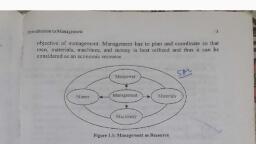
Every individual or entity requires setting objectives, making plans, handling people,, coordinating and controlling activities, achieving goals and evaluating performance, directed towards organizational goals., These activities relate to the utilization of variables or resources from the, environment − human, monetary, physical, and informational., Human resources refer to managerial talent, labor (managerial talent, labor, and, services provided by them), monetary resources (the monetary investment the, organization uses to finance its current and long-term operations), physical, resources (raw materials,physical and production facilities and equipment) and, information resources (data and other kinds of information)., Management is essentially the bringing together these resources within an, organization towards reaching objectives of an organization., Presented By: Bireswar Banik, , 5
Page 6 :
Various Definitions of Management, Management guru, Peter Drucker, says the basic task of management includes both, marketing and innovation. According to him, Management is a multipurpose organ, that manages a business and manages managers, and manages workers and work., , Harold Koontz defined management as the art of getting things done through and, with people in formally organized groups., , Presented By: Bireswar Banik, , 6
Page 7 :
Standard Definition of Management, Management is the process of planning and organising the resources and activities, of a business to achieve specific goals in the most effective and efficient manner, possible., Efficiency in management refers to the completion of tasks correctly and at minimal, costs., Effectiveness in management relates to the completion of tasks within specific, timelines to yield tangible results., , Presented By: Bireswar Banik, , 7
Page 8 :
CHARACTERISTICS OF MANAGEMENT, Multi-dimensional, A manager considers a staff member both as an individual with diverse needs and as a component of the larger group. To, be effective, managers influence their team members to apply their unique strengths toward achieving the organisation's, goals., Dynamic, Management is a dynamic function and evolves and adapts to changes in its environment, whether they are economic, sociopolitical or technological., For instance, a paper company could see a decline in sales because of the rapid adoption of screens and digital devices., Whether the company can still survive depends on how effectively its management can adapt to new market requirements., Intangible, Management consists of ideologies, policies and human interaction., Good management helps improve a company's target achievement ratios, employee gratification levels and overall ease in, the company's operation., , Presented By: Bireswar Banik, , 8
Page 9 :
OBJECTIVES OF MANAGEMENT, 1., , Make Proper Use of The Available Resources, , 2., , Ensure Business Development and Growth, , 3., , Quality Products And Services, , 4., , Availability of Goods and Services, , 5., , Ensuring Discipline in the Workplace, , 6., , Reduce the Element of Risks and maintain co-ordination, , 7., , Make Futuristic Plans, , Presented By: Bireswar Banik, , 9
Page 10 :
IMPORTANCE OF MANAGEMENT, Helps in achieving group goals: Effective management gives a common direction to, individual efforts and guides them towards achieving the overall goals of an, organisation., Increases efficiency: Efficiency reduces costs and increases productivity in all spheres, of an organisation's work., Creates a dynamic organisation: Management helps its personnel in adapting to, change so that the organisation continues to maintain its competitive edge. How well, an organisation can respond and adapt to change can mean the difference between, its success and failure., Helps in achieving personal objectives: Effective management fosters team spirit,, cooperation and commitment to achieve the organisational goals as a group, which, helps each term member achieve their personal objectives., Presented By: Bireswar Banik, , 10
Page 11 :
EXAMPLES, Some of the examples of management are:, How a skillful supervisor handles a difficult situation., How a CEO of an organization co-ordinates the whole, organization, How a person handles their personal finances, The show of concern when dealing with something fragile, , Presented By: Bireswar Banik, , 11
Page 12 :
EXCERCISE, 1. What do you mean by the term ‘Management’?, Explain with examples., 2. Describe the importance of management., 3. What are the basic of management?, 4. Explain the characteristics of management?, 5. Describe the advantages of having management skills?, , Presented By: Bireswar Banik, , 12