Page 1 :
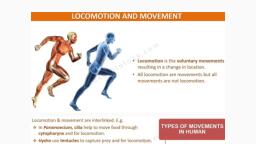
LOCOMOTION AND MOVEMENT, , MOVEMENT, movement refers to the change in position of any part of an organism's body., Eg:-Hydra can use its tentacles for capturing its prey and also use them for locomotion, LOCOMOTION, If the movements result in a change of place, such movements are called locomotion., Eg.Walking, running, climbing, flying, swimming, TYPES OF MOVEMENT, Cells of the human body exhibit three main types of movements., 1.Amoeboid, 2.Ciliary, 3.Muscular, , 1.Amoeboid- effected by pseudopodia formed by the streaming of protoplasm (as in, Amoeba)., (e.g-movement of leucocytes, macrophages (a type of white blood cell), , 2.Ciliary movement .eg mvmt of ova & sperm, movmt of particles through trachea, 3.MUSCULAR MOVEMENT eg.movement of our limbs, jaws, tongue, etc,, , MUSCULAR MOVEMENT, , MUSCLE PROPERTIES, , EXCITABILITY, CONTRACTILITY, EXTENSIBILITY AND ELASTICITY, , Types of Muscle Tissue, , 1,Skeletal Muscle, , 2.Cardiac Muscle, , 3.Smooth Muscle
Page 2 :
Skeletal Muscle, , Long cylindrical cells, Attached to skeletal system, Striated appearance, Voluntary in action, Function -muscular movement, 2.Cardiac Muscle, , Present in heart, , Branching cells, , One or two nuclei per cell, Striated present but faint, Involuntary, , The junction between two cardiac muscle fiber is called intercalated disc it allows rapid, spreads of impulse from on fiber to next throughout heart., , Smooth Muscle(Visceral muscles) (nonstriated muscles), , Present in hollow organs like alimentary canal, ovary ,urinary bladder etc, Fusiform cells, , uninucleus, , Involuntary in action, , Striations absent, , Not attached to skeletal system, , Function- in the transportation of food through the digestive tract and gametes through, the genital tract, , Microanatomy of Skeletal Muscle
Page 3 :
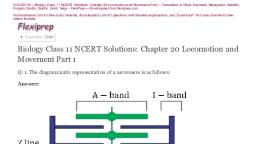
Muscle contains muscle cells, , Muscle cells are called muscle fibers, , A number of Muscles fibres are bundled to form muscle bundles or fascicles, Each bundle covered by fascia (a connective tissue layer), , Each skeletal muscle in our body is made of a number of muscle bundles or fascicles, held together by a common connective tissue layer called fascia., , Muscle cell or Muscle fibre Structure, Lined by sarcolemma (plasma membrane), , Syncitium-ie.Contains many nucleus, , Sarcoplasmic reticulam contains Ca+ ions, , A number of myofilaments or myofibrils present in cytoplasm, , Each myofibril has Striations with a dark band - A band (anisotropic band), Striations of myofibril-A close view, , Dark and light bands arranged alternatively, , Light band- I band, , In the centre of | band—Z line, , Actin filaments attached to Z line, , Dark band A band, , In the central part of A band a lighter region —H zone, , In the centre of H zone —M line, , Myofibrils contains two proteins, Rod like structures and arranged parallel to each other, Two types, , 1, Actin (thin filament), , 2,Myosin(Thick filament)
Page 5 :
Each meromyosin has 2 parts, 1.Globular head with a short arm(Heavy mero myosin-HMM), , 2. A Tail (Light mero myosin-LMM), , (a) Myosin molecule, , The head and shortarm projects outwards from the surface of the myosin filament., So known as cross bridges, Myosin head is an active ATPase enzyme, Has 2 binding sites, 1. for ATPase and, 2. site for binding of actin, Muscle contraction, 1. Signal from brain reaches neromuscular junction through motor neuron, . Releases neurotransmitter, generates action potential in sarcolemma., . Sarcoplasmic reticulam releases Ca ions., . Ca ions binds to the troponin on the actin filament, , . This causes the exposing of the active site on actin, , 2, 3, 4, S., 6. Myosin attaches to the actin utilizing energy by ATP hydrolysis., 7. Pulls the actin filaments towards the centre of A band., , 8. Zline also pulls inward. Results in the contraction of sarcomere., 9.Myosin goes back into a relaxed state, cross bridge broken, , 10.New ATP molecule attaches myosin heads and the reaction repeats, , Results of a muscle contraction