Page 2 :
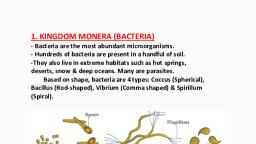
Bacteria - Occurance, Bacteria are the sole members of the Kingdom Monera. , Kingdom Monera includes prokaryotic, unicellular organisms like Bacteria and blue green algae (Eg: Nostoc, Anabena)., They are the most abundant micro-organisms. , They are omnipresent: occur everywhere, present free living in soil, in water, air, food, manure, in decaying matter, on the surface of plants and animals, also as endoparasites (live in other organisms) & symbiotic, on non living things etc.,; also as saprophytes and symbionts., Found in extreme habitats such as hot springs, boiling water, deserts, ice cold regions (snow) and deep oceans.
Page 3 :
Bacteria under microscope
Page 4 :
Structure if a Typical Bacterium
Page 5 :
Discovery, Def: Bacteria are unicellular prokaryotic, microscopic organisms, having cellular structure, belonging to the kingdom Monera., Bacteria were first discovered by Antony Von Leewen Hoek (1675), who coined them as “Animalcules”., Ehrenberg (1838) coined the term “Bacteria”, Bacteriology: the branch of Microbiology which deals with the study of bacteria.
Page 6 :
Types of Bacteria based on Organization / Habitat, Based on the nature of organization and origin, bacteria are grouped into following types:
Page 7 :
Archaebacteria, Def: These are a group of ancient bacteria, an earliest form of life., They live in unusual environment, harsh habitats. They grow in the absence of oxygen, at high temperature and acidic & alkaline environment. , Based on the type of environment that they live, Archaebacteria are grouped into following types :
Page 8 :
Archaebacteria, Def: These are a group of ancient bacteria, an earliest form of life., They live in unusual environment, harsh habitats. They grow in the absence of oxygen, at high temperature and acidic & alkali environment. , Based on the type of environment that they live, archaebacteria are grouped into 3 types; Halophiles, Thermoacidophiles and Methanogens: , 1) Halophiles : These are salt loving Archaebacteria that grow in saline habitats (extreme salty areas)., 2) Thermoacidophiles: These grow in hot acidic environment (hot springs). Eg: Thermophilous aquaticus (used in PCR), Under aerobic conditions at 800C, they convert the sulphur into H2SO4. During anaerobic condition they reduce sulphur into hydrogen sulphide (H2S).
Page 9 :
3) Methanogens : These grow in marshy areas. , Methanogens are present in the gut of ruminant animals such as cows and buffaloes., They are responsible for the production of methane gas (marsh gas) from the dung of these animals., Methane is a biogas produced from slurry in biogas plant / fermenter. , Archaebacteria differ from other bacteria in having a different cell wall structure and this feature is responsible for their survival in extreme conditions., In Archaebacteria, Cell wall made up of glycoproteins, proteins & non-cellulose polysaccharides., In Eubacteria, cell wall made up of murein (= Peptidoglycon)., Archaebacteria
Page 10 :
Additional points, Obligate anaerobes = The microbes like methanogens that grow only in the absence of oxygen. When oxygen is supplied they become inactive / die., Putrifying bacteria – present in large intestine of man that digest the proteins and liberate foul gases like H2S & CH3 (= Marsh gas).
Page 11 :
Eubacteria (=True Bacteria)�(= Schizomycophyta), Eubacteria are characterised by: , The presence of a rigid cell wall (= Murein) with or without capsule covering., Some are motile showing the presence of one or more flagella., Based on nutrition, Eubacteria is studied under two headings: Autotrophic and Heterotrophic bacteria., Autotrophic bacteria is of two types namely Photosynthetic and Chemosynthetic.
Page 12 :
Types of Eubacteria based on Nutrition�(Metabolic diversity in bacteria)
Page 13 :
Autotrophic Bacteria, They prepare their own food by using sunlight & CO2 or other inorganic elements or chemical energy. These are again of two types:, 1) Photosynthetic / Phototrophic bacteria : They prepare food by using sunlight just like plant cells. Here CO2 is reduced into glucose by using chlorophyll called bacteriochlorophyll. It differs from other green plants as follows:, They do not use water as the source of hydrogen / proton. They prepare food by using H2S instead of H2O, They do not produce oxygen, thus it is called Anoxygenic photosynthesis., Eg: Green sulphur bacteria, Purple sulphur bacteria., sunlight, 6CO2 + 12H2S C6H12O6 + 12S + 6H2O + energy
Page 14 :
Photosynthetic autotrophs – Eg: Nostoc, These are unicellular, prokaryotic, also called Cyanobacteria (= blue-green algae)., Eg: Nostoc, Anabaena (filamentous), , Oscillitoria, Scytonema (filamentous), , Spirulina (unicellular) , Gleocapsa (colonial)., They have chlorophyll ‘a’ molecule (= bacteriochlorophyll) similar to green plants and are photosynthetic in nature. , The cyanobacteria are unicellular, colonial or filamentous, marine or terrestrial algae (in moist soil)., Nostoc filaments, The colonies are generally surrounded by gelatinous sheath., They often form blooms (grow abnormally) in polluted water body. , Heterocysts: These are specialised cells in Nostoc filaments , which fix the atmospheric nitrogen into nitrates.
Page 16 :
2) Chemosynthetic bacteria (Chemotrophic), They are non-photosynthetic autotrophs. , They prepare food and derive energy from the oxidation of inorganic compounds (like ammonia, nitrates, nitrites, hydrogen, sulphur, iron etc,) without using sunlight and use the released energy for their ATP production., They play a great role in recycling nutrients like nitrogen, phosphorous, iron and sulphur., Eg: Sulphur bacteria, iron bacteria, hydrogen bacteria, , Nitrifying bacteria (Nitrosomonas, Nitrobacter), , Ammonifying bacteria etc., Eg: Free living soil bacteria like Clostridium and Azatobacter , fix atmospheric nitrogen.
Page 17 :
Heterotrophic bacteria, They cannot prepare their own food & so obtain the food from other sources like host body, sugary and dead & decaying organic substances. They are of mainly three types :, Parasitic bacteria: They depend on living organisms and get food from host body. , They act as pathogens by causing diseases in human beings, farm animals and pets. , Eg: Cholera, typhoid, tetanus, They also cause diseases in crop plants and reduce the yield., Eg: Citrus canker
Page 18 :
Other bacterial diseases in plants, Late blight of potato , Leaf blight of rice, Red rot of sugar cane , Crown gall of apple, Other bacterial diseases in Animals / man, Anthrox, Tuberculosis, Gastric ulcers, Syphilis and Gonorrhoea (sesually transmitted diseases – STD). , Pneumonia, Dysentery, Diphtheria, Pertusis (= whooping cough), Diarrhoea, Leprosy, Plague (= black death), Anthrox. , Brucellosis and Black leg in cattle.
Page 19 :
Heterotrophic Bacteria, 2) Symbiotic bacteria: They are associated with living plant or animal body and show mutual benefit., Eg: Rhizobium – present in root nodules of leguminous plants (groundnut) – helps in nitrogen fixation., Eg: Escherichia coli (E. coli) – present in large intestine (colon) of man help in cellulose digestion & vitamin - K synthesis., 3) Saprophytic bacteria: They grow and obtain food from dead and decaying matter and sugary products by converting them into inorganic. So they are also called decomposers (= micro consumers)., Eg: Lacto bacilli , (helpful in making curd from milk - feeds on lactose), Eg: Psedumonas , (found in humus soil – help in denitrification in N2 cycle)., Some soil bacteria produce antibiotics. Eg: Streptomyces
Page 20 :
Mycoplasma, These are a type bacteria that completely lack a cell wall. , They are the smallest living cells known., They can survive without oxygen. , Many mycoplasma are pathogenic in animals and plants and in man., Eg: PPLO (Pleuropneumonia-like organisms)., (It can cause pneumonia and urinary tract infection in man and cattle)., .
Page 22 :
Reproduction in Bacteria, Asexual reproduction is done by methods like , A) Binary fission during favourable conditions., B) Spore formation during unfavourable , conditions (eg: endospores), Sexual reproduction involves DNA transfer from one bacterium to the other. It is done by following methods, A) Conjugation, , B) transduction and , C) Transformation
Page 23 :
Sexual reproduction, Conjugation: The transfer of DNA from one bacterium to another through cytoplasmic bridge., Transduction: The transfer of DNA (or a segment of DNA) from one bacterium to another through the bacteriophage (virus)., Transformation : Transfer of DNA from dead bacteria to live bacteria through cell wall.
Page 24 :
Binary fission
Page 25 :
Binary fission (one division per 20 minutes)