Page 1 :
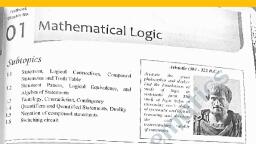
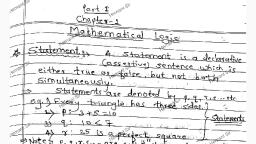
Introduction:, Mathematics is an exact science. Every, statement must be precise. There has to be, i, i, proper reasoning in every mathematical proof., Proper reasoning involves Logic. Logic related, i, to mathematics has been developed over last 100, years or so. The axiomatic approach to logic, was first propounded by the English philosopher, and mathematician George Boole. Hence it is, known as Boolean logic or mathematical logic, or symbolic logic., i, The word 'logic' is derived from the Greek, word Logos' which means reason. Thus Logic, deals with the method of reasoning. Aristotle, i, (382-322 B.C.), the great philosopher and, i, thinker laid down the foundations of study of, i, logic in a systematic form. The study of logic, helps in increasing one's ability of systematic, and logical reasoning and develop the skill of, understanding validity of statements., i, 1.1 Statement:, 1, A statement is a declarative sentence which, is either true or false but not both simultaneously., Statements are denoted by letters like p,q,r, .., Scanned by CamScanner

Page 2 :
For example:, i) 2 is a prime number., ii) Every rectangle is a square., iii) The Sun rises in the West., iv) Mumbai is the capital of Maharashtra., Truth value of a statement:, A statement is either true or false. The, truth value ofa 'true' statement is denoted by T, (TRUE) and that of a false statement is denoted, by F (FALSE)., Example 1: Observe the following sentences., i) The Sun rises in the East., ii) The square of a real number is negative., iii) Sum of two odd numbers is odd., iv) Sum of opposite angles in a cyclic rectangle, is 180°., Here, the truth value of statements (i) and, (iv) is T, and that of (ii) and (iii) is F., exclamatory,, interrogative, imperative are not considered as, Note: The sentences, like, statements., Scanned by CamScanner
Page 3 :
Example 2: Observe the following sentences., i) May God bless you!, ii) Why are you so unhappy?, iii) Remember me when we are parted., iv) Don't ever touch my phone., v) I hate you!, vi) Where do you want to go today?, The above sentences cannot be assigned, truth values, so none of them is a statement., The sentences (i) and (v) are exclamatory., The sentences (ii) and (vi) are interrogative., The sentences (iii) and (iv) are imperative., Scanned by CamScanner
Page 4 :
Open sentences:, Note:, An open sentence is a sentence whose truth, can vary according to some conditions which are, not stated in the sentence., i) An open sentence is not considered a, statement in logic., ii) Mathematical identities are true statements., Example 3: Observe the following., For example:, i) x+4 = 8, ii) Chinese food is very tasty, a +0 = 0 + a = a, for any real number a., Each of the above sentences is an open, sentence, because truth of (i) depends on the, value of x; if x = 4, it is true and if x + 4, it is, false and that of (ii) varies as degree of tasty, food varies from individual to individual., Scanned by CamScanner
Page 5 :
1.2 Logical connectives:, A logical connective is also called a logical, operator, sentential connective or sentential, operator. It is a symbol or word used to connect, two or more sentences in a grammatically valid, way., Observe the following sentences., i), Monsoon is very good this year and the, rivers are rising., ii) Sneha is fat or unhappy., iii) If it rains heavily, then the school will be, closed., iv) A triangle is equilateral if and only if it is, equiangular., Scanned by CamScanner